
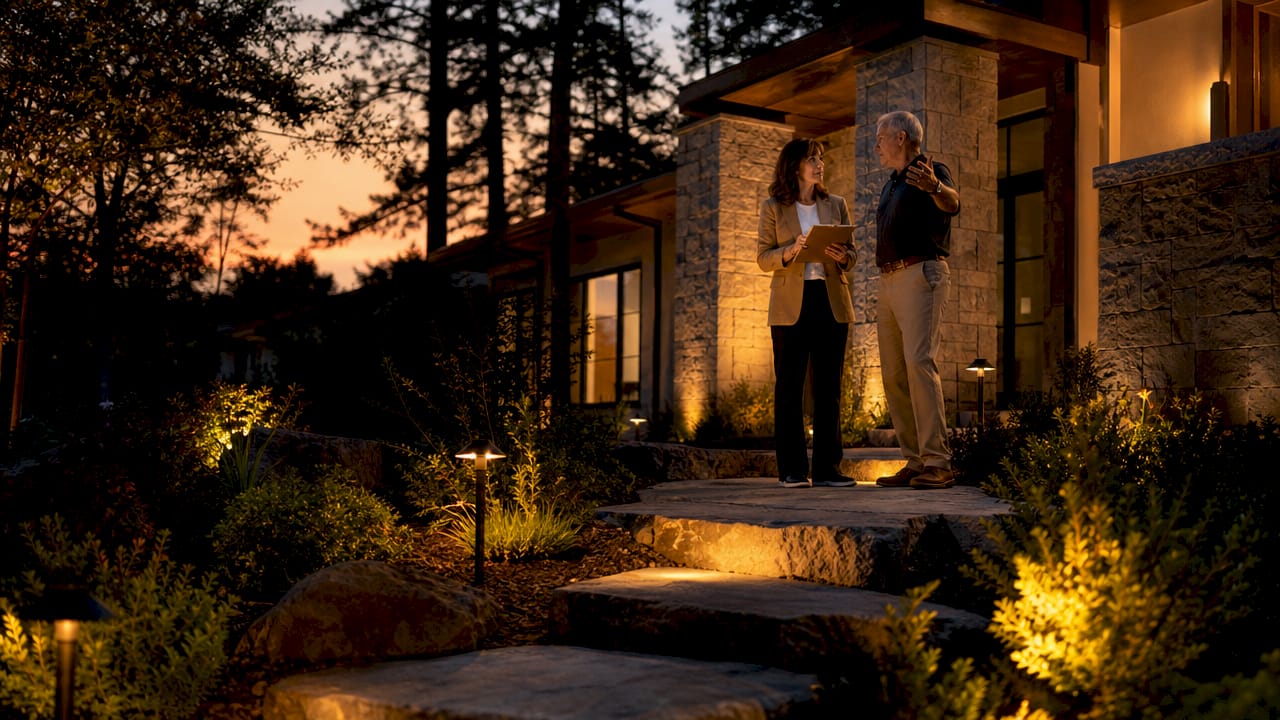
Landscape lighting safety benefits are defined as the measurable reductions in physical hazards and criminal risk that result from strategically illuminating a residential property’s exterior. Proper outdoor lighting serves two distinct functions: it prevents trips and falls by revealing elevation changes, and it deters intruders by eliminating the dark areas they rely on. Both functions work together, which is why professional lighting design treats safety and security as a single system rather than separate goals. Foreverglowlighting installs permanent LED systems across the Charlotte area that deliver consistent, reliable illumination every night without any effort from the homeowner.
1. How landscape lighting safety benefits start with preventing trips and falls
Proper landscape lighting reduces trip and fall hazards by illuminating elevation changes such as steps and uneven pavers. This is the most immediate and underappreciated benefit for most homeowners. A single unmarked step at the edge of a patio is a genuine injury risk after dark, and no amount of aesthetic lighting fixes that if the fixture is aimed at a tree instead of the ground.
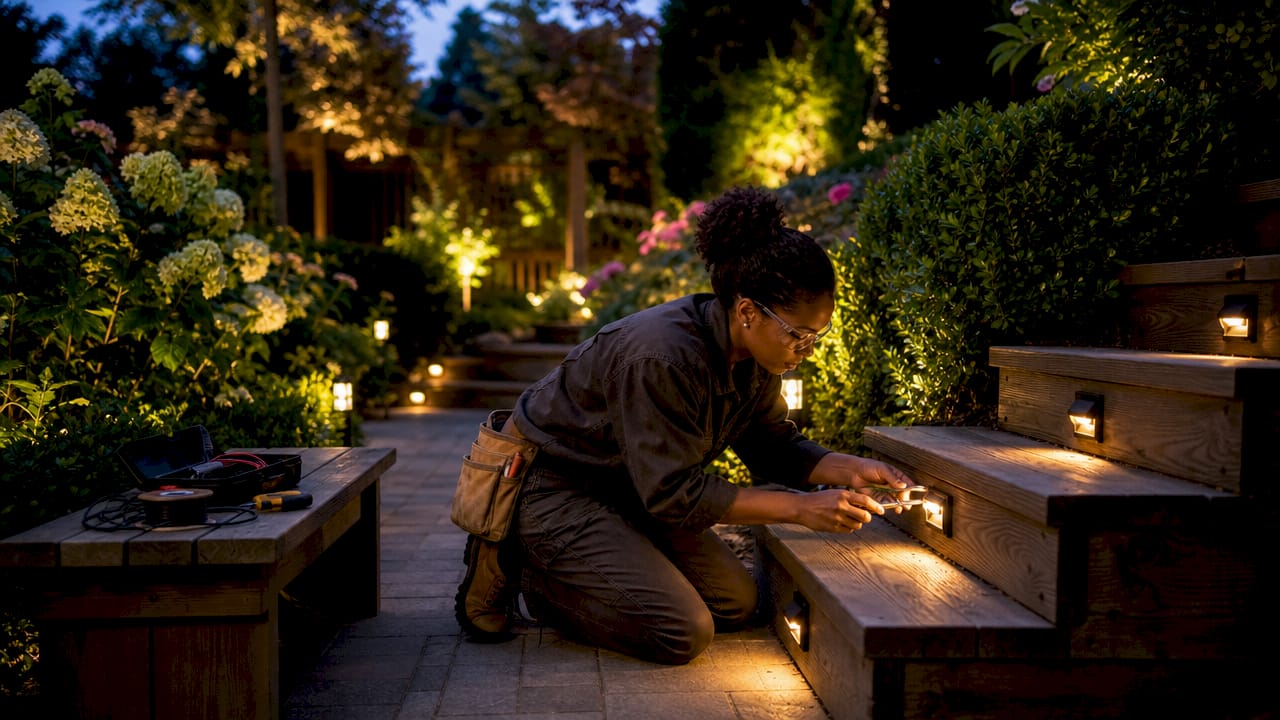
The key areas to address are pathways, stairs, driveways, and entry points. Step lights mounted directly into risers reveal the edge of each tread clearly. Path lights spaced at regular intervals along a walkway create consistent visibility without dark gaps between fixtures.
Lighting hazards increase during bad weather as rain, ice, and leaves hide dangers in low light. Illuminating outdoor walkways and steps helps homeowners adjust their footing and avoid slip and fall accidents. This is especially relevant in the Charlotte area, where autumn leaves and winter rain are regular seasonal conditions.
- Step lights: Mount into the riser face to cast light downward across the tread.
- Path lights: Space fixtures no more than 8–10 feet apart to avoid dark gaps.
- Low-voltage LED fixtures: Provide adequate brightness without creating glare that impairs night vision.
- Downlighting from above: Mimics natural moonlight and improves depth perception on uneven ground.
Pro Tip: Avoid placing path lights at eye level. Fixtures aimed upward create glare that actually reduces a person’s ability to see the ground clearly. Always direct light downward toward the walking surface.
2. The role of outdoor illumination in deterring intruders
Illumination acts as a psychological deterrent for intruders who prefer dark, shadowed areas. A well-lit property removes the cover that makes a home an easy target. Consistent, shadow-free coverage reduces blind spots around entry points, side yards, and driveways.
The areas that matter most for security are the ones homeowners tend to overlook: the gap between the garage and the fence, the side yard that runs along the house, and the rear entry. These are the spaces that create opportunity. Lighting them removes that opportunity.
Landscape lighting is not a replacement for security alarms, but it provides an important layer of active visibility. It empowers homeowners to recognize and react to suspicious activity more effectively. A well-lit property also increases the likelihood that neighbors and passersby will notice anything unusual.
Proper placement of lighting enhances security from inside the home by allowing clear views of the property at night. Fixtures must be positioned with the homeowner’s interior sightlines in mind, not just the exterior appearance. A light that looks great from the street but creates a bright glare on the window glass actually reduces the homeowner’s ability to see outside.
- Entry points: Front door, back door, and garage should all be well lit.
- Side yards: Often the most neglected and the most used by intruders.
- Fences and gates: Lighting along fence lines removes concealment.
- Driveways: Driveway lighting ensures arriving vehicles and approaching pedestrians are visible.
3. Extending safe use of outdoor spaces after dark
Outdoor lighting enhances nighttime usability of outdoor spaces by making areas like patios and gardens safe and accessible long after sunset. This benefit is practical and immediate. A homeowner who cannot safely walk to the fire pit or outdoor kitchen after dark simply stops using that space.
Safe nighttime usability depends on marking hazardous transitions clearly. These include the edge of a deck, the step down from a patio to the lawn, the border of a garden bed, and the perimeter of a pool. Lighting these boundaries is a safety measure, not a decorative choice.
Here are the most common outdoor spaces that benefit from deliberate illumination:
- Patios and decks: Ambient lighting defines the usable area and marks edges.
- Fire pit areas: Focused downlighting around the perimeter prevents trips on uneven ground.
- Outdoor kitchens: Task lighting at the cooking surface and bar area prevents burns and cuts.
- Garden paths: Path lights guide movement between areas without creating glare.
- Pool surrounds: Perimeter lighting marks the water’s edge and prevents falls.
- Lawn edges: Low fixtures along borders help guests navigate safely during evening gatherings.
Lighting also adds real property value. A well-lit outdoor living area extends the functional square footage of a home and signals to buyers that the property is well maintained. Safety and value are not competing priorities here. They reinforce each other.
4. Integrating motion sensors and automation for smarter safety
Motion-activated lighting improves safety by providing instant illumination and deterring unwanted activity. The key word is “instant.” A sensor that takes three seconds to trigger after detecting movement is far less effective than one that responds in under a second.
Local sensor networks using Zigbee or Z-Wave protocols provide near-instant activation. They avoid the latency typical with cloud-dependent sensors, which must send a signal to a remote server and back before triggering the light. For security applications, that delay matters. Local protocols keep the response time tight and reliable even when the internet is down.
Lux sensors add another layer of intelligence. They prevent daytime false triggers by measuring ambient light levels and only activating the motion response when it is actually dark. This reduces unnecessary wear on fixtures and keeps energy use low.
- Zigbee and Z-Wave sensors: Local processing means faster response and no cloud dependency.
- Lux sensing: Prevents false daytime triggers and conserves energy.
- Wide-angle detection: Sensors with 180-degree coverage eliminate blind spots at entry points.
- Adjustable sensitivity: Reduces false triggers from pets or wind-blown branches.
Pro Tip: Place motion sensors at the corners of your property rather than directly above entry points. Corner placement gives the sensor a wider view of approaching movement and triggers the light earlier, giving you more reaction time.
5. Best practices in professional landscape lighting design
Most lighting accidents happen due to shadows and inconsistent lighting that impairs depth perception. Layering lighting with ambient and targeted task light avoids the “runway look” and improves navigation safety. The runway look refers to a line of identical fixtures spaced evenly along a path, which creates a flat, uniform brightness that actually reduces depth perception rather than improving it.
Professional landscape lighting design focuses on how spaces are actually used, not just on aesthetics. Lighting tailored to daily paths and activity zones maximizes safety and usability. A designer who walks the property at night, observes where people actually move, and identifies the real hazards will produce a far safer result than one who works from a daytime site plan alone.
Maintenance is critical as dirty or malfunctioning fixtures reduce lighting effectiveness and safety benefits. Regular upkeep ensures consistent illumination and reliability. A fixture clogged with debris or aimed off-target after a lawn service visit provides no safety benefit at all.
| Feature | Safety function | Recommended placement |
|---|---|---|
| Step lights | Reveals tread edges | Mounted in riser face |
| Path lights | Consistent walkway visibility | Every 8–10 feet along path |
| Motion sensors | Instant activation on approach | Property corners and entry points |
| Downlights | Depth perception on uneven ground | Overhead on eaves or trees |
| Perimeter fixtures | Eliminates concealment zones | Along fences, side yards, and gates |
Common mistakes in DIY installations include over-brightening a single area while leaving adjacent zones dark, placing fixtures at eye level, and ignoring interior sightlines. Each of these errors reduces the actual safety benefit even when the system looks impressive from the street. Professional installation addresses all three by design.
Key Takeaways
Strategic landscape lighting reduces physical hazards and deters intruders by combining consistent coverage, layered fixture types, and motion sensor technology across all critical property zones.
| Point | Details |
|---|---|
| Prevent trips and falls | Illuminate steps, path edges, and elevation changes with downward-aimed fixtures. |
| Deter intruders | Eliminate dark zones at entry points, side yards, and fences with consistent coverage. |
| Extend outdoor usability | Mark patios, fire pits, and pool edges so spaces remain safe after dark. |
| Use motion sensor technology | Local Zigbee or Z-Wave sensors provide faster, more reliable activation than cloud-dependent options. |
| Prioritize professional design | Tailored placement based on actual usage patterns outperforms generic DIY installations every time. |
What I’ve learned about lighting for safety versus lighting for looks
Most homeowners come to me thinking about curb appeal first and safety second. After years of working on outdoor lighting projects, I’ve found that framing is backward. The properties that look the best at night are almost always the ones designed with safety as the primary constraint. When you place fixtures to eliminate hazards and blind spots, the aesthetic result tends to follow naturally.
The mistake I see most often is concentrating light on the front of the house and leaving everything else dark. The side yard, the rear entry, the path from the garage to the back door — these are the spaces where accidents happen and where intruders find opportunity. A beautiful front elevation with a dark side yard is not a safe property.
I also think homeowners underestimate how much maintenance matters. A system that works perfectly at installation but goes unchecked for two years is not delivering its safety benefits. Fixtures shift, bulbs dim, and lenses fog. Scheduling an annual check is not optional if you want consistent results.
The most important thing I can tell you is this: aesthetics, security, and safety coexist and should be integrated from the start. Treating them as separate decisions leads to a system that does none of them well.
— Dave
Professional outdoor lighting that works for your home’s safety
Foreverglowlighting designs and installs permanent LED lighting systems across the Charlotte area, built specifically to address the safety and security needs of residential properties. Every system is planned around how you actually use your outdoor spaces, not just how the property looks from the street.

Whether you need pathway and step lighting to eliminate trip hazards, perimeter coverage to close off security blind spots, or a full landscape lighting system that covers every zone of your property, Foreverglowlighting handles the design, installation, and ongoing support. Contact us for a free estimate and find out what a properly designed system can do for your home’s safety and security.
FAQ
Does landscape lighting actually reduce crime risk?
Consistent outdoor illumination removes the dark areas that intruders rely on for cover, making a property a less attractive target. It works best as one layer of a broader security approach that includes alarm systems and cameras.
What type of lighting is best for preventing outdoor falls?
Step lights mounted in riser faces and path lights spaced every 8–10 feet provide the most reliable hazard prevention. Downward-aimed fixtures improve depth perception without creating glare.
How do motion sensors improve outdoor lighting safety?
Motion sensors provide instant illumination when someone approaches, which deters intruders and improves visibility for residents. Local protocol sensors using Zigbee or Z-Wave respond faster than cloud-dependent alternatives.
Should I hire a professional or install landscape lighting myself?
Professional installation ensures fixtures are placed based on actual usage patterns, interior sightlines, and hazard locations. DIY installations frequently miss critical zones or create glare that reduces rather than improves safety.
How often should landscape lighting be maintained?
Annual maintenance checks keep fixtures properly aimed, lenses clean, and bulbs performing at full output. Dirty or misaligned fixtures reduce the safety benefits of even a well-designed system.