

Low voltage landscape lighting is defined as any outdoor lighting system that operates at 12 volts rather than the standard 120V line voltage found in household circuits. This 12V standard is the recognized industry benchmark for residential outdoor illumination, favored by lighting professionals and the National Electrical Code (NEC) alike for its safety, efficiency, and flexibility. Homeowners and property managers who choose low voltage outdoor lighting gain a system that is safer around children and pets, costs less to install and run, and gives far more design control than traditional line-voltage floodlighting. Understanding why low voltage landscape lighting dominates the residential market starts with knowing exactly what it does differently.
Why is low voltage landscape lighting safer for outdoor use?
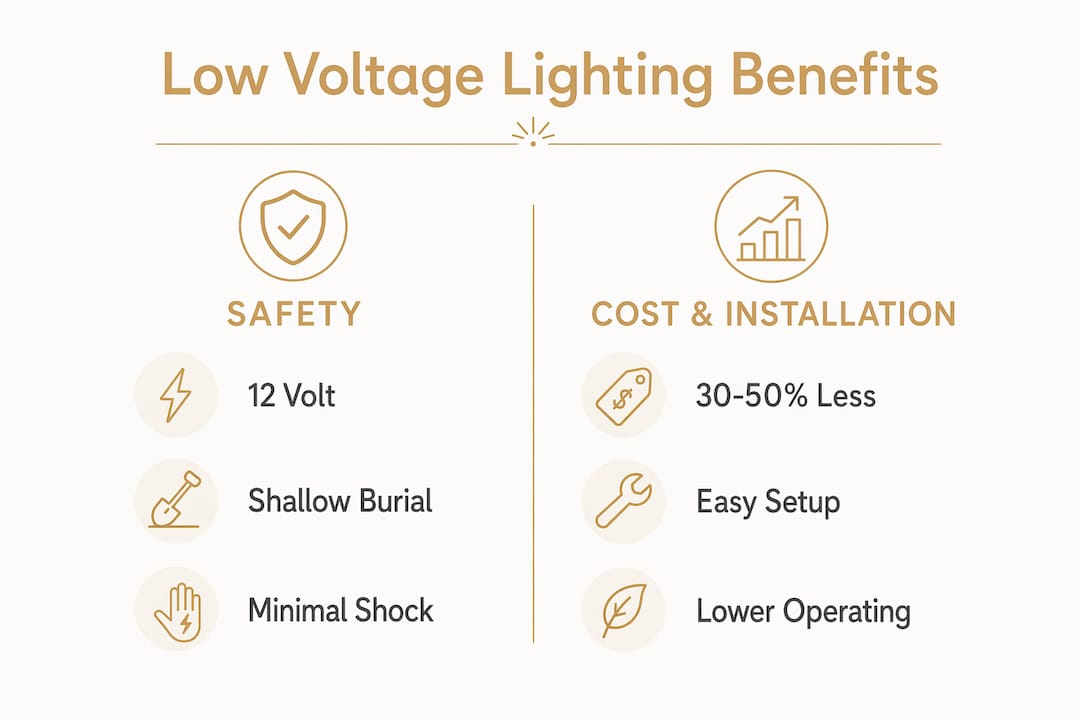
Low voltage landscape lighting operates at 12 volts, which is the industry safety benchmark for residential outdoor environments. At that voltage, accidental contact with a wire or fixture in wet conditions poses minimal shock risk. That is a meaningful distinction when you consider that sprinklers, rain, and morning dew are constant realities in any yard.
The NEC reinforces this safety advantage through its burial depth requirements. Low voltage wiring can be buried as shallow as 2–6 inches or even placed under mulch, while 120V wiring requires burial at 18 inches minimum, often inside rigid conduit. Shallower burial means fewer hazards during installation and less risk of accidental digging damage later.
The contrast with 120V systems matters for families and property managers specifically. Line-voltage systems require deep trenching, conduit protection, and licensed electrician work for most installations. The safety benefits for homeowners with low voltage systems are clear: less exposed infrastructure, lower shock risk, and a system that tolerates the wet, unpredictable conditions of outdoor life.
Key safety advantages of low voltage systems include:
- Minimal shock risk at 12V, even in damp or wet conditions
- Shallower NEC-approved burial depths reduce installation hazards
- No rigid conduit required, lowering the risk of improper installation
- Safer around children and pets who may contact fixtures or wiring
- Compatible with GFCI outlets for an additional layer of protection
Why is low voltage lighting more cost-effective and easier to install?
Low voltage landscape lighting installation costs 30–50% less upfront than high-voltage systems. That gap comes directly from the difference in trenching depth and materials. Lower installation costs make it accessible for more homeowners without sacrificing quality.

The trenching depth difference is significant in practice. Low voltage wiring goes in at 6–12 inches deep, while 120V wiring requires 18–24 inches or more. Shallower trenches mean less labor, less disruption to existing landscaping, and faster project completion. A yard that would take days to restore after a line-voltage installation can often be back to normal within hours after a low voltage job.
Operating costs also favor low voltage systems. LED technology has made low voltage LED systems capable of running more fixtures per transformer without overloading circuits. LEDs consume a fraction of the energy that older halogen low voltage bulbs required, and they last significantly longer. The combination of lower installation costs and reduced energy bills adds up to real savings over the life of the system.
| Feature | Low voltage (12V) | Line voltage (120V) |
|---|---|---|
| Typical burial depth | 6–12 inches | 18–24+ inches |
| Conduit required | No | Yes, in most cases |
| Upfront installation cost | 30–50% less | Higher |
| Permit/electrician required | Often not required | Usually required |
| DIY suitability | High | Low |
| Energy efficiency with LED | Excellent | Moderate |
Pro Tip: If you are expanding an existing low voltage system, always check your transformer’s total wattage capacity before adding fixtures. Overloading a transformer is the most common cause of dim or flickering lights in DIY installations.
How does low voltage lighting enhance outdoor design and visual quality?
Low voltage lighting prioritizes design control and atmosphere over raw brightness, which produces better residential lighting experiences than line-voltage alternatives. This is the key distinction that lighting designers emphasize when advising homeowners. A well-composed low voltage system creates depth, texture, and visual interest rather than simply flooding a yard with light.
Layered illumination is the defining technique of quality landscape lighting design. Low voltage systems support multiple zones, each with focused uplighting, path lighting, or accent lighting, all running from a single transformer. That layering creates the kind of visual depth that makes a property look professionally designed rather than just “lit up.”
“The goal of landscape lighting is not to replicate daylight outdoors. It is to compose light the way a photographer composes a shot, using shadow and highlight to reveal the best features of a space. Low voltage systems give you that level of control. Line-voltage floods do not.”
The design flexibility of low voltage systems also extends over time. As gardens mature, new features get added, or layouts change, low voltage fixtures can be repositioned and circuits reconfigured without major rewiring. Adjusting low voltage setups as your yard evolves is straightforward compared to the costly professional adjustments that line-voltage systems require.
Key design advantages of low voltage systems include:
- Focused uplighting for trees, architectural features, and garden sculptures
- Path and step lighting that guides movement without harsh glare
- Zone control allowing different areas to be lit independently
- Compatibility with smart controls for scheduling and color adjustment
- Repositionable fixtures that adapt as landscaping changes
What wiring and maintenance considerations should homeowners know?
Reliable long-term performance from a low voltage system depends on wiring quality and regular maintenance. The most overlooked factor is waterproofing at wire connection points. 90% of landscape lighting failures occur due to moisture ingress at wire connections, causing corrosion that leads to flickering or complete fixture failure. Standard wire nuts are not sufficient outdoors. Waterproof connectors rated for direct burial are the correct choice.
Voltage drop is the second most common performance issue. When voltage falls below 10.5V at a fixture, light output becomes unstable and inconsistent. The solution is a combination of proper wire gauge and smart wiring topology.
Here are the four wiring and maintenance practices that prevent the most common failures:
- Use waterproof connectors at every wire junction. Standard wire nuts allow moisture in and corrode within one to two seasons.
- Wire in a star topology, running cables from the transformer to individual hubs rather than daisy-chaining fixtures. This balances current distribution and prevents voltage drop at distant fixtures.
- Use 12-gauge wire as the standard for your runs. A 12-gauge wire standard reduces voltage drop and maintains stable light intensity at distant fixtures compared to thinner gauges.
- Clean fixture lenses twice a year and inspect all wiring connections. Regular maintenance combats mineral buildup and electrical resistance that cause dimming over time.
Pro Tip: When inspecting your system each spring, pull each connector apart and look for green or white corrosion. Replace any corroded connector immediately. Catching one bad connection early prevents it from causing a voltage drop that dims every fixture downstream.
Voltage drop management also benefits from keeping individual wire runs as short as practical. If your yard is large, use multiple transformer outputs or a larger transformer with separate zones rather than extending a single run past its effective range. This is a detail that professional landscape lighting design accounts for from the start, which is one reason professional installations tend to outperform DIY systems over time.
Key Takeaways
Low voltage landscape lighting is the definitive choice for residential outdoor illumination because it delivers superior safety, lower installation costs, precise design control, and long-term flexibility compared to 120V line-voltage systems.
| Point | Details |
|---|---|
| Safety at 12V | Operating at 12 volts poses minimal shock risk in wet outdoor conditions, meeting NEC safety standards. |
| Lower installation cost | Low voltage systems cost 30–50% less to install due to shallower trenching and no conduit requirement. |
| Design control | Layered, zoned low voltage lighting creates depth and atmosphere that line-voltage floods cannot match. |
| Wiring best practices | Use 12-gauge wire, waterproof connectors, and star topology to prevent voltage drop and corrosion failures. |
| Long-term flexibility | Low voltage fixtures reposition easily as landscapes evolve, avoiding costly rewiring that line-voltage systems require. |
What I have learned from years of watching homeowners light their yards
Most homeowners come to us thinking that brighter means better. They picture floodlights washing the entire yard in white light and assume that is what “good” outdoor lighting looks like. After seeing hundreds of completed projects, I can say with confidence that the opposite is true. The yards that draw compliments from neighbors are never the brightest ones. They are the ones where light is placed with intention, where shadows are as deliberate as the lit areas.
Low voltage systems make that kind of intentional lighting possible for the average homeowner. The misconception I hear most often is that low voltage means low quality or low brightness. Modern LED fixtures running at 12V produce more than enough light for any residential application. The difference is that you control where that light goes, rather than blasting an entire space uniformly.
The other thing I have observed is how often homeowners underestimate the value of a system that grows with their yard. A garden planted today looks completely different in five years. Low voltage systems accommodate that change without requiring a full reinstall. That flexibility alone justifies the choice for most properties, before you even factor in the safety and cost advantages.
— Dave
Foreverglowlighting’s approach to low voltage landscape lighting
Choosing the right system is one decision. Installing it correctly, so it performs reliably for years, is another.

Foreverglowlighting designs and installs custom landscape lighting for homeowners and property managers across Charlotte who want results that look professional and last. We account for voltage drop, transformer sizing, fixture placement, and zone control from the first consultation, so your system works exactly as designed from night one. Whether you want focused uplighting on mature trees, path lighting along a walkway, or a full multi-zone system with smart controls, we build it to your property’s specific layout. Contact Foreverglowlighting today for a free estimate and see what a properly designed low voltage system looks like in practice.
FAQ
What voltage does low voltage landscape lighting use?
Low voltage landscape lighting operates at 12 volts. This is the industry standard for residential outdoor systems and the voltage recognized by the NEC as safe for use in wet outdoor environments.
Is low voltage landscape lighting safe around children and pets?
Yes. At 12 volts, accidental contact with a wire or fixture poses minimal shock risk, even in wet conditions. This makes low voltage systems significantly safer than 120V line-voltage alternatives for family properties.
Can I install low voltage landscape lighting myself?
Many homeowners install low voltage systems without a licensed electrician, since NEC requirements for 12V wiring are less restrictive than for 120V systems. Using waterproof connectors, 12-gauge wire, and star topology wiring gives DIY installations the best chance of long-term reliability.
What causes low voltage landscape lights to flicker or dim?
Flickering and dimming are most commonly caused by moisture ingress at wire connections or voltage drop along long wire runs. Using waterproof connectors and keeping voltage above 10.5V at each fixture prevents both issues.
How often should I maintain my low voltage landscape lighting system?
Clean fixture lenses and inspect all wire connections at least twice a year, typically in spring and fall. Regular inspection catches corrosion and mineral buildup before they cause flickering or permanent fixture failure.