

Permanent lighting installation is the process of designing, mounting, wiring, and testing a fixed outdoor lighting system that stays in place year-round to enhance aesthetics and security. Unlike seasonal setups that require ladders and storage every december, a permanent system uses concealed tracks mounted along rooflines or landscape features, connected to smart controls, and built to last through every season. Understanding how permanent lighting installation process works helps homeowners and businesses make confident decisions before committing to a project. Foreverglowlighting specializes in exactly this type of custom lighting installation for Charlotte-area properties.
How does the permanent lighting installation process work?
The permanent lighting installation process follows five sequential phases: design, mounting, wiring, control setup, and testing. Each phase builds on the last, and skipping any one of them creates problems that are expensive to fix after the crew leaves.
Phase 1: Design and layout planning
Every installation starts with a site walkthrough. The installer measures linear footage along the roofline or landscape feature, sketches the layout, and identifies where power sources and control boxes will sit. Getting this right early is the single most important decision in the entire project. Pre-planning power locations prevents visible wiring and preserves the clean look that makes permanent lighting worth the investment.
Phase 2: Mounting the tracks or fixtures
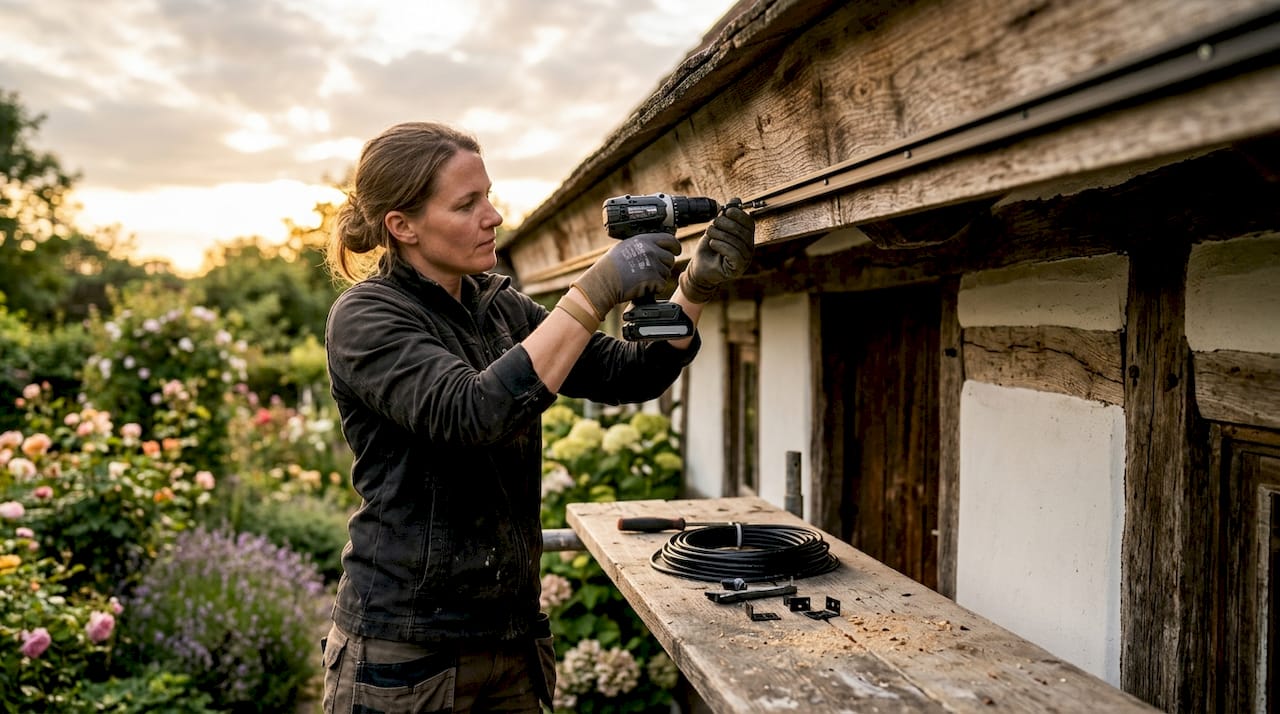
The installer mounts low-voltage lighting tracks along the eave or roofline using consistent fasteners spaced at regular intervals. Track color is matched to the trim or fascia so the hardware disappears during daylight hours. Maintaining roughly 3.5 inches off the house surface affects both the scalloping light effect and the brightness cast on the facade. Closer placement concentrates light; greater distance spreads it wider and softer.
Phase 3: Wiring and power connection
Powered harnesses route from the track back to a control box, which connects to a GFCI-protected outlet. The installer creates drip loops at every outdoor connection point so water runs away from the socket rather than into it. Low-voltage track systems often do not require a licensed electrician for the track work itself, but adding new circuits or GFCI outlets does. For multi-story homes or commercial buildings, a licensed electrician is the right call.
Phase 4: Control system setup
The control box connects to a smart app that lets the homeowner adjust colors, brightness, zones, and schedules from a smartphone. App-integrated controllers make the system versatile enough for holiday displays in december, subtle accent lighting in march, and security-focused white light year-round. This is where the system shifts from a fixed fixture to a fully programmable tool.
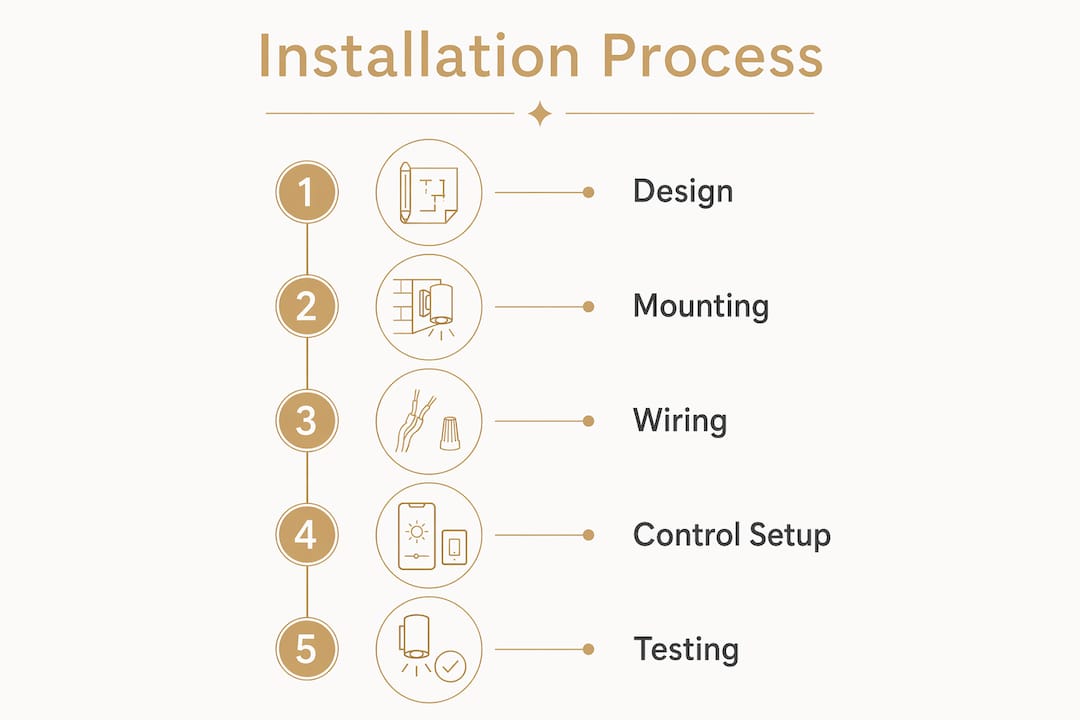
Phase 5: On-site testing
The crew tests the full system under working load before packing up. They check every connection point, confirm color accuracy across all zones, and verify that the app communicates correctly with the controller. Testing under load catches connection failures and color mismatches that only appear when the system is live. Fixing those issues on-site costs minutes. Fixing them after the crew leaves costs a return visit.
Pro Tip: Map your power outlet and control box locations on paper before any hardware goes up. Moving a control box after tracks are mounted means pulling wiring through finished surfaces.
How do permanent lighting systems enhance aesthetics and security?
Permanent lighting delivers two distinct benefits that reinforce each other: it makes a property look better and feel safer at the same time.
On the aesthetic side, a well-designed system adds architectural definition that no seasonal string light can match. The tracks follow the exact geometry of the roofline, creating clean lines that frame the house rather than decorate it. Permanent lighting boosts curb appeal and creates a consistent visual impression across every season, not just the holidays.
On the security side, the benefits are equally concrete:
- Consistent visibility eliminates dark zones around entry points, driveways, and side yards where intruders typically approach undetected.
- Impression of occupancy is maintained even when the homeowner is away, because schedules can simulate normal activity patterns.
- Deterrence effect comes from the simple fact that well-lit properties are less attractive targets. Lighting increases the likelihood that suspicious activity will be seen by neighbors or passersby.
- Integration with security cameras improves footage quality dramatically. A camera pointed at a dark driveway captures very little. The same camera with consistent illumination captures faces, license plates, and movement clearly.
- Color and brightness control lets homeowners switch to full-brightness white light instantly from a smartphone when motion sensors or cameras flag activity.
Pro Tip: Pair your permanent lighting zones with motion sensor triggers in your smart home app. The lights can jump to full brightness automatically when a sensor detects movement, giving you security-camera-quality coverage without any manual action.
What practical challenges come with permanent lighting installation?
Every installation faces at least one of four common challenges. Knowing them in advance prevents costly surprises.
Run length and power injection. Long lighting runs lose voltage over distance. A run that exceeds the manufacturer’s recommended length will show dimmer lights at the far end. The solution is power injection, which means adding a second power feed partway along the run to maintain consistent brightness. Installers who skip this step produce uneven results that are obvious at night.
Matching hardware to architecture. Track color, fastener type, and mounting position all affect how invisible the system looks during the day. A white track on a gray fascia stands out. Painting the track to match the trim takes an extra hour but makes the hardware disappear completely.
Weather-safe connections. Every outdoor electrical connection needs a drip loop and a weatherproof cover. Connections made without these fail faster and create safety hazards. Elevated cords that run along the fascia rather than hanging loose also last longer and look cleaner.
Scaling complexity. A single-story home with a straightforward roofline is a one-day job. A multi-story commercial building with multiple zones, long runs, and complex architecture requires detailed planning, additional power injection points, and almost always a licensed electrician.
| Challenge | Expert solution |
|---|---|
| Voltage drop on long runs | Add power injection at midpoint or per manufacturer spec |
| Visible hardware during daylight | Paint tracks to match fascia or trim color |
| Weather-related connection failure | Use drip loops and weatherproof covers at every junction |
| Uneven brightness across zones | Test under full load before crew departs |
| Complex multi-story installations | Hire a licensed electrician for new circuits and GFCI outlets |
What equipment does a permanent lighting installation require?
A complete permanent lighting setup uses five categories of hardware. Understanding each one helps homeowners evaluate quotes and ask the right questions.
| Equipment | Function | Installation note |
|---|---|---|
| Low-voltage LED track | Holds and powers individual light nodes along the roofline | Painted to match trim; mounted with consistent fasteners |
| Power supply unit | Converts household current to low-voltage DC for the track | Sized to match total run length and wattage |
| GFCI-protected outlet | Protects the circuit from ground faults in wet conditions | Required by electrical code for all outdoor circuits |
| Smart lighting controller | Connects the system to a smartphone app for color and schedule control | Paired during setup; supports zones and automation |
| Weatherproof connectors | Seals all outdoor wiring junctions against moisture | Installed with drip loops at every connection point |
The smart controller is the component that separates a permanent system from a fixed fixture. Smart controllers with app integration allow customization of colors, brightness, zones, and schedules. That flexibility is what makes the system useful for holiday displays, architectural accent lighting, and security applications without any hardware changes. Foreverglowlighting installs systems that support millions of color options controlled directly from a smartphone, which means the same hardware serves every occasion throughout the year. Homeowners interested in year-round lighting uses will find that a well-specified controller pays for itself quickly.
For the wiring phase, the installer routes harnesses from the track to the power supply and then to the controller. Every connection point outdoors gets a weatherproof cover and a drip loop. The GFCI outlet provides the final layer of protection. If the property does not already have a suitable outdoor outlet in the right location, a licensed electrician adds one before the track installation begins.
Key Takeaways
A permanent lighting installation succeeds or fails based on the quality of pre-planning, the precision of mounting, and the thoroughness of on-site testing before the crew leaves.
| Point | Details |
|---|---|
| Pre-planning is non-negotiable | Map power and control box locations before any hardware goes up to avoid visible wiring. |
| Mounting precision affects aesthetics | Track color, fastener spacing, and distance from the wall all determine how the system looks by day and by night. |
| Testing under load catches failures early | On-site testing identifies connection and color issues that only appear when the full system is live. |
| Smart controllers add year-round value | App-integrated systems handle holiday displays, accent lighting, and security functions without hardware changes. |
| Complex jobs need licensed electricians | Multi-story buildings and new circuit work require a licensed electrician to meet electrical code. |
What I’ve learned after seeing hundreds of permanent lighting installs
The single most common mistake I see is treating the testing phase as a formality. Crews rush through it, pack up, and leave. Then the homeowner calls two weeks later because one zone is flickering or the colors on the east side don’t match the west. That return visit costs everyone time and money. The testing phase is the differentiator between a satisfied customer and a frustrated one. I tell every crew: do not load the truck until every zone is confirmed live and correct.
The second thing I’ve learned is that homeowners consistently underestimate how much the pre-planning phase matters. Moving a control box after tracks are mounted is a real job. It means pulling wiring through finished surfaces and potentially repainting. Spending an extra hour on the design walkthrough prevents that entirely. The best installs I’ve seen start with a detailed sketch that shows every outlet, every control box, and every run length before a single fastener goes in.
Finally, I’d push back on the idea that permanent lighting is primarily a holiday product. The security and aesthetic benefits are present every night of the year. A homeowner who thinks of this as a Christmas light upgrade is leaving most of the value on the table. Think of it as architectural lighting that also happens to do Christmas beautifully.
— Dave
Foreverglowlighting’s approach to permanent outdoor lighting
Foreverglowlighting brings the full permanent lighting installation process to Charlotte-area homeowners and businesses, from the initial design walkthrough through final on-site testing.

The team at Foreverglowlighting installs smart LED track systems that mount invisibly along your roofline and connect to a smartphone app for complete color and schedule control. Whether you want landscape lighting that frames your property year-round, security-focused illumination that keeps entry points visible, or a system that handles every holiday without a ladder, Foreverglowlighting designs and installs it to last. Contact Foreverglowlighting today for a free estimate and see what a professionally installed permanent system looks like on your property.
FAQ
What does permanent installation mean in lighting?
Permanent lighting installation means a fixed outdoor lighting system that stays in place year-round, mounted along rooflines or landscape features and connected to a smart controller. It does not require seasonal setup or takedown.
How long does a permanent lighting installation take?
A standard single-story residential installation typically takes one day. Multi-story or commercial projects with longer runs and multiple zones take longer, depending on complexity and the need for new electrical circuits.
Do permanent lights require a licensed electrician?
Low-voltage track work often does not require a licensed electrician, but adding GFCI outlets or new circuits does. Multi-story and commercial installations should always involve a licensed electrician.
How much does permanent lighting installation cost?
Costs typically range from $25 to $35 per linear foot, depending on installation complexity, run length, system features, and region. A detailed estimate from a local installer gives the most accurate figure for your specific property.
Can permanent lighting be used for security as well as aesthetics?
Yes. Well-placed permanent lighting eliminates dark zones around entry points, deters intruders, and improves security camera footage quality. Smart controllers let homeowners schedule security-focused lighting or trigger full brightness automatically through motion sensors.