
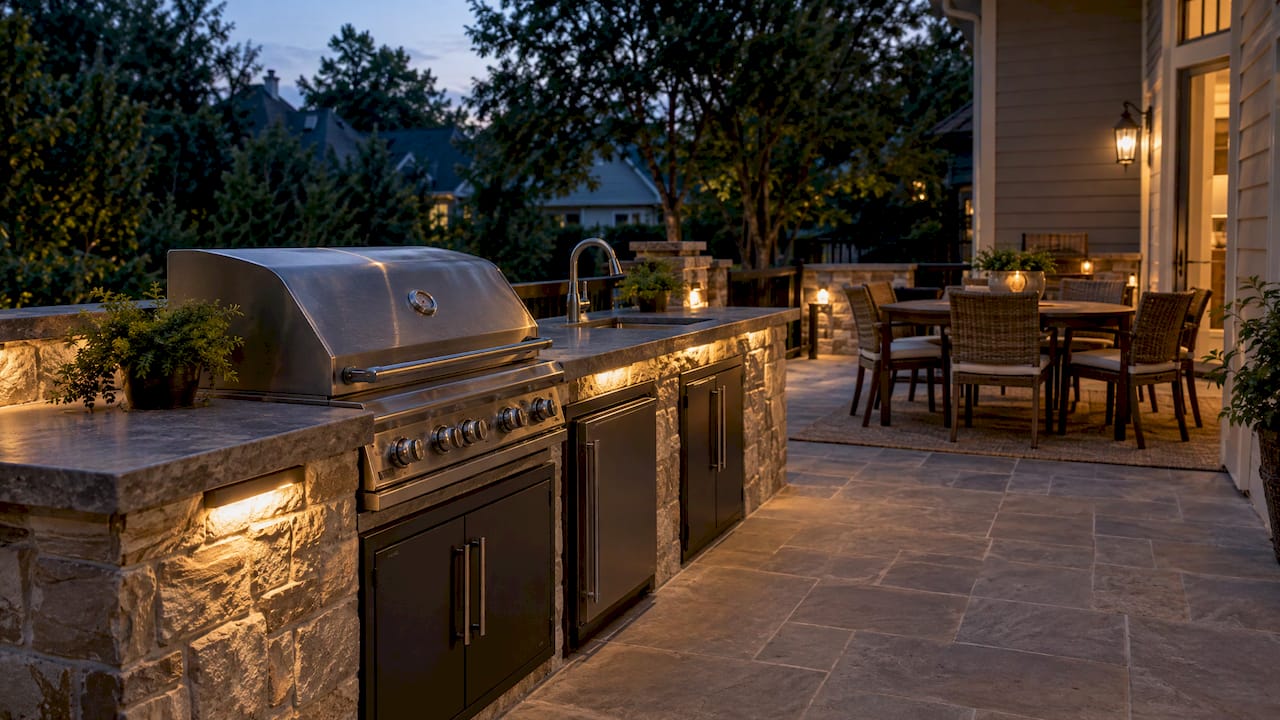
The best outdoor kitchen lighting works in layers: bright, focused light where you cook, softer warm light where you eat, and low, even light on steps and paths. Put each layer on its own dimmer, choose fixtures rated for Carolina humidity and storms, and have the wiring planned before the counters go in. At Forever Glow Lighting, we design and install permanent lighting for Charlotte patios, decks and landscapes, so the layers are planned together and controlled from your phone.
TL;DR
- Use three layers: task light over the grill and prep counter, ambient light over dining and lounge areas, and path and step light between zones.
- Keep color warm, 2700K to 3000K, and do not mix color temperatures across the property.
- Use wet-rated fixtures wherever rain can reach them, and put every outdoor outlet on GFCI protection.
- Dim everything. Most homeowners overestimate how much light they need outdoors.
- Plan wiring, controls and fixture locations before construction, not after.
Table of Contents
- Start with three layers, not one bright fixture
- Counters, prep areas and under-counter light
- The grill station
- Dining and lounge lighting
- Steps, paths and transitions
- Color temperature and brightness
- Weather ratings and electrical safety
- What Charlotte weather asks of your lights
- LED and energy use
- Let us light your outdoor kitchen
- FAQ
- Sources
Start with three layers, not one bright fixture
A single floodlight over the grill makes the cook comfortable and everyone else squint. A layered plan solves that. Think of it the way a restaurant does: bright where the work happens, dim where people sit.
- Task lighting for prep, grilling and cleanup.
- Ambient lighting for dining and conversation.
- Accent and safety lighting for steps, paths, planters and edges.
The layers should be controlled separately. A kitchen that runs at full brightness during cooking can drop to a low glow at dinner, then to paths only late at night. Charlotte builders recommend the same three-layer split: Master Pavers NC describes task lighting over the grill and prep counter, ambient string or pendant lights, and path lights to and from the house.
If you want a deeper look at how the layers stack across a whole yard, our guide to landscape lighting layering techniques walks through it. A written kitchen lighting plan helps too: list each zone, what happens there and what it needs before you pick a single fixture.
Counters, prep areas and under-counter light
The counter is where shadows do the most damage. Your own body blocks an overhead light, so the beam should come from above and in front, not straight behind you.
Ideas that work:
- Under-counter LED strips along the underside of the bar or overhang light the work surface without glare in your eyes.
- Toe-kick or hardscape lighting along the base of an island gives a floating effect and helps guests see the edge of the structure at night.
- Pendants over an island or bar add both task light and a design feature. Mount them so they light the counter and stay out of sight lines.
- Recessed downlights in a covered ceiling, placed over the prep counter and cooking station rather than spaced evenly across the whole ceiling.
For cooking surfaces, Outdoor Kitchens Charlotte suggests planning around 300 to 400 lumens per square foot at a grilling station so shadows do not hide what is on the grate. A lumen is simply a measure of total light output, so this is a useful number to hand your installer.
Food color matters as well. A warm 3000K light with a high color rendering index (CRI) shows meat and vegetables closer to their true color. We use the same logic indoors, and our note on 3000K and CRI 90+ for under cabinet lighting explains what the numbers mean.
The grill station
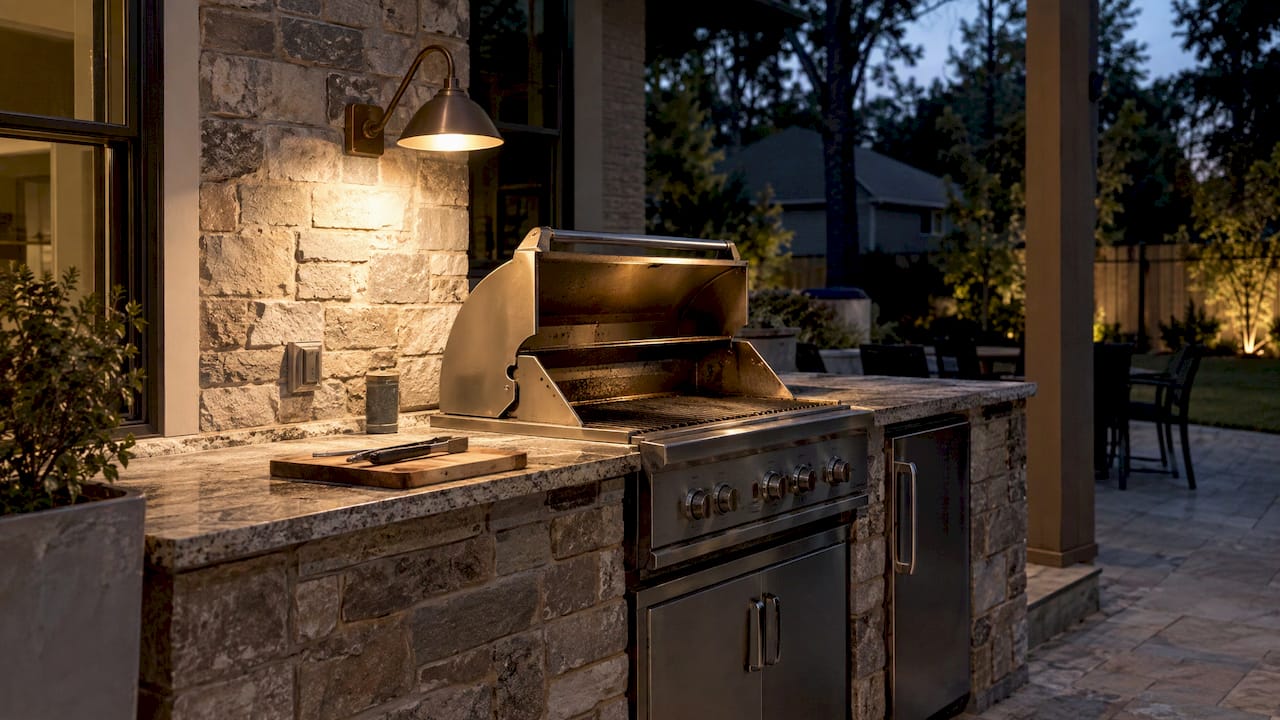
The grill is the one place where you want clear, direct light. Wall-mounted gooseneck or barn-style fixtures, or an adjustable fixture on a nearby post or overhead beam, put light on the grate from the side where the cook stands.
Keep two things in mind:
- Aim and shield. Task light should land on the cooking surface and not spill across the patio. A contained cooking zone stops the bright area from washing out the seating beyond it.
- Heat and smoke. Fixtures near a grill see grease, heat and moisture. Choose a higher weather rating here (more on ratings below) and keep wiring away from the hot zone.
If the grill sits under a roof, the vent hood and local building codes also shape where fixtures can go. A Mint Hill project documented by Carolina Decks pairs recessed LEDs and under-counter LEDs, and notes that vent hoods must meet Charlotte and Mecklenburg County codes. Check those requirements before locking in a fixture layout.
Dining and lounge lighting
Once the food is ready, the mood should change. This is where ambient light earns its place.
Over the dining table: a pendant or lantern hung low enough to feel intimate, on a dimmer. Hang it so it does not block faces across the table.
String and bistro lights: the classic outdoor-kitchen look. Use commercial-grade, wet-rated strands, anchor them to a guide wire and solid mounting points rather than letting the cord carry the load, and keep the bulbs warm. Our bistro string lighting installations are designed for this, and our article on patio string light patterns shows six layouts with code and safety in mind.
Pergolas and covered ceilings: lights built into the structure give even, soft illumination with no visible hardware. For ideas, see our pergola lighting ideas. Many Charlotte patio builders also recommend starting with integrated, outdoor-rated LEDs in the beams, then adding focused task lights only where needed, as Unique Patio Concepts does for louvered pergolas.
Lounge scenes: think in presets rather than switches. A cooking scene runs the kitchen lights high and the paths on. A dinner scene lowers the kitchen and dims the table light. After dinner, only the string lights and wall lights stay on. Late at night, paths and one door light are enough. Smart controls make those scenes one tap on your phone, which is how our systems are controlled.
Steps, paths and transitions
Safety lighting is the layer people forget until someone trips. Lighting should show each change in elevation without becoming a spotlight in someone’s eyes.
According to Homes and Gardens, pathways need roughly 2 to 10 lux and stairways about 10 lux at the tread, and brighter light can cause counterproductive glare. Lux is the amount of light that actually lands on a surface. For steps, low lighting set into the risers or just to the side defines each step cleanly.
Practical placement:
- Mount step lights in risers or under tread nosings so the light points down and across the step.
- Use downward-facing path fixtures along walkways between the house, the kitchen and the seating area, and add one at every turn.
- Keep the walk from the back door to the kitchen lit at a low, constant level.
We cover this in more detail in our guide to step lighting outdoors, and our deck and step lighting service handles the installation.
Color temperature and brightness
Color temperature is measured in kelvins (K). Lower numbers look warm and amber, higher numbers look blue-white.
For an outdoor kitchen, stay between 2700K and 3000K. Travis Hogue of Outdoor Lighting Perspectives, quoted by Homes and Gardens, advises against mixing color temperatures on one property and names 2700K to 3000K as the ideal range for landscape lighting. A small amount of extra contrast at the grill is fine, but a cool white fixture next to a warm one looks like a mistake.
On brightness, less is usually more. Joe Raboine of Oldcastle APG, also quoted in that article, cautions that most homeowners overestimate how much light they need outdoors and that too much light flattens depth, shadow and mood. Put the bright light where you work, use dimmers everywhere else, and let walls, planting and the sky do the rest.
If you are choosing between fixture types more broadly, what is the best type of lighting for outdoor use covers the options.
Weather ratings and electrical safety
This is the part of outdoor kitchen lighting that cannot be improvised.
Damp or wet location
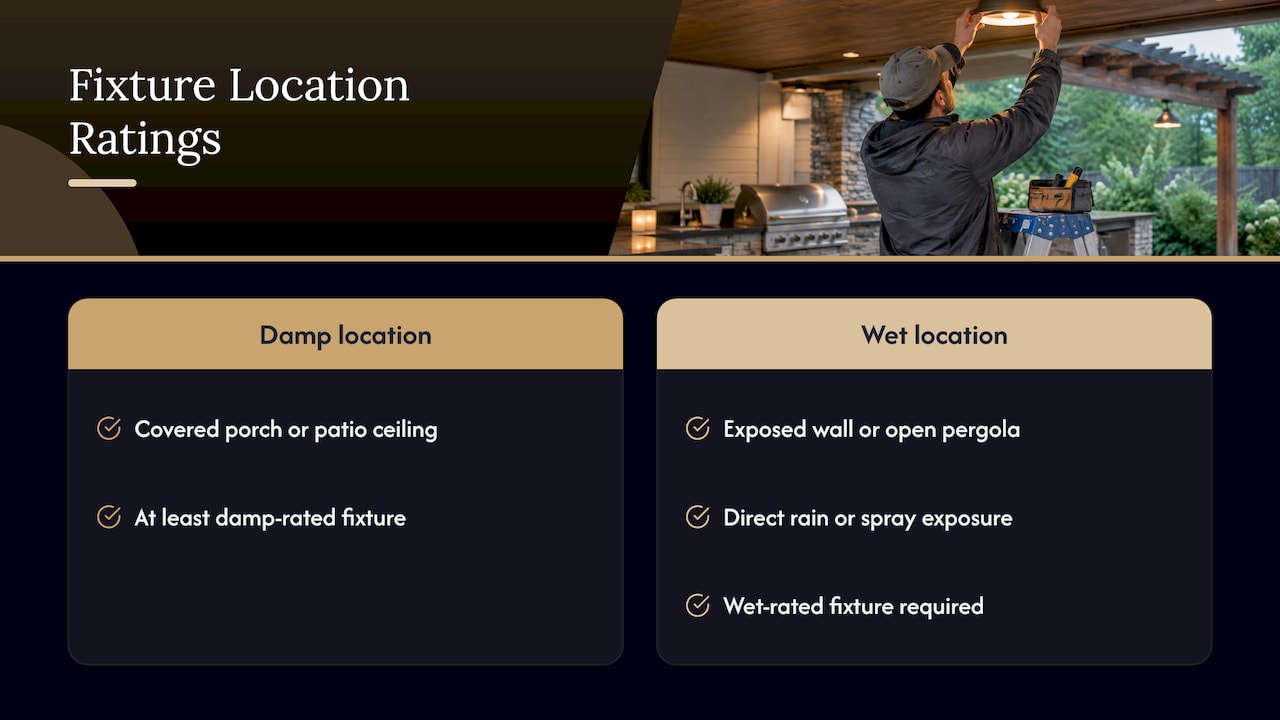
The National Electrical Code (NEC) classifies where a fixture sits. A covered porch or patio ceiling is typically a damp location and needs at least a damp-rated fixture. An exposed wall, an open pergola, or anywhere rain or spray can hit the fixture directly needs a wet-rated one. Outdoor Kitchens Charlotte also says damp-rated or wet-rated fixtures are mandatory, depending on the roof structure. When you are unsure, choose wet-rated.
IP ratings
An IP rating describes protection against dust and water. Kingdom Paver states that IP65 is the minimum for outdoor kitchens, that IP67 adds protection against temporary immersion and that IP68 is fully submersible. Fixtures near the grill or on exposed posts should sit at the top of that range.
GFCI protection and wiring
A ground-fault circuit interrupter (GFCI) cuts power quickly when current leaks, which protects people near water. The 2023 NEC, section 210.8(F), requires GFCI protection for outdoor outlets at dwellings on single-phase circuits rated 150 volts or less to ground and 50 amps or less, as summarized in Eaton’s 2023 NEC pocket guide.
Two practical points from Eastside Electrical: outdoor outlets need weather-resistant receptacles with weatherproof covers as well as GFCI protection, and GFCIs should be tested monthly. Kingdom Paver adds that outdoor wiring must be rated for wet locations, with UF or USE cable for buried runs, and that standard indoor NM (Romex) cable breaks down quickly outdoors.
Electrical work for a kitchen involves permits and local code, so have a licensed professional confirm the plan. Low-voltage lighting is often the simplest route for the fixtures themselves, and we explain why low voltage landscape lighting is the smart choice.
What Charlotte weather asks of your lights
Charlotte is hard on outdoor fixtures. Master Pavers NC reports summer afternoons around 92°F with 70% humidity, and heavy storms are common. Fixtures not built for that tend to show pitted metal, loose seals and fogged lenses, which is why Lapis Patios advises matching fixture toughness to how exposed each spot is: fully open, partly covered or under a solid roof.
Warm 2700K to 3000K light is also less attractive to insects than cool white, a real benefit on humid Carolina evenings, according to the Fun Outdoor Living overview of Carolina outdoor kitchens.
Lighting is also one of the more affordable parts of a kitchen project. Master Pavers NC budgets $1,500 to $4,000 for lighting in a Charlotte outdoor kitchen and calls it the cheapest upgrade that extends how much you use the space after dark. Your actual cost depends on fixtures, the number of zones and the wiring.
LED and energy use
LED is the standard choice for outdoor kitchens, and the efficiency is real. The International Energy Agency reports that LEDs sold today average close to 100 lumens per watt, against about 20 for a typical halogen lamp. In a U.S. Department of Energy fact sheet from 2008, LED outdoor luminaires saved between 26.8% and 50.6% of energy compared with 70W high-pressure sodium fixtures, depending on the model. That is older data on area lighting, but the direction has only strengthened. Our own look at outdoor LED energy use puts it in homeowner terms.
Our point of view
We design lighting around how people use a space, not around fixtures. An outdoor kitchen is three or four different rooms: a workshop, a dining room, a lounge and a walkway. Each one needs its own light level and its own control.
That is why we favor permanent, custom-installed systems on smart controls. Our LED systems are engineered for weather resistance, designed for HOA compliance, and controlled from your phone, so you can move from cooking to dinner to late evening without walking to a switch.
We also think lighting should be planned with the kitchen, not added after it. Our installations use commercial-grade, climate-optimized hardware with color-matched components, and our GlowCare maintenance plan keeps the system working season after season.
Dave
Let us light your outdoor kitchen
If you want the patio, steps, string lights and landscape planned as one system, our patio lighting service covers bistro and string lighting, deck and step lighting, and the smart controls that tie them together. We install across the Charlotte area, and every project is custom designed for the space.
To plan your outdoor kitchen lighting, request a free estimate through Forever Glow Lighting. Our landscape lighting design service can extend the same layers to the rest of your yard.
FAQ
What color light is best for an outdoor kitchen?
Warm white between 2700K and 3000K is the best range for most outdoor kitchens. It flatters food and skin tones and attracts fewer insects than cool white. Keep the same color temperature across the whole property so fixtures match.
How bright should outdoor kitchen lights be?
Brighter at the grill and prep counter, much dimmer everywhere else. A common planning figure for a grilling station is 300 to 400 lumens per square foot, while steps and paths need far less, about 10 lux on stair treads. Dimmers let one fixture serve several moods.
Do outdoor kitchen lights need to be waterproof?
They need to be rated for the exposure. Covered ceilings are damp locations, while exposed walls and open pergolas are wet locations that need wet-rated fixtures. Many builders treat IP65 as the minimum rating for an outdoor kitchen. All outdoor outlets should be GFCI protected.
Can I control outdoor kitchen lighting from my phone?
Yes. Our permanent LED systems are controlled by smartphone, so you can set scenes for cooking, dining and late evening, and adjust each zone separately.
Does lighting make an outdoor kitchen more useful in Charlotte?
Yes. Master Pavers NC calls lighting the cheapest upgrade for extending use of the space after dark. Good lighting makes the kitchen usable on warm evenings, when many Charlotte homeowners prefer to cook and entertain.
Sources
- Master Pavers NC: Outdoor Kitchen Charlotte NC
- Outdoor Kitchens Charlotte: Outdoor Kitchen Lighting Guide
- Carolina Decks: Custom Outdoor Kitchen in Mint Hill, NC
- Unique Patio Concepts: Lighting Under a Louvered Pergola
- Homes and Gardens: How to Plan Outdoor Lighting
- Kingdom Paver: Outdoor Kitchen Lighting and Electrical Planning Guide
- Eaton: 2023 NEC Pocket Guide
- Eastside Electrical: Outdoor Kitchen Power, Outlets and Landscape Lighting
- Lapis Patios: Outdoor Kitchen Lighting Design
- Fun Outdoor Living: Outdoor Kitchen Ideas for Carolina Backyard Living
- International Energy Agency: The next wave of LED lighting
- U.S. Department of Energy: LED Outdoor Area Lighting Fact Sheet
- Sorted Home Solutions: Kitchen Lighting Plan