
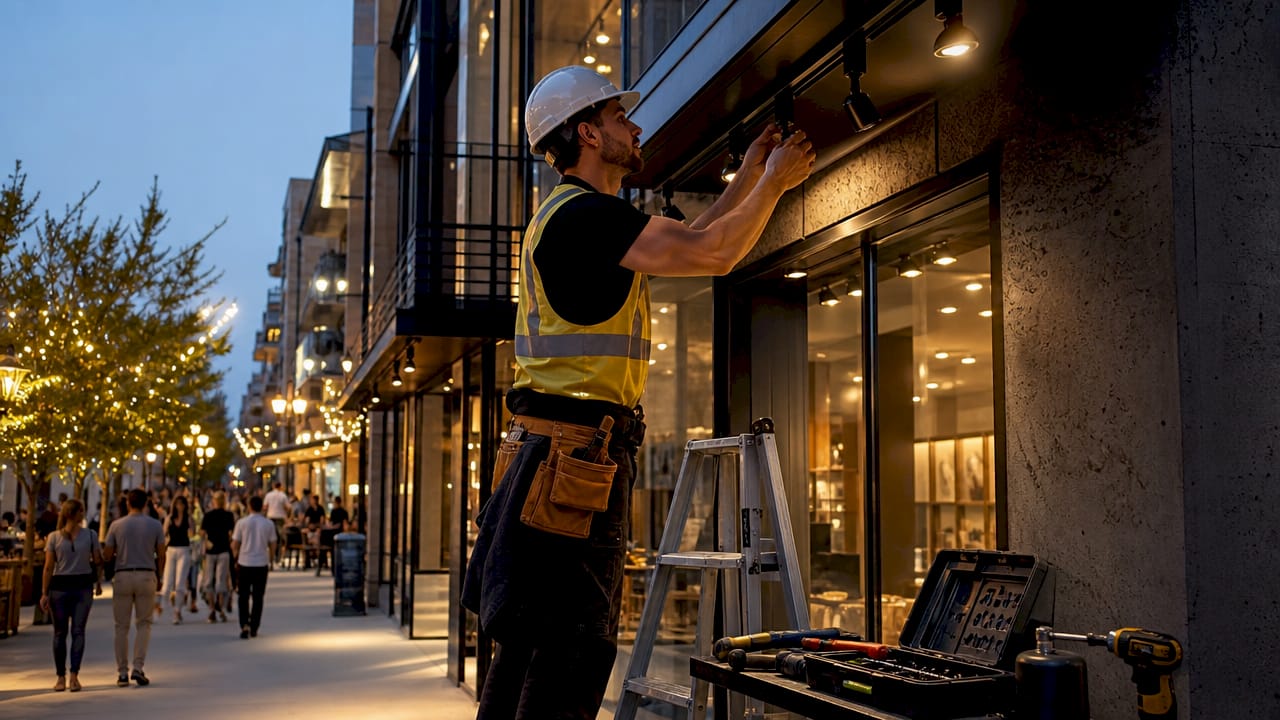
Permanent lighting for commercial buildings is a professionally installed LED system that delivers year-round illumination, programmable color control, and automated scheduling to improve safety, branding, and operating costs. Unlike seasonal or temporary setups, these systems mount directly to rooflines, fascias, and soffits where they remain invisible during the day and fully functional at night. Property owners and facility managers who invest in permanent commercial lighting gain a durable, low-maintenance solution that works across retail storefronts, office complexes, and restaurants alike. Foreverglowlighting specializes in exactly this type of installation, bringing custom design and app-based control to commercial properties throughout the Charlotte area.
1. Permanent lighting for commercial buildings: what it is and why it matters
Permanent commercial lighting, also called architectural LED lighting, refers to weatherproof LED track systems fixed to a building’s exterior structure. Systems mount on fascias or soffits and are compatible with retail storefronts, restaurants, and office complexes. The key distinction from temporary lighting is permanence: the fixtures stay in place year-round and require no seasonal removal or reinstallation.
These systems connect to smartphone apps that allow property managers to change colors, set schedules, and run holiday patterns without calling a technician. That control flexibility is what separates modern permanent lighting from older fixed-color floodlights. A well-lit commercial property attracts foot traffic and signals professionalism to customers before they ever walk through the door.

2. LED strip systems and linear track lighting
LED strip systems and linear track lighting are the most common permanent lighting solutions for commercial rooflines and building edges. These fixtures run continuously along fascias and soffits, creating clean, uniform illumination across the full face of a building. They suit retail centers, car dealerships, and multi-tenant office buildings particularly well.
Key features to evaluate when selecting a strip or track system:
- Color range: Full-spectrum RGB systems support millions of color combinations, allowing exact brand color matching.
- Waterproofing rating: Look for IP65 or IP66 rated fixtures, which resist rain, dust, and pressure washing.
- UV resistance: UV-stable housing prevents yellowing and brittleness after years of sun exposure.
- Voltage type: Low-voltage systems (12V or 24V DC) are safer for installers and reduce energy waste compared to line-voltage alternatives.
- Lifespan: Quality commercial LED fixtures last 15–20+ years with minimal maintenance.
Pro Tip: Ask your installer for fixtures rated IP66 rather than IP65 if your building faces heavy rain or regular pressure washing. The extra protection is worth it for commercial applications.
3. Integrated flood and security lighting with programmable zones
Integrated flood lighting combines broad area coverage with the programmable zone control that facility managers need. A zone is a defined section of the building or property that can be scheduled and colored independently from other sections. Facility managers use predefined zones to run security lighting overnight in parking areas while displaying holiday patterns on the building facade at the same time.
This separation of function is one of the most practical advantages of modern commercial systems. You are not choosing between security and aesthetics. You get both, controlled from a single app.
4. Color-changing capabilities for branding and seasonal promotions
Permanent lighting systems provide branding flexibility by enabling exact brand color matching and instant changes for holidays or promotions without physical light replacement. A restaurant can run warm amber tones on a Tuesday night and switch to red and green for the holiday season on a Friday morning, all from a smartphone.
This capability has real marketing value. Seasonal promotions that once required renting and installing temporary string lights now happen with a single app command. The consistency of brand colors across all exterior lighting also strengthens visual identity in competitive retail corridors.
5. How permanent lighting enhances safety and security
Permanent LED lighting deters vandalism, trespassing, and unwanted activity while reducing liability risks tied to poorly lit areas. Consistent illumination removes the dark zones in parking lots and entryways where incidents are most likely to occur. This is not a minor benefit. Poorly lit commercial properties face higher insurance premiums and greater exposure to slip-and-fall liability claims.
Security benefits of a well-designed permanent lighting system include:
- Elimination of dark corners near loading docks, dumpsters, and stairwells
- Programmable timers that keep lights on during high-risk overnight hours
- Integration with existing motion sensors and security cameras for layered protection
- Consistent visibility that increases the likelihood that suspicious activity is seen and reported
“A commercial property with consistent, bright exterior lighting signals to potential intruders that the premises are monitored and maintained. That signal alone reduces the probability of a security incident.”
Pro Tip: Program your security zones to activate at full brightness 30 minutes before closing time and hold through the first hour after opening. Those transition windows carry the highest risk for most commercial properties.
6. Energy efficiency and cost savings vs. traditional lighting
Permanent LED lighting uses up to 90% less energy than incandescent or halogen lighting. For a commercial property running exterior lights eight to ten hours per night, that reduction translates directly into lower monthly utility bills.
The cost advantage compounds over time. LEDs last far longer than traditional bulbs, which means fewer replacement cycles and less labor. Permanent lighting also eliminates recurring seasonal costs including labor, materials, and storage that temporary holiday lighting requires every year.
| Cost Factor | Traditional Lighting | Permanent LED Lighting |
|---|---|---|
| Energy use | High (incandescent/halogen) | Up to 90% lower |
| Bulb lifespan | 1,000–2,000 hours | 50,000+ hours |
| Seasonal labor | Annual reinstallation cost | None after installation |
| Maintenance frequency | High | Minimal |
| Fixture lifespan | 2–5 years | 15–20+ years |
Scheduling and zone controls add another layer of savings. Sections of the building that do not need overnight illumination can be dimmed or turned off automatically, reducing consumption without sacrificing security coverage where it matters.
7. Installation process and best practices
Typical commercial permanent lighting installation takes 1–3 days, covering site assessment, custom design, professional installation, and control app setup. The process is structured to minimize disruption to daily business operations. Most installations happen without requiring the business to close.
A standard installation follows these steps:
- Site assessment: The installer measures rooflines, fascias, and key architectural features to plan fixture placement and wiring routes.
- Custom design: Lighting zones are mapped to the property layout, matching security needs and aesthetic goals.
- Fixture installation: Weatherproof LED fixtures are mounted and wired by licensed electricians familiar with commercial electrical codes.
- App configuration: The control system is set up with schedules, color programs, and zone assignments tailored to the property.
- Walkthrough and handoff: The facility manager receives a full demonstration of the app controls and a warranty overview.
Pro Tip: Request a written zone map from your installer before the job begins. That document becomes your reference point for future scheduling changes and makes troubleshooting far faster if an issue arises.
Choosing an experienced commercial installer matters more than most property managers realize. Residential lighting contractors often lack familiarity with commercial electrical codes, load requirements, and the zone complexity that larger properties demand. Foreverglowlighting’s commercial LED installation work at properties like Gastonia Chevrolet Buick GMC illustrates what a properly executed commercial project looks like in practice.
8. How to choose the best permanent lighting solution for your property
The best permanent lighting solution for a commercial property matches the building’s architecture, the brand’s visual identity, and the facility’s security requirements. No single system works for every property type. A strip mall has different needs than a standalone office building or a restaurant with outdoor seating.
Evaluate these factors before committing to a system:
- Brand color accuracy: Confirm the system supports the specific RGB values that match your brand standards.
- Zone count and flexibility: Larger properties need systems that support multiple independent zones without additional hardware.
- Energy efficiency rating: Prioritize fixtures with high lumens-per-watt ratings to maximize the energy savings benefit.
- Scalability: Choose a system that allows additional fixtures or zones to be added as the property expands.
- Installer experience: Verify the contractor has completed commercial projects of similar scale and complexity.
- Warranty coverage: Commercial-grade systems should carry a minimum five-year fixture warranty and a clear support process.
Permanent lighting is one of the highest ROI exterior upgrades for commercial properties because it combines energy savings, maintenance reduction, security enhancement, and marketing potential in a single installation. That combination is why facility managers increasingly treat it as infrastructure rather than decoration.
Key takeaways
Permanent LED lighting is the most cost-effective exterior upgrade for commercial properties because it reduces energy use, eliminates seasonal labor, deters crime, and supports year-round branding from a single installed system.
| Point | Details |
|---|---|
| Energy savings are substantial | Permanent LEDs use up to 90% less energy than incandescent or halogen fixtures. |
| Security improves immediately | Consistent illumination removes dark zones and deters vandalism and trespassing. |
| Zone control adds flexibility | Facility managers can run security and decorative lighting independently on one system. |
| Installation is fast | Most commercial installations complete in 1–3 days with minimal business disruption. |
| ROI comes from multiple sources | Savings stack from energy, seasonal labor elimination, and reduced maintenance costs. |
Why I think most facility managers underestimate permanent lighting
Most facility managers I talk to think of exterior lighting as a utility expense. They budget for it the same way they budget for trash pickup. That framing costs them money.
Permanent commercial lighting is closer to a marketing asset than a utility. The ability to match exact brand colors, run promotional displays for holidays, and shift the visual identity of a building overnight is something that used to require a full event production team. Now it happens from a phone. The properties that recognize this use their lighting systems actively, not just as background infrastructure.
The security angle is also undervalued in the selection process. Property managers often add motion sensors and cameras first, then treat lighting as an afterthought. That order is backwards. Lighting is what makes cameras effective. A camera pointed at a dark parking lot captures very little. The same camera with consistent, bright illumination behind it becomes a genuine deterrent.
The one pitfall I see most often is choosing a system based on upfront cost alone. The cheapest installation almost always means fewer zones, lower-rated fixtures, and a contractor who has never handled a commercial property of real complexity. The value of professional design shows up in year three and four, not on the invoice.
— Dave
Foreverglowlighting’s commercial lighting services
Foreverglowlighting brings custom permanent lighting solutions to commercial properties across the Charlotte area, from roofline LED track systems to full exterior security and accent lighting.
Every project starts with a site assessment and a custom design that accounts for your building’s architecture, your brand’s color requirements, and your security priorities. We handle installation, app configuration, and zone setup so your team is ready to manage the system from day one. Our permanent lighting services cover commercial properties of all sizes, and we back every installation with clear warranty terms and ongoing support. Contact Foreverglowlighting today to schedule your free property assessment and see what a professionally designed system looks like on your building.
FAQ
What is commercial permanent lighting?
Commercial permanent lighting is a weatherproof LED system installed on a building’s exterior that provides year-round illumination with programmable color and scheduling controls. It mounts to rooflines, fascias, and soffits and requires no seasonal removal.
How long does a commercial permanent lighting installation take?
Most commercial installations complete in 1–3 days, including site assessment, fixture installation, and app setup, with minimal disruption to business operations.
How much energy does permanent LED lighting save?
Permanent LED lighting uses up to 90% less energy than incandescent or halogen alternatives, with additional savings from scheduling controls that reduce consumption during low-traffic hours.
How does permanent lighting improve commercial property security?
Consistent, bright illumination removes dark zones in parking lots and entryways, deters vandalism and trespassing, and makes security camera footage significantly more useful.
How long do commercial permanent LED fixtures last?
Commercial-grade LED fixtures rated IP65 or IP66 typically last 15–20+ years with minimal maintenance, far outlasting traditional bulb-based exterior lighting systems.