
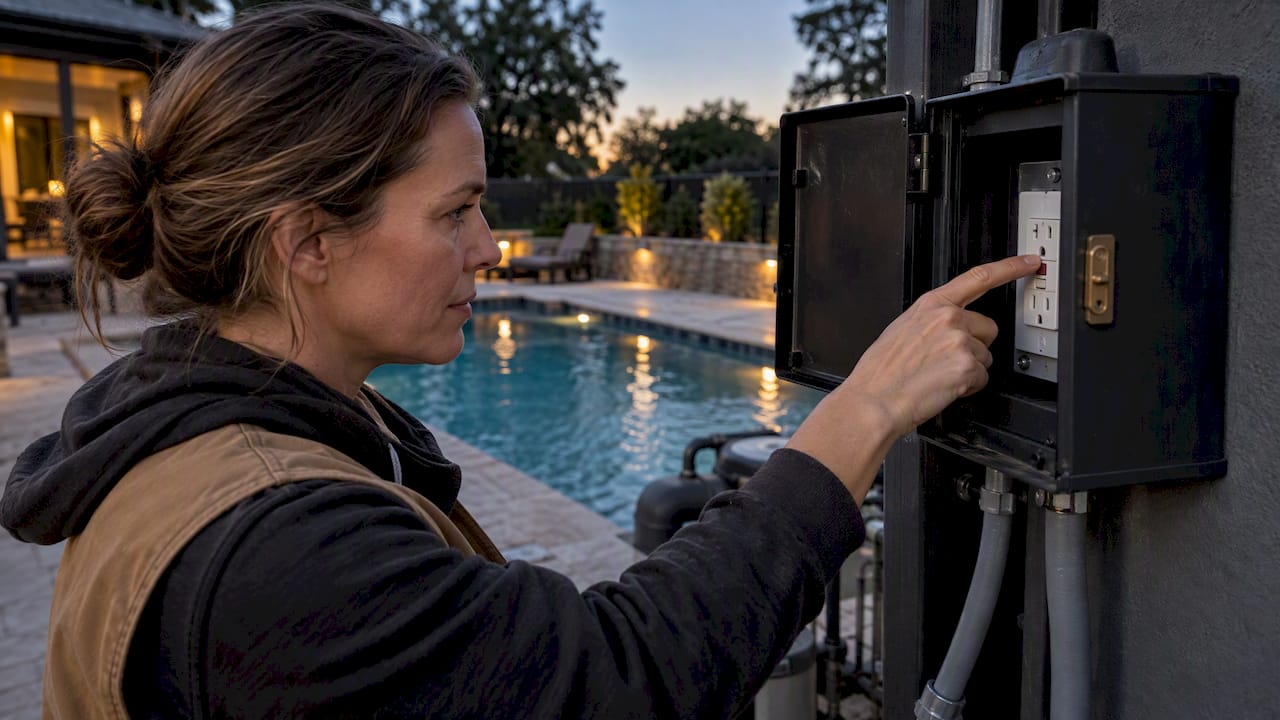
Modern pool lighting is safe when it has listed underwater fixtures, equipotential bonding, and GFCI protection, and a licensed electrician installed it. If your pool is already in use, the immediate next steps are simple: test every GFCI outlet monthly, check fixtures and housings for corrosion or cracked lenses, and call an electrician the moment anything looks or feels wrong, following important solar panel cleaning safety tips to avoid electrocution hazards.
TL;DR:
- Homeowners should regularly test GFCI outlets monthly, inspect fixtures for corrosion or damage, and replace faulty components immediately to maintain safety.
- All underwater fixtures must be UL676 listed with an IP68 rating rated for continuous submersion and proper voltage to ensure compliance and safety.
- Proper placement of multiple lower-wattage fixtures with even coverage reduces glare, enhances visibility, and diminishes shadowy hazards in the pool area.
- Professional installation and annual inspections by licensed electricians are crucial to verifying bonding, fixture integrity, and adherence to electrical codes.
- Emergency lighting like battery-backed path lights and designated exit routes are essential for safe egress during power failures or electrical incidents around the pool.
Table of Contents
- How pool electrical safety systems work: bonding, grounding, and GFCI
- Fixture types, standards, and ratings homeowners must insist on
- Placement and design for safety and good visibility
- Installation, inspection, and maintenance: what homeowners should require
- Emergency actions for an electrical shock or stray-current incident
- Why a professional permanent installation can reduce safety risk and maintenance burden
- Emergency lighting and exit path illumination around pool areas
- Adequate ambient and task lighting levels to prevent trips and falls
- Use of timers and photoelectric sensors to control lighting for safety
- Lighting placement to ensure clear visibility of pool edges and depth markings
- When to DIY vs. hire a professional: a homeowner’s perspective
- Forever Glow Lighting: professional, safety-focused permanent installations
- FAQ
- Sources
How pool electrical safety systems work: bonding, grounding, and GFCI
Pool safety rests on three interlocking systems, and homeowners benefit from understanding how each one functions rather than treating them as interchangeable.
Equipotential bonding ties together every metal component around the pool, ladders, rails, the reinforcing steel in the deck, and the pump housing, so that no two surfaces a swimmer might touch can carry a different electrical charge. The National Electrical Code addresses this directly in Article 680, and a recent TIA No. 1809 revision to NFPA 70 updates ground-fault protection language for pool motors, a sign that the code keeps evolving as variable-speed pumps and new drive technology enter the market. Grounding is a related but separate concept: it gives fault current a deliberate path back to the source, while bonding equalizes voltage across surfaces so current has no reason to pass through a swimmer’s body at all.
GFCI (ground-fault circuit interrupter) protection is the backstop. A GFCI monitors the current flowing out to a circuit and the current returning; if it detects even a small imbalance, it cuts power in a fraction of a second. According to the CPSC’s pool electrical safety guidance, GFCIs are the single most effective residential defense against pool electrocution, and underwater lighting and pump circuits should always have one.
- Test every pool-related GFCI monthly using the built-in test button.
- Replace any GFCI that fails to trip or fails to reset.
- Have an electrician verify bonding continuity during routine inspections.
As of 2026, the CPSC has reported dozens of fatalities related to pool and spa electrocutions since 2002, a reminder that aging wiring and degraded fixtures remain a real hazard even in well-built pools.
Fixture types, standards, and ratings homeowners must insist on
Not every light labeled “waterproof” belongs anywhere near a pool. A listed fixture has been tested by an independent lab against a specific safety standard, and for underwater pool lighting that standard is UL676. Buying anything less leaves you guessing about how the fixture performs under sustained submersion, thermal cycling, and electrical fault conditions.
IP ratings matter too. A fixture rated IP68 is built for continuous submersion, which is what an in-pool luminaire actually experiences, not the occasional splash an IP65 fixture is designed to handle. UL’s evaluation program for isolated, low-voltage underwater LED luminaires notes that these fixtures simplify compliance testing while offering real safety and efficiency advantages over traditional 120-volt underwater lights, since a fault on an isolated low-voltage circuit carries far less energy to begin with. UL has also revised underwater luminaire requirements covering lens guards and grounding terminations, so it pays to confirm a fixture meets the current standard rather than an outdated one.
Before buying any fixture for the splash zone, confirm:
- It carries a UL676 listing number you can verify.
- Its IP rating is IP68 or equivalent for continuous submersion.
- It is rated for the voltage and circuit type your electrician specifies.
Placement and design for safety and good visibility
Good pool lighting is less about brightness and more about distribution. A single powerful fixture creates harsh glare and deep shadows, both of which hide hazards rather than reveal them. Spreading light across several lower-wattage fixtures produces even illumination with no hot spots and no blinding reflections off the water’s surface.
- Position underwater fixtures so light washes across the pool floor evenly, not aimed directly at swimmers’ eyes.
- Place deck and step lights at every elevation change so edges, handrails, and depth markings stay visible after dark.
- Aim fixtures to minimize shadows along walking paths, since a shadowed step is often the one someone misses.
- Consider zoned controls or an emergency-brightness setting that floods the area with light instantly if someone needs help.
Even coverage, zoned controls, and an emergency-brightness override are design principles borrowed from commercial facilities that prioritize visibility during emergency response, and they scale down well for a residential backyard. Our landscape lighting safety benefits page covers similar placement logic for the broader yard.
Pro Tip: Ask your installer for a lumen budget and beam-angle spec for each fixture rather than just a total wattage number, since two fixtures with identical wattage can produce very different glare and shadow patterns.
Installation, inspection, and maintenance: what homeowners should require
Hire an electrician who can speak specifically to NEC Article 680, not just general residential wiring. Ask direct questions: What is the bonding plan for this pool? Where will the GFCI protection sit relative to the lighting and pump circuits? What are the listing numbers for the fixtures being installed? A contractor who can’t answer these without hesitation isn’t the right fit for pool work.
Before installation begins, confirm permits are pulled and that fixture listing numbers appear on the proposal. Our landscape lighting checklist for homeowners walks through similar pre-project steps for outdoor systems generally.
- Pull permits and request fixture listing numbers in writing before work starts.
- Test every pool GFCI monthly using the built-in button.
- Inspect underwater fixture seals and housings annually for cracks or corrosion.
- Replace any fixture showing lens fogging, discoloration, or a failed seal immediately.
| Red flag | What it means | What to do |
|---|---|---|
| Tingling sensation in water | Possible stray voltage | Exit immediately, shut off power, call an electrician |
| GFCI won’t reset | Circuit fault or failed device | Stop using the circuit, call an electrician |
| Flickering pool lights | Loose connection or failing fixture | Schedule an inspection before next use |
| Visible corrosion on housing | Seal failure, water intrusion risk | Replace fixture, check wiring behind it |
Emergency actions for an electrical shock or stray-current incident
A swimmer who suddenly can’t move normally, seems to freeze, or reports tingling in the water may be experiencing electric shock drowning. Acting fast and correctly matters more than acting quickly but wrong.
- Do not enter the water yourself, since you risk becoming a second victim.
- Shut off power at the breaker serving the pool equipment immediately.
- Call 911 right away, even if the person seems to recover.
- Use a non-conductive rescue pole, such as a fiberglass shepherd’s crook, to pull the person to safety.
The CPSC specifically recommends fiberglass rescue poles because metal ladders and poles can themselves be energized during a fault. Afterward, tell first responders an electrical hazard may be involved, and have an electrician inspect the entire system before anyone swims again. Keep a marked, non-conductive rescue pole within reach of the pool at all times, and consider posting a brief emergency plan where anyone supervising the pool can see it.
Why a professional permanent installation can reduce safety risk and maintenance burden
Permanent, professionally designed lighting removes a lot of the guesswork and ladder exposure that comes with seasonal DIY setups. Custom-installed, smartphone-controlled LED systems can be engineered for weather resistance and designed around the specific layout of a property, which cuts down on the improvised wiring and mismatched fixtures that create risk over time.
- Climate-optimized hardware reduces the corrosion and seal failures that lead to fixture replacement.
- Smartphone control eliminates repeated ladder trips to adjust or re-aim fixtures.
- Ongoing maintenance support through our GlowCare subscription keeps seals, housings, and connections in check year-round.
- Integrated design coordinates pool, deck, and landscape lighting so coverage stays even instead of patchy.
Emergency lighting and exit path illumination around pool areas
A pool area needs a clear, lit path to every exit, not just bright light over the water itself. If the power needs to be shut off during an incident, the deck, gate, and walkway back to the house should still be visible enough for someone to move safely in the dark.
Battery-backed or low-voltage path lighting along the route from the pool to the house or street solves this, since it stays lit even if the main circuit trips. Gate hardware and pool fencing should be lit well enough that someone can locate a latch or exit without fumbling, especially in an emergency when seconds matter.
Deck steps and changes in elevation deserve their own dedicated fixtures rather than relying on spillover from pool lights, since spillover is the first thing to disappear if a circuit shuts down. Our deck and step lighting installations are built around this exact scenario: independent, low-voltage circuits that keep critical paths lit even when the main pool lighting circuit is off.
Think through the worst case when planning exit lighting: a nighttime incident, one circuit dead, and someone who needs to get out fast without tripping over a step they can’t see. Lighting that only works when everything else is working isn’t really emergency lighting at all.
Adequate ambient and task lighting levels to prevent trips and falls
Pool decks fail people in two ways: too little light to see a hazard, or so much glare that the hazard disappears into the contrast. Ambient lighting fills the whole area with a soft, even glow, while task lighting targets specific spots, steps, diving boards, ladder rungs, where a misstep carries real consequence.
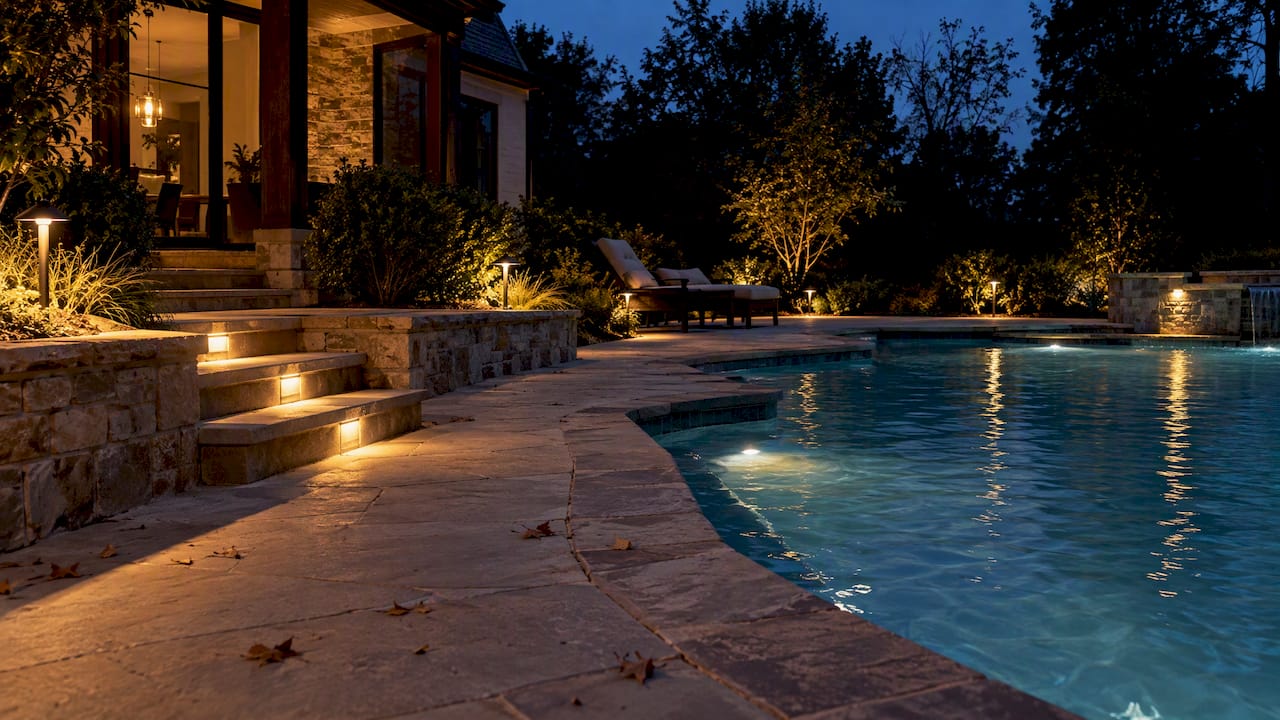
The goal is layered coverage rather than one dominant source. A single floodlight mounted high on the house casts long shadows across the deck, and anything in those shadows becomes invisible right when someone needs to see it. Multiple lower-output fixtures spread around the perimeter close those shadow gaps without creating the blinding glare that a single bright source produces.
Task lighting at the edge of every step and at the pool’s shallow and deep ends does double duty: it marks the physical hazard and helps swimmers judge depth before they jump or dive. Our landscape lighting brightness levels guide walks through how to balance ambient and task lighting for a yard that includes a pool, patio, and walkways together rather than treating each zone in isolation.
Skip the temptation to just add more wattage when an area feels dim. Fixture placement and beam angle usually solve a visibility problem faster, and with less glare, than simply installing a brighter bulb in the same spot.
Use of timers and photoelectric sensors to control lighting for safety
Lighting that depends on someone remembering to flip a switch eventually fails, usually on the one night it matters most. Timers and photoelectric sensors remove that human error by turning pool and deck lighting on automatically at dusk and off at a set hour, or keeping it running until a sensor detects enough daylight to make it unnecessary.
A photoelectric sensor reacts to actual light levels, which means pool lighting comes on consistently even as sunset times shift across the seasons. Timers work well for predictable schedules, such as turning entry and deck lights on before guests typically arrive and off after a reasonable bedtime, but they need periodic adjustment as daylight hours change.
Combining both approaches tends to work best for pool areas specifically: a photoelectric sensor handles the baseline dusk-to-dawn safety lighting, while a timer or smartphone schedule manages supplemental lighting for entertaining or late swims. Our smart landscape lighting app control systems let you set both from a phone, so there’s no manual switch to forget and no fixture left dark because someone assumed another person handled it.
Automated controls also reduce one quiet risk: lights left on constantly burn out faster and get neglected because no one notices a bulb has failed during daylight hours. A system that only runs when needed gets checked more often simply because someone is there to see it working.
Lighting placement to ensure clear visibility of pool edges and depth markings
The edge of the pool is the single most important line in the entire layout, and it needs to be visible from every angle, at every time of night, without exception. A swimmer or a child walking the deck needs to know exactly where solid ground ends and water begins, and depth markings need enough light to actually be read rather than guessed at.
Perimeter lighting set low and close to the coping line does more for edge visibility than tall fixtures aimed down from a distance, since low-angle light grazes the pool edge and makes the transition obvious. Depth markers benefit from small dedicated fixtures or reflective treatments paired with nearby ambient light, since a marker no one can read at night isn’t doing its job.
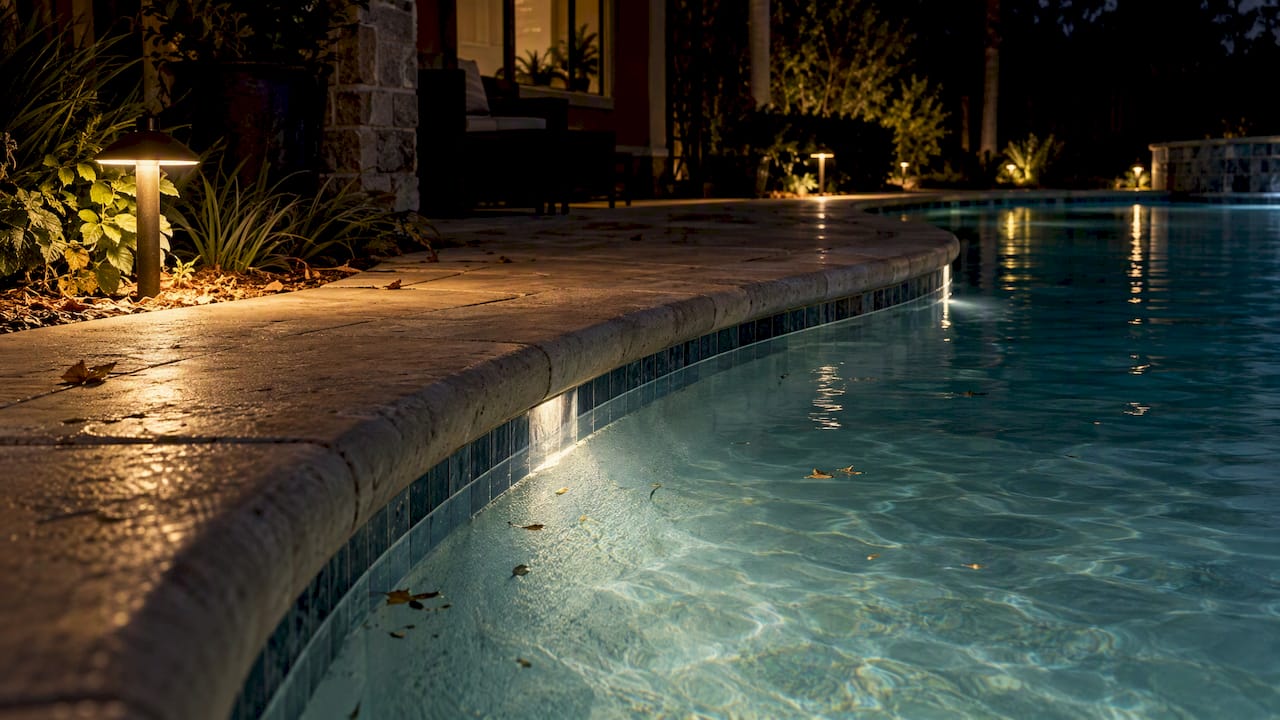
Underwater fixtures placed to illuminate the pool floor near the edges, rather than concentrated in the center, help swimmers judge where the wall is before they reach it. This matters most at the deep end, where misjudging distance to the wall carries more risk than it does in the shallows.
Our landscape lighting design process treats pool edges, steps, and depth markers as a single connected system rather than separate line items, which is the difference between a yard that looks lit and one that is actually safe to move through after dark.
When to DIY vs. hire a professional: a homeowner’s perspective
Visual inspections and the monthly GFCI test button push are reasonable DIY tasks for any homeowner. Anything involving bonding, fixture replacement, or new wiring belongs to a licensed electrician, full stop. Professional design up front costs more initially but tends to cost far less in repeat repairs and reduced risk over the life of the pool.
— Dave
Forever Glow Lighting: professional, safety-focused permanent installations
We design and install permanent lighting systems built around the exact layout of your pool, deck, and landscape, so coverage stays even and ladder trips become a thing of the past. Smartphone-controlled LED systems can be designed to withstand local weather conditions and comply with HOA design requirements.

- Landscape Lighting Design covers full pool, patio, and yard layouts.
- Patio, Bistro & String, and Deck & Step Lighting brightens walkways and entertaining areas.
- Dock & Waterfront lighting extends coverage to waterfront properties.
- Maintenance subscriptions can help keep seals, housings, and connections checked year after year.
Request a free estimate and safety review for your pool area through our permanent lighting services page.
FAQ
How close is too close for lightning in a pool?
Lightning safety and electrical fixture safety are separate issues: once thunder is audible, everyone should exit the pool and stay out of the water entirely until it is safe to return. This guidance addresses atmospheric lightning strikes, not the wiring-related shock hazards covered in this article.
Are lights in pools safe?
Underwater pool lights are safe when they carry a UL676 listing, sit on a GFCI-protected circuit, and are installed by a licensed electrician following NEC Article 680. Isolated low-voltage LED fixtures carry an added safety margin over older 120-volt designs because a fault on a low-voltage circuit delivers far less energy.
What is the best type of outdoor lighting for a pool area?
Isolated, low-voltage LED underwater luminaires paired with low-wattage deck and path fixtures generally offer the best combination of safety, efficiency, and even coverage. UL’s evaluation program notes these fixtures simplify listing compliance while reducing fault energy compared to standard 120-volt lights.
What is the most effective way to avoid electrical hazards in a pool area?
GFCI protection on every pool-related circuit, paired with proper equipotential bonding, is the most effective combination for preventing electrical hazards, according to CPSC guidance. Testing GFCIs monthly and having a licensed electrician inspect bonding and fixture condition annually closes most of the remaining gaps.
How often should pool lighting fixtures be inspected?
Underwater fixture seals and housings should get a visual check at least once a year, with GFCIs tested monthly year-round. Any sign of corrosion, lens fogging, or flickering warrants an immediate electrician visit rather than waiting for the next scheduled check.
Sources
- Cpsc
- Standards Council Decision (Final): D#25-1 Standards Council Agenda Item: SC#25-4-6-d Date of Decision: 10 April 2025 TIA No. 1809 on NFPA 70®
- UL Solutions: Streamlined evaluation program for isolated, low-voltage underwater LED luminaires