
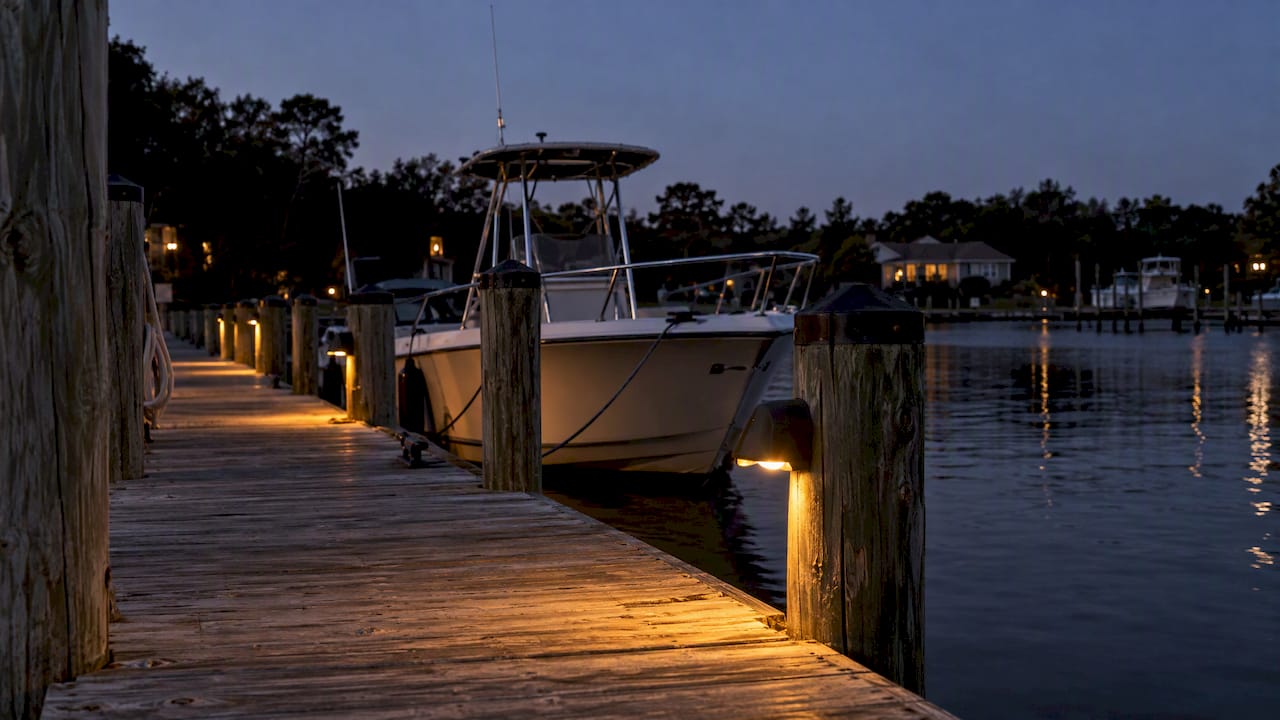
For safe, low-glare dock lighting, choose shielded, downward-facing LED fixtures with strong BUG ratings in warm or amber tones, then control them with timers or motion sensors. If your dock sits near antennas, ask your installer about RTCM 13700.0 compliance before you buy. We handle these projects regularly and can walk you through the right setup for your waterfront.
TL;DR:
- Aim for 50 to 100 lumens per linear foot, using lower output on paths and brighter task lighting only at fuel or loading areas.
- Require low BUG glare and uplight ratings, IP67 or IP68 protection, and written RTCM 13700.0 test reports near boats with active electronics.
- Use motion sensors, timers, and separate dock zones to keep task lights on only when needed; uniform full brightness can impair night vision.
- Near coastal nesting areas, amber or red shifted LEDs reduce wildlife disruption compared with standard white light while still providing visibility.
- A simple solar lighting setup may suit DIY, but hardwired work near water or antennas calls for a professional; Charlotte projects typically cost $4,000 to $8,000.
Table of Contents
- Which Fixture Types And Placements Cut Glare On Your Dock
- Technical Specs To Require Before You Buy Fixtures
- Design And Control Tactics That Keep Light Where You Need It
- Deciding Whether To DIY Or Hire A Pro For Dock Lighting
- How Long A Commercial Dock Lighting Project Actually Takes
- Our Approach To Low-Glare Dock Lighting Projects
- How We Can Help With Your Dock Lighting Project
- FAQ
- Sources
Which Fixture Types And Placements Cut Glare On Your Dock
Dock lighting fails in one of two ways: it is too dim to walk safely, or it is so bright and poorly aimed that it blinds boaters and irritates neighbors. The fix is picking the right fixture for each zone and mounting it so the light goes down, not out.
Three fixture types cover most docks:
- Piling lights: mounted on posts, these light the water’s edge and help with docking approach without throwing light sideways.
- Recessed dock dots: flush-mounted into decking, these mark walking paths and steps with almost no visible glare.
- Low-profile path lights: these line walkways at ankle height, useful where you need continuous guidance but not task brightness.
Aim and mounting height matter as much as fixture choice. A light mounted too high or angled outward creates disability glare, the kind that makes it hard to see past the fixture into the dark water beyond it. Keep fixtures low, shielded, and angled down toward the deck or water surface rather than out toward the horizon.
For brightness, dock lighting guidance from DRSA recommends 50 to 100 lumens per linear foot of dock, adjusted for local rules and how the space gets used. Walking paths and steps can sit at the lower end of that range. Fuel areas or loading zones where you need sharper task visibility can run higher, but only where people are actively working.
Color selection is the final piece. Standard white LEDs scatter more visible light and can disturb wildlife, particularly nesting sea turtles in coastal areas. Where that matters, long-wavelength amber or red-shifted LEDs reduce disruption while still giving you enough light to see by, according to sea turtle lighting guidance from the Florida Fish and Wildlife Conservation Commission.
Technical Specs To Require Before You Buy Fixtures
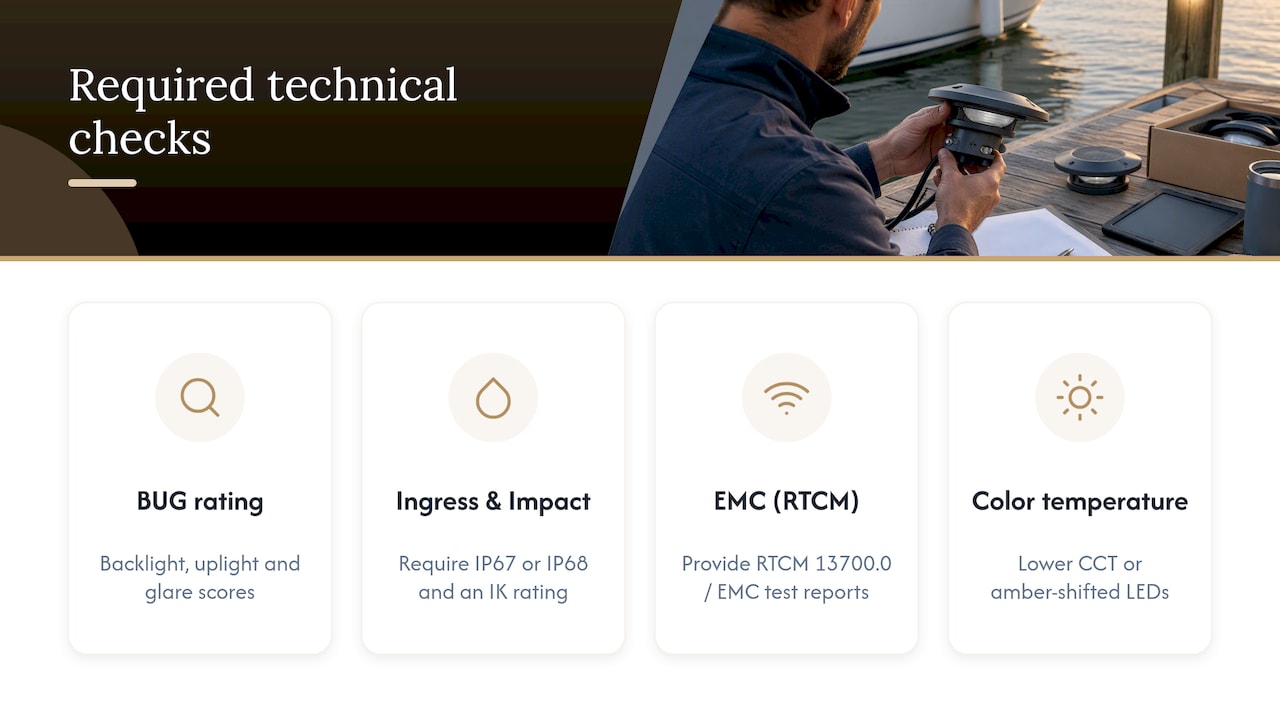
A glossy spec sheet means little if it skips the numbers that actually predict glare, water damage, or radio interference. Ask for these four things before you commit to any fixture.
BUG rating. The IES BUG system rates backlight, uplight, and glare separately, which makes it far more useful than older “full cutoff” labels for predicting how a fixture will behave on your dock, according to the Texas Department of Transportation’s explanation of cutoff and BUG ratings. A fixture with a low glare and uplight component is the better fit for a residential waterfront.
Water and impact resistance. Dock fixtures sit in a harsh environment, so IP67 or IP68 ratings are worth requiring over the lower IP65 rating common in general outdoor fixtures. Pair that with a reasonable IK impact rating so a fixture can take a bump from gear or a line without cracking its housing.
EMC compliance. This is the one most homeowners never think to ask about. RTCM Standard 13700.0 sets electromagnetic compatibility requirements for LED devices so they do not interfere with VHF radios, AIS, or GNSS receivers on nearby boats. The U.S. Coast Guard has flagged LED-related radio interference as a real issue near antennas, so ask manufacturers for written EMC or RTCM test reports before installing anything close to a slip with active electronics.
Color temperature. Lower CCT and amber-shifted LEDs are easier on the eyes at night and gentler on nearby wildlife than cool white output.
Pro Tip: Keep a copy of every fixture’s BUG rating and EMC test report on file. If a neighbor or marina complains later, you will want that paperwork handy.
Design And Control Tactics That Keep Light Where You Need It
Good dock lighting is less about buying brighter fixtures and more about controlling when and where light actually turns on. A short sequence gets most projects right:
- Shield or louver every fixture so the light source itself is never visible from boats or neighboring properties.
- Aim each fixture downward toward the deck, steps, or water’s edge rather than outward across the water.
- Break the dock into zones: approach, walkway, work area, and swim platform, each with its own brightness target.
- Add motion sensors or timers so lights activate only when someone is actually on the dock.
- Build in dimming presets so you can run a low ambient level most nights and a brighter task level only when needed.
Zoning matters more than most owners expect. A dock lit uniformly at full brightness all night looks less safe, not more, because it washes out your night vision and makes the unlit water beyond it look like a wall of black. Short-duration task lighting triggered by motion keeps the walkway visible when you need it and dark the rest of the time.
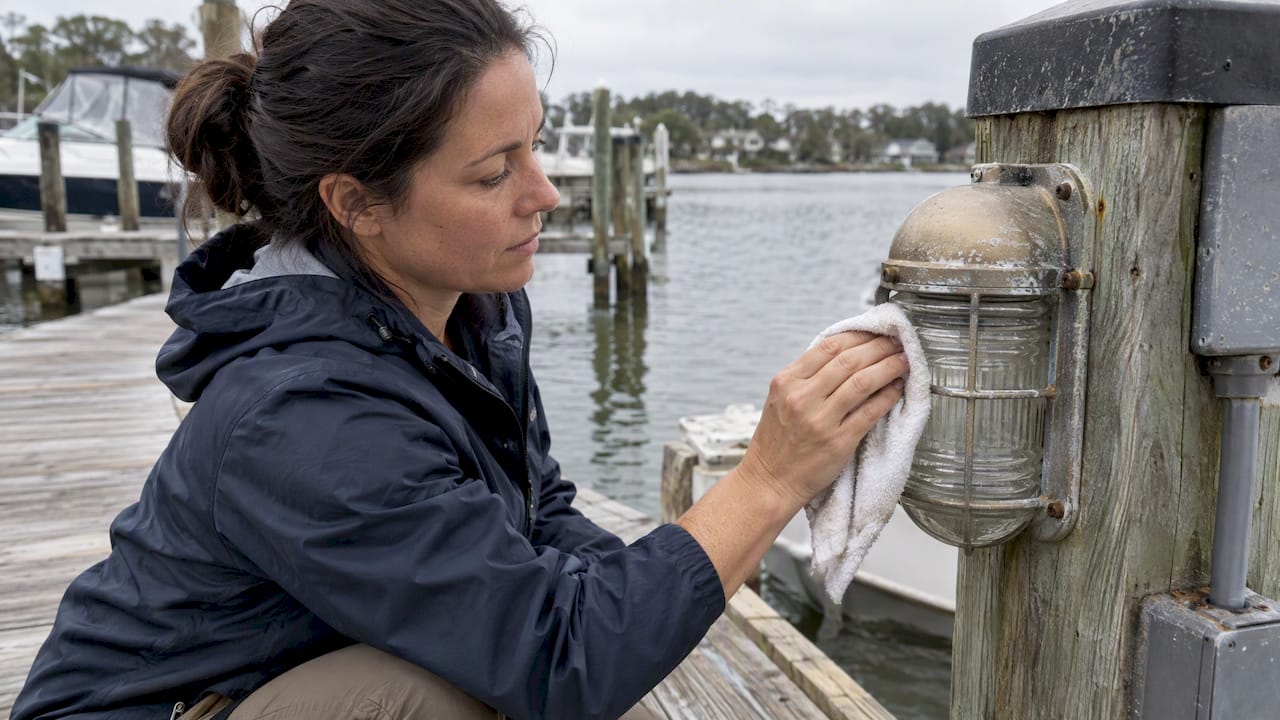
Maintenance protects your investment. Marine-grade housings, corrosion-resistant fasteners, and sacrificial anodes on metal components all extend fixture life in salt or brackish water. Salt buildup on a lens also scatters light unpredictably, so a seasonal wipe-down keeps beam control the way it was designed. For the full list of what to demand from fixture materials, our guide to coastal lighting corrosion covers the details.
That keeps the dock visible enough for safety while still cutting back on constant bright light that annoys neighbors.*
Deciding Whether To DIY Or Hire A Pro For Dock Lighting
A straightforward string of solar path lights is a reasonable weekend project. Anything involving hardwired fixtures, shared circuits, or electronics near a slip full of boats is a different category of risk.
Several factors tilt that decision toward hiring a professional:
- EMC and interference risk: verifying RTCM compliance and avoiding radio interference near antennas is not something most DIY installs account for.
- Waterproof wiring: improperly sealed connections near water create both a safety hazard and a warranty problem.
- Permitting and HOA rules: many waterfront communities require approval before you install permanent dock lighting, covered in more detail in our guide to dock lighting regulations.
- Warranty coverage: a professional install typically preserves manufacturer warranties that a DIY wiring job can void.
Cost scales with fixture class, how many linear feet of dock you are lighting, whether conduit needs to be run, and whether you add smart dimming controls. A mid-range dock lighting project in the Charlotte area typically runs $4,000 to $8,000, though your number will vary with site conditions and fixture choice.
When interviewing an installer, ask for EMC test evidence, a marine-grade spec sheet, warranty terms, and references from past dock projects. For more common pitfalls and design choices, see our dock lighting ideas guide.
How Long A Commercial Dock Lighting Project Actually Takes
Commercial dock lighting projects, whether for a marina, HOA common dock, or multi-slip property, tend to follow a predictable sequence. An initial site visit and design consultation usually comes first, where an installer maps zones, counts linear footage, and flags any fixtures that need EMC compliance because of nearby antennas or shore power equipment.
Permitting and HOA or municipal approval, when required, typically runs in parallel with final fixture selection. Lead time on marine-grade fixtures can add a few weeks if a project calls for custom color-matched housings rather than stock parts.
Physical installation for a standard multi-slip dock usually takes a few days once permits clear and materials are on site, covering conduit runs, fixture mounting, waterproof connections, and control wiring for timers or motion sensors. Larger commercial properties with multiple docks or extensive walkways take longer, particularly where conduit has to be run underwater or through existing decking.
A final walkthrough confirms beam angles, dimming presets, and zone timing before handoff. Our overview of how the permanent lighting installation process works covers the same sequence we follow across our residential and commercial projects.
Our Approach To Low-Glare Dock Lighting Projects
We prioritize BUG-rated fixtures, full shielding, and smart dimming controls on every dock project we take on, complemented by boat graphics and safety visibility upgrades for enhanced waterfront safety. Coordinating with local codes and HOA requirements is a standard part of our process, not an afterthought. We are glad to walk through a design and answer questions before you commit to anything.
— Dave
How We Can Help With Your Dock Lighting Project
We design and install marine-grade dock lighting with the same shielded, BUG-rated approach outlined above, built around climate-optimized hardware and color-matched fixtures that meet HOA and municipal standards.

What that looks like in practice:
- Custom dock lighting design matched to your waterfront layout and local rules.
- Marine-grade, corrosion-resistant fixtures built for salt and freshwater exposure.
- Smartphone-controlled dimming and zone presets so lights run only when needed.
- Ongoing upkeep through a maintenance subscription.
If you want a second opinion on your plans or a full design from scratch, our dock and waterfront lighting page has more detail, and we offer a free estimate to get started.
FAQ
What are the best interior boat lights?
The best interior boat lights are low-glare LEDs with warm color temperatures and dimming control, since bright white light inside a cabin can wreck your night vision when you step back outside. Look for fixtures rated for marine use with sealed, corrosion-resistant housings.
Can LED lights be waterproof?
Yes, LED fixtures built for marine use carry IP ratings such as IP67 or IP68, which indicate resistance to submersion and heavy water exposure rather than just splashing. For dock applications, an IP67 or higher rating is worth requiring over the lower IP65 rating common in general outdoor lighting.
What LED light is easiest on the eyes?
Warm or amber-toned LEDs in the lower color temperature range are generally easier on the eyes at night than cool white fixtures, since they scatter less and cause less disability glare. Shielded, downward-aimed fixtures with a favorable BUG rating add further comfort by keeping the light source itself out of your direct line of sight.
Are there any LED underwater boat lights available?
Underwater LED fixtures exist for docks and boats, typically used for accent lighting near the waterline or swim platforms. Any underwater fixture should carry a high IP rating for full submersion and, where boats with active electronics are nearby, documented EMC compliance to avoid radio interference.
What is RTCM 13700.0 and why does it matter for dock lighting?
RTCM Standard 13700.0 sets electromagnetic compatibility requirements for LED devices so they do not interfere with marine VHF radios, AIS, or GNSS receivers, a concern the U.S. Coast Guard has flagged for LED fixtures near antennas. It matters most for docks with slips where boats keep electronics running close to shore power or lighting circuits.
Sources
- Dock Lighting Guide | Marine LED Dock Lights
- Sea turtle lighting guidance — Florida Fish and Wildlife Conservation Commission
- Cutoff and BUG rating — Texas Department of Transportation (IES/BUG explanation)
- USCG Marine Safety Information Bulletin / RTCM 13700.0