
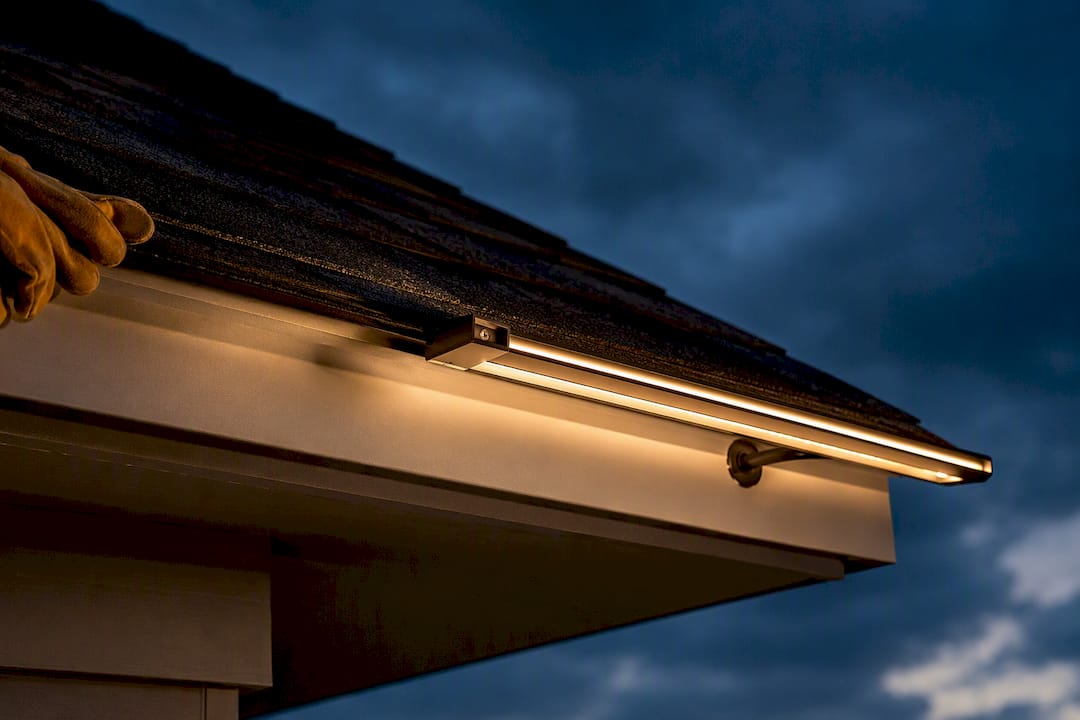
Yes, permanent roofline lighting is normally covered by both a manufacturer product warranty and an installer workmanship guarantee, but the written terms and the installer’s willingness to stand behind the job determine whether you actually get service. Before buying, homeowners should check warranty duration, exclusions, registration rules, and the claims process. Installer accountability is the single factor that decides whether a warranty is useful or just paperwork.
TL;DR:
- Homeowners should verify that the warranty covers LEDs, controllers, tracks, and connectors, and confirm whether labor is included beyond the first year.
- Exclusions such as storm damage, third-party repairs, delayed reporting, and prorated terms can invalidate claims, so asking for these in writing is essential.
- The manufacturer warranty typically covers defective components, while the installer warranty guarantees the quality of the installation, with overlap being a key factor in claim success.
- A clear, written warranty is crucial, including details on duration, transferability, registration deadlines, and claims procedures, to avoid surprises.
- “Lifetime” warranty claims are based on operating hours, not years, making realistic usage patterns and maintenance important for ensuring system longevity.
Table of Contents
- What permanent lighting warranties normally cover
- Common exclusions and real-world warranty pitfalls
- Installer workmanship vs manufacturer product warranty: who covers what
- How to evaluate and compare warranty terms before you buy
- Typical warranty lengths, expected lifespans, and what “lifetime” really means
- Forever Glow Lighting: how our warranties, lifespan estimate, and GlowCare support homeowners
- Implications of warranties on insurance claims and liability related to permanent roof lighting
- Comparison of warranty offers among leading manufacturers and installers in the permanent lighting industry
- Tips for negotiating or extending warranty terms when purchasing permanent roof lighting
- Regulatory baseline: what federal rules require before you buy
- Limitations and conditions affecting warranty validity
- Why installer-backed coverage matters
- How Forever Glow Lighting can help with warranty-backed installation
- Sources
- FAQ
What permanent lighting warranties normally cover
A written manufacturer warranty typically names specific components: LEDs or light engines, the controller that runs colors and schedules, power supplies, mounting tracks, and connectors. Some brands also cover the smartphone app or cloud features that control the system, though this varies and should be confirmed before signing anything.
Warranty length is usually expressed one of three ways: a set number of years, a number of operating hours, or the word “lifetime,” which almost always means something narrower than it sounds. Remedies also differ. Some manufacturers repair the defective part, others replace it outright, and a few offer a refund only within a short window after purchase.
- LEDs and light engines: the core light source, most often the best-covered part.
- Controllers and power kits: electronics that run colors, dimming, and app connectivity.
- Tracks and connectors: the physical mounting hardware along the roofline.
- Labor for repairs: frequently excluded or limited to the first year, so it needs separate confirmation.
The FTC requires written warranties for consumer products costing more than $15 to be clearly disclosed and available to buyers before purchase. That means you have a right to read the exact terms before you sign an installation contract, not after.
Common exclusions and real-world warranty pitfalls
Warranty language reads fine until a claim gets denied, and the denial usually traces back to an exclusion buried in the fine print. Storm damage, impact damage, and roof failures unrelated to the lighting itself are almost always carved out. So is any repair performed by someone other than the original installer or manufacturer-approved technician.
- Storm and impact damage: hail, falling branches, and wind events are typically excluded from product warranties.
- Third-party repairs: having another contractor touch the system can void remaining coverage.
- Delayed reporting: waiting months to report a defect can be treated as neglect rather than a covered failure.
- Prorated coverage: many warranties shift to parts-only, prorated terms after the first few years.
Watch for dispatch or “trip” fees too. Some installers charge a service call fee even when the underlying part is still under warranty, which turns a “free” repair into an unexpected bill.
Pro Tip: Ask for the exclusion list in writing, not a verbal summary, since the exact wording is what a claims department will reference.
Installer workmanship vs manufacturer product warranty: who covers what
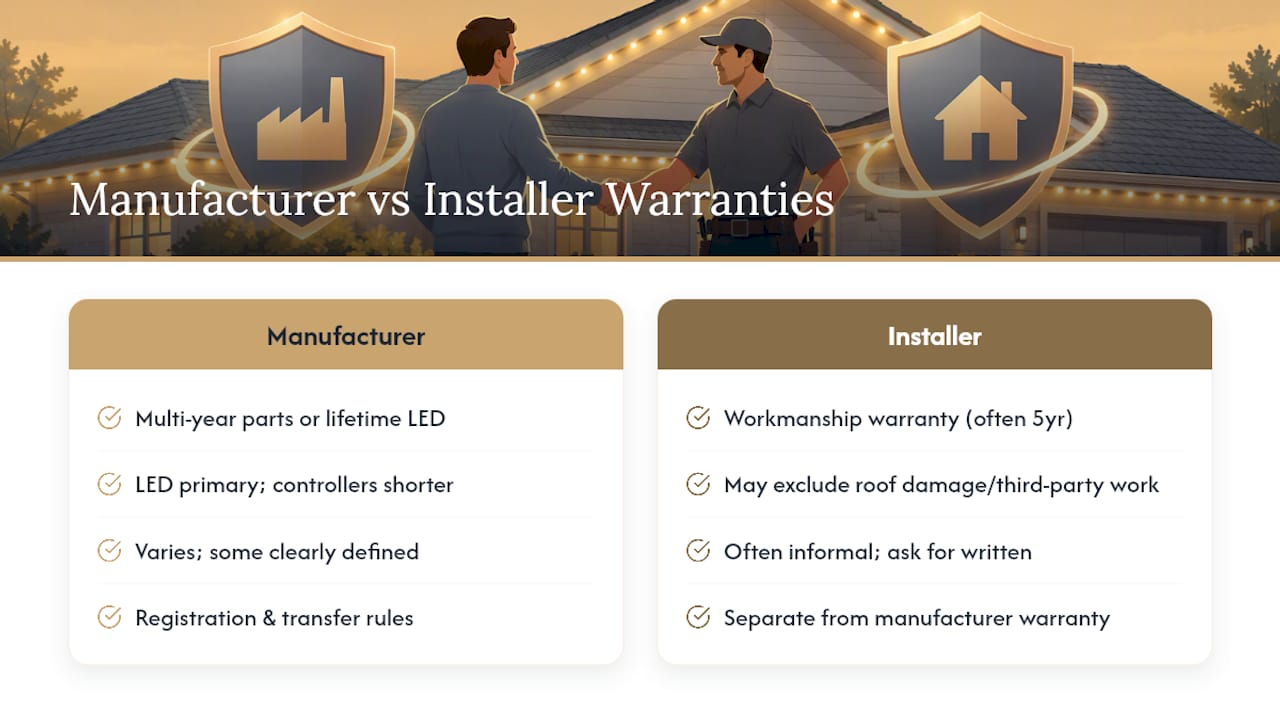
These are two separate promises, and confusing them is where most disputes start. The manufacturer warranty covers defective parts. The installer’s workmanship warranty covers the quality of the labor: whether the tracks were mounted correctly, wiring was sealed properly, and the system was configured to spec.
- Manufacturer warranty: covers defective components, rarely includes labor after the first year.
- Installer workmanship warranty: covers installation quality, typically running one to several years.
- Overlap risk: a failure blamed on “improper installation” lets the manufacturer deny the claim, leaving the installer’s workmanship warranty as the only recourse.
Installer warranties often limit labor coverage after the first year and may exclude roof-related failures or damage caused by third-party roof work. A single installer who accepts responsibility for both the hardware and the labor removes the guesswork over whom to call when something fails.
How to evaluate and compare warranty terms before you buy
Before signing anything, ask to see the exact written warranty rather than accepting a sales pitch about coverage. A short checklist keeps the conversation focused on what actually matters.
- Confirm the warranty is written and available before purchase, not promised verbally.
- Check whether it’s labeled “full” or “limited,” since that designation changes your legal remedies.
- Ask when coverage starts: installation date or purchase date can differ by weeks.
- Confirm whether labor is included or billed separately after year one.
- Ask about registration requirements and deadlines, plus whether coverage transfers to a new homeowner.
- Get the claims process in writing: who to call, what documentation is needed, and the response window.
| What to check | Why it matters |
|---|---|
| Full vs limited designation | Changes what remedies you’re legally entitled to |
| Registration deadline | Missing it can void coverage entirely |
| Labor inclusion | Determines if repairs are free or billed by the hour |
| Transferability | Affects resale value and buyer confidence |
Keep photos of the installed system, copies of the warranty document, and any correspondence with the installer. Federal regulations implementing Magnuson-Moss require that written warranties disclose coverage, who is covered, duration, and the procedure to obtain service, so a legitimate warranty should already spell out that process. For a broader pre-purchase checklist, see this landscape lighting checklist for homeowners.
Typical warranty lengths, expected lifespans, and what “lifetime” really means
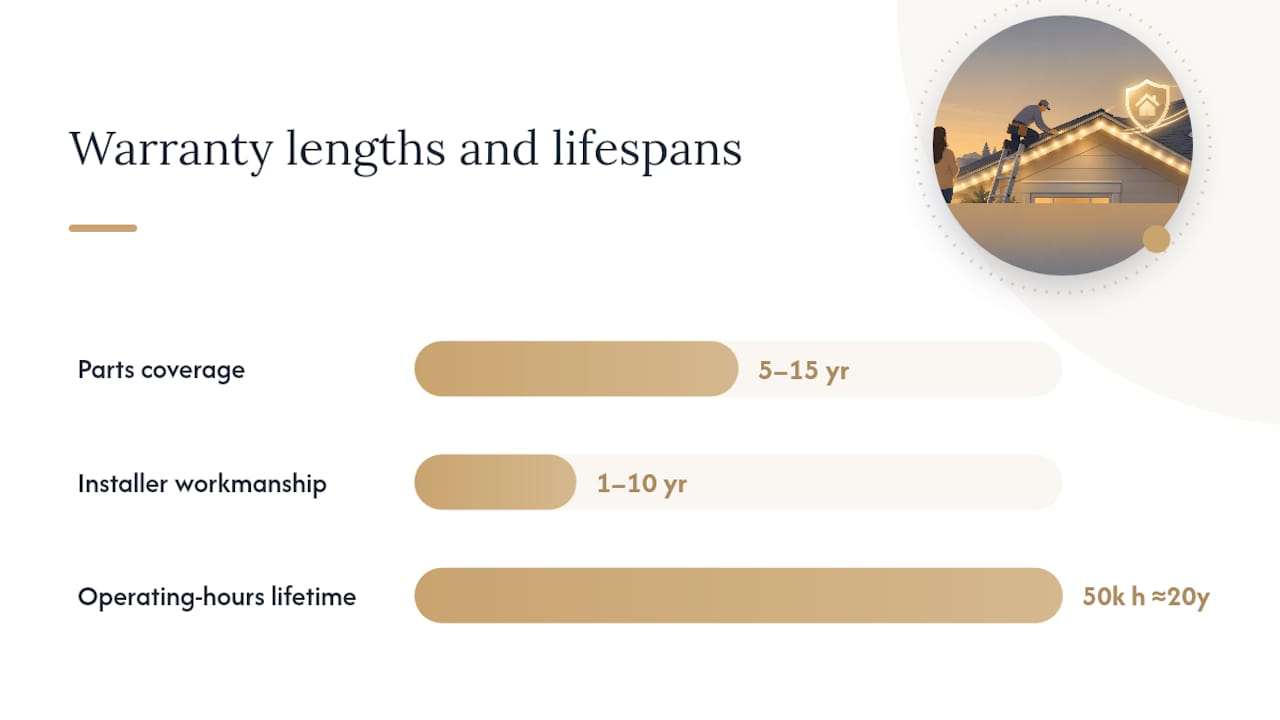
Parts coverage on permanent lighting systems commonly runs five to fifteen years, while installer workmanship terms are usually shorter, often one to ten years. “Lifetime” claims are the trickiest, since manufacturers define them by tested operating hours rather than calendar years.
Some lighting manufacturers define “lifetime” by testing hours, such as 50,000 hours equaling roughly 20 years at 7 hours a day, and pair that with a separate parts warranty for other components. That conversion depends entirely on how many hours a day the system actually runs, so a homeowner who runs lights nightly year-round will hit that hour count faster than someone who uses them seasonally.
Maintenance and climate exposure both affect real-world lifespan. Salt air, extreme heat, and infrequent cleaning of connectors can shorten a system’s useful life regardless of what the warranty document promises.
Forever Glow Lighting: how our warranties, lifespan estimate, and GlowCare support homeowners
Forever Glow Lighting documents a 22-year lifespan estimate at 6 hours of nightly use for its installed systems, a figure based on typical homeowner usage patterns rather than a generic industry claim. That kind of documented estimate gives homeowners a realistic planning number instead of a vague “lifetime” label.
Maintenance subscriptions can keep systems inspected and functioning, which also supports smoother warranty claims since service history is already on file. Our installation process includes photo documentation of roof condition and clear registration guidance, so homeowners aren’t left digging for paperwork if a claim comes up later. When the same party handles both the equipment and the labor, there’s typically one point of contact for warranty questions instead of a manufacturer and installer pointing at each other.
Implications of warranties on insurance claims and liability related to permanent roof lighting
Permanent lighting sits at an odd intersection between a home improvement and an electrical system attached to your roof, which means warranty terms can affect more than just repair costs. If a system is damaged in a storm, your homeowner’s insurance policy, not the lighting warranty, is typically the first line of coverage, since manufacturer warranties almost universally exclude storm and impact damage.
Liability gets murkier when a system contributes to a roof leak or an electrical issue. A workmanship warranty that explicitly covers installation quality gives you a documented party to hold responsible if faulty mounting caused water intrusion, which matters when filing a homeowner’s insurance claim that may ask who performed the work and whether it was warrantied. Without that documentation, an insurer may treat the damage as a maintenance failure rather than a covered event.
This is also where installer accountability pays off in a way that’s easy to overlook. If a manufacturer denies a parts claim by citing “improper installation,” a homeowner without a workmanship guarantee has no one to turn back to. A written workmanship warranty creates a paper trail that can support both a repair claim and, if needed, a conversation with your insurance adjuster about who bears responsibility for damage tied to the installation itself. Keeping the warranty document, installation photos, and any correspondence together makes that conversation far simpler.
Comparison of warranty offers among leading manufacturers and installers in the permanent lighting industry
Warranty language varies enough across the permanent lighting industry that comparing two offers side by side often reveals very different levels of actual protection. Some manufacturers publish a straightforward multi-year parts warranty with clear remedies, while others use “lifetime” language that only applies to the LED itself and leaves controllers or power kits under a much shorter term.
Manufacturer warranty pages and installer warranty statements vary widely, making it necessary to compare exact written warranty text to understand buyer remedies and obligations. One brand’s warranty page, for example, defines its “lifetime” light warranty by testing hours alongside a separate multi-year parts term and explicit registration and transfer rules, a structure worth using as a benchmark when evaluating any other manufacturer’s terms.
Installer-side comparisons matter just as much as manufacturer comparisons. Some installers offer a five-year workmanship warranty but exclude any damage tied to roof failure or third-party roof work performed after installation. Others fold workmanship coverage into a maintenance subscription, which keeps the system inspected regularly and can catch small issues before they become warranty disputes. When comparing quotes, ask each installer for their workmanship warranty in writing and compare it against the manufacturer’s parts warranty for the same system, since a strong manufacturer warranty paired with a weak or informal installer guarantee still leaves labor costs exposed.
Tips for negotiating or extending warranty terms when purchasing permanent roof lighting
Warranty terms are often more flexible than the printed page suggests, particularly with a local installer who wants repeat business and referrals. Asking directly whether workmanship coverage can be extended, especially when bundled with a maintenance subscription, is a reasonable question at the quote stage rather than after the contract is signed.
- Ask if a maintenance subscription extends or strengthens the workmanship warranty term.
- Request labor coverage be included for a longer period than the standard first year.
- Ask whether multiple services booked together, such as roofline and patio lighting, qualify for combined warranty terms.
- Get any verbal warranty extension added to the written contract before signing.
Bundling services can also work in a homeowner’s favor. An installer handling both architectural lighting and roofline systems may be more willing to extend workmanship terms across the whole project rather than treating each installation separately. It never hurts to ask, since the cost of extending a warranty by a year or two is often small compared to the cost of an uncovered repair.
Regulatory baseline: what federal rules require before you buy
Federal rules set a floor for what any written warranty on permanent lighting has to disclose, and knowing this baseline helps you spot a document that falls short. The FTC’s Businessperson’s Guide to Federal Warranty Law explains the pre-sale availability rule and the required ‘full’ versus ‘limited’ designation that sellers must use.
The Magnuson-Moss Warranty Act, implemented through federal regulations, requires that a written warranty disclose who is covered, what’s covered, the duration, and the exact procedure for obtaining service. If an installer or manufacturer can’t produce a document meeting those basics, that’s a warning sign worth taking seriously before signing a contract.
Limitations and conditions affecting warranty validity
Most warranties come with maintenance expectations attached, even when they aren’t spelled out clearly at the point of sale. Skipping recommended cleaning of connectors, ignoring a flickering section for months, or letting debris build up around tracks can all be cited as neglect if a claim is filed later.
Environmental exposure plays a role too. Coastal salt air, extreme heat, and heavy storm seasons all accelerate wear on connectors and seals, which is part of why some warranties specify climate-related conditions or recommend professional inspection on a set schedule. Homeowners who keep up with basic upkeep and document it, even informally with photos or service records, put themselves in a much stronger position if a warranty dispute ever comes up. For background on how installation quality intersects with warranty terms more broadly, this construction warranty explainer for property owners is a useful outside reference.
Why installer-backed coverage matters
The gap between a warranty that reads well and one that pays out almost always comes down to whether a single party accepts responsibility for both the equipment and the labor. Manufacturers deny “improper installation” claims routinely, which is exactly why a documented workmanship guarantee matters more than most homeowners expect at the point of sale. Ask for it in writing before you sign anything.
— Dave
How Forever Glow Lighting can help with warranty-backed installation
Choosing an installer who stands behind both the hardware and the labor means you’re not stuck mediating between two companies when something goes wrong. Some installers design and install permanent roofline systems with documented installation notes and registration guidance built into the process, so a warranty claim starts with paperwork that already exists rather than one you have to track down months later.
- Permanent roofline and holiday lighting with documented installation records.
- Maintenance subscription options for ongoing inspection and support.
- Landscape, architectural, and patio lighting installed and warrantied by the same team.
- Coordinated service calls so homeowners have one contact for repairs.
If you want a system backed by clear workmanship terms and a maintenance plan that keeps it running, request a free estimate on permanent lighting installation and ask about GlowCare when you do.
Sources
- Businessperson’s Guide to Federal Warranty Law | Federal Trade Commission
- Warranties | Consumer Advice
- PART 701—DISCLOSURE OF WRITTEN CONSUMER PRODUCT WARRANTY TERMS AND CONDITIONS
FAQ
How much do permanent roof lights cost?
Pricing for permanent roofline lighting depends on roof size, system type, and installer, and Forever Glow Lighting does not publish flat rates since every project is quoted individually. Contact an installer directly for a free estimate based on your specific property.
Are permanent lights covered under warranty?
Yes, most permanent lighting systems carry both a manufacturer product warranty for components and a separate installer workmanship warranty for the labor. Coverage details, including duration and exclusions, vary by brand and installer, so reviewing the written warranty before purchase is the only reliable way to know what’s included.
What are people saying about Forever Glow Lighting’s permanent lighting?
Forever Glow Lighting reports a 22-year lifespan estimate at 6 hours of nightly use for its installed systems, based on typical homeowner usage. Public reviews and ratings for local availability are best checked directly with the company, as they aren’t published in this article.
What is the typical warranty period for LED lights?
Parts warranties on LED lighting components commonly run five to fifteen years, while workmanship warranties from installers typically last one to ten years. Some manufacturers use “lifetime” language instead, which is usually defined by operating hours rather than a fixed calendar term.