
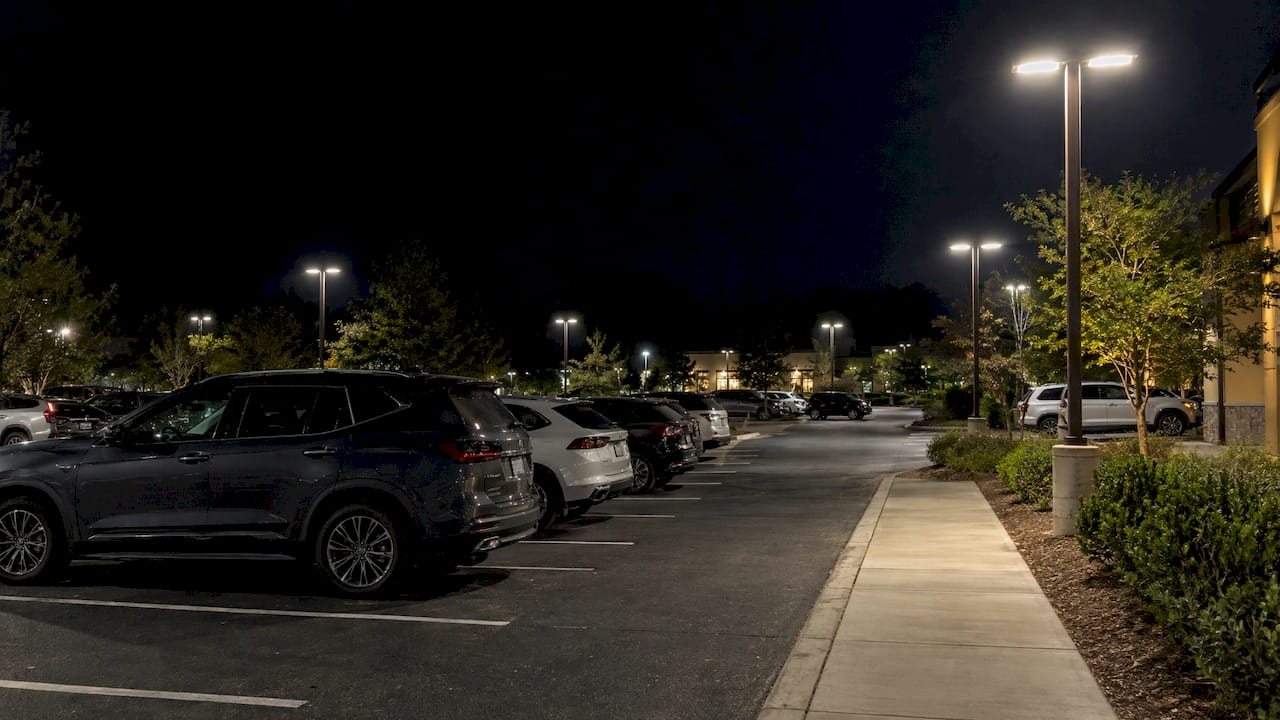
Most open parking lots are designed to an average of about 1 foot-candle, or 2.5 foot-candles where security is a concern. The lowest allowed reading at any point is far smaller, around 0.2 to 0.5 foot-candles. The Illuminating Engineering Society (IES) publishes these targets, and your design is only as good as the point-by-point layout that proves them. If you manage a commercial property in Charlotte, the sections below give you the numbers to ask for and the checks that decide whether a lot is safe, even and compliant. We install commercial exterior lighting in the Charlotte area, and we design it around those targets and local rules.
TL;DR
- IES guidance for open lots starts at a minimum of 0.2 foot-candles (basic) and 0.5 foot-candles (enhanced security), with preliminary average targets of 1 and 2.5 foot-candles.
- One foot-candle is one lumen per square foot, roughly 10 lux. Light levels are measured on the pavement, not counted in fixture lumens.
- Uniformity matters as much as brightness: a lot with a bright average and dark pockets still fails.
- Vertical light at 5 ft above the ground is what lets you recognize a face, so security areas are checked for it.
- IES now folds parking guidance into RP-8-25 (2025), and many municipal codes still cite RP-20, so confirm which edition your project follows.
Table of Contents
- What a foot-candle measures
- IES parking lot light levels by lot type
- Why the average is not enough
- What changed: RP-20, RP-8 and your code
- Charlotte-specific checks
- How to specify parking lot lighting levels
- Where the lot meets the building
- Our perspective
- Plan your lot lighting with us
- FAQ
- Sources
What a foot-candle measures
Illuminance is the light that actually lands on a surface. In the United States it is measured in foot-candles (fc), defined by the Department of Energy as one lumen per square foot, about 10 lux. A fixture’s lumen rating tells you how much light leaves it, in every direction. The foot-candle reading tells you what reaches the asphalt.
That is why two lots with identical fixtures can look completely different. Pole height, spacing, beam pattern and surface color all change what lands on the ground. Ask for foot-candle targets in your specification and treat lumen counts as a fixture detail.
Two measurements are used:
- Horizontal illuminance: light on the pavement. This is the main number for driving and walking.
- Vertical illuminance: light on an upright surface, such as a person or a door, measured 5 ft above the ground. This is what makes faces and movement visible.
IES parking lot light levels by lot type
The IES recommendations most often quoted for open lots come from RP-20. The DOE’s federal parking lot guide summarizes IES RP-20-98 as follows:
| Lot category | Minimum horizontal | Max:min ratio | Minimum vertical | Preliminary average |
|---|---|---|---|---|
| Basic | 0.2 fc | 20:1 | 0.1 fc | 1 fc |
| Enhanced security | 0.5 fc | 15:1 | 0.25 fc | 2.5 fc |
The later RP-20-14 revision keeps the same minimums (2 lux and 5 lux) and ratios. It also adds a visibility-based approach that recognizes how differently concrete and asphalt reflect light, and it introduces lighting zones, so minimum levels drop in rural settings and rise toward city business districts.
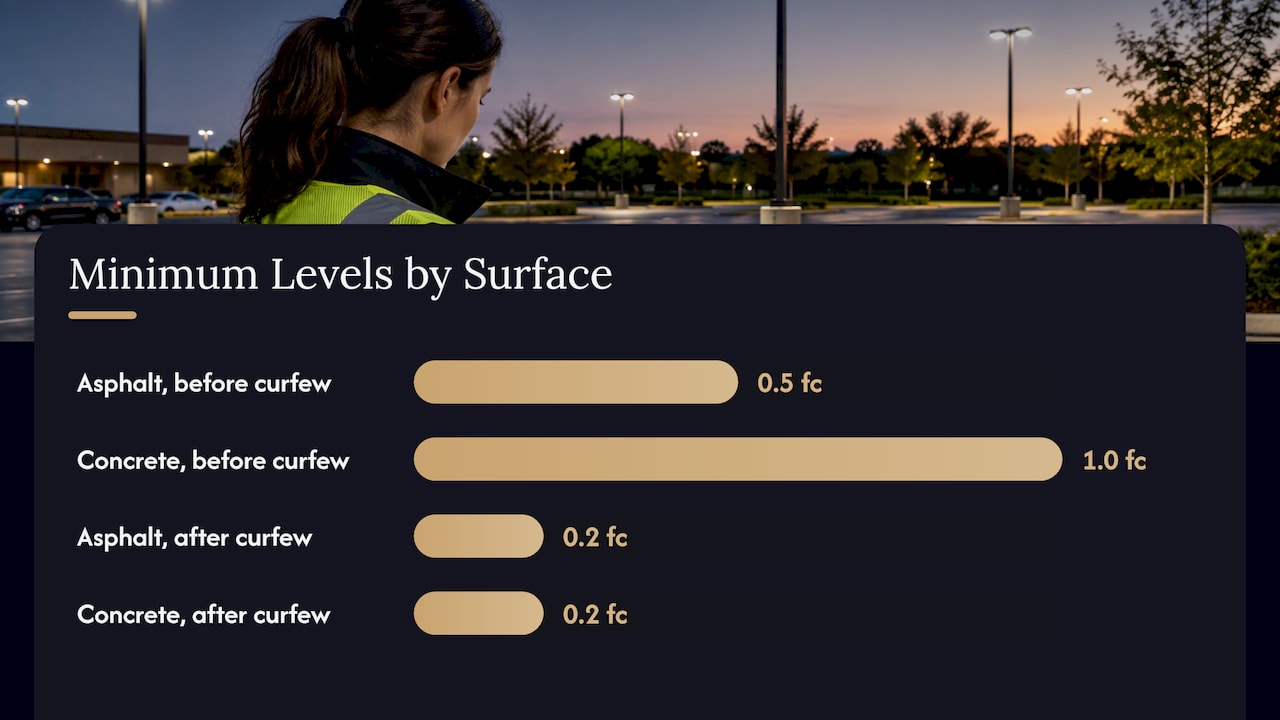
The surface matters in practice. A university-hosted summary of RP-20-14 values lists asphalt at 0.5 fc minimum horizontal before curfew and 0.2 fc after, while concrete is listed at 1.0 fc before curfew and 0.2 fc after. Dark asphalt needs more light than pale concrete to look equally bright to a driver.
Higher-risk and higher-traffic areas
Payment points, entrances and vehicle access control are usually held to a higher standard than the stalls. IES security guidance (G-1-16), as noted in the RP-20-14 preview, recommends an average of 3 fc on pavement in open lots where security is an issue, and 6 fc on sidewalks and footpaths around them, each with a 4:1 average-to-minimum ratio.
Covered parking runs higher. The Lighting Design Lab foot-candle guide lists 5 fc average for covered parking, with a 1 fc minimum. For medium-activity open lots it lists 1.5 fc average in an urban lighting zone and 1.0 fc in a suburban one.
A quick way to place your lot
- Low-activity lot (office after hours, small retail, no known security issues): basic category, 0.2 fc minimum.
- Busy retail, restaurant, medical or event lot: enhanced security, 0.5 fc minimum and a 2.5 fc preliminary average.
- Entrances, payment points, walkways to the building: higher targets, up to the 3 fc average that IES security guidance gives for open lots with security concerns.
Your insurer, municipality or lease may set a different target, so confirm it before design begins.
Why the average is not enough
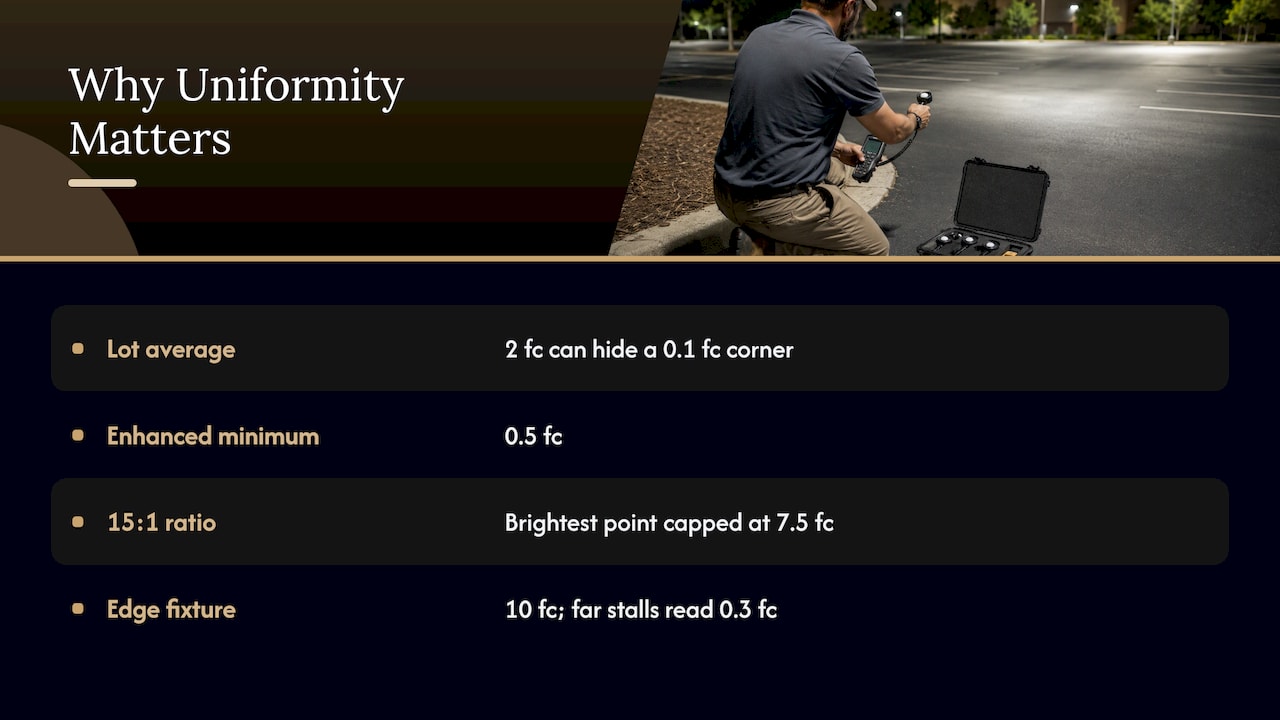
An average of 2 fc can hide a corner at 0.1 fc. That is why every IES target comes with a uniformity ratio, the brightest point divided by the dimmest. The RP-20-98 history notes that a ratio above about 15:1 tends to make the minimum areas look dark.
Here is a worked example. Suppose a lot is designed for an enhanced-security minimum of 0.5 fc with a 15:1 maximum-to-minimum ratio. The brightest reading anywhere cannot exceed 7.5 fc. Put a fixture too close to the building edge and the area under it may read 10 fc while the far stalls read 0.3 fc. The average looks fine, but both ends of the lot fail.
Uniformity depends mostly on the light distribution of the fixture. The DOE explains that a batwing distribution sends more light to wide angles and allows wider spacing with more even ground lighting. A distribution with its peak straight down can meet the average but fail uniformity. The same guide warns that swapping fixtures one for one may not hit specific levels and ratios.
Vertical light and glare
Vertical illuminance is the factor most often skipped. The DOE guide points out that the pavement is not what a driver sees when entering a lot, so lighting signs, walls and landscape features makes the site feel brighter and more inviting. For security areas, RP-20 pairs the horizontal minimum with a vertical minimum at 5 ft: 0.25 fc for enhanced security.
Glare is the other side of it. The UC Davis and National Park Service retrofit guide recommends shielding or reflectors to cut glare and obtrusive light, motion-sensing adaptive luminaires, and matching the lot entrance level to the surrounding public lighting.
What changed: RP-20, RP-8 and your code
If you read an older spec, you will see RP-20. The IES now publishes ANSI/IES RP-8-25, Lighting Roadway and Parking Facilities, released May 14, 2025. IES says the update covers changes to light loss factors, luminance versus illuminance, calculation precision and obtrusive light.
In practice, you may meet three situations:
- A city code cites RP-20-14 by name, so the plan is checked against those values.
- A designer works to the newer RP-8 framework, which sets minimum maintained levels by lighting zone.
- A corporate or franchise standard sets its own target, often higher than the IES minimum.
Ask the designer which edition the layout targets and request that it also shows the values your reviewer expects. Light loss factors matter here: levels are “maintained” values, meaning what the lot still delivers after fixtures age and collect dirt. A design that only hits its number on day one will drift below it.
Charlotte-specific checks
In Charlotte, the question is not only how much light the lot needs but how much may spill off it. The Charlotte Unified Development Ordinance sets a maximum of one foot-candle at the lot line for sign illumination, and requires sign lighting to be shielded and directed so it does not cast glare on rights-of-way or neighbors. Lot lighting and sign lighting often share the same poles and circuits, so plan them together. We cover the permit side in our Charlotte exterior lighting ordinance guide.
HOA-managed commercial and mixed-use communities add their own rules about color, brightness and shielding. Settle those before fixtures are ordered, not after.
How to specify parking lot lighting levels
A good brief to a lighting contractor is short and specific. Include:
- Lot category: basic, enhanced security, or a mix by zone.
- Targets in foot-candles: minimum horizontal, vertical at 5 ft where security matters, and the uniformity ratio.
- Surface: asphalt or concrete, since reflectance changes the result.
- Lighting zone and curfew hours: many sites dim after closing, and post-curfew minimums are lower.
- Edge limits: the lot-line limit and any shielding requirement from the city or HOA.
- Deliverable: a point-by-point layout showing every number, not an average alone.
The UC Davis retrofit guide recommends modeling all designs in computer-based software to validate light levels and uniformity, and that is the standard we would expect of any commercial design. Our article on photometrics in commercial LED retrofits lists the questions to ask before approving one.
What about “how many lumens”?
There is no single lumen figure for a lot. The total depends on area, target foot-candles, pole height, distribution and how much light falls beyond the boundary. Specify foot-candles, and let the layout determine how many lumens, and how many poles, it takes.
The “5’7” rule"
There is no IES parking lot rule by that name. The nearest real thing is the 5 ft height at which vertical illuminance is measured, which stands in for a person’s face.
Where the lot meets the building
A lot is rarely lit alone. Walkways, entries, signage and the building face are part of what a driver and a pedestrian see. Light on the facade and entrance gives the vertical surfaces the DOE guide describes, and it makes the approach from the stalls feel clear. See our ideas for commercial facade lighting at night and our guide to permanent lighting for commercial buildings.
Our perspective
Property managers often ask us what number their lot needs. The honest answer is a set of numbers: a minimum, a ratio, a vertical reading and a limit at the property line. Any one of them alone can mislead.
Our commercial exterior lighting is built from commercial-grade, climate-optimized hardware with smart controls, and designed for the strict HOA and municipal compliance that Charlotte properties face. We pair that with a climate-specific warranty and the GlowCare maintenance subscription, because a lighting level only counts if the system keeps delivering it.
Whatever the target is, ask for it in foot-candles, on paper, point by point. That is the version of the plan that protects your tenants and your approvals.
Dave
Plan your lot lighting with us
If you manage a commercial property in the greater Charlotte area, our team designs and installs exterior lighting for commercial and municipal sites, with smart controls and weather-ready hardware. Tell us the lot, the surface and the security needs, and we will work from there. See our permanent lighting for commercial buildings page, or contact us for a free estimate.
Maintenance keeps the numbers honest over time. Our GlowCare maintenance subscription is part of how we support systems after installation.
FAQ
What is the recommended foot-candle level for a parking lot?
For basic open lots, IES RP-20 recommends a minimum of 0.2 fc, and 0.5 fc for enhanced security. Preliminary average targets are 1 fc and 2.5 fc, according to the DOE’s federal guide. Entrances and payment areas are usually held to higher levels.
How many lumens does a parking lot need?
There is no fixed number. The total depends on lot area, the foot-candle target, pole height and fixture distribution. A designer works backward from foot-candles and confirms the result with a point-by-point layout.
Is IES RP-20 still current?
IES now publishes parking guidance within RP-8-25, released in 2025. Many local codes and older specifications still cite RP-20, so confirm which edition your project follows.
How much light can spill past my property line in Charlotte?
Charlotte’s ordinance limits sign illumination to one foot-candle at the lot line and requires shielding against glare. Check the city’s exterior lighting rules and any HOA requirements before finalizing a design.
Sources
- Guide to FEMP-Designated Parking Lot Lighting, U.S. Department of Energy
- Lighting for Parking Facilities, IES RP-20-14 preview
- Outdoor lighting values summary, SEDAC
- Footcandle Light Guide, Lighting Design Lab
- NPS Outdoor Lighting Retrofits Guide, UC Davis
- ANSI/IES RP-8-25, Lighting Roadway and Parking Facilities