
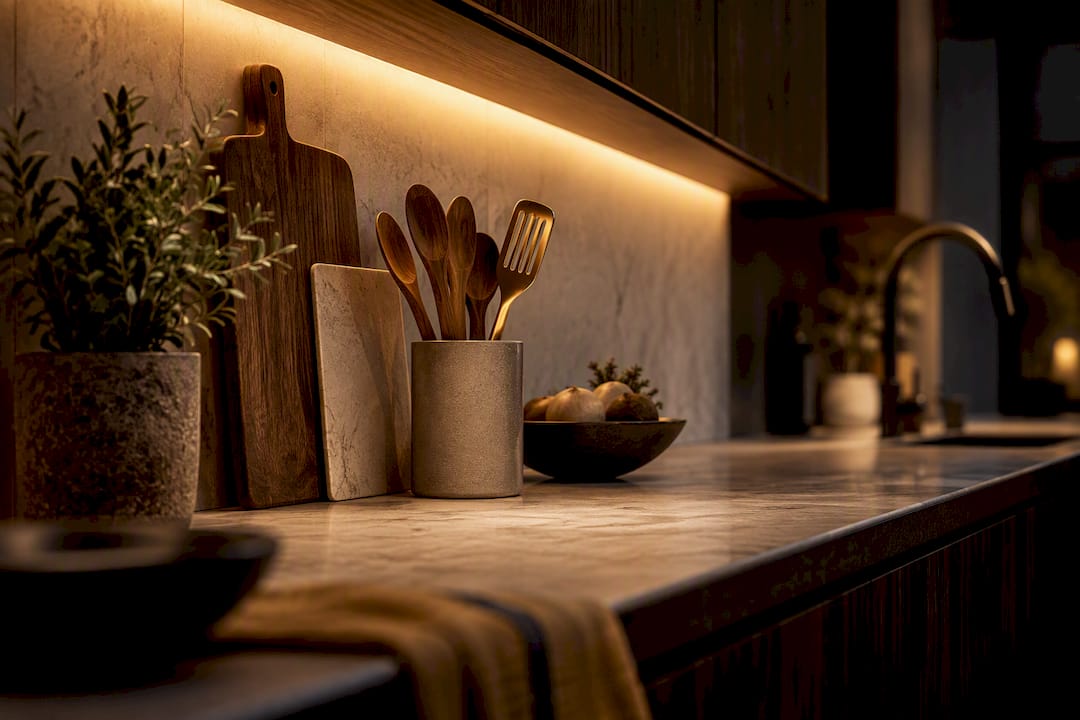
For most kitchens, warm white in the region of 3000K with a CRI of 90 or higher is considered the safest under cabinet lighting color temperature. Go warmer, to 2700K, for dark wood cabinetry, and reserve 3500K to 4000K for stainless steel or task-first kitchens. Before buying anything, check the product spec sheet for its Kelvin rating and CRI score. If either number is missing or unclear, look for a fixture with selectable or tunable CCT instead.
TL;DR:
- Most kitchens should use lighting with a color temperature of 3000K or higher CRI 90 for accurate color rendering, especially with mixed finishes.
- Dark wood cabinets look best under 2700K to 3000K warm white lights, while stainless steel and white surfaces pair well with 3500K to 4000K neutral to cool tones.
- Testing a sample fixture with selectable CCT before installation helps ensure the lighting matches your specific materials and desired ambiance.
- CRI 90 or above is essential for vibrant food, wood, and cabinet colors, with R9 specifically important for red tones in food and finishes.
- Professional installation ensures flicker-free, evenly diffused light, proper driver and dimmer compatibility, and an overall tailored lighting system.
Table of Contents
- Understanding Color Temperature Bands for Kitchen Lighting
- Matching Light Color to Your Cabinets and Countertops
- Why CRI Matters as Much as Kelvin
- Tunable and Selectable CCT: The Flexible Middle Ground
- Choosing the Right Fixture and Mounting Position
- Best Color Temperature by How You Use Your Kitchen
- Common Under Cabinet Lighting Mistakes to Avoid
- When a Professional Install Makes the Difference
- Energy Efficiency and Color Temperature
- How Kitchen Lighting Color Affects Sleep and Daily Rhythm
- Why 3000K Is the Default Most Homeowners Should Start With
- Get Under Cabinet Lighting Installed Right the First Time
- Sources
- FAQ
Understanding Color Temperature Bands for Kitchen Lighting
Kelvin numbers on a lighting box aren’t marketing fluff. They tell you exactly how the light will feel once it’s mounted under your cabinets and hitting your countertop every day.
Warm white typically ranges from about 2700K to 3000K, evoking the cozy, soft feel of traditional incandescent bulbs. Neutral white ranges approximately from 3500K to 4000K, providing a balanced, clean light similar to daylight without feeling clinical. Cool white begins around 4000K and higher, producing a crisp and bright glow often used in commercial or task-focused settings, which many homeowners find less suitable for kitchen counters.
Here’s how those bands typically show up on product listings, and where you’ll see them used:
- 2700K: Very warm, amber-tinted light common in living rooms and traditional kitchens with wood-heavy palettes.
- 3000K: The dominant residential choice, warm but clear enough for food prep. Many designers consider 3000K to 3500K the safest all-purpose under-cabinet range, which is why it shows up so often in remodel guides.
- 3500K: A transitional tone, neutral enough for modern kitchens but still forgiving on skin tone and wood grain.
- 4000K: Bright and functional, favored in kitchens built around heavy-duty cooking rather than ambiance.
Once you know which band you’re shopping in, matching it to your cabinets and counters gets a lot easier.
Matching Light Color to Your Cabinets and Countertops
Your finishes should drive the Kelvin decision more than personal taste alone, because the wrong temperature can make expensive materials look cheap or dull.
Wood and darker cabinetry generally look best under 2700K to 3000K light. Warm white in that range flatters wood grain and creates the cozy, residential feel most homeowners want, pulling out the reds and golds in cherry, walnut, or oak instead of washing them out. Cool light on wood cabinetry tends to make the finish look gray or lifeless, almost like it’s under fluorescent office lighting.
White or cool-toned stone countertops need a bit more caution. Quartz and marble with blue or gray undertones can pick up an unwanted cream or greenish cast under warm 2700K bulbs. Staying in the 3000K to 3500K range usually keeps whites looking clean without drifting into a yellow tint.

Stainless steel appliances and modern all-white kitchens generally pair best with 3500K to 4000K. That neutral-to-cool light matches the crispness of the materials and avoids the muddy look that warmer bulbs can create against brushed metal.
Pro Tip: Buy one sample strip with selectable CCT before committing to a full run. Tape it under a cabinet for a weekend, cook a few meals under it, and see how your specific countertop and cabinet combination actually reads at night versus during the day.
Since palettes vary so much from kitchen to kitchen, testing beats guessing almost every time.
Why CRI Matters as Much as Kelvin
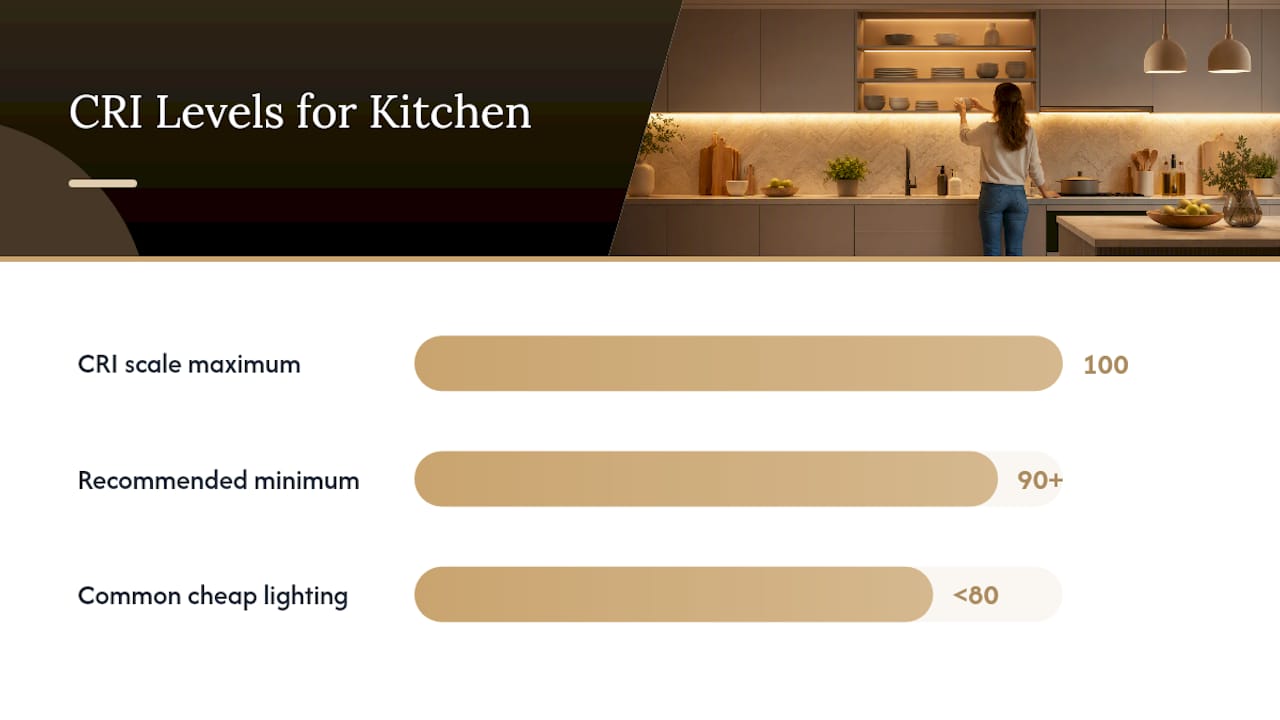
Color Rendering Index, or CRI, measures how accurately a light source shows the true colors of what it’s illuminating, on a scale from 0 to 100. A bulb can have the perfect Kelvin rating and still make your food, cabinets, and countertops look off if the CRI is low.
A CRI of 90 or higher is generally recommended for kitchen fixtures to ensure accurate and vibrant color rendering. Anything below 80, which is common in cheap big-box strip lighting, tends to mute reds and oranges, the exact tones that make tomatoes, strawberries, and cooked meat look appetizing. That’s where R9 comes in: it’s a specific sub-score within the CRI test that measures red rendering accuracy, and it’s worth asking about R9 specifically when color fidelity matters for food or wood finishes.
CRI has limits, though. It only averages performance across eight reference colors, so two bulbs with the same CRI score can still render certain hues differently. Lighting designers increasingly reference TM-30, a newer metric from the Illuminating Engineering Society that reports both fidelity (Rf) and color saturation (Rg) for a fuller picture. Homeowners don’t need to chase TM-30 data, but it’s worth knowing the term exists if you’re working with a designer or comparing high-end fixtures.
Before buying, run through this checklist:
- Confirm the listing states CRI 90+, not just “high CRI.”
- Ask the manufacturer or installer about R9 if food color accuracy matters to you.
- Skip any fixture that doesn’t publish a CRI number at all.
Tunable and Selectable CCT: The Flexible Middle Ground
If you can’t decide between warm and neutral, you don’t have to. Selectable and tunable-white fixtures solve that problem by letting you change the Kelvin output after installation instead of locking it in at purchase.
Selectable CCT fixtures come with a handful of fixed presets, typically 2700K, 3000K, 3500K, and 4000K, chosen with a small switch on the driver or fixture itself. Tunable white goes further, allowing continuous adjustment across a range, often controlled through an app or a compatible smart dimmer. Both options are commonly recommended for future-proofing kitchens that serve multiple uses, since your needs at 7 a.m. prep time look different from what you want during a dinner party.
Control methods vary by product:
- Simple toggle switch: Basic on/off with a fixed Kelvin, no flexibility after install.
- Compatible dimmer: Adjusts brightness only, unless paired with a tunable driver, so confirm compatibility before wiring.
- Smart driver with app or voice control: The most flexible setup, letting you shift both brightness and color temperature from a phone, though it usually requires a dedicated driver and sometimes a neutral wire.
Pro Tip: If your kitchen has an open floor plan connecting to a living or dining area, tunable white is worth the extra cost. It lets you match your under-cabinet lighting to whatever ambient lighting scheme is running elsewhere in the room, rather than fighting a fixed mismatch every evening.
Selectable CCT fixtures also work as an affordable compromise when a full tunable system isn’t in the budget or the existing wiring can’t support one.
Choosing the Right Fixture and Mounting Position
The fixture type and mounting position matter just as much as Kelvin and CRI, because a poorly placed light source can undercut even the best color temperature.
Linear LED strips housed in an aluminum channel with a frosted diffuser give the most even, dot-free wash across a countertop. Mounting the channel behind the cabinet’s front lip, rather than flush against the back wall, eliminates the harsh shadow line that shows up on backsplashes when light is placed too far back. LED bars are a solid choice for full remodels where hardwiring is already planned, since they integrate cleanly into new cabinetry. Puck lights are better reserved for accent purposes or very short runs. Spaced out across a full counter, they tend to create visible hot spots rather than a continuous glow.
A few placement rules are worth following on every install:
- Offset the fixture about 1 to 2 inches from the front face of the cabinet to avoid shadowing the backsplash.
- Choose a frosted or opal diffuser lens over a clear one to prevent visible individual LED dots.
- Confirm the driver and any dimmer switch are rated as compatible before finalizing the purchase, since mismatched components cause flickering or buzzing.
- For long runs, check that the manufacturer specifies tight color binning, since inconsistent binning can cause visible color shifts along a single strip, even within the same product line.
Readers weighing fixture types in more depth can find a full breakdown of strip, bar, and puck options in Forever Glow Lighting’s guide to dot-free under cabinet lighting.
Best Color Temperature by How You Use Your Kitchen
The right Kelvin rating often comes down to what your kitchen is actually for, night after night.
- Entertaining and ambient use: 2700K paired with a dimmer gives the softest, most flattering light for evening gatherings, and dimming lower as the night goes on helps the kitchen feel less like a workspace.
- Everyday cooking in a mixed-palette kitchen: 3000K remains the universal sweet spot for open-concept homes with a blend of wood, stone, and metal finishes, since it’s warm enough to feel welcoming without distorting colors.
- Serious home cooking and food prep: 3500K to 4000K gives the visual clarity needed to check doneness on meat, judge produce freshness, and read recipe cards without squinting.
Before finalizing your order, run through this short buyer’s checklist: confirm the Kelvin rating matches your primary use case, verify CRI is 90 or above, check dimmer compatibility if you want adjustable brightness, and confirm the mounting style fits your cabinet depth.
Common Under Cabinet Lighting Mistakes to Avoid
Even a well-chosen Kelvin rating can feel wrong if the installation details are off.
- Mixed color temperatures across fixtures: Pairing a 3000K under-cabinet strip with 4000K recessed ceiling lights creates a visibly dissonant, mismatched glow. Fix it by matching the whole room’s CCT or switching to tunable fixtures that can adjust to meet the rest of the room.
- Scalloped light or visible LED dots: This usually means puck lights were used across a long run, or the strip lacks a proper diffuser. Switching to an in-channel strip with a frosted lens solves it.
- Flickering or a buzzing dimmer: This is almost always a driver or dimmer compatibility issue, not a bad bulb. Check the manufacturer’s compatibility list and upgrade the driver or dimmer switch if needed.
- Trusting the product photo’s color temperature: Marketing photography for under-cabinet kits often defaults to a cooler 4000K look that reads as institutional once installed in a real home. Always check the listed Kelvin number rather than judging by the photo.
Pro Tip: If a fixture you already installed looks harsher than expected, don’t assume you need to replace it. Swapping to a warmer bulb or adding a dimmer is often a five-minute fix that solves the problem without touching the wiring.
When a Professional Install Makes the Difference
DIY strip lighting works fine for a quick weekend project, but certain details are hard to get right without experience.
Professional installers handle hardwiring into existing cabinetry, position drivers where they stay cool and accessible for future maintenance, and integrate channels cleanly so no wiring or hardware is visible from the counter. They also verify dimmer and driver pairings before the first light goes on, which avoids the flickering and buzzing issues that plague a lot of DIY installs.
Forever Glow Lighting brings that same attention to detail to interior work, not just the roofline and landscape systems the company is known for around Charlotte. Homeowners who want:
- Color-accurate fixtures with CRI verified before installation
- Tunable or selectable CCT wired correctly for app or dimmer control
- Clean channel mounting that hides wiring and eliminates shadow lines
- A maintenance plan for long-term reliability
benefit most from a professional consult rather than a trial-and-error weekend project. If you’re also weighing DIY against a pro quote, Forever Glow Lighting’s per-foot cost breakdown is a useful reference point before you decide.
Energy Efficiency and Color Temperature
Color temperature itself doesn’t change how much energy an LED fixture draws. Two strips rated at the same wattage, one at 2700K and one at 4000K, will pull roughly the same power regardless of how warm or cool the light appears. What does affect efficiency is the LED chip quality and driver design behind that Kelvin rating.
That said, perceived brightness plays a role in real-world energy use. Cooler light in the 4000K range often reads as brighter at the same lumen output, which can tempt homeowners to install fewer fixtures or run them at lower brightness settings, trimming energy use slightly. Warmer 2700K to 3000K light can feel dimmer at identical lumen levels, sometimes leading buyers to compensate with higher wattage strips than necessary.
The bigger efficiency lever is choosing ENERGY STAR certified LED fixtures regardless of Kelvin, since certified products meet minimum efficacy standards measured in lumens per watt. Pairing efficient LEDs with a dimmer or smart control adds another layer of savings, since dimming even modestly cuts power draw in a way that’s noticeable over a full year of daily use. For more on how LED technology handles efficiency more broadly, Forever Glow Lighting’s overview of LED advantages covers the underlying reasons LEDs outperform older bulb types on power draw and heat output.
How Kitchen Lighting Color Affects Sleep and Daily Rhythm
Light exposure in the evening hours can influence how ready your body feels for sleep, and kitchen lighting plays a bigger role in that than most homeowners realize, since it’s often the last bright space used before bed.
Cooler light, especially in the 4000K and higher range, contains more blue wavelength content, which can suppress melatonin production and signal to your body that it’s still daytime. Running bright, cool under-cabinet lighting while cooking a late dinner or cleaning up before bed may make it harder to wind down afterward. Warmer light in the 2700K to 3000K range contains less blue content and tends to feel more consistent with evening relaxation, which is part of why so many bedroom and living room fixtures default to that warmer band in the first place.
This is one more practical argument for tunable or selectable CCT in the kitchen. A fixture that can shift from 3500K during morning meal prep to 2700K in the evening lets the room support both tasks: alertness and focus during the day, and a gentler wind-down once dinner is done. If your kitchen doubles as a late-night snack stop or a spot where family gathers before bed, that flexibility does more for comfort than any single fixed Kelvin choice ever could.
Why 3000K Is the Default Most Homeowners Should Start With
Most kitchens have a mix of finishes: some wood, some stone, some stainless. That mix is exactly why 3000K works as a default. It splits the difference, warm enough to feel inviting, neutral enough to keep white surfaces from picking up a yellow cast. When I’d steer someone toward 2700K instead, it’s almost always because the cabinetry is dark, heavily grained wood that deserves the extra warmth. And 3500K to 4000K earns its place only in kitchens built around serious daily cooking, where clarity beats coziness.
— Dave
Get Under Cabinet Lighting Installed Right the First Time
Picking the right Kelvin and CRI on paper is only half the job. Getting a color-accurate, flicker-free, evenly diffused result depends on driver selection, dimmer pairing, and channel placement, the exact details that separate a strip you tape up yourself from one that looks like it belongs in the kitchen.

Forever Glow Lighting installs under cabinet lighting and interior accents throughout the greater Charlotte area, using high-CRI fixtures with tunable or selectable CCT so your countertops look right whether you’re prepping vegetables at 7 a.m. or hosting friends at 9 p.m. Every install is backed by the same maintenance-minded approach the company applies to its outdoor lighting systems, so you’re not left troubleshooting a flickering dimmer six months later. If you’re ready to stop guessing at Kelvin numbers on a box and get a system matched to your actual cabinets and countertops, contact a professional installer for a free estimate and design consult.
Sources
- How to Choose Under-Cabinet Lighting | NYKB
- Light quality for under-cabinet lighting: Color, Brightness & Comfort | 1000Bulbs blog
- Under cabinet kitchen lighting: What actually works | DesignLike
FAQ
Should Under Cabinet Lighting Be 3000K or 4000K?
For most residential kitchens, 3000K is the better choice because it flatters wood and stone finishes without the clinical look that 4000K can create. Reserve 4000K for stainless steel, all-white modern kitchens, or households that prioritize task visibility over ambiance.
How Do I Adjust the Color Temperature of My LED Light?
If your fixture has selectable CCT, there’s usually a small switch on the driver or fixture body that toggles between preset Kelvin options like 2700K, 3000K, and 3500K. Tunable white fixtures adjust continuously through a paired app or compatible smart dimmer, though this requires the correct driver at installation.
Should I Use Cool White or Daylight LED for a Kitchen?
Cool white (4000K and above) works best in kitchens centered on stainless steel, all-white cabinetry, or heavy daily cooking where visual clarity matters most. For most other kitchens, warmer 2700K to 3500K light looks more inviting and renders food and wood finishes more accurately.
Is 3000K or 3500K Better for a Kitchen?
Both fall within the safe range designers commonly recommend for under-cabinet lighting, but the right pick depends on your finishes. Consider 3000K as the universal sweet spot for mixed palettes, warm enough for wood, and 3500K for modern kitchens with white or cool-toned surfaces.
Does Forever Glow Lighting Install Under Cabinet Lighting?
Yes, Forever Glow Lighting installs under cabinet lighting and interior accents as part of its residential lighting services in the Charlotte area, including high-CRI and tunable CCT options. Current pricing details are available directly through the company’s site rather than listed publicly here.