
Most professionally installed bistro and string lighting projects in Charlotte typically cost several thousand dollars installed, with small residential patios near the lower end and larger backyards or commercial patios at the higher end. The exact number depends on linear footage, anchor points, and whether new electrical work is needed. Your best next step is a free on-site estimate, since photos and square footage alone rarely capture what a span actually requires.
TL;DR:
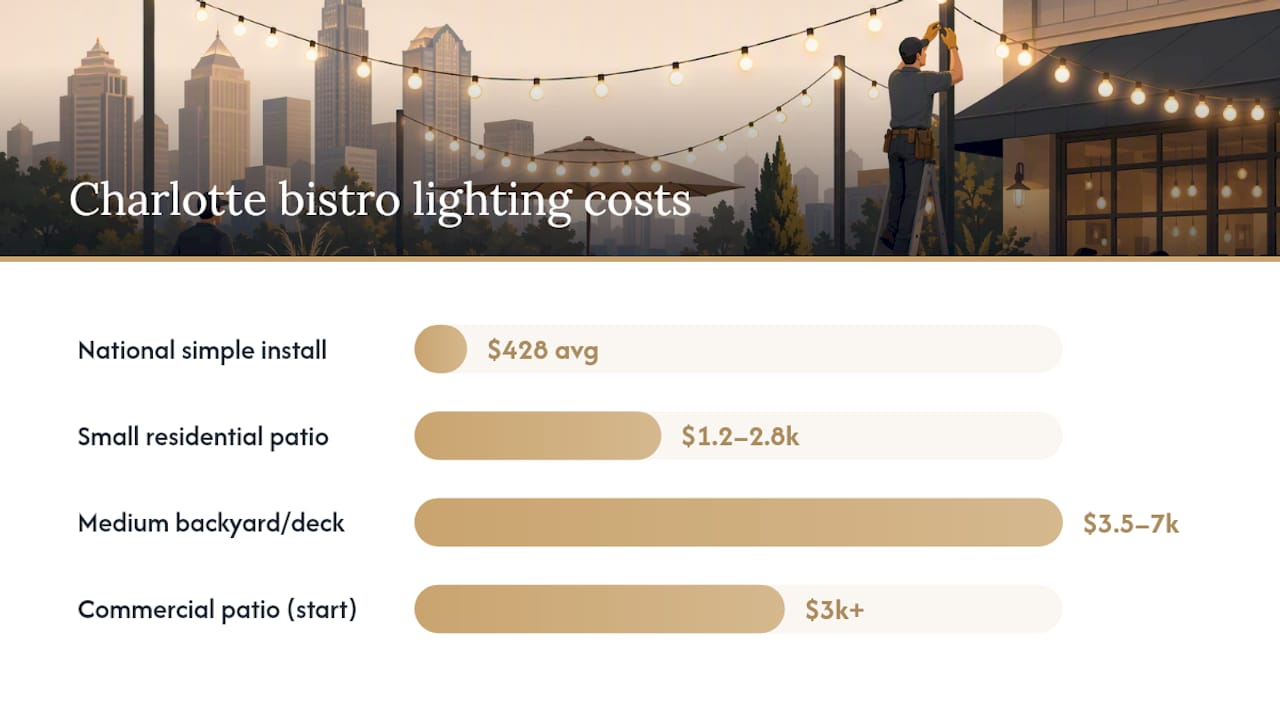
- Charlotte lighting projects often cost between $1,200 and $2,800 for small patios, $3,500 to $7,000 for larger backyard setups, and start around $3,000 for commercial spaces.
- Cost variations mainly depend on material quality, anchor point complexity, electrical scope, access issues, and control system sophistication.
- A detailed, itemized quote should specify linear footage, electrical work, permits, and warranty coverage to enable accurate bid comparison.
- Local factors like HOA design standards, weatherproof hardware, and high tree coverage raise typical project budgets above national averages.
- Permits are usually necessary for new wiring or line-voltage work, while low-voltage, existing outlet-based systems often qualify for exemptions.
Table of Contents
- What Does Bistro Lighting Cost in Charlotte?
- What Makes Bistro Light Installation Cost More or Less?
- Which Materials and Controls Should You Choose?
- How Long Does Installation Take, and What Permits Apply?
- How Long Do Bistro Lights Last, and What Should a Warranty Cover?
- What Should Be in Your Contractor Quote Checklist?
- Why Charlotte Budgets Rarely Match the National Average
- Get a Local, Written Estimate Instead of Guessing
- Sources
- FAQ
What Does Bistro Lighting Cost in Charlotte?
Bistro lighting prices in Charlotte follow the same national patterns you’d see anywhere, but local labor rates, HOA design requirements, and Carolina humidity all nudge the numbers in specific directions. Nationally, installed string lighting averages $299.77 to $599.54 for straightforward jobs, with a reported average near $428 once materials and labor are combined. That figure covers a modest single-span project, not a full patio wraparound with posts and dimming controls.
Charlotte homeowners and small-business owners typically fall into one of three budget tiers:
- Small residential patio: A single 20 to 40 foot run over a deck or backyard seating area often lands between $1,200 and $2,800 installed, based on industry installation price guides. Regional installers in the Carolinas frequently quote in the $15 to $30 per linear foot range for standard bistro setups, which lines up with that bracket.
- Medium backyard or deck project: Multiple spans, a few extra anchor posts, and basic dimming controls typically move the total into the $3,500 to $7,000 range, according to the same price guide data.
- Commercial or restaurant patio: Charlotte commercial exterior lighting projects commonly start around $3,000 and climb from there depending on square footage, seating capacity, and whether the layout needs custom mounting hardware.
Pro Tip: Ask any contractor for a per-linear-foot breakdown alongside the total quote. It’s the fastest way to compare bids that look wildly different but cover the same footprint.
A real written estimate should list the linear footage priced separately from anchor or post installation, the lamp type (commercial LED versus decorative bulb), labor hours, and any permit or inspection fees. If a quote skips any of these line items, ask for a revision before signing anything. Restaurant and café patios in Charlotte increasingly treat bistro lighting as a foot-traffic investment rather than a decorative afterthought, which is part of why commercial bids often run higher than a homeowner might expect from a residential quote alone.
What Makes Bistro Light Installation Cost More or Less?
Two quotes for what looks like the same backyard can differ by thousands of dollars, and almost every time, the gap traces back to five factors.
Material grade is the first split. Consumer-grade string lights from a big box store cost less upfront but degrade faster outdoors. Commercial-grade LED modules built for permanent installation cost more per foot but hold up through Charlotte’s humid summers and occasional ice.
Anchor points and structural work drive a surprising share of labor cost. Installers typically price each anchor separately from the span itself, and a single hard-to-reach mounting point, say, a chimney or a tall oak, can add real time and equipment cost to an otherwise simple job. Scope creep here, more posts, custom brackets, structural bracing, is the single biggest reason a “$1,500 job” turns into a $4,000 one.
Electrical scope matters just as much. A low-voltage driver plugged into an existing outdoor outlet is inexpensive to install. Running a new line-voltage circuit, adding GFCI protection, or trenching conduit to a detached patio adds licensed electrician hours and, often, a permit.
Access and height issues, think two-story decks, steep rooflines, or waterfront docks, sometimes require lift rental or traffic control, both of which show up as separate line items.
Finally, smart controls add cost on top of the base install:
- Basic on/off timers or plug-in dimmers: minimal added cost
- Smartphone-controlled color-changing systems: moderate increase
- Multi-zone setups covering separate patio areas independently: highest increase, but often the most requested upgrade for commercial spaces
Which Materials and Controls Should You Choose?
The bulb debate comes down to a trade-off between aesthetic and durability. Decorative filament-style bulbs give off a warm vintage glow that many homeowners love, but they burn hotter, use more energy, and fail faster outdoors. Sealed commercial LED modules cost more initially but use far less energy and last considerably longer, which is why ENERGY STAR recommends efficient fixtures for any permanent outdoor lighting. Sealed LED units with integrated diffusers also mean fewer maintenance visits, since individual bulb failure is less common than with exposed filament bulbs.
For Charlotte’s lake and river properties, IP rating matters more than most homeowners realize. A fixture rated for occasional splashes is not the same as one rated for constant moisture and salt-adjacent exposure near a dock. Marine-grade connectors and a higher IP rating cost more but prevent the corrosion that shortens the life of budget hardware near water.
Mounting method depends entirely on span length and wind exposure:
- Simple hook mounts work fine for short spans under 20 feet with minimal tension.
- Tension cable systems are needed for longer spans to keep lights from sagging or swinging in wind.
- Structural anchors (lag bolts into framing, not just siding) are required wherever a cable will bear real weight over time.
Control systems range from a basic plug-in dimmer to a full smart hub that lets you change colors and schedules from a phone. Low-voltage drivers are generally the safer, cheaper option for residential patios, while commercial spaces often justify the added cost of a multi-zone smart system.
How Long Does Installation Take, and What Permits Apply?
A typical bistro lighting project in Charlotte moves through five stages, and most homeowners can expect the whole process to run one to three weeks from first call to final walk-through, depending on permitting.
- Site visit and measurement. An estimator walks the property, measures spans, and identifies anchor points.
- Design and written quote. You receive a detailed proposal with linear footage, materials, and labor broken out separately.
- Permitting, if required. Projects involving new circuits or line-voltage wiring typically need a permit and inspection.
- Installation day or days. A crew handles mounting, cable tensioning, and fixture placement; larger commercial jobs may take two or more days.
- Electrical hookup, testing, and walk-through. A licensed electrician completes any wiring, and the crew tests every zone before handing off.
A designer or estimator typically handles the first two steps, while a licensed electrician and an installation crew handle steps three through five. For straightforward low-voltage jobs, Mecklenburg County guidance allows some exemptions from full licensing requirements, but permanent installations involving new circuits or line-voltage wiring generally still require licensed electrical work, permits, and inspection. This is a high-level summary, not legal advice, so confirm specifics with your contractor or the county before assuming your project qualifies for an exemption.
HOA approval, tree trimming permissions, or easement questions near property lines can add days or weeks to the schedule, so raise those issues at the site visit stage rather than after a contract is signed.
How Long Do Bistro Lights Last, and What Should a Warranty Cover?
Commercial-grade LED bistro strings typically last several years under normal outdoor exposure, with the most common failure mode being connector corrosion or seal degradation rather than bulb burnout. Seasonal checks matter more than most homeowners expect.
- Inspect connectors and seals each spring for cracking or water intrusion.
- Check tension cables after major storms, since wind load can loosen anchor points over time.
- Clean fixtures periodically; dust and pollen buildup dims output more than people realize.
- Test smart controls and dimming systems after any power outage or firmware update.
Maintenance subscriptions, sometimes called GlowCare-style plans in the industry, typically bundle these seasonal checks along with bulb and connector replacement, which simplifies long-term upkeep instead of leaving you to track it yourself. When comparing warranties, confirm three things specifically: whether labor is covered or only parts, whether the warranty excludes storm or flood damage, and how long the coverage runs relative to the expected life of the LED modules themselves.
What Should Be in Your Contractor Quote Checklist?
Getting apples-to-apples quotes means requiring the same information from every contractor you talk to.
- Line-item pricing for materials, separate from labor and anchor installation fees.
- A clear statement of electrical scope: existing outlet versus new circuit, and whether GFCI protection is included.
- Permit responsibility spelled out. Confirm who pulls the permit and who pays for it.
- Warranty terms in writing, covering both parts and labor, with any exclusions listed.
- A projected timeline with milestone dates, not just a vague “a few weeks.”
Pro Tip: Reject any quote that skips the electrical scope entirely. Vague wording like “we’ll handle power” often means unlicensed work that voids your homeowner’s insurance if something goes wrong.
Compare per-foot pricing only when scope matches. A $20-per-foot quote with three included anchors can cost less overall than a $15-per-foot quote that bills anchors separately. At close, ask for as-built notes showing where circuits and anchors are located, plus all warranty paperwork in writing.
Why Charlotte Budgets Rarely Match the National Average
A typical Charlotte project we see involves a homeowner with a covered patio and a handful of mature trees who wants warm white lighting that doesn’t scream for HOA attention. The budget usually lands in the $2,500 to $4,500 range once anchor work and a weatherproof commercial LED system are factored in, higher than the national average because Charlotte’s tree canopy and HOA design standards both add complexity most national guides don’t account for.
Licensing, weatherproof hardware, and HOA-friendly design consistently top the priority list for local clients. If you want to see how that plays out on real properties, browse recent installations before requesting your own estimate.
— Dave
Get a Local, Written Estimate Instead of Guessing
A professional local company is the alternative to piecing together a DIY string light kit or gambling on an out-of-town crew that doesn’t know Charlotte’s HOA design standards or humidity-driven hardware failures. Every quote is built from a real site visit, not a phone estimate, so the number you get matches the anchor points, span length, and electrical scope your property actually needs.
Our patio and bistro lighting installations use commercial-grade, climate-optimized hardware designed for the Carolinas, with smart controls you run from your phone and a maintenance plan that catches connector wear before it becomes a repair bill. If your project is commercial in scale, our Charlotte commercial exterior lighting page outlines starting budgets for restaurants and venues. Ready to see real numbers for your property? Schedule a free site survey and request a written estimate today.
Sources
- Cost to Install String Lights in USA in 2026 | Contractor+
- String Lights Installation Price Guide | Spring 2026 | String Lights Installation Pros
- ENERGY STAR
- Low-Voltage Wiring | Code Enforcement
FAQ
What’s the Difference Between String Lights and Bistro Lights?
String lights typically refer to any string of small connected bulbs, while bistro lights specifically mean the larger, warm-toned bulbs (often globe or Edison-style) strung on tensioned cable for a patio or restaurant setting. Bistro lights are usually permanent installations with commercial-grade hardware, while generic string lights can be a lightweight seasonal product.
What Is the Average Cost to Install Outdoor Lighting?
Nationally, installed string lighting averages $299.77 to $599.54 for a straightforward job. In Charlotte, most professionally installed bistro and patio projects run higher, typically between $1,200 and $7,000, depending on span length, anchor points, and electrical scope.
How Expensive Are String Lights?
The lights themselves are inexpensive compared to installation labor. Most of the total cost comes from anchor points, tension cables, electrical hookup, and labor hours rather than the bulbs or fixtures alone, which is why professional installs cost more than a store-bought kit but last far longer.
How Long Is 500 Feet of Bistro Lighting?
Five hundred feet of bistro lighting is enough to wrap a large commercial patio, restaurant courtyard, or multiple residential zones, well beyond a typical single backyard span. At regional per-foot rates of roughly $15 to $30 per linear foot, a run that long would fall into commercial-scale pricing rather than a standard residential budget.
Do I Need a Permit for Bistro Lighting in Charlotte?
It depends on the electrical scope. Low-voltage systems plugged into an existing outlet may qualify for exemptions, but installations involving new circuits or line-voltage wiring generally require licensed electrical work and permits under Mecklenburg County guidance. A contractor should confirm your specific project’s requirements before installation begins.