
HOA-friendly holiday lights have three things in common. They stay on your lot, they use restrained color and brightness, and they were approved in writing before anyone climbed a ladder. That applies to a string of warm white bulbs on the eaves. It applies even more to a permanent roofline system you plan to keep up all year.
This guide covers what boards tend to look at, how to read your own documents, and how to submit a request that is easy to approve. It is written for homeowners in planned communities, with a focus on the Charlotte area and North Carolina.
TL;DR
- Read your CC&Rs and architectural guidelines first. Most planned communities give the association power over exterior changes, and permanent lighting almost always counts as one.
- Boards usually judge lights on brightness, color temperature, placement, timing and light spilling onto neighbors. Warm, shielded, dimmable and scheduled lighting answers most of those concerns.
- Permanent systems need approval before installation. A board can require removal of lighting installed without it.
- Submit specs, a color-matched sample, a placement diagram and a schedule. A complete package is the fastest route to a yes.
- Safety counts too: inspect cords, don’t overload circuits, and use a professional installer for anything that stays on the house.
Table of Contents
- What boards actually object to
- Read your documents before you buy anything
- Choosing lights a board will say yes to
- Permanent holiday lights in an HOA
- Perspective: what we see at Forever Glow
- How to submit an ARC request that gets approved
- Be a good neighbor: the unwritten rules
- Safety checks that boards and insurers care about
- Putting it together before the season
- How we can help
- FAQ
- Sources
What boards actually object to
The viral stories about HOA holiday fights make it sound as if boards dislike Christmas. In practice, complaints cluster around a handful of issues. A recent North Carolina example is a Waxhaw dispute covered by a management company’s blog. According to AMG’s write-up of the case, the board upheld two of five alleged violations: lighting directed beyond the lot, and an illuminated sign that exceeded the size limit. It did not ban the display.
That pattern matches what we see in practice. Rules that look like “anti-holiday” rules are usually about:
- Light trespass: beams or glare crossing into a neighbor’s windows.
- Brightness and color: very bright, saturated or flashing lights.
- Duration: lights left up or on too long.
- Unapproved exterior changes: hardware attached to the structure without sign-off.
- Noise and traffic: moving mechanics, music and crowds.
A community-management firm advises that if your display has noisy mechanics or very bright lights, you should shut them down at a reasonable hour each evening. That is the kind of courtesy that keeps a board from getting involved.
Read your documents before you buy anything
Homeowners often assume that owning the house means they can decide what goes on it. In most North Carolina planned communities, the governing documents give the association the power to regulate exterior modifications, as DarkSky International’s HOA guidance notes. DarkSky also observes that many U.S. HOAs have no outdoor lighting requirements at all in their CC&Rs. Those that do often limit the rules to preventing light trespass.
So you may have more room than you fear. Or less. You only know by reading three documents:
- The declaration (CC&Rs): look for exterior modification and architectural review clauses.
- Architectural guidelines or rules and regulations: these often contain the lighting specifics.
- Any holiday decoration policy: many associations publish one separately.
What real policies say
Policies vary a lot, which is exactly why you should read yours. A few published examples show the range:
- One community’s year-round lighting rule, recorded February 28, 2024, lets holiday lights be illuminated from November 15 to January 15.
- The Remington Park holiday lighting policy starts from the fact that the community’s CC&Rs require approval of all exterior lights by the architectural review authority before installation.
- The Shores HOA wrote to residents about permanently affixed lighting with a wide variety of colors, styles and patterns after concerns about recent installations.
Three communities, three different approaches. Don’t assume your neighbors’ rules match yours, even a few miles away.
Choosing lights a board will say yes to
DarkSky International recommends five principles for responsible outdoor lighting: lights should be useful, targeted, low-level, controlled with timers or sensors, and warm in color. Those are written as model guidance for associations, and they double as a checklist for your request. If your proposal visibly follows them, you have answered most of a board’s questions before they ask.
| Board concern | What to propose |
|---|---|
| Color | Warm white as the default. Add color only for defined holiday windows. |
| Brightness | Dimmable fixtures with a stated maximum output. |
| Spill onto neighbors | Downward-facing or tightly aimed lighting, kept on your lot. |
| Hours | Automated schedule with a shutoff time. |
| Visible hardware | Color-matched track or low-profile mounting that blends with the trim. |
| Season length | Clear dates for when holiday programming runs. |
If you want ideas for restrained palettes, our guide to holiday lighting color schemes built around warm white shows how to get a festive result without saturated color. For the broader idea behind these principles, see what night sky friendly lighting means for homeowners.
Temporary string lights
Seasonal lights are the simplest case. Most boards are comfortable with them if they go up and come down within the stated dates. Check the take-down deadline, because a lot of policies specify one. The NFPA’s January fire-safety release is a reminder that leaving seasonal decor in place too long isn’t just a rules problem. It reports that 35 percent of U.S. home fires involving Christmas trees occur in January.
Inflatables and animated displays
These are where disputes start. Inflatables, projectors, music and moving lights are more likely to be restricted by name, so check the decorations policy specifically before buying. If your documents are silent, ask the manager or board in writing instead of assuming silence means permission.
Permanent holiday lights in an HOA
Permanent lighting is the fastest-growing source of new questions for boards. These systems use low-profile LED tracks along the roofline or eaves that can display white, warm tones or full color on a schedule from a phone app. A Charlotte homeowner can run warm white most of the year and switch to red and green in December.
That flexibility is what makes boards cautious. According to Mulcahy Law Firm, boards have the authority to require removal of permanent lighting installed without prior architectural approval. They also evaluate systems on luminosity, color temperature and placement. The firm notes that professionally integrated systems are more likely to win approval than DIY or aftermarket installs.
Two practical points follow:
- Get approval first. Paying for an installation and then being ordered to remove it is the most expensive outcome in this topic.
- Propose the controls, not just the hardware. A board that sees locked-in maximum brightness, a default warm white setting and an automatic shutoff is approving a system it can understand.
If you are weighing the permanent route against hanging lights each year, we compare the two in why permanent holiday lights beat seasonal ones.
Perspective: what we see at Forever Glow
We install permanent roofline lighting in the Charlotte area, so we sit in the middle of this question every season. Our view is simple: most HOA denials are about missing information, not about the lights themselves.
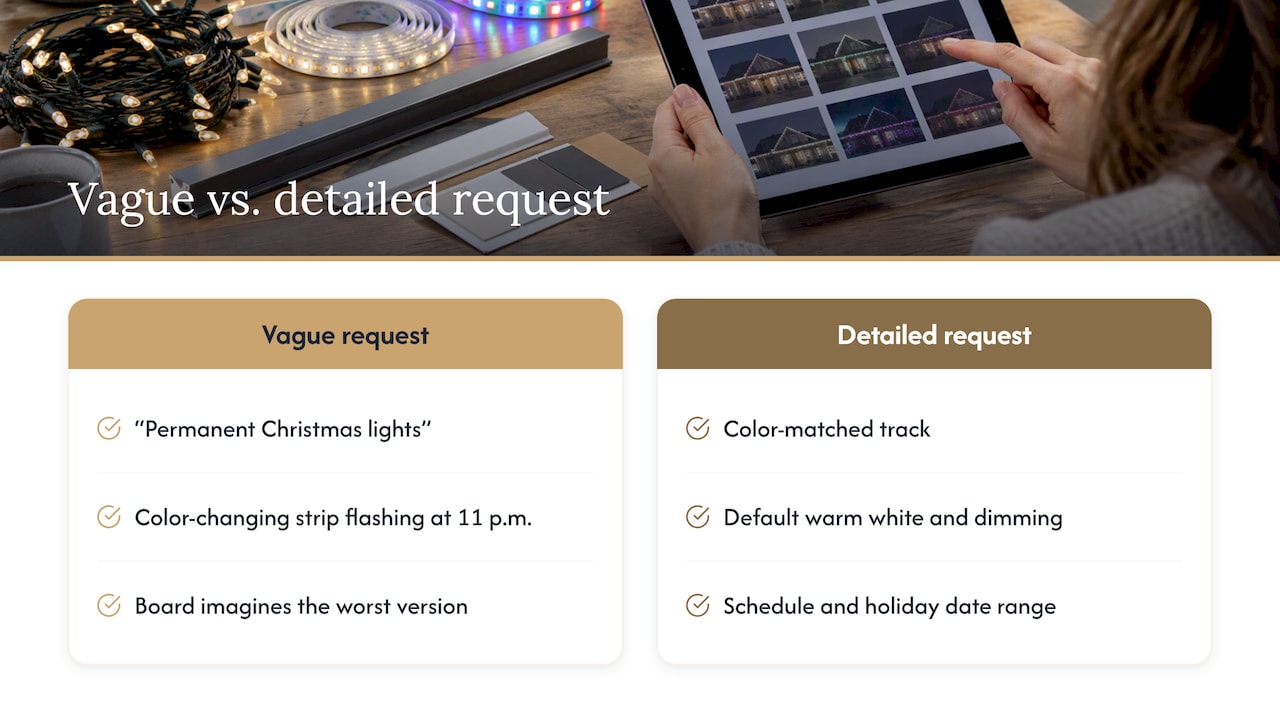
A board looking at a request that says “permanent Christmas lights” imagines the worst version: a color-changing strip flashing across the street at 11 p.m. A board looking at a request that names a color-matched track, a default warm white, dimming, a schedule and a holiday date range imagines something quieter, and that is closer to the truth. So we design with compliance as a starting requirement. Our systems use commercial-grade, climate-optimized hardware with color-matched tracks, and the controls let a homeowner limit what the system can do.
We would also tell any homeowner this: be honest with your board about the color capability. A permanent system can do millions of colors. Saying so, and then proposing a limited set of uses, builds more trust than a vague application that leaves the board to find out later.
— Dave
How to submit an ARC request that gets approved
The architectural review committee (ARC) is the group that decides. Make its job easy.
- Get the form and the guidelines. Ask your manager for the current versions. Don’t rely on an old copy.
- Describe the project in plain terms. Where lights go, how many linear feet, what they look like by day.
- Attach specifications. Brightness, color temperature range, dimming, controls and the manufacturer’s data sheet.
- Show appearance. A photo of the house with the proposed track location marked, plus a color sample matched to your trim.
- State the schedule. Default hours, shutoff time, and dates for any holiday color programming.
- Name the installer. Licensed professionals and a warranty reassure boards that the work will be done safely.
- Keep a record. Save the submission date, the written decision and any conditions.
As for timing, the North Carolina General Assembly’s bill summary for HB 372/SB 378 describes provisions requiring associations to use a fair, reasonable and expeditious review procedure for architectural modification proposals. They would have to issue a written decision within 90 days, and explain any denial and the way to request reconsideration by the executive board. Check the current status of that legislation and your own documents, since it affects how long you should plan to wait. For a practical walk-through of the process, see our guide to winning ARC approval in 30 to 60 days.
If your request is denied, don’t stop at the denial. Ask for the reasons in writing, then address them. Often a lower maximum brightness or a revised placement is enough.
Be a good neighbor: the unwritten rules
Approval is one half. The other half is whether your neighbors complain afterward, because complaints are what trigger enforcement.
- Aim lights away from other homes’ windows.
- Set a shutoff time that fits your street, not just the minimum your rules allow.
- Keep sound off or low.
- Tell neighbors if you plan something unusual.
- Take temporary decorations down on schedule.
For homeowners comparing approaches outside the Carolinas, a Florida-focused list of HOA outdoor compliance tips shows how boards in other states frame exterior rules. Always attribute rules to your own state and association, since the details differ.
Safety checks that boards and insurers care about
A clean application also covers safety. The NFPA reports that electrical distribution and lighting equipment are involved in more than 40% of home Christmas tree fires. It advises homeowners not to pull the cord when unplugging decorations, since that can damage insulation, and to regularly check strings for cracked or bare wires. That is guidance about seasonal strings. For anything permanently wired to your house, use a qualified installer, and have the system checked after it has been through its first season. We cover that in our permanent Christmas light safety check after 90 days. For questions about your own wiring or circuits, a licensed electrician is the right person to ask.
Putting it together before the season
If you want lights up this December, work backward. Review times can run weeks, and a board may only meet monthly. Here is a rough order of operations:
- Now: read your documents and ask what is allowed.
- Next: decide between seasonal strings and a permanent system.
- Then: submit the request with full specs.
- After approval: schedule installation and confirm the controls match what you promised.
- Ongoing: keep the approval letter on file in case a neighbor complains.
If approval won’t come before the holidays, hang simple warm white strings within your community’s dates this year and apply for the permanent system for next season.
How we can help
Forever Glow Lighting designs and installs permanent roofline lighting for Charlotte-area homes, with color-matched tracks, smartphone controls and a design process built around HOA and municipal requirements. Our permanent Christmas lighting page explains the system and the GlowCare maintenance subscription, and you can ask us for a free estimate. If you want a year-round holiday display designed for a community with rules, start with our residential holiday lighting service.
FAQ
Can my HOA stop me from putting up Christmas lights?
It can regulate them if your governing documents give it that power, and most planned-community documents do for exterior changes. Many associations allow seasonal lights within set dates and restrict brightness, color, or light spilling on neighbors. Read your CC&Rs and decoration policy, or ask your manager in writing.
Do I need approval for permanent holiday lights?
Almost certainly. Permanent lighting is an exterior modification, and boards can require removal of systems installed without prior architectural approval, according to Mulcahy Law Firm. Submit the request before you sign a contract or schedule work.
What colors are safest for an HOA?
Warm white is the easiest to approve and matches DarkSky’s guidance for warm-colored lighting. If you want color, propose it only for holiday dates and say so in the application. Some associations restrict colors or patterns, so check yours.
Can I put inflatables outside if I have an HOA?
Sometimes. Inflatables and animated displays are often addressed directly in decoration policies, with limits on dates, hours or size. If your documents don’t mention them, ask the board before buying.
How long does an HOA take to approve lighting?
It depends on your documents and board schedule. A North Carolina bill summary describes a requirement for a written decision within 90 days of submission, but confirm current law and your community’s own timeline before planning around it.
Sources
- AMG: HOA Holiday Lights in North Carolina
- KPPM: Holiday Decorations, HOAs, and Happy Homeowners
- DarkSky International: Neighborhood-friendly lighting for HOAs
- Suncrest: Amended Rule 17, Year Round Lighting
- Remington Park HOA Holiday Lighting Policy
- The Shores HOA: Exterior Lighting Rule
- Mulcahy Law Firm: Permanent Lighting in HOAs
- NFPA: More than one-third of Christmas tree home fires occur in January
- North Carolina General Assembly: HB 372 bill summary