
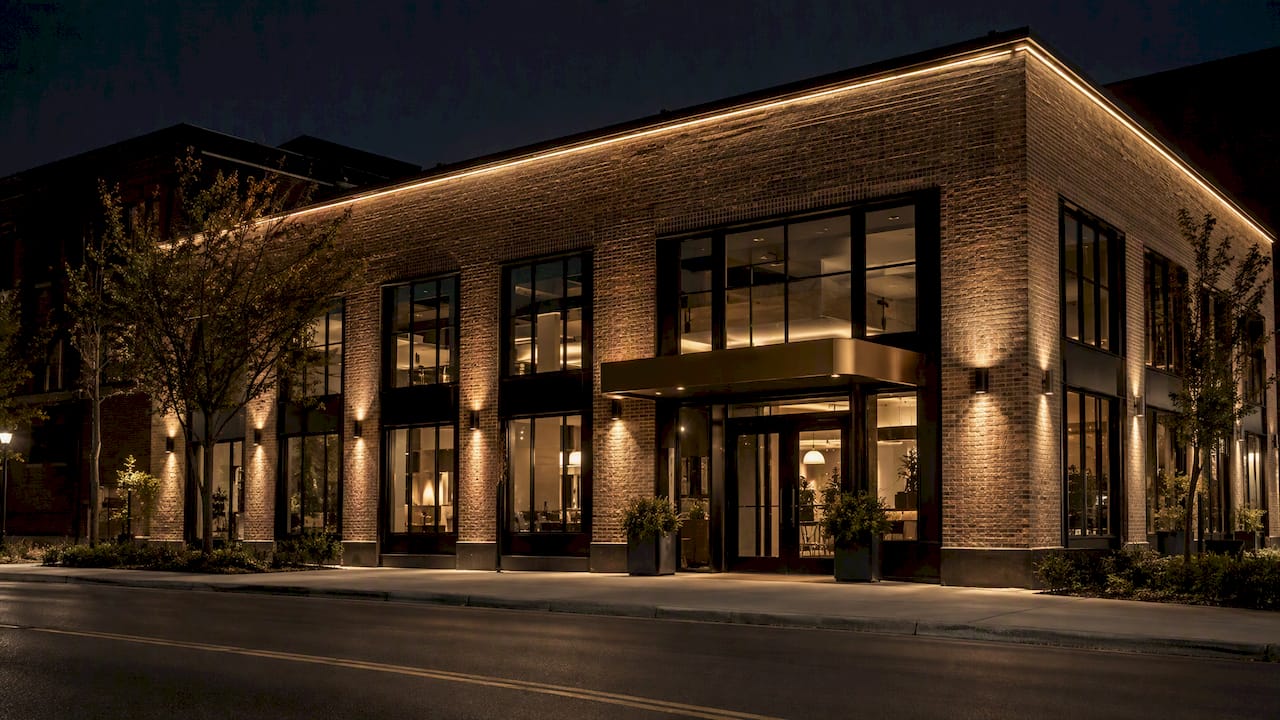
The best commercial facade lighting ideas share one trait: they light the building’s best features, not the whole building. Grazing for texture, washing for broad walls, a concealed linear outline for the roofline, and warm, shielded fixtures at the entry. Add smart scheduling so the facade drops to a quieter security scene after closing. In Charlotte, you also have to design around the city’s exterior lighting rules before anything gets mounted.
This guide walks through the main techniques, how to match them to your building, the glare and code traps that sink projects, and how to run a facade project from first walk-through to final aiming.
TL;DR
- Pick the technique from the facade: grazing for stone, brick and timber, washing for smooth walls, linear outlines for rooflines and canopies, spotlights for columns and signs.
- Warm white, low glare and restrained color usually look more expensive than maximum brightness.
- Controls matter as much as fixtures: scheduling and automatic control can save 30% to 50% in many exterior applications.
- In Charlotte, permanent fixtures must be full or semi cut-off, flashing is prohibited, and light at the lot line is capped.
- Start with a lighting plan and a night-time mockup, not a fixture catalog.
Table of Contents
- Start with what the facade is for
- Seven facade lighting ideas for commercial buildings
- Matching the idea to your building
- The mistake most facade projects make: too much light
- Charlotte rules to check before you design
- Controls: the idea that pays for itself
- How a facade lighting project runs
- Our perspective
- Working with Forever Glow Lighting
- FAQ
- Sources
Start with what the facade is for
Exterior lighting on a commercial property typically serves aesthetics, security, or utility, and most facades need a mix. Before choosing a technique, decide which job comes first:
- Recognition: drivers should find your entrance and read your sign from the road.
- Wayfinding: customers should see where to park, walk and enter.
- Security: faces, doors and approaches should be visible, and cameras need usable light.
- Architectural emphasis: the building should look intentional after dark.
The right technique depends on facade texture, viewing distance, surrounding ambient brightness and the effect you want. A dental office on a quiet street and a dealership on a four-lane road need different answers, even with identical walls.
Seven facade lighting ideas for commercial buildings
1. Grazing light for texture
Grazing places fixtures close to the surface and rakes light across it. It is the best option for brick, stacked stone, board-formed concrete and timber, because grazing light brings out the fine texture of timber and natural stone. It is a poor choice for smooth stucco or glass, where it exposes every flaw in the surface.
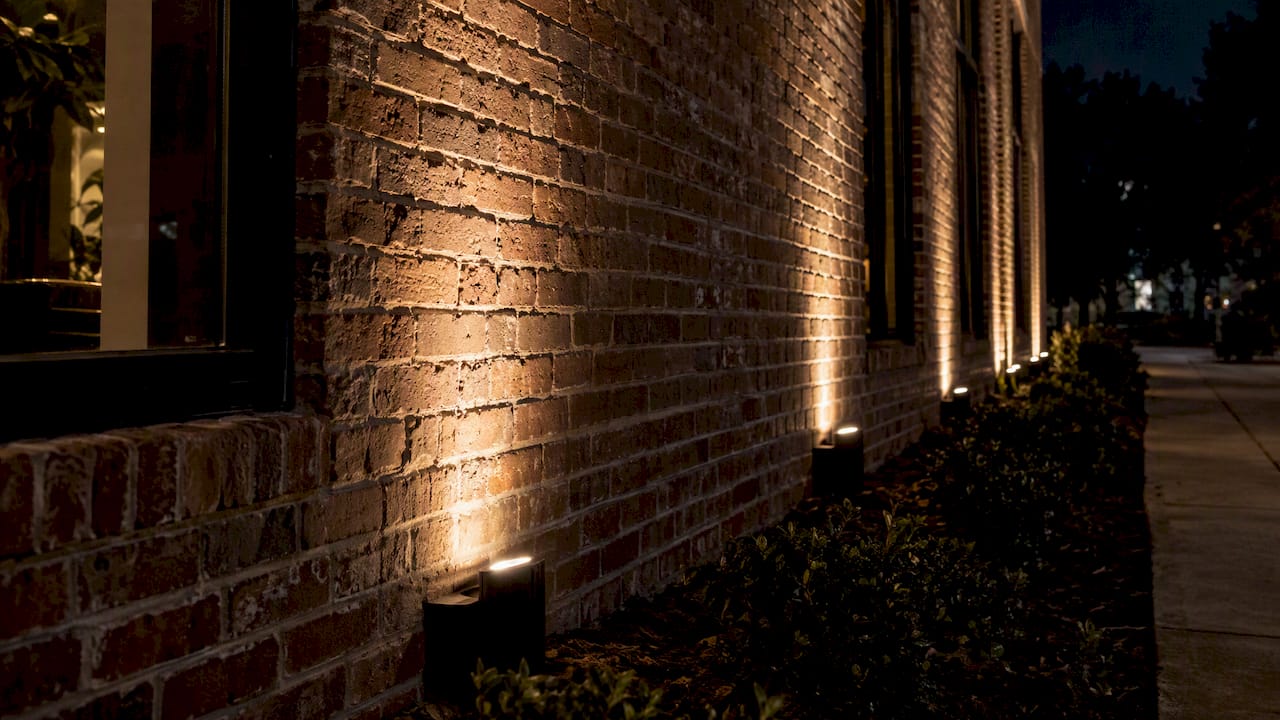
Keep fixtures tight to the wall and evenly spaced. Uneven spacing creates scalloped hot spots that read as mistakes.
2. Wall washing for broad, flat planes
Washing spreads even light across a surface from a distance. It suits painted panels, metal cladding and large storefront walls. It makes the building look taller and cleaner, and it is the least dramatic technique. Use it when you want presence without fuss.
3. Concealed linear LED outlines
Linear LED lines the roofline, parapet, canopy edge or a reveal in the facade. Done well, the hardware disappears by day and gives you a clean, continuous glowing edge at night. This is the idea closest to what we install every day, and it is where color-matched tracks earn their keep: the track should match the fascia so no one notices it in daylight. See our guide to permanent lighting for commercial buildings for how that works on real properties.
4. Spotlighting columns, entries and signage
Spotlighting picks out individual elements: a column, a stone feature wall, a monument sign, a canopy. Use it sparingly. Three or four deliberate focal points create hierarchy. Fifteen spotlights create a runway. Combining accent light with general wash is a classic way to build hierarchy and points of interest on the facade.
5. Silhouetting
Silhouetting lights the surface behind an object so the object reads as a dark shape. It works for sculptural canopies, open frames and projecting features against a light wall. It needs a plain, light backdrop and careful aiming, so it is a specialist choice rather than a default.
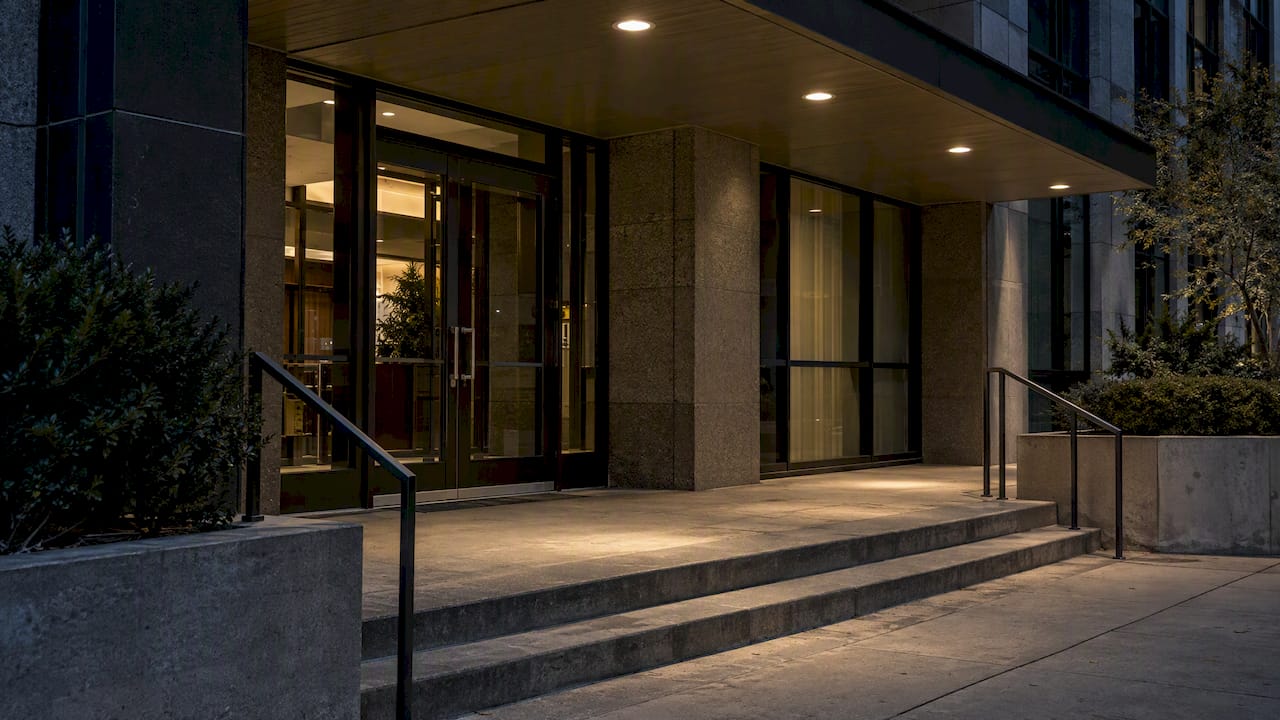
6. Recessed step, soffit and canopy lighting
Recessed fixtures in soffits, canopies, stairs and bollards handle the approach. They give low-glare light exactly where people walk and pair well with the facade scene. For the ground-level side of this, our pieces on path lighting and layering techniques apply to commercial landscaping too, even though they are written for homeowners.
7. Tunable white and restrained color
Color-changing lighting is now routine, but the strongest commercial use is restrained: a steady warm or neutral white most nights, with brand colors, school colors or holiday scenes on set dates. Current trends favor warm-white, low-glare illumination, concealed linear systems, tunable white and scene-based scheduling. Constant color cycling tends to cheapen a building and, in Charlotte, runs into the flashing prohibition (more below).
Matching the idea to your building
| Facade or building type | Strong first choice | Add | Watch out for |
|---|---|---|---|
| Brick or stone office | Grazing | Warm entry downlights | Hot spots from uneven spacing |
| Stucco or painted retail | Wall washing | Concealed linear roofline | Visible fixtures from the road |
| Glass and metal storefront | Linear outlines, canopy lighting | Sign spotlights | Reflections and interior glare |
| Dealership or showroom | Linear roofline, bright entry | Scheduled brand scenes | Overlighting and lot-line spill |
| Restaurant or hospitality | Warm wash, accent on features | Patio and string lighting | Glare toward neighbors |
| Multi-tenant center | Roofline outline, entry accents | Zoned schedules | Inconsistent tenant lighting |
One of our commercial projects is a good example of a roofline-led approach: the LED lighting installation at Gastonia Chevrolet Buick GMC.
The mistake most facade projects make: too much light
In bright photometric renderings, almost everything looks good. In real darkness, the picture changes. The dark sky creates stronger contrast around lit surfaces, so a facade that looked fine on paper can glare from the road if the source is visible.
Three failure points show up again and again:
- Glare: a visible bright source blinds drivers and customers and makes everything around it look darker.
- Light trespass: spill onto the neighbor’s property or the street.
- Hot spots: bright patches that pull the eye to the wrong place.
DOE’s outdoor lighting guidance makes the case that a lower-output, carefully shielded system can give better visibility than an overlit one. The Dark Sky Society puts it plainly: more light is not automatically better light. Our own explainer on reducing glare without losing curb appeal covers the practical fixes.
Efficiency does not rescue a bad design either. GSA points out that lamp, fixture, optics, controls and surface reflectance have to be considered together, because an efficient LED that is aimed poorly or left on all night still wastes energy and annoys people.
Charlotte rules to check before you design
If the property is in Charlotte, the city’s Unified Development Ordinance (UDO) sets exterior lighting standards for multi-family, mixed-use and nonresidential properties. Based on Article 16 of the Charlotte UDO:
- Lots abutting a Neighborhood 1 or Neighborhood 2 place type are limited to zero foot-candles at the lot line. Lots abutting other place types are limited to one foot-candle at the lot line.
- Permanent fixtures, including those mounted on rooftops and exterior walls, must be full cut-off or semi cut-off designs.
- Flashing lighting is prohibited.
- Exterior lighting must be located, screened or shielded so it does not cause glare or impair the vision of cyclists or motorists.
Sign lighting is treated separately from these general standards, so confirm the sign rules for your zoning district. The ordinance is amended over time, so verify against the current text, and confirm permits with the city before construction. We break down the practical side in our pages on the Charlotte exterior lighting ordinance and avoiding permit delays under UDO Article 16.
Two design consequences follow. First, a fixed or very slowly changing scene is safer than any rapid color effect. Second, shielding and aiming are not finishing touches: they decide whether the project passes review and whether the neighbors complain.
Controls: the idea that pays for itself
Exterior lights run for long hours. GSA notes that facade, parking and walkway lighting present a large savings opportunity because those lights are on for nearly half the year. PNNL’s exterior lighting study adds that scheduling and automatic control can matter as much as fixture wattage.
In practice, a smart facade can run three scenes:
- Evening scene: full architectural effect from dusk until closing.
- Security scene: a lower, steady output after hours that keeps entries and approaches visible.
- Event scene: brand colors or holiday looks on scheduled dates, then back to normal automatically.
This is the part owners rarely think about at the start, and it is the part they appreciate most a year later. Smartphone control means a property manager can change a scene without a lift or a service call. Our guides on app control and seasonal automation explain how scheduling works.
How a facade lighting project runs
A sound process looks like this. It follows the same logic as the Dark Sky Society’s lighting plan guidelines, which also advise involving a professional on larger projects.
- Document the building. Photograph it from the street, the parking lot and the main approach, in daylight and at dusk.
- Define the goals. Recognition, security, brand, events, or all four.
- Divide into zones. Facade, entry, sign, landscape, parking and security each get their own treatment and schedule.
- Select the hardware. Beam spread, color temperature, shielding and mounting points.
- Check glare and trespass. Model it, then confirm the plan against Charlotte’s requirements.
- Install and aim after dark. Aiming in daylight is guesswork.
- Program scenes and schedule maintenance. Set the evening, security and event scenes, then check them on a routine.
Our installation process page shows how we handle those steps from estimate to final walkthrough.
Our perspective
We install permanent track lighting on roofs and facades across the Charlotte area, and the same lesson comes up on nearly every commercial job: owners ask for brightness and what they actually want is confidence. They want the building to look cared for, the entrance to feel safe and the sign to be readable.
That is why we like concealed linear tracks for commercial roofline work. The track is color-matched to the building, so by day it is nearly invisible, and by night one continuous line frames the structure. Because the system runs on smart controls, the same line can be a warm architectural accent at 8 p.m., a dimmer security presence at 2 a.m., and a team-color or holiday scene when the calendar calls for it.
We also design with Charlotte’s rules in mind from the first sketch: shielded, steady, aimed down and in. A facade that passes review and does not bother the neighbors is a facade you will not have to rework. Our hardware is built for Carolinas weather, and our GlowCare maintenance subscription keeps the system checked over time.
— Dave
Working with Forever Glow Lighting
If your building has a roofline, canopy or fascia that deserves to be seen, our architectural lighting service is the place to start. We design and install smart, color-matched LED track systems for commercial properties, and we also handle commercial and municipal holiday displays on the same permanent system, so you do not need a seasonal crew every November. Request a free estimate and we will walk the property with you.
FAQ
What are the best exterior lights for a commercial building?
Use application-specific LED fixtures with proper optics, shielding and controls. Wall grazers or linear fixtures suit texture, concealed uplights or downlights suit columns and entries, and adjustable floodlights suit broad planes. GSA also recommends downward-facing exterior lighting with reflectors, deflectors or covers to limit pollution and trespass.
What are the different types of facade lighting?
The main types are grazing, washing, spotlighting, silhouetting, linear outlining, recessed architectural lighting and dynamic color-changing illumination. Most good designs combine two or three. The choice depends on the facade material, viewing distance and what you want people to notice.
What are the current trends in architectural lighting?
Warm-white, low-glare light, concealed linear LED, restrained color and smartphone or network control lead the list. The biggest shift is controllability: the facade can move from an evening scene to a lower security scene instead of staying fully on all night.
Can I use color-changing lights on a commercial building in Charlotte?
Steady color is generally workable, but Charlotte’s UDO prohibits flashing lighting under its exterior lighting standards, and fixtures must be shielded to avoid glare. Sign lighting and permits have their own rules, so confirm your zoning district with the city before design is final.
Sources
- GSA: Lighting (High-Performance Building Clearinghouse)
- IES RP-33-14: Lighting for Exterior Environments (preview)
- PNNL: Exterior Lighting Scoping Study
- California Energy Commission: Leading in Los Angeles
- DOE: Next Steps, Five principles for responsible outdoor lighting
- Dark Sky Society: Guidelines for Good Exterior Lighting Plans
- ERCO Knowledge: Facade lighting