
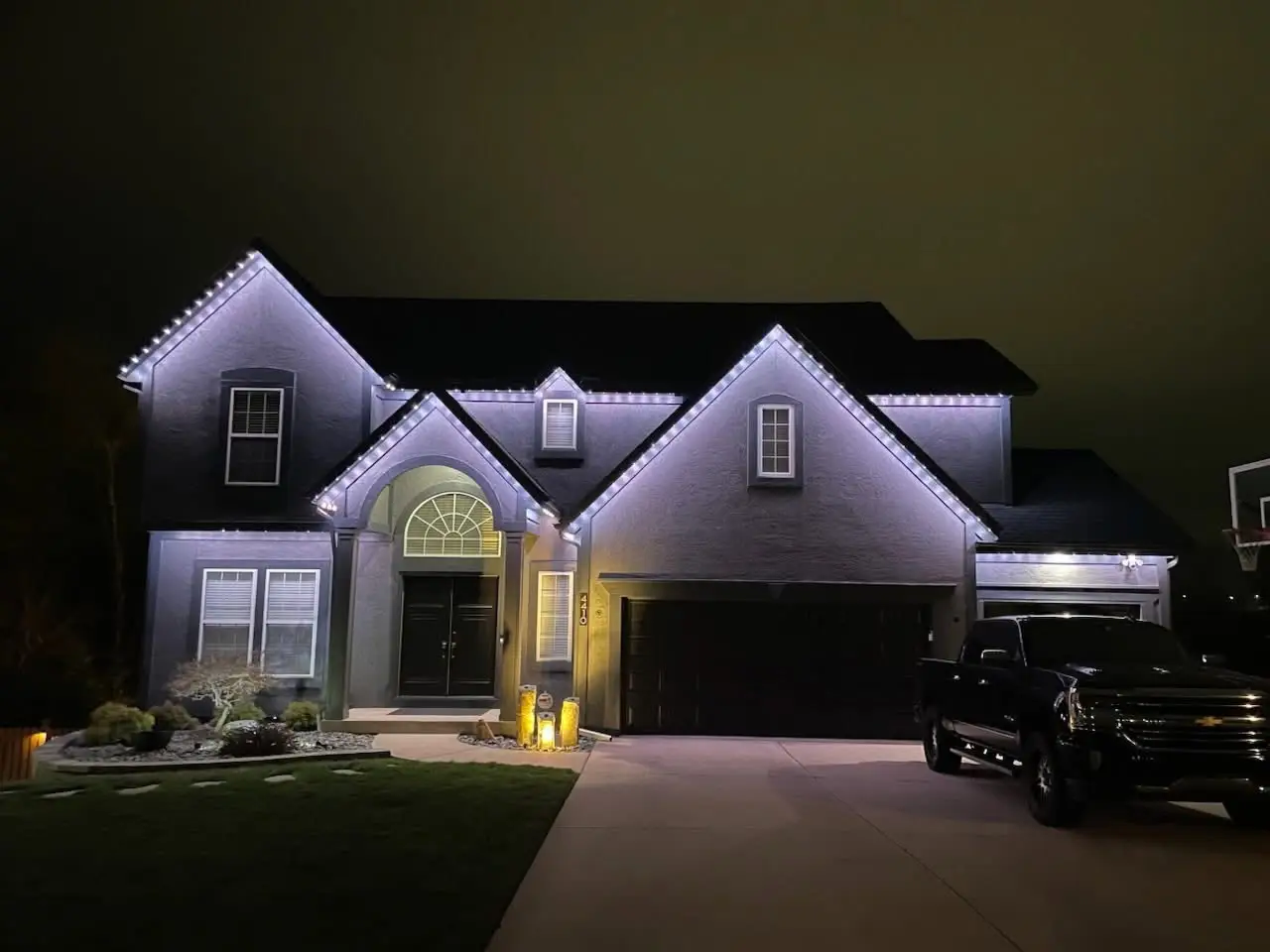
How much does it cost to get permanent outdoor lights installed?
- Cost Per Linear Foot ($20 – $40 installed): Represents the standard turn-key industry pricing metric, bundling custom color-matched aluminum soffit track, RGB-WW point-source LED pucks, power supplies, cloud controllers, and high-ladder or boom-lift labor.
- Average Residential Roofline Investment ($4,000 – $8,000): Covers a complete front and side architectural installation (typically 150 to 225 linear feet) on a standard single- or two-story home with multiple gables and peaks.
- Entry-Level Front Facade Runs ($2,500 – $4,000): Designed for single-story ranch homes, townhomes, or targeted street-facing eaves measuring between 75 and 125 linear feet.
- Large Multi-Story & Waterfront Estates ($6,000 – $10,000+): Encompasses 200 to 350+ linear feet of 360-degree perimeter coverage, steep third-story roof pitches, back patio rooflines, boathouses, and multi-controller synchronization.
- Ongoing Operating & Maintenance Costs ($4 – $10/month in electricity): Powered by low-voltage (12V–24V) LED diodes rated for 50,000 hours (20+ years of nightly use), eliminating annual $500 to $1,500 temporary holiday light hanging fees.
Professional installation of permanent roofline track lighting typically costs $20 to $40 per linear foot, bringing the average residential project to $4,000 to $8,000. Smaller front-facing runs start around $2,500, while extensive multi-story homes or waterfront properties requiring 200+ linear feet range from $6,000 to $10,000+.
Over the past several years, permanent outdoor roofline lighting has transitioned from a novelty holiday upgrade into a staple of modern architectural design. Rather than paying seasonal crews every November to staple brittle plastic strings onto roof shingles—only to tear them down in January—homeowners are investing in permanent, color-matched aluminum track systems tucked seamlessly beneath the soffit overhang.
Because every roofline features unique peak heights, fascia angles, and electrical access points, contractors price these systems by the linear foot alongside site-specific complexity factors. Breaking down how linear footage, diode engineering, and roofline geometry impact your quote will help you budget accurately for a permanent system.
Project Pricing Tiers by Linear Footage and Home Style
When an estimator measures your home for permanent outdoor lights, they calculate the total linear distance along your eaves, rakes, ridges, and covered patios. Below is how linear footage translates into real-world project budgets:
| Property Profile | Typical Linear Footage | Average Installed Cost | Scope & Architectural Coverage |
| Single-Story / Front Facade Only | 75 – 125 Linear Feet | $2,500 – $4,000 | Street-facing roofline, primary entry peak, and garage eaves on a single-level ranch or townhome. |
| Standard Two-Story Residential | 150 – 225 Linear Feet | $4,000 – $6,500 | Full front facade, side returns, and upper second-story gables. Includes 1–2 smart zone controllers. |
| Full-Perimeter / Covered Patio | 225 – 300 Linear Feet | $6,500 – $8,500 | Front roofline plus complete backyard patio, deck overhang, and walkout basement eaves. |
| Custom Estate / Waterfront Home | 300 – 450+ Linear Feet | $8,500 – $12,000+ | 360-degree wrap on steep multi-story architecture, detached garages, guest houses, or private docks. |
Deconstructing the $20 to $40 Per-Foot Price Tag
Why do some quotes land at $22 per linear foot while others approach $40? The variance comes down to five distinct hardware and installation variables:
1. Roofline Elevation, Pitch, and Access Complexity
Labor and safety equipment represent a major portion of a permanent lighting quote. Installing track along a flat, 10-foot first-story garage soffit from an A-frame ladder is fast and straightforward, typically sitting at the $20 to $25 per-foot end of the spectrum.
However, if your home features a steep 12/12 roof pitch, third-story dormers sitting 35 feet in the air, or zero-lot-line side yards blocked by air conditioning condensers and retaining walls, installation slows down considerably. High-elevation runs require two-man harness crews, specialized roof-ridge hooks, or towable hydraulic boom lifts, pushing the rate for those upper peaks toward $30 to $40 per linear foot.
2. Custom Color-Matched Extruded Aluminum Track
The defining feature of a true permanent lighting system is its daytime invisibility. Cheap DIY strip lights use adhesive backing that peels off in summer humidity, leaving wires dangling from the gutters. Professional systems house the wiring and LED pucks inside rigid, extruded architectural aluminum channels (available in over 100 factory powder-coated colors to match your exact aluminum, vinyl, or wood soffit and fascia trim).
Every corner, peak, and T-intersection requires precision miter cuts and custom color-matched splice plates so the track looks like an original piece of architectural crown molding bolted flush into the soffit underside.
3. Diode Technology: RGB-WW vs. Standard RGB
Not all permanent LED pucks are engineered equally. Entry-level systems rely on basic 3-channel RGB (Red, Green, Blue) diodes that mix colors to simulate white light, often resulting in a harsh, bluish tint.
Premier architectural systems (costing roughly $3 to $6 more per foot in hardware) utilize 4-channel RGBW or 5-channel RGB-WW (Red, Green, Blue + Warm White + Cool White) point-source pucks. By housing a dedicated, isolated 2700K warm-white phosphor chip inside every lens, the system produces genuine, high-CRI architectural downlighting for everyday security and curb appeal, while reserving 16 million customizable colors for holidays, birthdays, and game days.
4. Soffit Geometry and Custom Mounting Profiles
How your roof overhang was built by the original framer dictates the type of track channel required:
- Standard Flat Closed Soffits: The easiest surface to mount onto. Installers screw a U-channel track directly into the flat soffit panel roughly 2 to 3 inches back from the inside fascia lip, allowing the light cones to wash down the brick or siding.
- Open Rafter Tails & Exposed Eaves: Common on Craftsman bungalows, mountain cabins, and historic homes where there is no flat soffit underside. Technicians must install specialized L-bracket tracks or right-angle flange channels mounted against the back of the fascia board so the diodes still point straight down rather than shining outward into the street.
- Tile, Slate, or Metal Roof Transitions: Where a first-story roofline terminates into a second-story brick wall, installers must route color-matched aluminum conduit (“jumpers”) across the roof tiles or tucked behind downspouts to carry power and data cleanly to the upper level without exposing bare wire.
5. Power Supplies, Data Boosters, and Cloud Controllers
Because permanent roofline systems run on safe 12V to 24V low-voltage DC power, a central weatherproof control box is mounted inside your garage, attic, or exterior utility wall. Depending on your total linear footage, a single power supply can typically drive 150 to 200 feet of lights before requiring an auxiliary power injection booster to prevent voltage drop at the end of the line. High-end systems include Wi-Fi and Bluetooth cloud controllers with astronomical timers, music-sync microphones, and multi-zone splitting so your front facade can run sophisticated white architectural peaks while your back patio glows in warm amber for an evening barbecue.
Return on Investment: Permanent Track vs. Seasonal Holiday Hanging
While a $4,500 to $7,000 upfront investment is significant, permanent outdoor lighting is one of the few exterior upgrades that actively pays for itself by eliminating a recurring annual service bill:
- Eliminating Annual Installation Fees: Professional seasonal holiday light hanging (leasing C9 bulbs, installation, takedown, and off-season storage) averages $600 to $1,500+ per year for a two-story home. Within 4 to 6 years, a permanent system reaches a complete financial break-even point.
- 365-Day Utility vs. 45-Day Seasonal Use: Instead of paying thousands of dollars over five years for temporary lights that only stay up for six weeks in December, a permanent RGB-WW system serves as your everyday architectural security lighting, game-day celebration system, and backyard entertainment lighting every night of the year.
- Energy Efficiency and 50,000-Hour Lifespan: Individual low-voltage LED pucks draw just 0.6 to 1.0 watt each. Running 200 linear feet of lights in warm-white architectural mode (where only every third or fourth puck is illuminated to highlight peaks and columns) costs roughly $4 to $8 per month on your electric bill, with diodes rated to last 15 to 22 years of nightly operation.