
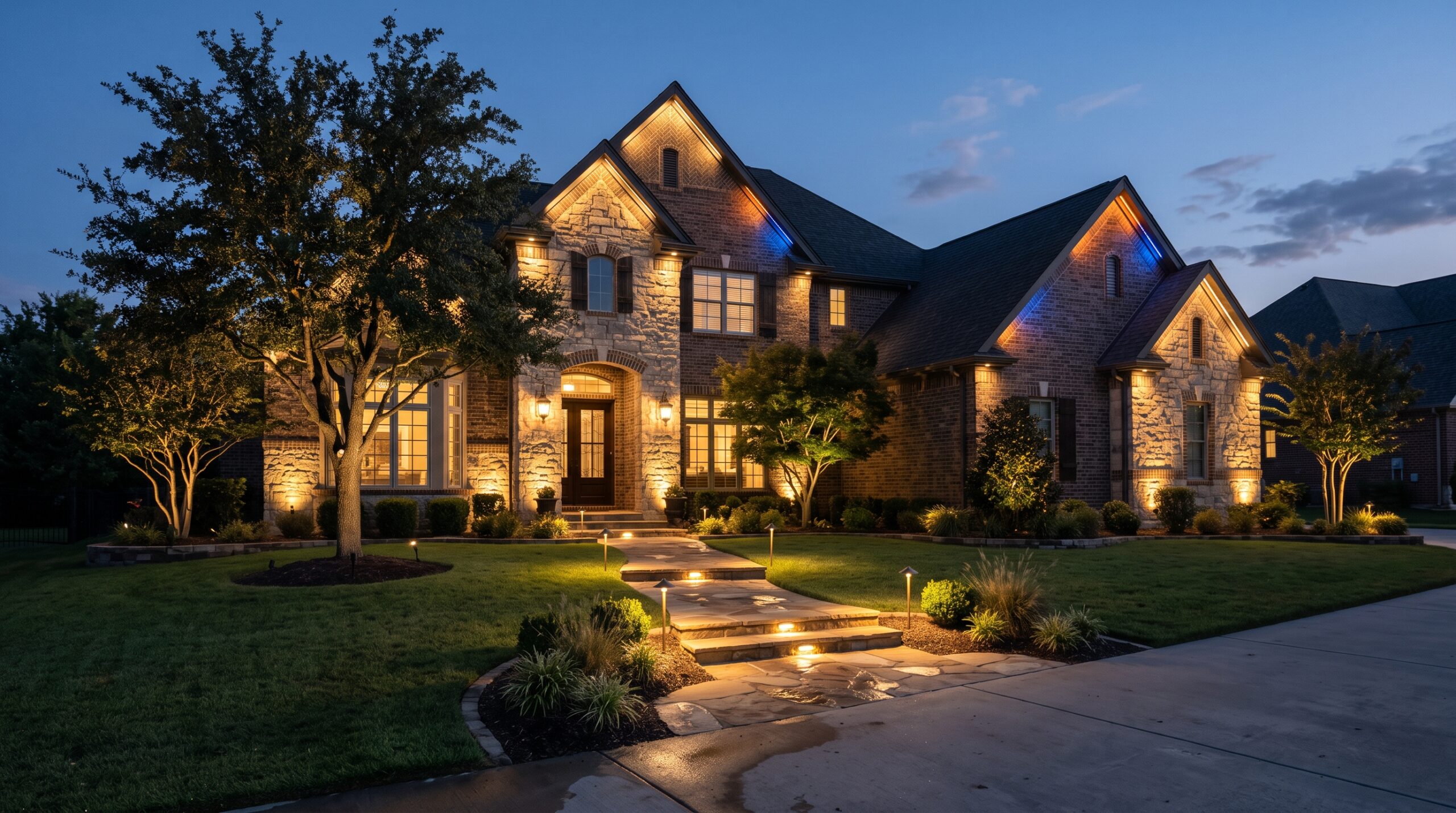
What is the best type of lighting for outdoor use?
- Low-Voltage LED Systems (12V – 24V): The industry gold standard for residential landscapes, delivering superior electrical safety, 80% lower energy consumption than halogen, and micro-optical beam precision without requiring expensive deep-trench 120V conduit.
- Solid Cast Brass, Copper, & Architectural Aluminum Housings: Non-corrosive, heavy-duty metals that resist UV degradation, pressurized sprinkler minerals, and freeze-thaw soil shifting while developing a natural protective patina.
- IP65 to IP68 Ingress Protection Ratings: Commercial weatherproofing standards that guarantee internal LED electronics are hermetically sealed against dust intrusion, high-pressure water jets (IP65/IP66), and continuous subterranean water submersion (IP67/IP68).
- RGB-WW Smart Roofline Track Systems: Colour-matched aluminum soffit tracks that conceal permanent point-source LEDs, pairing dedicated architectural warm-white diodes (2700K–3000K) for nightly curb appeal with full-spectrum RGB color tuning for holidays and events.
- Serviceable vs. Potted Integrated LEDs: High-CRI (85–95+) LED engines rated for 40,000 to 50,000 hours, engineered with surge suppression and thermal heat-sinking to prevent premature lumen depreciation.
Low-voltage (12V to 24V) integrated LED luminaires housed in solid brass, copper, or heavy-duty architectural aluminum with an IP65 to IP68 weather rating are the premier choice for outdoor use. For rooflines, RGB-WW smart track systems provide the ultimate versatility by combining dedicated architectural warm-white diodes with full-spectrum color customization.
Selecting the right exterior illumination requires looking far beyond daytime fixture aesthetics. Outdoor lighting hardware must survive continuous environmental assault—from blistering summer heat and sub-zero winter frost heave to acidic mulch, lawn care machinery, and high-mineral irrigation spray. While big-box stores flood the market with solar stakes and high-voltage floodlights, professional lighting designers and architectural engineers rely on a specific combination of low-voltage power distribution, non-ferrous metallurgy, and strict ingress protection standards to build systems that perform flawlessly for decades.
Understanding how voltage architectures, fixture materials, weatherproofing ratings, and roofline technologies work together will ensure you select the ideal lighting system for every zone of your property.
1. Power Architecture Comparison: Low-Voltage vs. Line-Voltage vs. Solar
Before choosing individual light fixtures, you must choose the electrical platform that powers them. In outdoor applications, 12V to 24V low-voltage LED systems overwhelmingly outperform both 120V line-voltage and solar alternatives.
| Power System | Operating Voltage | Installation Requirements | Best Use Case & Limitations |
| Low-Voltage LED (Premier Choice) | 12V – 24V DC/AC | Shallow 6–8″ turf trenching; stepped down via stainless multi-tap transformer. | Best for all landscape, architectural, and roofline zones. Safe around children, pets, and water; easy to expand or relocate as plants grow. |
| Line-Voltage (High Voltage) | 120V AC | Requires licensed electrician, rigid conduit buried 18–24″ deep, and junction boxes. | Best for wall-mounted porch sconces and garage coach lights. Too rigid, hazardous, and expensive for in-ground garden beds or tree uplighting. |
| Solar-Powered Fixtures | 1.2V – 3.7V Battery | No wiring; stakes pushed directly into soil. | Best for temporary markers. Tiny solar panels fail under tree shade or winter cloud cover, output weak blue-tinted lumens, and batteries die within 12–24 months. |
Why 12V–24V Low-Voltage Dominates Outdoor Design
Low-voltage systems utilize a central weatherproof transformer plugged into an exterior GFCI outlet to step standard 120V household current down to a safe 12V to 24V level. Because the current carries minimal shock hazard, direct-burial copper cable can be cleanly slit-trenched just 6 to 8 inches beneath the sod without tearing up root systems or pouring concrete over rigid pipes. Furthermore, low-voltage LED chips are physically compact, allowing manufacturers to engineer precision reflectors and lenses (from tight 10-degree spot beams to 60-degree wide washes) that bulky 120V lamps simply cannot replicate.
2. Housing Metallurgy: Choosing Materials Built for the Elements
The physical shell of an outdoor luminaire serves two purposes: protecting the internal optics from moisture and acting as a thermal heat sink to draw heat away from the LED diode. The best outdoor lighting relies on three commercial-grade metals:
Solid Cast Brass and Bronze (Best for In-Ground & Landscape Beds)
Cast brass is virtually impervious to the elements. Unlike ferrous metals that rust or thin aluminum that oxidizes when exposed to lawn fertilizers and wet mulch, solid brass naturally develops an organic, dark bronze patina over time. It possesses the structural density to survive accidental strikes from commercial string trimmers and edging shovels, making it the undisputed champion for path lights, directional uplights, and in-grade well lights.
Solid Copper (Best for Organic Botanical Integration)
Raw copper fixtures start with a bright penny finish and rapidly weather into a rich espresso brown and eventually a classic verdigris patina. Copper is exceptionally malleable and corrosion-resistant, making it a favorite for custom path light hats and hanging tree-canopy downlights.
Heavy-Duty Architectural-Grade Aluminum (Best for Roofline Tracks & Wall Mounts)
While thin, consumer-grade die-cast aluminum pits and blisters within a few years, extruded architectural-grade aluminum (such as 6061 or 6063 alloys) treated with chromate conversion coating and polyester powder-coating is the premier material for roofline tracks and structural wall sconces. Because roofline channels are mounted high under soffits—away from acidic soil and lawnmowers—heavy-gauge aluminum provides a lightweight, rust-free housing that can be custom color-matched to exact fascia and trim paint codes without sagging over long linear runs.
3. Decoding IP Weather Ratings: Why IP65 to IP68 Matters
Never install an outdoor light labeled merely “weather-resistant” or “for damp locations.” Professional outdoor lighting relies on the international Ingress Protection (IP) rating system, a two-digit code certified through rigorous laboratory testing. The first digit (rated 0–6) measures protection against solid particles like dust and soil; the second digit (rated 0–8) measures protection against water intrusion.
- IP65 (Dust-Tight & Water-Jet Protected): The minimum benchmark for architectural wall sconces, soffit roofline tracks, and under-cap hardscape lights. An IP65 rating certifies that the fixture is 100% sealed against dust and can withstand low-pressure water jets from any angle—such as wind-driven rainstorms or washing down the house siding with a garden hose.
- IP66 (Heavy Seas & High-Pressure Spray): Essential for directional landscape uplights and path lights positioned in open turf zones. Lawn irrigation rotors fire concentrated streams of water at close range every morning; IP66-rated fixtures use compressed silicone gaskets and tempered borosilicate glass lenses to prevent pressurized sprinkler spray from bypassing the seals.
- IP67 (Temporary Submersion up to 1 Meter): Required for in-grade well lights, driveway core lights, and turf-flush uplights. During heavy spring downpours or snowmelt, recessed holes in the ground inevitably fill with standing water before the soil can drain. An IP67 fixture is potted with marine-grade epoxy resin so it can sit completely submerged in a flooded trench without shorting out.
- IP68 (Continuous Pressurized Submersion): Reserved for underwater pond lights, fountain luminaires, pool niches, and dock lighting engineered to operate permanently beneath the waterline.
4. Roofline Illumination: The Rise of RGB-WW Smart Track Systems
In recent years, permanent roofline lighting has evolved from novelty holiday strips into sophisticated architectural lighting systems. The best roofline illumination utilizes low-voltage (12V–24V) RGB-WW smart track systems recessed seamlessly into the eaves and soffits.
Dedicated Warm-White (WW) vs. Simulated White (RGB)
Cheaper permanent holiday lights rely on standard RGB (Red, Green, Blue) diodes. When you ask a basic RGB light to produce white light for everyday architectural use, it turns on the red, green, and blue channels simultaneously. The result is a harsh, bluish-purple “hospital white” with terrible color rendering that makes red brick and stone look washed out and artificial.
By contrast, premier RGB-WW (Red, Green, Blue + Warm White) or RGBW systems integrate a dedicated, isolated warm-white phosphor LED chip (2700K to 3000K) inside every single puck alongside the color diodes.
- 330 Nights a Year (Architectural Mode): You run only the dedicated warm-white channel—turning off random intermediate pucks via smartphone app so only the fixtures aligned above peaks, gables, and columns illuminate. This mimics the look of high-end recessed soffit downlighting at a fraction of the electrical installation cost.
- Holidays & Game Days (Event Mode): With a single tap in the app, the entire roofline track awakens with individually addressable full-spectrum color animations, warm candlelight presets, or subtle security perimeters.
5. Integrated LED Engines vs. Drop-In Modular Lamps
When evaluating the best low-voltage landscape fixtures, you will encounter two internal light-source designs—both of which have distinct advantages when built to commercial specifications:
- Integrated LED Luminaires: The LED diode array is engineered directly into the brass or aluminum body from the factory. Because the LED board is thermally bonded directly to the heavy metal housing, heat dissipates rapidly, allowing integrated fixtures to achieve ultra-slim profiles (ideal for hardscape bars, roofline pucks, and micro-uplights) and superior IP67/IP68 waterproof sealing. Look for integrated fixtures with modular replaceable light engines so the internal board can be swapped decades down the road without cutting the underground wire.
- Retro-Fit / Drop-In Modular Fixtures: Uses a heavy solid-brass housing paired with a commercial-grade replaceable LED lamp (such as a sealed MR16, PAR36, or G4 bi-pin). This gives lighting designers extreme flexibility on site: if a tree grows twice as wide over five years, a technician can simply unscrew the brass shroud and swap a 15-degree narrow spot MR16 bulb for a 60-degree wide flood bulb in thirty seconds.
6. Matching the Best Fixture Type to Each Outdoor Zone
To achieve a balanced, cohesive property design, combine these specialized low-voltage fixture categories across your exterior architecture:
- Front Facade & Gables: RGB-WW architectural soffit tracks up high, paired with solid-brass directional spot uplights (IP66, 2700K, 15°–36° beam) grazing stone and brick columns from the foundation bed.
- Walkways & Garden Borders: Solid cast brass or copper shielded path lights (IP65/IP66, 50–100 lumens) staggered every 10 to 15 feet to cast downward pools of glare-free light.
- Driveways & Open Turf Trees: Recessed in-grade brass well lights (IP67) with angled internal hex louvers, allowing lawnmowers and vehicles to drive directly over the fixture without damage.
- Patios, Retaining Walls & Steps: Extruded aluminum or brass linear under-cap hardscape lights (IP65/IP67, 2700K) tucked invisibly beneath stone coping overhangs to wash stair treads and seat walls.
- Outdoor Kitchens & Pergolas: Low-voltage miniature overhead downlights (IP66) mounted into timber beams to provide crisp, high-CRI task lighting over grills and dining tables.
Have more Questions?
How much does it cost to get permanent outdoor lights installed?