
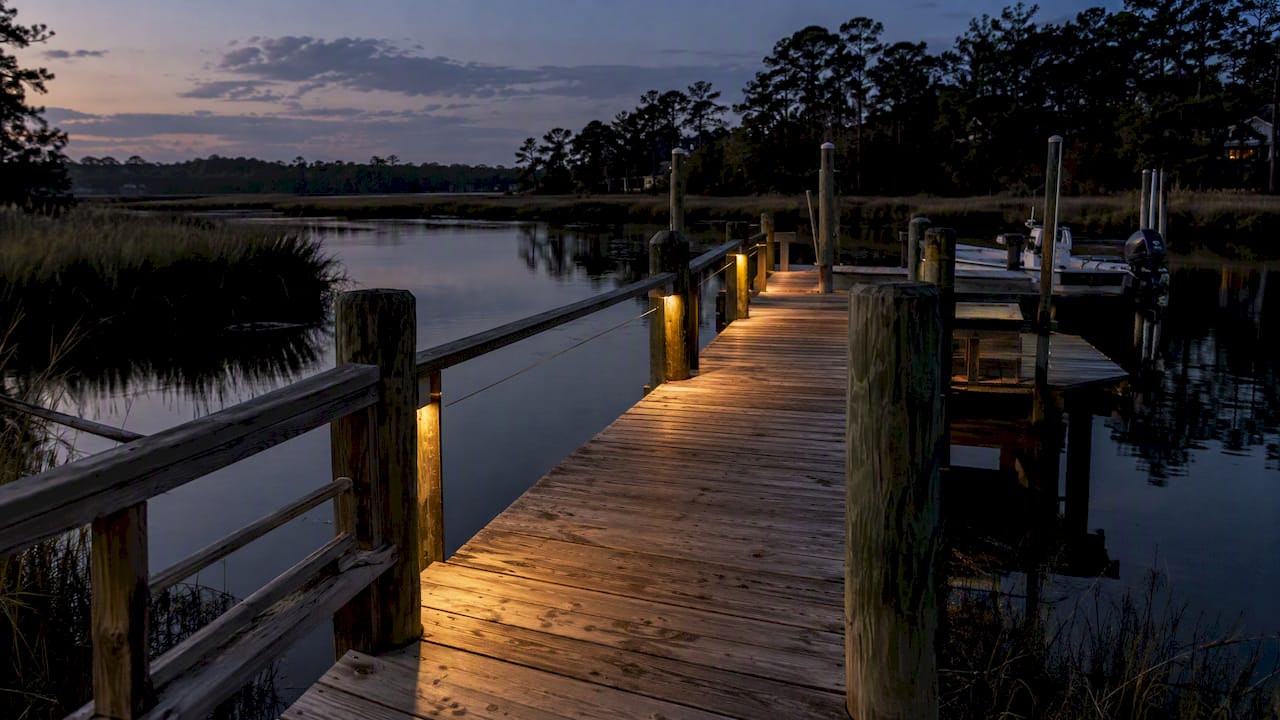
The simplest way to light a dock without harming wildlife is to use the lowest practical brightness, amber long-wavelength LEDs, full shielding aimed downward, and controls that keep lights off when nobody needs them. The U.S. Fish and Wildlife Service (USFWS) and Florida Fish and Wildlife Conservation Commission (FWC) both back this approach. It matters: hatchlings near artificial light lingered about 19.5 minutes versus 15.8 minutes in the near-shore study array.
TL;DR:
- FWC criteria favor amber, orange, or red sources without shorter wavelength emissions, but some amber lights still disrupted hatchlings, especially on moonless nights.
- Mount fixtures low and shielded, then inspect from shore after dark; any visible bulb or glowing lens needs repositioning or added shielding.
- Set motion lights to run for 1 to 5 minutes, divide the dock into sensor zones, and switch off unused lighting after 10:00 PM.
- In a coastal tracking study, hatchlings spent 19.5 minutes in the array under artificial light, versus 15.8 minutes under ambient conditions.
- During bird migration from April through May and August through October, shorten motion timers or keep the dock dark when it is unused.
Table of Contents
- What fixture specs make dock lights wildlife friendly?
- How should you place, aim and shield dock lights?
- How do timers, dimmers and motion sensors reduce impact?
- Can vegetation and barriers block light from reaching the beach?
- What does the research say about hatchlings and birds?
- What do FWC and USFWS standards mean on a site visit?
- How do you keep dock lighting wildlife friendly over time?
- Why a dock should be designed around darkness first
- How does Forever Glow Lighting help with wildlife friendly dock lighting?
- FAQ
- Sources
What fixture specs make dock lights wildlife friendly?
Start with the spectrum, because it is the one spec you cannot fix later with a shield. FWC’s Wildlife Lighting Criteria call for long-wavelength light sources with no shorter-wavelength emissions, which in practice means amber, orange or red LEDs. Shorter wavelengths, the blues and violets in white and “cool” LEDs, travel well through water and are easy for wildlife to see. A dock sits right at the water’s edge, so that spill has a clear path to the animals you are trying to protect.
Then think about how much light you need. Wildlife-friendly design starts from natural darkness and adds light only for a specific purpose, a principle laid out in practitioner guidance on nocturnal birds. A dock is not a parking lot. You need to see edges, steps and cleats, not the whole waterfront.
As a working rule of thumb from our installs (an installer’s judgment, not a regulatory number), aim for a faint, even glow on the tread or surface rather than a pool of brightness:
- Walkway and steps: very low output at each tread or edge, enough to see a change in level. Several dim fixtures beat one bright one.
- Docking area and cleats: a small, shielded downlight at each point where someone actually ties off.
- Gangway and landing: low-level lighting at the transition between land and dock, where trips happen.
Notice that every one of these is about task lighting. If a fixture lights something nobody uses at night, it should not be installed.
Fixture type matters as much as output. These are the housings we specify:
- Full-cutoff downlight housings: FWC’s criteria require fixtures that emit no light above the horizontal plane, and a full-cutoff housing is how you get there.
- Low-profile bollards: short, directional, and aimed at the walking surface rather than outward.
- Recessed step and dock lights: set flush so the light source itself is hidden from every angle except directly above.
- Marine-grade construction: look for a high ingress protection (IP) rating and corrosion-resistant materials, since salt, humidity and splash will defeat a cheap fixture over time. A fixture that fails and gets replaced with whatever is on hand is how wildlife-friendly designs quietly turn into unfriendly ones.
Just as important is what to leave off the dock entirely:
- Underwater decorative lights. Light on the water is a particular problem: hatchlings in the near-shore study showed strong attraction to artificial light on water and lingered near it.
- RGB and color-change fixtures. They cycle through exactly the short wavelengths you are trying to avoid.
- Exposed globe fixtures. A bare globe sends light in every direction, including toward the beach.
- Uplighting visible from the beach. Anything that throws light upward or outward is visible from far away.
Amber is not a free pass. A lab and field assessment of “turtle-friendly” lights found that some amber lights still disrupted sea-finding in loggerhead hatchlings, especially on moonless nights, with red lights less disruptive. That is why spectrum, shielding, placement and timing all have to work together. Our low-glare dock lighting page covers how we apply this on boat-owner properties.
Pro Tip: Read the manufacturer’s spectral data sheet, not the marketing label. “Amber” or “warm” on a box is not a spec. Look for the peak wavelength and confirm the fixture avoids shorter-wavelength emissions. If the sheet does not show a spectrum, ask for it or choose another fixture.
How should you place, aim and shield dock lights?
Good fixtures installed badly still spill light where you do not want it. Placement is where most dock projects succeed or fail, and the rule is simple: nobody standing on the beach or shoreline should be able to see a bulb, an LED chip or a glowing lens.
FWC’s guidance for property owners says to mount fixtures as low as appropriate and shield them so the bulb or glowing lens is not visible from the beach. On a dock, “low” usually means at or just above deck level. A light mounted high on a post lights a huge area and is visible for a long distance. A light mounted low and aimed down lights the boards and little else.
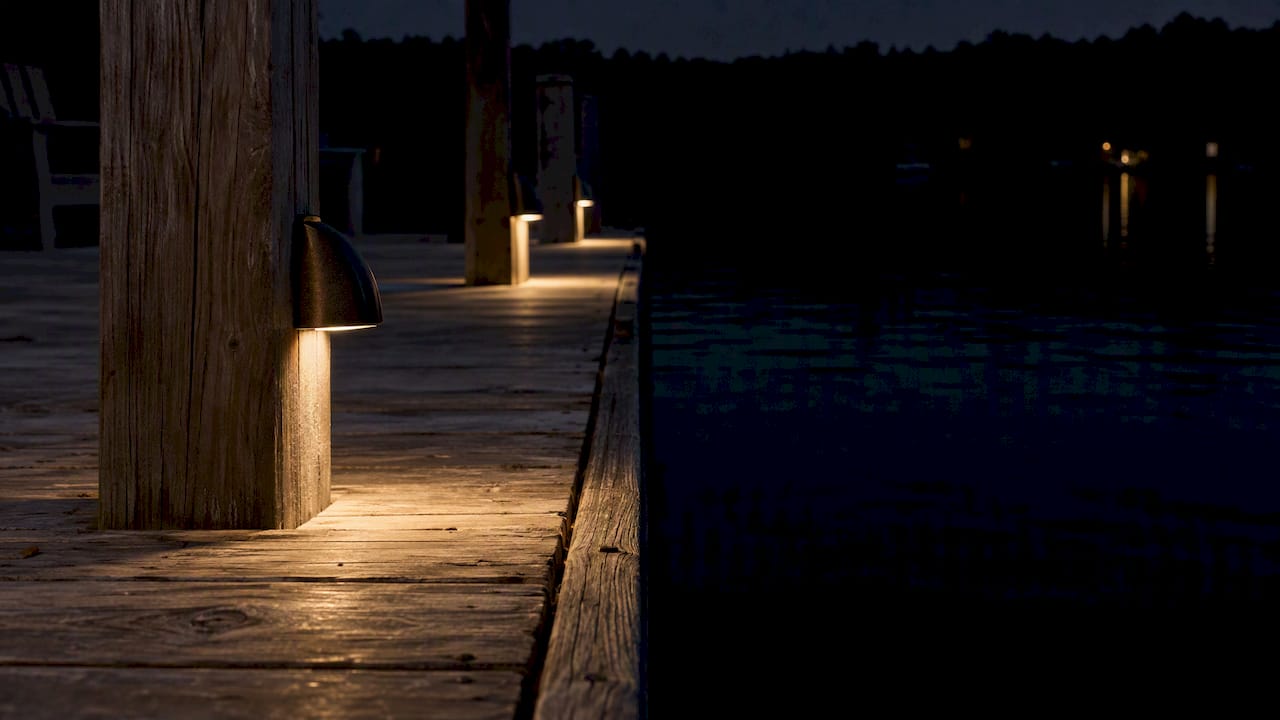
Shielding and orientation
Shielding is the physical barrier between the light source and the viewer. A few approaches work well together:
- Full-cutoff optics keep light from escaping above the horizontal plane at all.
- House-side shields and baffles are placed on the seaward side of the fixture so the lens cannot be seen from the water or beach.
- Recessed mounting puts the source inside a housing, so it is visible only from straight above.
Orientation is the part people miss. Stand where the animals would be, on the beach or at the water’s edge looking back at the dock, and check which direction each shield faces. A shield that blocks the wrong side does nothing.
Common dock features
Each part of a dock has its own tricks:
- Rail lights: mount on the inside face of the rail, pointing down at the deck, so the rail itself acts as a shield.
- Under-rail strips: only with shielded housings that keep the diodes hidden. An exposed strip is effectively a long, unshielded line of glare.
- Step lights: recess them into the riser so only the tread is lit.
- Landing-area lighting: one shielded downlight over the spot where people actually step on and off.
Our dock and waterfront lighting page shows how we handle these details on real waterfront properties. For ideas on safe, low-profile fixtures on elevated surfaces, deck lighting options pros use offers practical examples that translate well to dock railings and steps.
Temporary retrofit fixes
If you already have lights that cause problems, you do not have to wait for a full redesign. Quick fixes that help in the meantime:
- Aluminum flashing shields wrapped around the seaward side of an existing fixture to cut off visibility from the beach.
- Matte black paint inside a fixture to reduce reflected glare. Treat this as a stopgap, since heat and weather will wear it down.
- Repositioning or removing nonessential fixtures. The best light for wildlife is the one that is not there. If a fixture does not serve a safety task, take it down.
Our dock lighting regulations page explains how local codes can affect what you are allowed to keep.
Pro Tip: Do the night walk before you finalize anything. Turn on every dock light after dark, then walk the shoreline and the beach looking back toward the dock. Any fixture where you can see the lens or bulb needs a shield, a new aim or a new location.
How do timers, dimmers and motion sensors reduce impact?
Even a perfectly shielded amber fixture should not run all night. Duration is one of the cheapest and most effective levers you have. USFWS recommends limiting lighting to necessary safety and navigation needs and using automatic controls such as timers, dimmers and motion sensors so lights are off when not in use. The same guidance notes that ordinances often require security lights to shut off within 5 minutes of activation, and suggests that lights should generally be turned off after 10:00 PM if not in active use.
Practical control settings
These are the settings we start from, and we adjust them for each site:
- Motion-on duration: 1 to 5 minutes. This lines up with the shutoff times many ordinances expect, and it is long enough to walk the length of most docks.
- Dim-to-level: if you want a faint baseline for safety, set a very low passive level rather than full brightness, and let motion raise it briefly.
- Zones: split the dock into separate zones so only the area someone is approaching lights up. A person stepping onto the gangway should not light the far end of the pier.
Seasonal and adaptive operation
Dock lighting does not need the same schedule in July as in January. Experts note that disorientation risk for migratory birds rises during spring and fall migration, April through May and August through October, and that shielding, dimming and warm-colored lighting at or below 2200K help. Nesting and hatchling seasons for sea turtles call for the same kind of caution. During these windows, consider shorter motion timers, earlier shutoff, or simply keeping the dock dark when it is not in use.
Commissioning checklist
Once the controls are installed, test them before you call the job done:
- Confirm each zone turns on only when its own sensor is triggered, not when something in a neighboring zone moves.
- Walk the dock at night and confirm each motion sensor detects a person at the distance you need, with no dead spots on steps or at the gangway.
- Time the on-duration at each zone and confirm lights shut off on schedule, with no stuck-on behavior.
- Check that wind, waves, birds, boat movement or swaying branches do not trigger the sensors and cause accidental continuous illumination.
- Verify the dim-to-level setting looks correct from the shoreline, with no visible glow from the beach side.
- Set and confirm the nightly shutoff schedule, including any seasonal override during nesting and migration windows.
Pro Tip: Sensors aimed across open water are the most common cause of lights that never turn off. Point motion detectors at the walking surface, shade them from the water side, and recheck sensitivity after the first windy night.
Can vegetation and barriers block light from reaching the beach?
Fixtures and controls handle the light you produce. Landscaping and structures handle what is left. A good buffer interrupts the line of sight between your dock and the beach, which is exactly what practitioners identify as the most effective single step.
Vegetation is the most natural option. Native, salt-tolerant plants such as sea grape and other coastal shrubs can form a living screen that blocks direct view from the beach while fitting the habitat. Plant them where they sit between the lit area and the shoreline, and keep your plant choices local to your region.
Not every property has room or permission for plantings, so other measures help too:
- Low berms that raise the ground between the light and the beach.
- Privacy screens or solid railings on the seaward side of the dock or landing.
- Balcony shields on elevated decks and docks attached to waterfront homes.
- Window tints and blinds to stop interior light from spilling out toward the water. FWC specifically points to window treatments and motion detectors to limit how much interior light is visible from the beach.
One caution: do not disturb the dune system to build a buffer. Dunes are part of the nesting habitat, and altering them or blocking access for nesting animals can cause more harm than the light you are trying to hide. Before planting, grading or building anything in or near a dune, talk with your local wildlife authority. A buffer that protects the beach from light should never come at the cost of the beach itself.
What does the research say about hatchlings and birds?
The guidance above rests on experiments, not just good intentions. A peer-reviewed tracking study measured how long green turtle hatchlings spent in a near-shore array with and without artificial light:
Hatchlings exposed to artificial light spent an average of 19.5 minutes in the near-shore tracking array, compared with 15.8 minutes under ambient conditions. That extra time near shore is time spent where predators concentrate.
Here is what the research tells us in practical terms:
- Hatchlings are drawn toward light. The tracking showed strong attraction to artificial light on the water, a response known as positive phototaxis, and animals lingered near the source.
- Lingering raises risk. More time near shore likely means more predation exposure and a delayed trip to deeper water.
- Water makes it worse. Light that reaches the water, including underwater fixtures, is typically not wildlife-safe for coastal environments.
- Birds are affected too. Wildlife-friendly lighting benefits both sea turtles and migratory birds, and disorientation risk climbs during April through May and August through October.
- Amber and red reduce disruption but do not erase it. Researchers testing so-called turtle-friendly lights found disrupted sea-finding in some cases, particularly on moonless nights and when lights were close to hatchlings.
A broader review of urban marine lighting points the same way. Light reach, intensity, spectrum and duration all shape the effect on marine habitats, and combined measures such as shielding, spectral control and vegetation buffers work best. It also admits that low-level light can still harm some species, so in the most sensitive spots, darkness is the only full solution. An international review recommends case-by-case impact assessments and consulting qualified biologists for sensitive habitats.
The practical lesson is not that amber lights are the answer. Amber helps, but placement, shielding, intensity and timing carry equal weight. That is why we treat every dock as a system rather than a fixture choice. Conservationists make the same point, noting that modern shielded amber LEDs can provide sufficient safety illumination while reducing impacts when placement and shielding come before simply adding brightness.
What do FWC and USFWS standards mean on a site visit?
Regulatory language can be dense. Here is how we translate it into things you can check on the ground. The FWC criteria and model standards call for these measures:
- Mount low and use the lowest wattage or lumen output needed for the task.
- Use long-wavelength sources that avoid shorter-wavelength emissions.
- Use full-cutoff fixtures that emit no light above the horizontal plane.
- Shield so the lamp or lens is not visible from the beach.
For lights that already exist, the Florida model lighting ordinance points to a familiar set of fixes:
- Reposition fixtures so they do not light the beach.
- Replace exposed bulbs with shielded or recessed fixtures.
- Use low-intensity lights for parking areas within line of sight of the beach.
- Tint windows or add interior measures to reduce spill.
- Plant buffers, and remove noncompliant decorative lights.
For a quick site-visit checklist, here is what we check at each dock:
| Check | What passes |
|---|---|
| Light color | Amber, orange or red, with no shorter-wavelength emissions |
| Fixture shape | Full cutoff, with no light above the horizontal plane |
| Mounting height | As low as practical for the task |
| Visibility from the beach | No bulb or glowing lens in view |
| Controls | Timers, dimmers or motion sensors with short on-times |
Ordinances vary by location, and some areas have stricter local rules than model language. Before you finalize a design, review our dock lighting regulations guide and confirm requirements with your local authority.
How do you keep dock lighting wildlife friendly over time?
A compliant system on day one can drift out of compliance by next season. Shields get knocked, fixtures get bumped out of aim, lenses get hazy with salt, and a homeowner swaps a failed bulb for the wrong one. A short routine prevents that.
Audit before and during sensitive seasons, meaning nesting season and the spring and fall migration windows. At each audit, check that shields are intact, fixtures are still aimed down, and lenses are clean. Dirt on a lens scatters light in directions the optics were not designed for.
Here is the field routine we use:
- After dark, walk the shoreline and look back at the dock. Note any visible lens, bulb or glow.
- Check the spec sheet of any replacement fixture for its wavelength profile and confirm it avoids shorter-wavelength emissions.
- From the beach side, check whether interior lights from the house or any dock building show through windows.
- Run through the control commissioning checklist again: zones, durations, sensor coverage and the nightly shutoff.
- Record the date, what you found and what you fixed, so you can spot recurring problems.
A simple log makes patterns obvious. If the same fixture keeps getting knocked out of aim, it needs a better mount or a different location.
Many owners prefer to hand this off. Our GlowCare Maintenance Subscription helps maintain your lighting system over time.
Pro Tip: Keep a spare set of the exact shields, lenses and amber lamps you installed. When something breaks mid-season, use a matching replacement rather than reaching for a bright white bulb as a quick fix.
Why a dock should be designed around darkness first
Here is where I land after years of looking at docks from both the land side and the water side: the best wildlife-friendly dock lighting plan begins with the question “what can we leave dark?” Most owners start from the opposite end. They pick a fixture they like, then try to make it behave. That gets you a dock that is less bad, not one that is good.
The trade-offs are real, and I will not pretend otherwise. Safety matters. A dock with no light at all is a hazard, especially around steps and gangways. The answer is to put light only at the points where a foot lands and keep everything else dark. That is a design decision, and it costs almost nothing in looks. A dock with a few low amber glows on the treads can be quietly beautiful, and many clients tell us they prefer it to a bright, flat wash.
The mistakes I see most often are DIY ones: fixtures aimed outward instead of down, bare strips along the rail, a decorative underwater light added “just for ambiance,” or a motion sensor pointed at open water that never lets the lights shut off. Each one undoes the work the rest of the design is doing. Professional design is mostly about avoiding those quiet errors before they get installed.
— Dave
How does Forever Glow Lighting help with wildlife friendly dock lighting?
We design and install marine-grade dock lighting built around the criteria in this guide: amber long-wavelength sources, full shielding, low mounting and short, smart controls. Every project starts with a night walk of your waterfront so we can see what the beach and water see.

Here is what we bring to a dock project:
- Marine-grade fixtures for dock lighting.
- Custom design for lighting stairs, gangways and cleats.
- Smart controls that you can adjust from your phone.
- GlowCare maintenance so shields, aim and lenses get inspected and corrected through the seasons.
You can see how we approach waterfront work on our dock and waterfront lighting page and our landscape lighting design page, which covers the buffers and plantings that support a dock plan. Current pricing details are on our website, since every dock is different. When you are ready, request a free estimate and we will walk your waterfront with you.
FAQ
What are the best lights for a wildlife friendly dock?
The best choice is a shielded, full-cutoff fixture with a long-wavelength amber or red LED, mounted low and aimed at the walking surface. FWC’s Wildlife Lighting Criteria set this standard. Pair it with a motion sensor or timer so the light is off when nobody needs it.
Are underwater dock lights safe for wildlife?
Underwater lights are typically not wildlife-safe in coastal environments. Light on or in the water is especially attractive to hatchlings, and a peer-reviewed tracking study found they spent longer in the near-shore array under artificial light. Skip decorative underwater fixtures and light the dock surface from above instead.
Do LED lights attract fewer bugs?
Amber and other warm LEDs may attract fewer insects than white or blue-heavy light. Long-wavelength LEDs are also recommended in wildlife lighting criteria, so one choice may help with both. Shielding and short on-times reduce the draw even further.
What material works best for outdoor dock lights in coastal areas?
Look for marine-grade construction with a high ingress protection (IP) rating and corrosion-resistant housings, since salt and splash destroy ordinary fixtures quickly. A sealed, rugged fixture also holds its shield and aim longer, which keeps the lighting wildlife friendly as the dock ages.
How long should dock lights stay on?
Keep motion-triggered lights on for roughly 1 to 5 minutes, and turn nonessential lighting off by 10:00 PM when you can. USFWS notes that ordinances often require security lights to shut off within 5 minutes of activation and suggests lights go off after 10:00 PM if not in active use.