
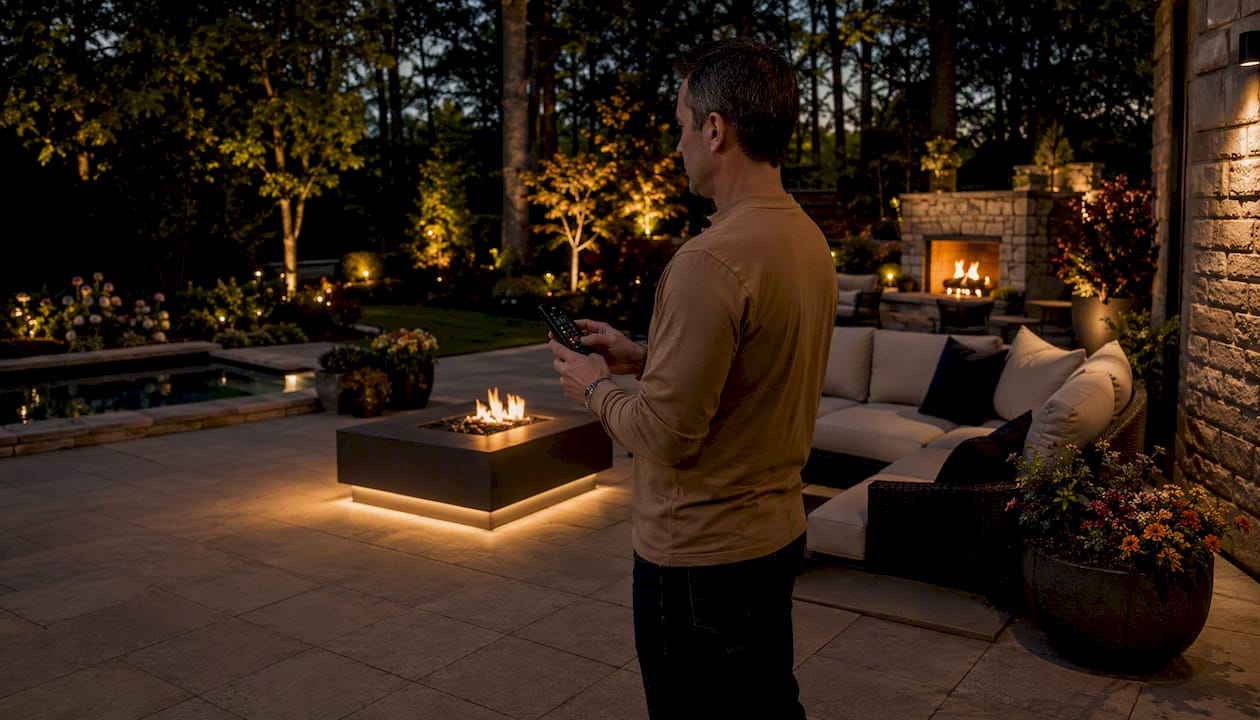
A permanent, smart, color-changing LED system installed by a professional is the most reliable way to cover every occasion from Christmas to gameday to a backyard dinner party without touching a ladder or swapping a single fixture. The first step is scheduling a free on-site estimate so a designer can assess your roofline, landscape, and power availability before recommending a fixture plan.
Table of Contents
- What does a permanent smart outdoor lighting system actually mean?
- How one system adapts for holidays, gameday, events, and everyday use
- Which fixture types do you actually need, and where do they go?
- How do smart control systems compare, and what should you ask about?
- Design rules that make multi-occasion lighting look intentional
- What does the installation process look like, and how long does it take?
- What does a permanent lighting system cost?
- What should you expect from maintenance and warranties?
- How do you choose the right lighting system and installer?
- What lighting trends should influence your system choice in 2026?
- Key Takeaways
- Why permanent smart lighting is the right call for most homeowners
- Foreverglowlighting brings permanent smart lighting to Charlotte homes
- Useful sources
What does a permanent smart outdoor lighting system actually mean?
“Permanent” does not mean inflexible. It means weather-rated LED fixtures and track systems are mounted once, wired cleanly into your home’s electrical supply, and stay in place year-round. The hardware is discreet by day, typically flush to the eave or roofline, and fully controllable by night through a smartphone app or local controller.
Key capabilities that separate these systems from seasonal temporary lights:
- Multi-color and tunable white output — millions of color combinations, switchable in seconds
- Scene scheduling and geo/time triggers — set a holiday palette to activate at sunset automatically
- Smart home integration — compatible with Alexa, Google Home, and Apple HomeKit on most platforms
- Professional waterproofing and fixture ratings — commercial-grade IP ratings designed for year-round outdoor exposure
- Electrical and permitting compliance — professional installers handle low-voltage or line-voltage work to code
The practical difference from temporary seasonal lighting is significant. You eliminate the annual labor of hanging and storing lights, avoid the visual clutter of extension cords, and gain the ability to change scenes instantly. A permanent lighting system also handles electrical permitting considerations that DIY string lights never address.
How one system adapts for holidays, gameday, events, and everyday use
The real value of a permanent smart system is how many distinct occasions it covers without any physical changes. Each occasion simply calls up a different preset.
Holiday lighting uses animated color sequences, traditional red-and-green palettes, or warm white outlines along the roofline. Presets can be scheduled to activate at dusk and shut off at midnight automatically, so you never think about it after October.
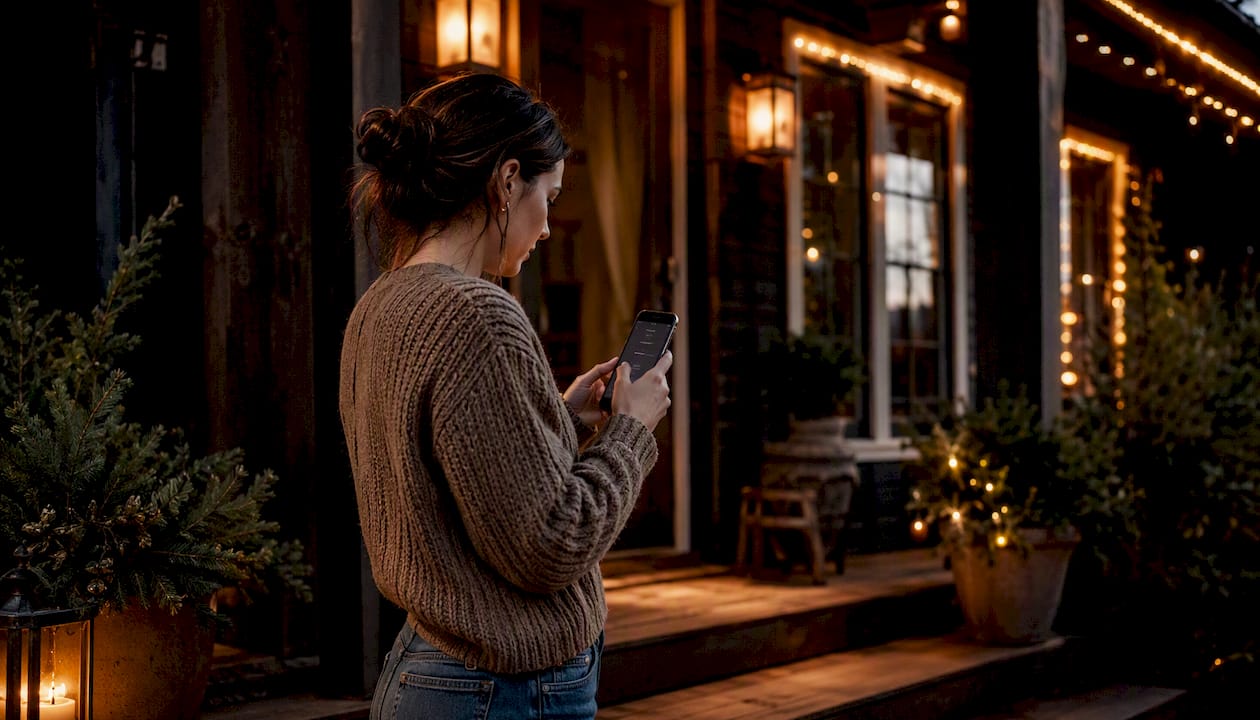
Gameday displays are where color-changing systems genuinely surprise homeowners. Switching to your team’s colors for a Saturday afternoon takes about three seconds in the app. Timed flash sequences and animated patterns are available on most platforms.
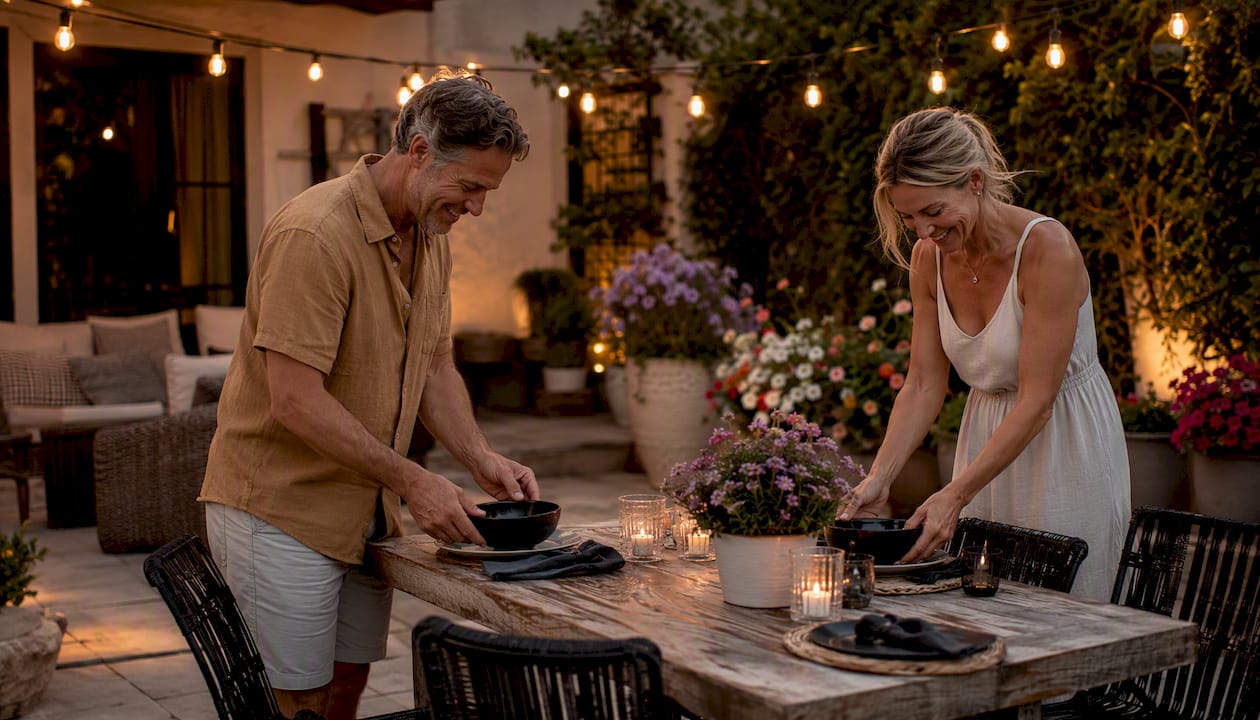
Dinner parties and outdoor events benefit most from warm-amber scenes on the patio, bistro string lights overhead, and soft uplighting on trees or garden beds. Outdoor entertaining spaces feel entirely different at 2700K than they do under harsh white light. Planners increasingly treat lighting as atmosphere strategy, designing scenes that guide guest movement and set emotional tone from arrival through dinner.
Security and functional lighting uses bright white at full intensity, triggered by motion sensors or scheduled for late-night hours. This is the same fixture set, just a different scene preset.
Everyday accent lighting runs a soft, low-intensity warm white that highlights architectural details and landscaping without drawing attention to itself. Moon-wash and tree uplighting, where fixtures are aimed up through a mature canopy, create depth that flat overhead light cannot replicate.
Which fixture types do you actually need, and where do they go?
Understanding fixture categories helps you evaluate any proposal and ask the right questions during a site visit.
- Roofline track systems — the backbone of most permanent installations; they outline the home’s profile and produce color sweeps, animated sequences, or clean white accents. Spacing typically runs moderate distances between nodes depending on the desired density.
- Low-voltage uplights — aimed at trees, facade stone, or architectural columns; they add vertical depth and are the primary tool for moon-wash effects. Choose fixtures with high CRI for photography-friendly results.
- Path and step lights — low-level fixtures that handle safety along walkways, stairs, and driveway edges; they also contribute a soft ambient glow at ground level.
- Bistro and string lights — warm patio string lights suspended overhead create the ambient dining atmosphere that photographs best for events; warm amber string lights paired with candle clusters are consistently rated the highest-impact, most cost-effective event lighting investment.
- Pin spots and accent fixtures — tight-beam fixtures aimed at centerpieces, sculpture, or portrait zones; they require high CRI (95+) for broadcast-quality video and event photography.
Placement matters as much as fixture selection. Reserve focal points — the front entrance, a specimen tree, a stage or dining area — for accent fixtures rather than spreading everything evenly. Decorative fixtures like sconces and pendants serve double duty as ambient sources and visual anchors, which makes them worth including in layered designs even when they are not the primary light source.
Pro Tip: Warm uplights and pin spots with CRI 90+ photograph significantly better than cool-white floods. If your events will be photographed or livestreamed, specify fixture CRI before approving any proposal.
How do smart control systems compare, and what should you ask about?
Control method is one of the most consequential decisions in a permanent lighting system, and it is frequently underexplained during the sales process.
| Control Type | Reliability | Scalability | Ease of Use | Event Features |
|---|---|---|---|---|
| Vendor app ecosystem | High (cloud-dependent) | Moderate | Very easy | Scene presets, scheduling, color picker |
| Wireless DMX | Very high (local) | High | Moderate | Full show control, cue sequences |
| Local controller (no app) | Very high | Low | Easy | Fixed scenes, timer-based only |
Vendor app ecosystems are the most common choice for residential installations. They are easy to use and support scheduling, color changes, and scene libraries. The tradeoff is cloud dependency — if the vendor’s servers go down or the company discontinues the product, local control may be limited. Ask specifically whether the system supports local fallback operation.
Wireless DMX is the professional standard for event production. It eliminates copper cabling runs, reduces visual clutter, and supports full show-control cue sequences. For homeowners who host frequent events or want broadcast-quality control, it is worth the added complexity.
Beyond control method, evaluate these technical specs before approving a fixture package:
- IP rating — IP65 minimum for exposed outdoor fixtures; IP67 or IP68 for ground-level or wet-zone placements
- CRI — 90+ for general use; 95+ if photography or video matters
- Dimming frequency — camera-safe dimming (typically 2000Hz+) prevents flicker artifacts in photos and video
- Firmware update policy — ask whether updates are pushed automatically or require a technician visit
Smart home integration with Alexa, Google Home, or Apple HomeKit is available on most modern vendor platforms. For a broader look at how permanent lighting fits into a connected home, smart home integration guides cover the compatibility questions worth asking before you commit to a platform.
Pro Tip: For hybrid or livestreamed events, mixed color temperatures in a single wash create unfixable camera color issues. Specify consistent color temperature across all fixtures in any zone that will be on camera.
Design rules that make multi-occasion lighting look intentional
Layered lighting — ambient, accent, and functional — is the fastest way to make any scene feel designed rather than simply bright. Relying on one source creates a flat or clinical look regardless of how many lumens you add.
A practical checklist for any multi-occasion design:
- Choose a dominant color temperature. Warm amber 2700K–3000K flatters skin tones and creates the cinematic look that dominates event photography in 2026.
- Build three layers. Ambient light sets the overall glow; accent light adds depth and drama to focal elements; functional light covers safety and task areas.
- Preserve dark space. Contrast between lit and unlit areas creates visual interest. A yard lit uniformly at the same intensity looks like a parking lot.
- Allocate accent fixtures to focal points. The entrance, a specimen tree, and the dining or stage area each deserve dedicated accent fixtures rather than sharing ambient wash.
Pro Tip: The most common homeowner mistake is adding more fixtures to solve a flat-looking result. Less bright but layered lighting reads as higher quality in photos and in person. Audit the layers before adding lumens.
What does the installation process look like, and how long does it take?
A professional permanent lighting installation follows a clear sequence. Knowing the steps helps you plan around events and seasonal deadlines.
- Site survey and measurements — a designer visits to assess roofline dimensions, tree health for uplights, power availability, and HOA or permit requirements. This is where fixture placement and scene priorities are confirmed.
- Design and proposal — you receive a written lighting plan with a fixture schedule, scene descriptions, and an itemized cost breakdown.
- Permitting — if line-voltage electrical work is required, the installer pulls the necessary permits. A qualified installer handles this; you should not need to manage it yourself.
- Installation — fixtures are mounted, wiring is concealed in conduit or within the roofline channel, and all connections are weatherproofed. A typical residential installation runs one to two days depending on scope.
- Commissioning and scene programming — the installer programs your initial scene library (holiday, security, everyday accent, event warm-amber) and walks you through the app.
- Final walkthrough — you review each scene, request adjustments, and receive a written operations and maintenance handoff document.
During the site visit, confirm these items: power panel capacity for the added load, roofline mounting details and any HOA restrictions on hardware visibility, tree health and root zones for uplight placement, and the plan for cable concealment at ground level. Professional installation removes the guesswork from all of these decisions.
What does a permanent lighting system cost?
Cost varies based on system scale, fixture grade, control complexity, and the amount of electrical or trenching work required. The table below shows representative ranges for three common project sizes.
| Project Scale | Typical Range | What’s Normally Included |
|---|---|---|
| Small yard / townhome | a lower cost range | Site visit, roofline track, basic app control, install labor, scene setup |
| Mid-size home | a moderate cost range | Site visit, roofline + uplights + path lights, app control, full scene library, permit handling |
| Large estate / commercial | a higher cost range | Full fixture schedule, wireless DMX option, landscape layering, programming, maintenance plan |
The primary cost drivers are linear feet of roofline, number of uplights and path fixtures, control system complexity, and the amount of electrical work required. Trenching for buried conduit adds cost but produces a cleaner result.
Budget guidance: allocate 10–20% of total project cost to programming and scene creation. A well-programmed scene library is what makes the system genuinely useful across occasions rather than just functional. A landscape lighting upgrade for an existing system typically costs less than a full installation because the electrical infrastructure is already in place.
For event-specific budget priorities, warm amber string lights and candle clusters deliver the highest impact at lowest cost, followed by perimeter uplighting, with moon-wash and projection effects reserved for milestone events where the investment is justified.
What should you expect from maintenance and warranties?
Permanent outdoor lighting systems are designed for durability, but they do require periodic attention to stay performing well.
Typical warranty coverage runs multiple years on fixtures and about a year on installation labor, though commercial-grade products often carry longer hardware warranties. Common maintenance tasks include fixture cleaning (dust and debris reduce output over time), gasket inspection and replacement on ground-level fixtures, firmware updates for app-connected systems, and seasonal inspections before high-use periods like the holidays.
Before signing any installation contract, confirm three things: spare parts availability for the specific fixture model (discontinued fixtures are a real long-term risk), whether firmware updates are pushed remotely or require a service visit, and the installer’s response SLA for fixture failures during an active event or holiday season.
How do you choose the right lighting system and installer?
A structured decision process prevents the most common mistakes: buying on price alone, approving vague proposals, or discovering permit issues after installation begins.
Step-by-step selection checklist:
- Define your primary use cases and rank them. Holiday lighting, security, and everyday accent are the most common priorities; event staging and gameday displays are secondary for most homeowners.
- Set a realistic budget range before the first conversation with any installer.
- Require a physical site survey. Any proposal built from photos or a phone call is missing critical information.
- Request a written lighting plan with a fixture schedule, IP and CRI ratings for each fixture type, and a scene description for each preset.
- Ask for a live scene demo, either on a mockup or on a comparable installed property.
Questions to ask every installer:
- What IP and CRI ratings do your fixtures carry?
- How are firmware updates managed, and what happens if the platform is discontinued?
- Who pulls permits and handles electrical work?
- What does the warranty cover, and what is the response time for fixture failures?
- Can you show before-and-after photos from comparable installations?
Red flags to watch for:
- Vague fixture specs with no IP or CRI ratings listed
- No site survey before a proposal is delivered
- No written commissioning plan or scene library description
- Consumer-grade fixtures presented without commercial ratings for permanent outdoor use
Professional landscape lighting design pays for itself when it eliminates these risks upfront.
What lighting trends should influence your system choice in 2026?
The clearest shift in 2026 is from static lighting setups to reactive, immersive experiences controlled by smarter automation. Lights that respond to event schedules, adjust color temperature through the evening, and integrate with music or AV systems are moving from event production into residential installations.
Trend Callout: Warm amber in the range that flatters skin tones is the dominant tone for event photography and design in 2026, favored for its ability to flatter skin tones and create a cinematic, romantic atmosphere.
Two technical trends are worth factoring into any system purchase this year. First, wireless DMX and battery-powered LED fixtures are reducing rigging complexity and visual clutter, enabling high-impact placements without heavy cabling runs. Second, high-CRI fixtures (95+) are becoming the baseline expectation for any installation that will be photographed or broadcast, as they eliminate the color-shift problems that affect 4K and 8K cameras.
For future-proofing, favor systems with open APIs that allow integration with new platforms as they emerge. Design conduit or access points into the installation now so future fixture upgrades do not require reopening walls or rooflines. On sustainability, marine-grade housings and efficient LED drivers reduce long-term replacement costs more reliably than any other single specification choice.
Key Takeaways
A permanent, professionally installed smart LED system is the most cost-effective and reliable way to deliver flexible, high-quality lighting across every occasion a homeowner or event planner faces.
| Point | Details |
|---|---|
| Permanent systems cover all occasions | One installation handles holidays, gameday, events, security, and everyday accent through app-controlled scene presets. |
| Layering beats raw brightness | Ambient, accent, and functional layers produce higher-quality results than adding more lumens to a single source. |
| Warm amber 2700K–3000K is the 2026 standard | This color temperature flatters skin tones and dominates event photography; specify it for any event-facing scene. |
| Budget 10–20% for scene programming | A well-built scene library is what makes a permanent system genuinely useful across multiple occasions. |
| Foreverglowlighting offers free on-site estimates | Foreverglowlighting’s Charlotte-based team provides site surveys, written fixture plans, and GlowCare maintenance subscriptions for year-round reliability. |
Why permanent smart lighting is the right call for most homeowners
The conventional wisdom in outdoor lighting is that you buy what you need for the season and store the rest. That approach made sense when the only option was a box of incandescent strings from a hardware store. It does not hold up against what a permanent smart system actually delivers.
The argument for permanent installation is not about convenience alone, though never climbing a ladder to hang Christmas lights again is genuinely valuable. The stronger case is design quality. Temporary lights are placed where they are easy to hang, not where they produce the best result. Permanent fixtures are positioned by a designer with a fixture schedule, a scene plan, and knowledge of how the light will read in photos. The difference shows immediately.
There is also an honest point about HOA compliance and permitting. Many homeowners assume permanent outdoor lighting triggers restrictions. In practice, discreet roofline track systems are frequently more HOA-friendly than seasonal decorations because the hardware is low-profile and the installation is clean. Foreverglowlighting designs with HOA guidelines in mind and handles permit requirements when electrical work is involved, which removes the compliance uncertainty that stops many homeowners from acting.
The free on-site consultation exists precisely because no two properties are the same. A site survey is where the real design work begins.
Foreverglowlighting brings permanent smart lighting to Charlotte homes
Skip the seasonal storage bins and the annual ladder climb. Foreverglowlighting installs custom permanent LED systems across the greater Charlotte area that handle every occasion you can plan for, and a few you cannot.
The core services cover everything a multi-occasion system needs: permanent roofline track systems, landscape layering with uplights and path fixtures, bistro string installations for patios and entertaining spaces, smart control programming with a full scene library, and GlowCare maintenance subscriptions that keep the system ready before every holiday and event season.
A free estimate includes a physical site survey, sample scene mockups, an itemized fixture schedule with IP and CRI ratings, a project timeline, and permit handling where required. There are no vague proposals and no consumer-grade fixtures passed off as permanent solutions.
Ready to see what your home looks like with a professionally designed scene? Schedule your free consultation or browse the portfolio to see before-and-after results from Charlotte installations. For homeowners who want to go beyond holiday use, the guide on using permanent lighting year-round shows exactly how versatile one installation can be.
Useful sources
- Event Lighting Trends 2026: What’s Actually Worth It — Covers warm amber color temperature recommendations, layering principles, and budget priority guidance for 2026 event design.
- Event Lighting Design Trends 2026 for Modern Event Experiences — Explains the shift from static lighting to reactive, automation-driven experiences and what it means for residential and event installations.
- Corporate Event Lighting Design Ideas: The 2026 Technical Production Guide — Technical reference covering wireless DMX, high-CRI fixture specs, camera-safe dimming, and broadcast-quality lighting standards.
- Event Lighting Ideas: How Lighting Transforms Your Event — Practical definitions of ambient, accent, and functional lighting layers with guidance on how each contributes to event atmosphere.
- What is Decorative Lighting? — Explains how decorative fixtures serve multiple roles in layered designs, useful for homeowners evaluating fixture proposals.
- Permanent Lighting Services — Foreverglowlighting’s overview of permanent outdoor lighting services for Charlotte-area homeowners.
- Outdoor Lighting Scene Setting — Foreverglowlighting’s guide to scene programming and how to get the most from a multi-occasion system.