
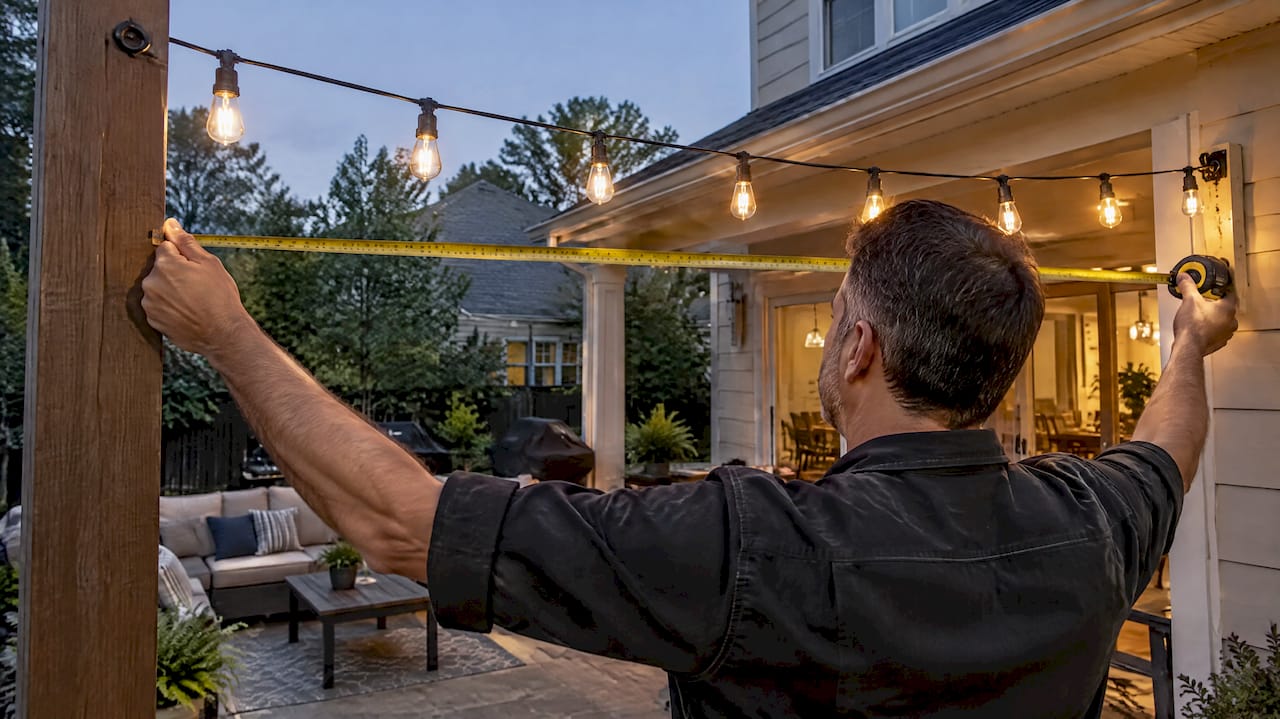
For most patios, bulb-to-bulb spacing ranging from close to moderate distances works well, with a middle spacing offering a balanced look for typical gatherings. Support or anchor points typically need to sit every 6 to 20 feet depending on the product, and longer spans call for a dedicated support cable. Hang the lowest bulb high enough to keep heads clear, generally around typical adult height, and always follow the manufacturer’s instructions with GFCI-protected, outdoor-rated power.
TL;DR:
- Proper support cables and fixtures are essential for spans longer than the manufacturer’s rated distance to prevent hazards.
- Support and anchor points should be spaced every 6 to 20 feet, depending on the product, and support cables should carry weight instead of the electrical cord.
- Bulb spacing of 15 inches is most common for balanced coverage, with 12 inches for dense brightness and 24 inches for ambient effects.
- Conduct measurements of perimeter and support distances before purchasing, ensuring your total length matches the manufacturer’s maximum connectable strings.
- UL ratings must specify all-year use capability, and outdoor-rated cords with GFCI protection are mandatory for safe installation.
Table of Contents
- How bulb spacing and pattern choices affect light density and mood
- Measure first: what you need to know before you buy
- How high to hang lights and when to add support cables
- Product markings, UL listings, and code basics homeowners should check
- Worked calculations for a patio, a yard, and a tree
- Professional notes on when to DIY and when to go permanent
- Balancing looks, function, and safety
- A permanent alternative to seasonal string light setup
- Sources
- FAQ
How bulb spacing and pattern choices affect light density and mood
The distance between bulbs changes how a space feels as much as how bright it looks. Closer spacing reads as festive and full, while wider spacing creates a softer, more ambient glow that still defines the space without overwhelming it.
- 12-inch spacing gives a dense, bright look suited to dining areas or spaces where you want strong task lighting.
- 15-inch spacing is the most common middle ground, offering even coverage for general patio use.
- 24-inch spacing creates an airy, ambient effect that works well for large yards or subtle accent lighting.
Pattern choice matters just as much as bulb distance. A zig-zag pattern spreads light evenly across a wider area and hides gaps better than straight lines. A swag pattern, where lights drape in soft curves between two points, creates a decorative focal cluster rather than even coverage. Perimeter lighting outlines the edges of a patio or deck, drawing the eye to the boundary, while parallel rows deliver the most uniform coverage overall. As a rule of thumb, keep row-to-row spacing at roughly 2 to 3 feet to avoid dark bands between strands, tightening that distance over dining or cooking areas where you want more direct light.
Measure first: what you need to know before you buy
Skipping measurements is the most common reason homeowners end up short on lights or overloaded on cord length. A little math before you shop saves a return trip to the store.
- Measure the total perimeter or span you plan to cover, then add 10 to 20% extra for sag and connection slack.
- Separately note three distances: bulb spacing (socket to socket), anchor or support spacing (where the load is actually carried), and row-to-row spacing for even coverage.
- Check the manufacturer’s maximum connectable strings and the extension-cord amperage guidance for your cord length before wiring multiple runs together, since longer runs need heavier gauge wire and reduce safe amperage.
- Build a shopping list: outdoor-rated string lights, support cable if spans exceed the manufacturer’s limit, rated hooks or eye bolts, weatherproof connectors, and a GFCI outlet or outdoor-rated GFCI adapter.
Pro Tip: Measure twice with a tape measure or laser measure before ordering, since string lights are sold in fixed lengths and cutting one short means buying a whole extra set.
How high to hang lights and when to add support cables
Hanging height and structural support are two different problems, and treating the light strand itself as the support is one of the most common installation mistakes. Utah State University Extension’s festoon guidance warns that decorative strings are not structural lighting systems and must be supported at the intervals the manufacturer specifies, never by tensioning the cord itself.
- Keep the lowest bulb at a height that clears most adults’ heads, adjusting lower only for pergolas or covered structures where fewer people pass beneath.
- Choose posts sized for your span, and set them in concrete footings when the run is long or exposed to wind.
- Use a separate support cable for any span beyond what the manufacturer rates for unsupported hanging, and leave the electrical cord relaxed rather than pulled taut.
- Install the support cable first, then attach the lights to it, so the cable carries the weight and wind load instead of the wiring.
Our patio string lights height page walks through this same 8 to 10 foot recommendation in more detail for specific patio layouts.
Product markings, UL listings, and code basics homeowners should check
Not all string lights are built for the same use, and the markings on the packaging tell you which rules apply. UL Solutions distinguishes seasonal holiday lighting strings from “string lights” rated for all-year use under UL 588 Supplement SD, which carries its own marking and installation requirements, including downward-facing sockets and covered unused connectors.
- Check the tag for UL or ETL listing, and look specifically for wording that says the product is intended for all-year use if that’s your plan.
- Confirm the manufacturer’s maximum number of connectable strings before linking multiple sets end to end.
- Use outdoor-rated cords, grounded three-prong plugs, and GFCI protection on every outdoor circuit.
- Keep connectors elevated above standing water and away from grills or fire pits.
Utah State University’s guidance notes that following the manufacturer’s stated support-spacing and maximum span limits, rather than improvising, is what separates a safe installation from a hazard. Read the full festoon safety guidance for the complete checklist. If your install is meant to stay up year-round or you’re unsure whether it meets local electrical code, an electrician can confirm NEC compliance before you plug in.
Worked calculations for a patio, a yard, and a tree
Numbers make spacing decisions concrete. These examples use simple, labeled assumptions you can adjust to your own space.
- For a 10 by 10 foot patio with a two-row zig-zag pattern, the two rows total roughly 20 linear feet of coverage; at 15-inch bulb spacing that’s about 16 bulbs per row, or 32 bulbs total, plus 10 to 20% extra length for sag and end connections.
- For a 20 by 30 foot yard strung in parallel rows every 3 feet, you’d run roughly ten rows of 30 feet each, or 300 linear feet total, and spans over roughly 20 feet should get a mid-span support point rather than relying on the cord alone.
- For a 7-foot tree, wrapping typically uses about 1.5 to 2 feet of lights per vertical foot of trunk or branch, so a full wrap might use 10 to 14 feet of lights per section, and you should total the wattage of all strands against your outlet’s rated amperage before plugging in multiple sets.
- Before buying, sanity-check your total planned length against the extension-cord gauge and amperage guidance so you’re not overloading a single circuit or an undersized cord.
Professional notes on when to DIY and when to go permanent
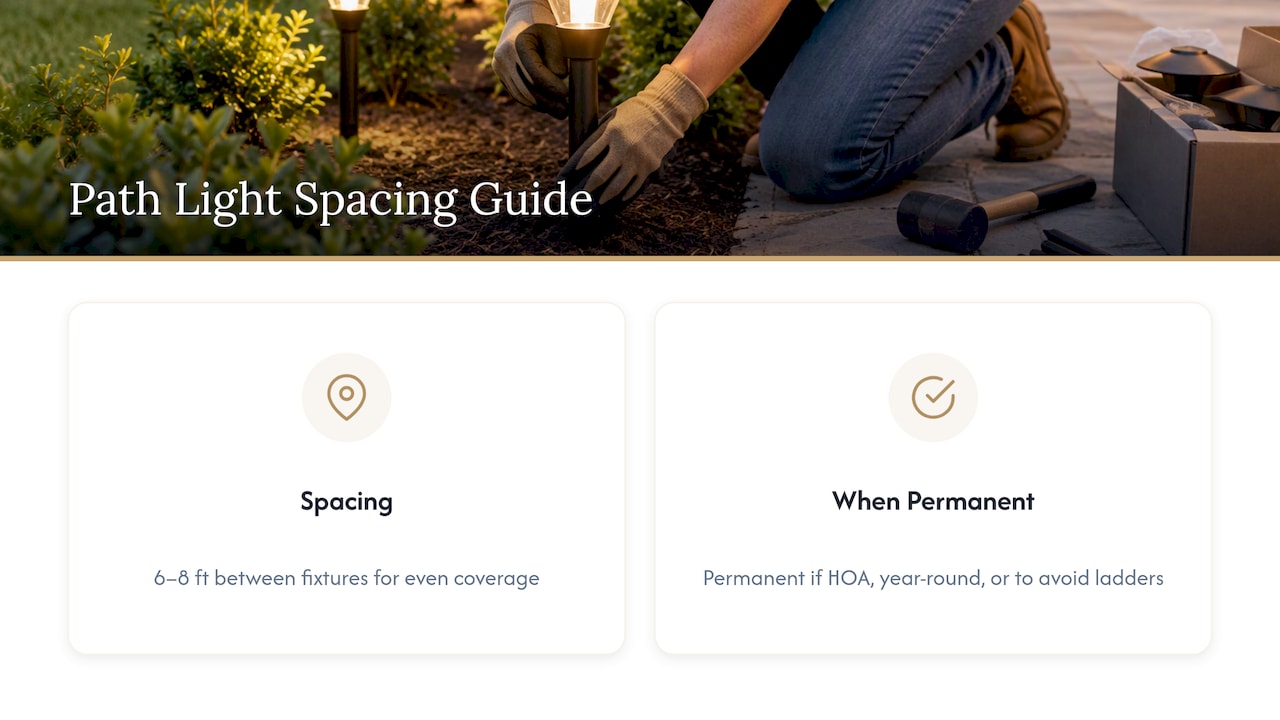
Seasonal string lights make sense for short-term use, but homeowners who want lighting up year-round, need to meet HOA rules, or are tired of ladder work each season often move to a permanent system. For complementary walkway lighting, we recommend path light spacing of 6 to 8 feet for even coverage. Before requesting a quote, have your patio dimensions and desired use (seasonal or year-round) ready.
Balancing looks, function, and safety
Denser spacing looks great but adds weight and hardware demands. Every shortcut around manufacturer instructions creates a repair or a hazard later. When in doubt, especially for anything permanent, bring in a professional.
— Dave
A permanent alternative to seasonal string light setup
If you’re tired of climbing a ladder every season to restring lights, a permanent system removes that chore entirely. Forever Glow Lighting installs smart, weather-optimized LED lighting, including bistro and string lighting designed to stay in place year-round, with color and brightness controlled from a smartphone.
- Permanent patio and bistro string lighting built for year-round use rather than seasonal takedown.
- Smart LED track systems that blend into your roofline and disappear from view in daylight.
- Maintenance subscriptions are offered to keep the system running without the need for climbing a ladder again.
A permanent installation makes the most sense when you want the look every night of the year, need to meet HOA lighting standards, or simply want to stop the seasonal setup and teardown. Contact Forever Glow Lighting for a free estimate on patio lighting built for your space.
Sources
- String Lights for All-Year UseUL 588 Supplement SD | UL Solutions
- Festoon your house safely | Utah State University Extension
- Factsheet: Extension Cords | University of Texas EHS
FAQ
How far apart should string lights be?
Bulb-to-bulb spacing typically runs from 12 to 24 inches, with 15 inches offering a balanced middle ground for most patios. Support or anchor spacing is a separate measurement and depends on the manufacturer’s rated span, often every 6 to 20 feet.
What is the best pattern for outdoor string lights?
There’s no single best pattern since it depends on the space: zig-zag rows spread light evenly across wide areas, while swag patterns create decorative focal clusters. Perimeter lighting works well for outlining a patio’s edges, and parallel rows give the most uniform coverage for larger yards.
How many feet of string lights do I need for a 10×10 patio?
A two-row zig-zag layout across a 10 by 10 foot patio totals around 20 linear feet of coverage, which comes to roughly 32 bulbs at 15-inch spacing.
How long of a string of lights do you need for a 7 ft tree?
Wrapping a 7-foot tree typically uses about 1.5 to 2 feet of lights for every vertical foot of trunk or branch covered, so a single wrapped section often needs 10 to 14 feet of lights. Always total the wattage of all connected strands against your circuit’s rated amperage before plugging everything in.
Do I need a support cable for string lights?
You need a support cable whenever your span exceeds the manufacturer’s rated distance for unsupported hanging, since the light strand itself isn’t designed to carry structural load. Utah State University Extension recommends supporting strings at the manufacturer’s specified intervals rather than tensioning the electrical cord.