
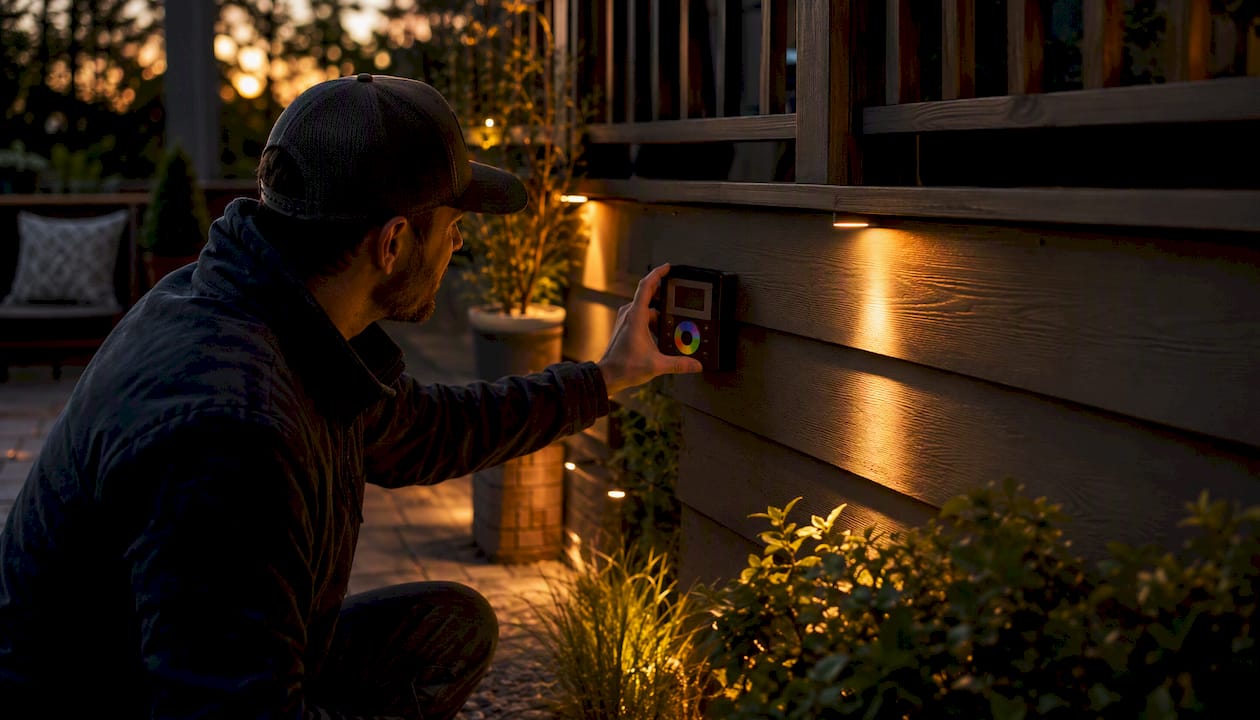
An outdoor lighting color wheel is the control interface, digital or physical, that maps every hue your fixtures can produce around a circle so you can pick, sweep, or animate exterior colors from a phone app or remote. Turn the selector to blue and your landscape lights shift to blue. Slide it to amber and you get a warm glow instead. It’s the same logic as a paint color picker, applied to light instead of pigment.
Homeowners use this control in a handful of practical ways:
- Daily ambiance: a warm white scene (usually 2700K to 3000K) for everyday evenings on the patio or along the walkway.
- Seasonal and holiday themes: red and green for December, orange for Halloween, or red, white, and blue for the Fourth of July, all without touching a single bulb.
- Team and event colors: switching the whole house to your college’s or NFL team’s colors on game day, then back to white an hour later.
This guide covers how the wheel actually works, why RGBW beats plain RGB for most homes, what to look for in a controller, and how to build color palettes that look designed rather than random.
Key Takeaways
RGBW outdoor lighting paired with a consistent 3000K white default and restrained color accents delivers the most usable, long-lasting results for homeowners.
| Point | Details |
|---|---|
| Choose RGBW over RGB | A dedicated white chip produces true white light without sacrificing color quality when you switch scenes. |
| Default to 3000K | This CCT balances warmth and clarity across mixed-material facades like brick, stone, and siding. |
| Plan zones before buying fixtures | Map out separate zones for rooflines, landscaping, and accents so each area can run its own scene independently. |
| Match channels to your controller | Confirm your controller supports RGBW or RGBCW output before installation to avoid wasting the white channel. |
| Test scenes from the street | View every scene from pedestrian and street distance before finalizing, since close-up views can be misleading. |
| Call a professional for whole-house systems | Forever Glow Lighting designs and commissions HOA-aware RGBW systems for multi-zone Charlotte-area properties. |
Table of Contents
- What Is an Outdoor Lighting Color Wheel and How Does It Work?
- RGB vs. RGBW vs. RGBWW: Which One Actually Works Outdoors?
- What Do Color-Wheel Controllers Actually Do?
- When Should You Use Color vs. White Outdoor Lighting?
- How Do You Design Outdoor Color Schemes That Actually Look Good?
- What Are Simple Color Palettes You Can Actually Use?
- How Do You Actually Implement a Color-Wheel System?
- Why Do My Outdoor Lights Look Off After Installation?
- When Should You Call a Professional Installer?
- A Homeowner’s Perspective on Restraint With Color
- Ready to Design Your Own Color-Capable Outdoor Lighting?
- Sources
What Is an Outdoor Lighting Color Wheel and How Does It Work?
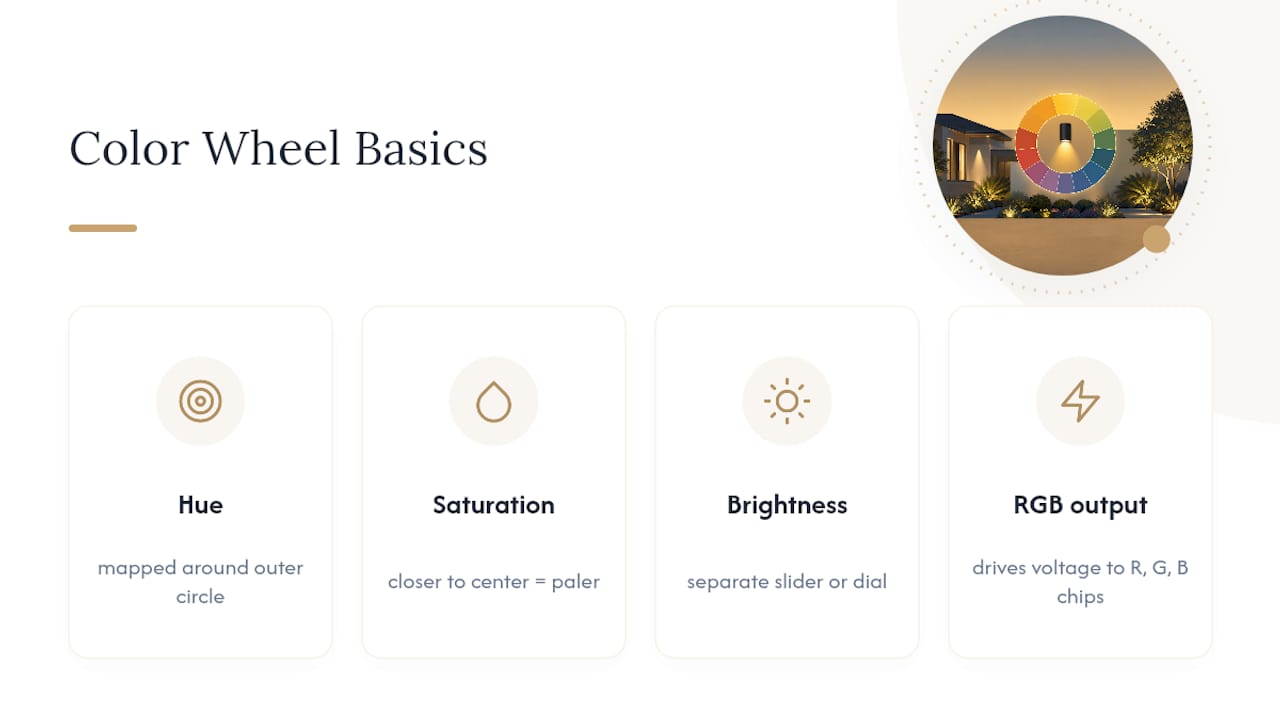
A color wheel maps hue around the outer circle, saturation toward or away from the center, and brightness as a separate slider, then translates that position into voltage levels for the red, green, and blue LED chips inside each fixture. Touch a point near the edge of the wheel and you get a bold, saturated color. Touch a point closer to the middle and you get a paler, washed-out version of that same hue. Brightness usually lives on its own dial or slider because it controls overall output rather than color character.
Inside the fixture, this is simple math dressed up as a friendly interface. Each LED cluster typically has separate red, green, and blue diodes, and the controller adjusts how much power flows to each one. Full red plus full green produces yellow. Red and blue together make magenta. All three at once, balanced correctly, approximate white, though as you’ll see in the next section, that approximation is usually worse than a dedicated white LED chip. The wheel abstracts all of that channel math into something you can operate with a fingertip.
Controllers layer a few behaviors on top of basic color selection. A “pick” function locks in a single static hue. A “sweep” or “scan” mode cycles through the wheel automatically, and you can typically adjust the speed of that cycle along with how the transition between colors happens, whether it snaps instantly or fades smoothly. Picture the wheel as a clock face: a scan function is the second hand sweeping continuously, while a manual pick is stopping that hand at exactly 3 o’clock and leaving it there.
The most useful color wheels aren’t the ones with the most exotic effects. They’re the ones that let you lock in a clean, reliable white scene just as easily as they let you flip to color, because most nights you want the white.
RGB vs. RGBW vs. RGBWW: Which One Actually Works Outdoors?
RGBW, sometimes labeled RGBCW when it includes tunable white, is usually the better outdoor choice because a dedicated white LED chip produces a clean, usable white light without robbing quality from your color scenes. RGB-only fixtures have to fake white by blending red, green, and blue at full power, and that blend tends to skew slightly blue, pink, or green depending on the fixture. Add a real white chip to the mix and you get true warm white on demand, plus full color capability when you want it.
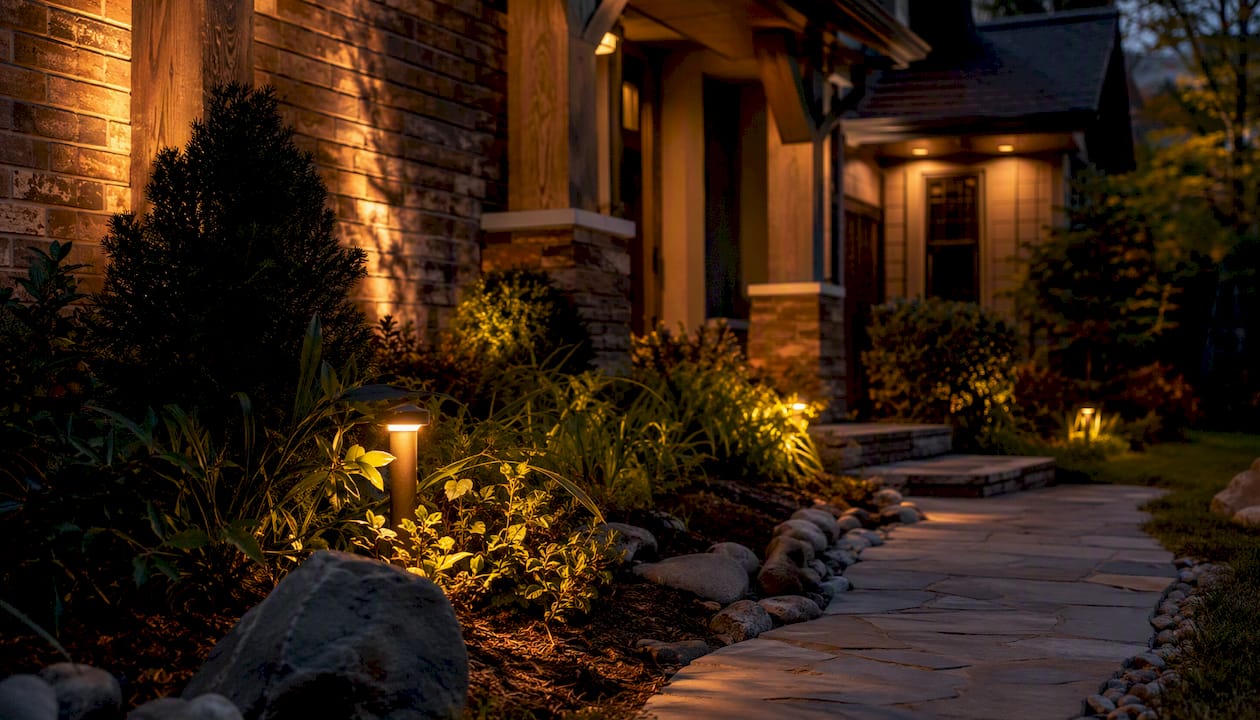
Color-changing landscape lights generally fall into three categories, and the differences matter more than most spec sheets let on.
VOLT Lighting describes RGBW fixtures as combining red, green, blue, and white chips specifically so the white output holds up on its own, without needing the color channels to fake it. RGBCW extends that further by letting you dial the white channel itself between warmer and cooler tones, which matters if your exterior mixes stone, brick, and painted trim under the same lighting plan.
Correlated color temperature, or CCT, describes where that white output sits on the warm to cool scale, measured in Kelvin. Lower numbers like 2700K read warm and amber, similar to an old incandescent bulb. Higher numbers like 4000K read crisp and closer to daylight. For most mixed-material exteriors, 3000K lands as the most versatile default, balancing warmth and clarity across brick, siding, and stone without leaning too far in either direction.
Pro Tip: Set 3000K as your default white scene before you experiment with color. If your home leans toward a hospitality or historic look, drop to 2700K. If you want a cleaner, more modern edge on contemporary architecture, try 4000K, but avoid it near warm-toned brick or wood, where it can look sterile.
What Do Color-Wheel Controllers Actually Do?
Most color-wheel controllers combine a handful of core features: a hue selection wheel, saved presets, group or zone control, animation modes, and a dedicated white-channel option. Understanding these before you shop keeps you from paying for effects you’ll never use, or worse, missing a feature you actually need.
Here’s what shows up across the range of consumer and installer-grade systems:
- Zone and group control lets you send different colors or scenes to different sections of your house independently, so the roofline can run white while the landscape beds shift to color.
- Speed and transition settings govern how fast a scan cycles through hues and whether colors fade smoothly or cut sharply from one to the next.
- Scheduled scenes trigger a specific color or white setting automatically at sunset, on a holiday date, or at a set time each evening.
- Remote or app control lets you make changes from your phone rather than a wall-mounted panel, which matters most for larger properties with multiple zones.
- DMX or proprietary protocol support becomes relevant for larger commercial installs or synchronized shows, where dozens of fixtures need to move together.
Many vendor documentation pages describe a “color wheel scan” behavior where the controller cycles through hues at an adjustable interval and applies that scan to an entire group at once rather than fixture by fixture. This is exactly how Luxor-style controllers and similar landscape lighting systems handle whole-yard color transitions without requiring you to program each light individually.
Fixtures like the Freedom II Color spotlight from Americana Outdoor Lighting show how this comes together in a real product: app control, long-range wireless connectivity, full RGBW color output, and a choice of 2700K or 3000K white settings baked into one integrated fixture. That combination, color when you want it and dependable white the rest of the time, is what separates a system homeowners actually use from one they set once and ignore.
When Should You Use Color vs. White Outdoor Lighting?
Color adds value in four main situations: everyday white ambiance, holidays and events, accenting architecture or landscape features, and supporting a team or brand color scheme. Everything else, especially safety-critical areas, generally calls for consistent white light instead.
Here are six scene examples that put this into practice:
- Warm-white patio evenings: 3000K at full brightness, no color, for the nights you’re just relaxing outside.
- Subtle facade gradients: a low-saturation blue-to-purple wash across architectural columns, dimmed to 30% so it reads as texture rather than a spectacle.
- Independence Day red, white, and blue: bold saturated bands cycling slowly across the roofline for one week each July.
- Pool-adjacent blue glow: a soft, dim blue along pool decking that improves nighttime visibility without glaring off the water’s surface.
- Game-day team colors: a quick preset swap to your team’s palette for a few hours, then back to the default white scene.
- Holiday reds and greens: classic seasonal color from Thanksgiving through New Year’s, timed on a schedule so you’re not manually switching it each night.
Color works best as a layer on top of a reliable white foundation, not as a replacement for it. The moment your walkway or driveway loses consistent white light for the sake of a color effect, you’ve traded function for novelty.
Skip color entirely in a few specific spots: stair edges and walkways where footing safety depends on even, predictable light; anywhere facing a neighbor’s bedroom window, where an HOA or a simple courtesy conversation should guide your brightness and color choices; and wildlife-sensitive areas near wooded lots or waterways, where steady warm white causes far less disruption than shifting saturated color.
How Do You Design Outdoor Color Schemes That Actually Look Good?
Prioritize a clean, consistent white scene as your everyday default, and treat color as an occasional or layered accent rather than the main event. This single rule prevents the most common mistake homeowners make with new color-capable systems: running color every night until the novelty wears off, then feeling like the investment doesn’t hold up long term.
A few practical guardrails keep results looking designed rather than accidental:
- Keep the same CCT across every fixture in a zone. Mixing 2700K roofline lights with 4000K landscape spots reads as uncoordinated rather than intentional, even if each fixture looks fine on its own.
- Aim and shield fixtures carefully to control glare, especially on spotlights aimed upward toward siding or trees.
- Reserve warm white for seating areas and gathering spaces, and shift slightly cooler for task lighting or security zones where visibility matters more than mood.
- Limit saturated color on pathways and steps. Warm white in the 2700K to 3000K range creates cozy ambiance, while cooler whites in the 3500K to 4500K range serve visibility better, and neither job benefits from a shifting rainbow underfoot.
| CCT Range | Best Use | Material Effect |
|---|---|---|
| 2700K | Entryways, historic or hospitality-style homes | Enhances warm wood tones, red brick, and traditional trim |
| 3000K | General exterior use, mixed-material facades | Balanced rendering across brick, stone, and siding |
| 4000K | Modern architecture, security and task zones | Crisp, neutral rendering; sharpens contemporary lines |
Pro Tip: Walk your scenes from the street and from the sidewalk before calling a design finished. What looks balanced standing directly under a fixture often looks blown out or uneven from twenty feet away, which is exactly where most people will actually see your home.
If your exterior finishes lean toward crisp whites and neutral trim, it’s worth looking at how interior white tones pair with warm exterior lighting, since a 2700K to 3000K glow tends to complement cooler interior whites rather than clash with them.
What Are Simple Color Palettes You Can Actually Use?
Start every palette from a clean white base, then add restrained, low-saturation color as an accent rather than the dominant element. This approach, sometimes described as layered scene design, keeps your everyday lighting usable while still giving you color options for special occasions.
Six ready-to-use palettes to try:
- Cozy warm evening: white at 3000K, full brightness, with a low-saturation amber accent at around 20% brightness on select landscape beds.
- Independence Day (triadic): red, white, and blue at full saturation, transitions set to a slow fade rather than a hard cut.
- Autumn accent (analogous): amber, orange, and deep red blended at moderate saturation across facade uplights, white base dimmed to 50%.
- Cool pool glow (complementary): soft blue accents around the pool deck paired with warm 3000K white everywhere else for contrast without clashing.
- Winter holiday classic: alternating red and green at full saturation on rooflines, white base reserved for walkways and entry steps.
- Subtle modern accent: a single low-saturation violet wash on architectural columns at 15 to 25% brightness, with 4000K white handling everything else.
A few rules keep any palette from tipping into visual chaos: limit yourself to one or two saturated hues at a time rather than cycling through the full wheel, keep any moving or scanning elements slow enough to read as ambiance rather than a light show, and always test the final palette at night from at least two distances, close up and from the street.
How Do You Actually Implement a Color-Wheel System?
The implementation sequence runs in four steps: plan your zones, choose fixtures that support RGBW or RGBCW output, select a controller that matches the scenes you want, then commission the system and set your white default. Skipping the planning step is the single most common reason homeowners end up with a system that looks impressive in the app demo and disappointing on the actual house.
Start by mapping zones based on how you’ll use each area, not just where fixtures happen to go. Rooflines, landscape beds, and architectural accents often deserve separate zones so you can run white on the house while color plays out in the garden. Next, count channels. RGB fixtures need three data channels per unit, RGBW needs four, and RGBCW needs five once you add tunable white control, so your controller needs enough capacity for every fixture you’re planning to add, plus room to grow.
Check your transformer and load capacity before adding fixtures, since color-capable LEDs sometimes draw slightly more power than basic white-only units, and an undersized transformer causes flickering or dimming under load. Decide between wireless and wired control based on property size and how much you value walking the yard for troubleshooting versus checking a signal strength meter on an app. Finally, commission the system by testing every zone individually before combining them into full scenes, and set a reliable white preset as your default before you leave the color programming to guests, kids, or future you at 11 p.m. on a Tuesday.
Match your fixture channels to your controller output before you buy anything. An RGBW fixture wired to an RGB-only controller will still light up, but that white chip becomes useless dead weight, and you’ll have paid for a feature you can’t actually use.
Why Do My Outdoor Lights Look Off After Installation?
The three most common post-install color problems are muddy or tinted whites, mismatched CCT between zones, and colors that drift or flicker over time, and all three usually trace back to configuration rather than defective fixtures. Before assuming a hardware failure, run through a short diagnostic list.
- Check whether the white channel is actually configured to use the dedicated white chip, rather than defaulting to an RGB blend that reads pink or blue.
- Verify the controller’s firmware is mapped correctly to your specific fixture type, since a controller set for RGB will misread an RGBW fixture’s fourth channel.
- Recalibrate color balance if reds look orange or blues look purple, since LED color can shift slightly as chips age or as voltage fluctuates across a long wire run.
- Inspect wiring connections and voltage drop across the run, particularly on longer landscape lighting circuits where the far end of the line receives less power than the near end.
Pro Tip: Save and clearly label a standard 3000K white scene the day your system is installed. When colors start looking strange months later, that saved reference gives you an instant baseline to compare against, instead of guessing whether the problem is the fixture, the controller, or just your memory of how it used to look.
When Should You Call a Professional Installer?
DIY color-wheel systems work fine for a single zone with a handful of fixtures and a simple app-based controller, but professional installation earns its cost once you’re dealing with whole-house zoning, HOA approval requirements, or any DMX-level integration across multiple properties. The complexity doesn’t scale linearly. Four zones aren’t twice the work of two zones, they’re closer to four times the wiring, load calculations, and troubleshooting.
A professional installer brings a few things a weekend project usually can’t:
- Coordinated design across rooflines, landscape beds, and architectural accents so zones complement rather than compete with each other.
- Correct CCT selection based on your actual materials, brick, siding, stone, rather than guessing from a spec sheet.
- Proper aiming and shielding to control glare and light trespass onto neighboring properties.
- Load calculations and wiring sized correctly for the number of fixtures and channels you’re running, avoiding the voltage drop issues that cause flickering.
- Warranty coverage and ongoing maintenance, so a failed chip or controller glitch doesn’t become a weekend project years down the road.
Forever Glow Lighting works throughout the greater Charlotte area designing, installing, and commissioning permanent RGBW-capable systems, from roofline tracks to landscape beds to commercial exteriors, with HOA-aware design built into the planning stage rather than bolted on after a complaint letter arrives.
The gap between a color-capable system that gets used every week and one that gets forgotten after the first month almost always comes down to whether the white default was set correctly on day one.
A Homeowner’s Perspective on Restraint With Color
The temptation with any color-wheel system is to treat every capability as something you should use constantly, cycling through saturated hues because the controller makes it effortless. Resist that instinct. The homes that actually get compliments year after year are the ones running a clean 3000K white scene most nights, with color reserved for the Fourth of July, the holidays, or game day, then switched right back. Test every scene from the street and the sidewalk before deciding it works, and if you share a property line with a neighbor, have the color conversation before installation, not after a complaint. A color wheel is a tool for occasional expression, not a nightly obligation.
Ready to Design Your Own Color-Capable Outdoor Lighting?
Forever Glow Lighting designs, installs, and commissions RGBW-capable outdoor lighting systems for homeowners across the greater Charlotte area, setting up the daily white scenes and occasional color programming covered throughout this guide without you ever climbing a ladder. Our process starts with the same zone planning and CCT selection outlined above, then adds smart control integration, HOA-aware design, and ongoing maintenance through our GlowCare program so your system keeps working the way it did on installation day.
Whether you’re picturing a warm 3000K glow along the roofline or a full scene library for holidays and game days, our team handles the fixture selection, wiring, and controller setup so the scene programming actually matches what you pictured when you started researching color wheels in the first place. Contact Forever Glow Lighting today for a free estimate and find out what a properly commissioned RGBW system looks like on your own home.
Sources
- How to Choose Color Temperature for Outdoor Architectural Lighting (2700K vs 3000K vs 4000K + RGBW) – Daou Lighting
- What Light Color Is Better for Your Outdoor Area? – Dazuma®