
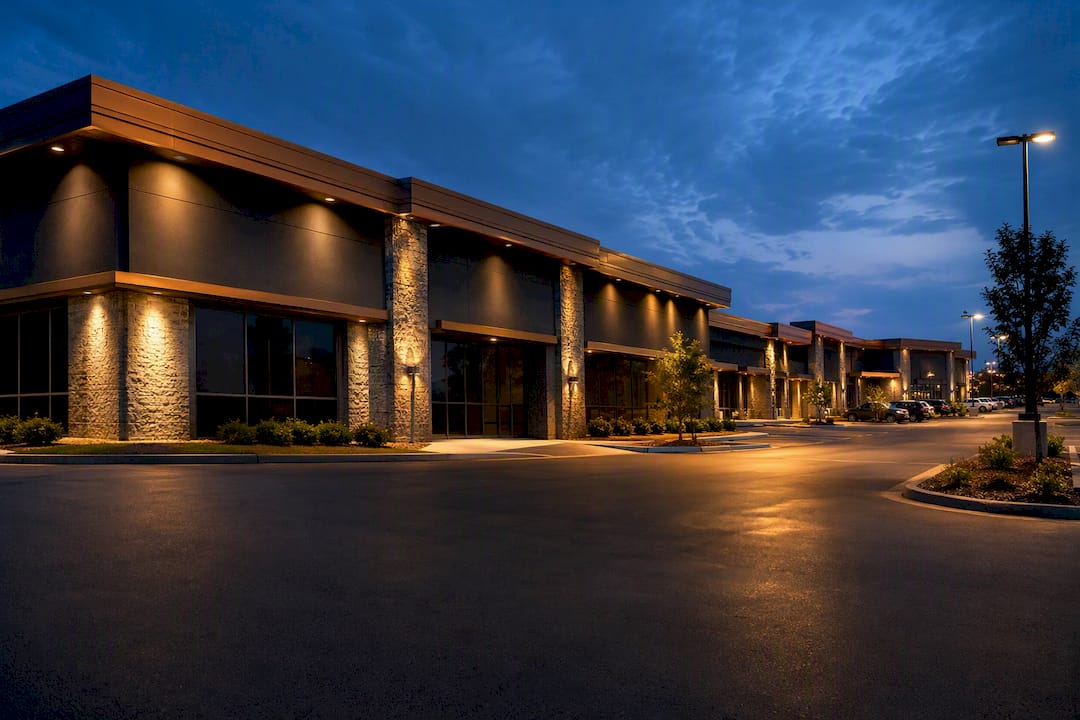
Most Charlotte commercial exterior lighting projects fall within a wide price range depending on building size, fixture count, and site complexity. Small security or floodlight jobs often land near $3,000 to $6,000. Medium parking lot or plaza projects typically run $6,000 to $12,000, and multi-building or industrial sites can exceed $15,000. LED retrofits paired with utility rebates usually cut the net cost fastest. Your next move: request three itemized, fixture-by-fixture quotes from licensed contractors before you commit to a budget.
TL;DR:
- Site prep, fixture quality, electrical complexity, smart controls, and contractor markup can cause quote variations of several thousand dollars for the same project.
- Upgrading to LED fixtures with utility rebates and tax incentives can significantly reduce payback periods, often making projects more economically viable.
- Permits require a site survey, permit filing, and inspections, with larger projects needing additional panel work and potentially more complex approval processes.
- Budgeting should include regular maintenance costs of 5% to 10% of initial expenses annually, focusing on fixture inspections and component replacements.
- Itemized quotes with fixture-by-fixture pricing, separate site-prep and permit costs, and proof of licensing ensure more accurate and comparable contractor bids.
Table of Contents
- How Much Does Commercial Exterior Lighting Cost in Charlotte?
- What Drives Commercial Outdoor Lighting Quotes Up or Down?
- Which Incentives Lower the Net Cost of Charlotte LED Upgrades?
- What Permits and Inspections Should You Expect?
- What Should You Budget for Ongoing Maintenance?
- How Do You Get an Accurate, Comparable Contractor Quote?
- How Should You Budget or Finance a Charlotte Lighting Project?
- The Cost Surprise Almost Every Property Manager Misses
- Ready to Budget Your Charlotte Commercial Lighting Project?
- Sources
How Much Does Commercial Exterior Lighting Cost in Charlotte?
Cost scales with project size, and Charlotte pricing tracks close to national averages with a regional bump for labor availability. A single-building security retrofit with floodlights is the cheapest entry point. A parking lot or strip plaza with pole-mounted fixtures and trenching costs several times more. A multi-building complex or industrial yard with panel upgrades and long conduit runs sits at the top of the range.
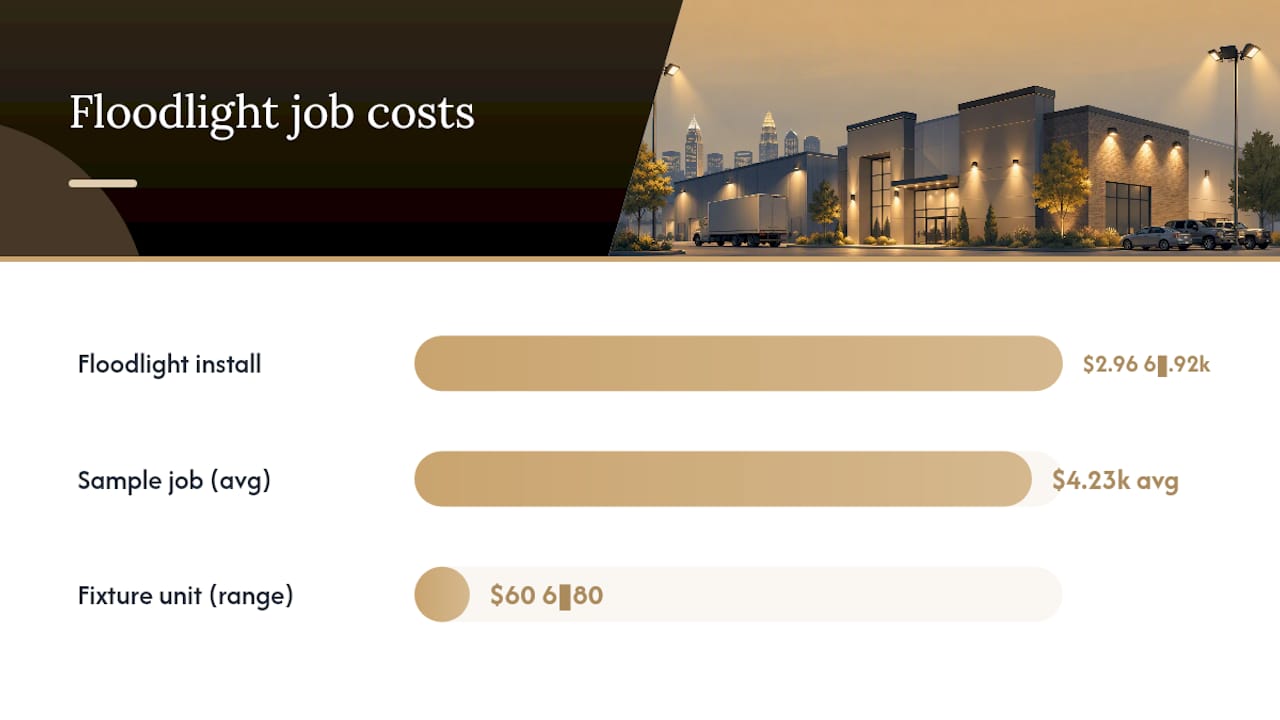
A Charlotte-specific example makes this concrete: installing commercial floodlights typically runs $2,958 to $5,915 including materials and labor, with a sample job averaging around $4,225. That number includes fixture units priced between $60 and $180 each before labor and markup are added.
National data backs up the wider range. Exterior lighting installation nationally spans $800 to $6,000 for typical jobs, with premium commercial projects climbing past $15,000. Landscape and accent lighting alone commonly runs $2,000 to $4,500 per project, at roughly $100 to $200 per fixture.
Here’s how a sample medium project pencils out: 25 fixtures at $150 average unit cost equals $3,750 in hardware, plus labor at $45 to $100 per hour for a two-person crew over three days (roughly $2,000 to $4,000), plus trenching and panel work. That puts a realistic medium job in the $6,000 to $9,000 band before permits.
| Fixture type | Typical unit cost range |
|---|---|
| Security floodlight | $60 to $180 |
| Pole-mounted parking lot fixture | $150 to $180 |
| Architectural accent/wall wash | $100 to $200 |
| Landscape/path fixture (low-voltage) | $100 to $200 |
| Smart controller/hub per zone | $150 to $180 |
Use a ZIP-based Charlotte cost calculator to sanity-check any quote against local labor and material rates before you sign a contract.
What Drives Commercial Outdoor Lighting Quotes Up or Down?
Two quotes for the same fixture count can differ by thousands, and the gap almost always traces back to five factors:
- Site prep and trenching. Cutting and repairing concrete or asphalt to run conduit adds real cost, especially in older parking lots with buried utilities.
- Fixture specification. A DLC-listed fixture with a proper IP65 wet-location rating and higher lumen output costs more per unit than a bargain floodlight, but it lasts longer and often qualifies for rebates.
- Electrical complexity. Panel upgrades, long conduit runs, or hard-to-access rooflines push labor hours up fast.
- Smart controls. App-based scheduling and zone dimming add both hardware and setup labor, though they usually pay back in energy savings.
- Contractor markup and coverage. Legitimate markup covers warranty backing, liability insurance, and licensing, none of which are corners worth cutting.
Pro Tip: Ask every bidder to break out site prep and electrical work as separate line items. A contractor who bundles everything into one number is usually hiding where the real cost sits.
Which Incentives Lower the Net Cost of Charlotte LED Upgrades?
Commercial LED retrofits in Charlotte often qualify for more than one incentive at once, and stacking them changes the payback math significantly.
- The federal Section 179D deduction rewards energy-efficient commercial lighting upgrades, and pairing it with a project’s LED retrofit savings typically shortens payback compared to sticking with older fixtures.
- Duke Energy periodically runs commercial lighting rebate programs for qualifying LED upgrades. Eligibility and rebate amounts shift year to year, so check current terms before finalizing a fixture spec.
- Stacking a utility rebate with a tax deduction can meaningfully reduce the net installed cost, sometimes enough to shift a marginal project into “approve now” territory.
One number worth remembering: LED retrofits paired with rebates and deductions often produce fast payback through lower lifetime energy costs, which is why more Charlotte property managers are timing upgrades around rebate windows rather than waiting for old fixtures to fail outright.
File paperwork before the work starts, not after. Most rebate programs require pre-approval or a specific application window, and missing that step can forfeit the incentive entirely.
What Permits and Inspections Should You Expect?
Commercial exterior electrical work in Mecklenburg County generally requires an electrical permit, and larger jobs touching a building’s main panel may need a separate inspection sign-off.
- Site survey and design (1 to 2 weeks): the contractor measures the property, photographs the electrical panel, and drafts a photometric layout.
- Permit filing (a few days to two weeks): timeline depends on county review load and project scope.
- Installation (1 day for small jobs, up to two weeks for large multi-building sites): night work is common for parking lots to avoid disrupting tenants or customers.
- Final inspection (typically scheduled within a few days of completion): required before the system goes live under code.
A licensed electrician or general contractor is required by code for any work involving panel connections or new circuits, not just for the fixtures themselves.
What Should You Budget for Ongoing Maintenance?
Commercial exterior lighting isn’t a set-it-and-forget-it expense. Budget for it the same way you’d budget for HVAC upkeep.
- Inspect fixtures, wiring, and waterproofing seals twice a year, ideally before summer storms and before winter.
- LED systems draw meaningfully less power than metal halide or older sodium fixtures, and that gap shows up directly on the electric bill within the first year.
- A maintenance contract should cover driver and bulb replacement, connector resealing, and a scheduled inspection visit, not just emergency repair calls.
- A reasonable rule of thumb: reserve 5% to 10% of your original installation cost annually for upkeep and eventual component replacement.
How Do You Get an Accurate, Comparable Contractor Quote?
Quotes that skip line items are impossible to compare fairly, so structure your request the same way every time you send it out.
- List every fixture by type and quantity so contractors price against the same scope.
- Separate labor from materials in the bid response.
- Request the photometric layout and spec sheets for every proposed fixture.
- Confirm DLC listing and IP rating on each fixture, not just the headline product name.
- Ask for proof of licensing, insurance, and warranty length in writing.
When you send the request, ask directly: “What is the DLC listing status and IP rating for each fixture? Can you provide a photometric plan and two references from similar commercial installs in the Charlotte area?” A contractor who hesitates on any of those four items is worth crossing off your shortlist.
- Fixture-by-fixture pricing, not a single lump sum
- Trenching and site-prep costs itemized separately
- Permit costs listed, not buried in “miscellaneous”
- Warranty terms in writing, including labor coverage
Pro Tip: Score each bid on a simple 1 to 5 scale across price, warranty length, and reference quality. The cheapest quote rarely wins once you weigh all three.
How Should You Budget or Finance a Charlotte Lighting Project?
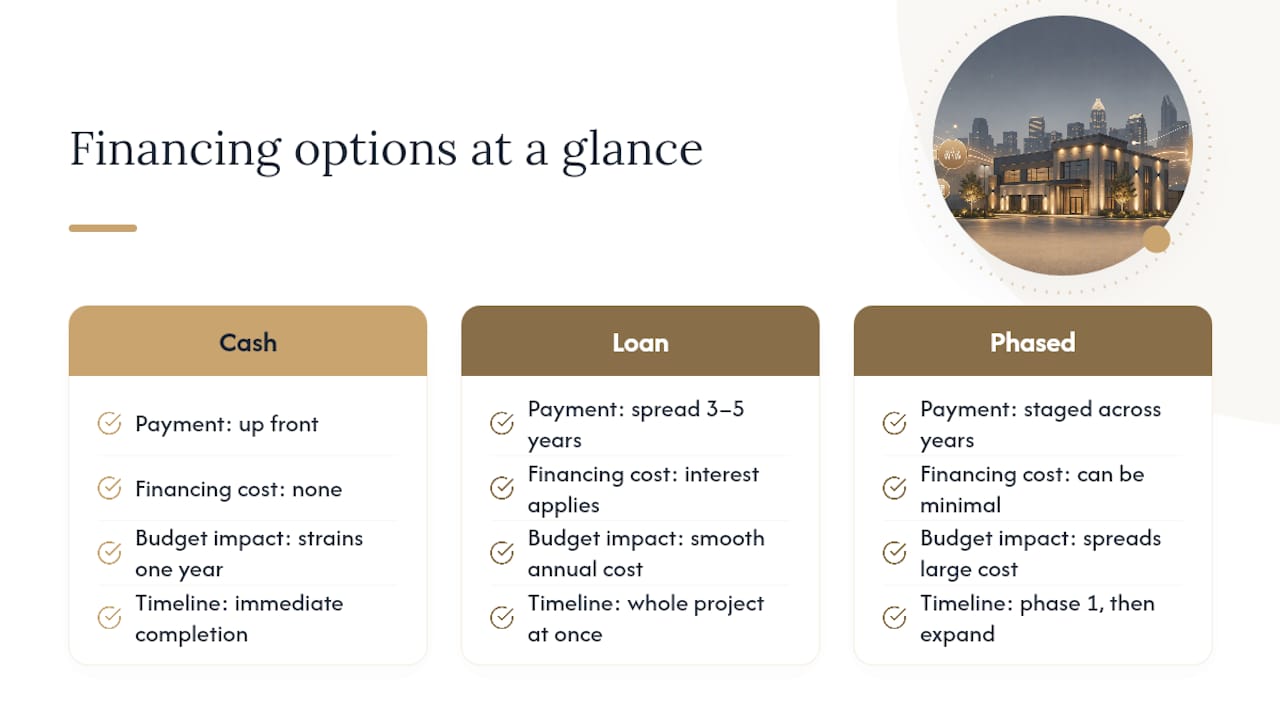
Most commercial property owners pay for exterior lighting one of three ways: cash from an operating budget, a capital improvement loan, or a phased rollout that spreads cost across fiscal years. Cash payment avoids financing costs entirely but strains a single year’s budget on larger jobs. A capital improvement loan or line of credit lets you spread the cost over three to five years, which often aligns better with the useful life of an LED system.
Phasing is underused and worth considering for larger properties. Instead of relighting an entire complex at once, tackle the highest-priority building or the darkest parking area first, then expand in year two once the first phase proves out energy savings. This approach also lets you apply for a Duke Energy rebate cycle in each phase rather than missing a window because the full project wasn’t ready.
Property managers who skip this step are the ones who come back mid-project asking for change orders. Pair your budget plan with the itemized bid checklist above so financing decisions are based on real numbers, not a rough guess pulled from a single quote.
The Cost Surprise Almost Every Property Manager Misses
The biggest budget-buster on Charlotte commercial jobs is rarely the fixtures. It’s the trenching and panel work nobody scoped during the walk-through. A proper site survey and an itemized bid catch this before it becomes a change order. Incentives and solid contractor warranties do the rest.
— Dave
Ready to Budget Your Charlotte Commercial Lighting Project?
Forever Glow Lighting is the local alternative to piecing together your own contractor list and hoping the quotes line up. We handle commercial exterior lighting, smart LED roofline systems with app-based control, and ongoing GlowCare maintenance, all under one Charlotte-based team that already knows Mecklenburg County’s permitting process.
Our recent Charlotte landscape lighting project shows the kind of fixture selection and layout work we bring to commercial sites. If you want a deeper cost breakdown before requesting a formal bid, our permanent lighting installation cost guide walks through local pricing in more detail, and our commercial lighting guide covers system options built for property managers. Contact Forever Glow Lighting today for a free estimate on your property.
Sources
- Cost to Install Floodlights in Charlotte NC in 2026 — Contractor+
- How Much Does Landscape Lighting Cost in 2026? — LawnStarter
- Cost to Install Exterior Lighting — CostToRenovate