
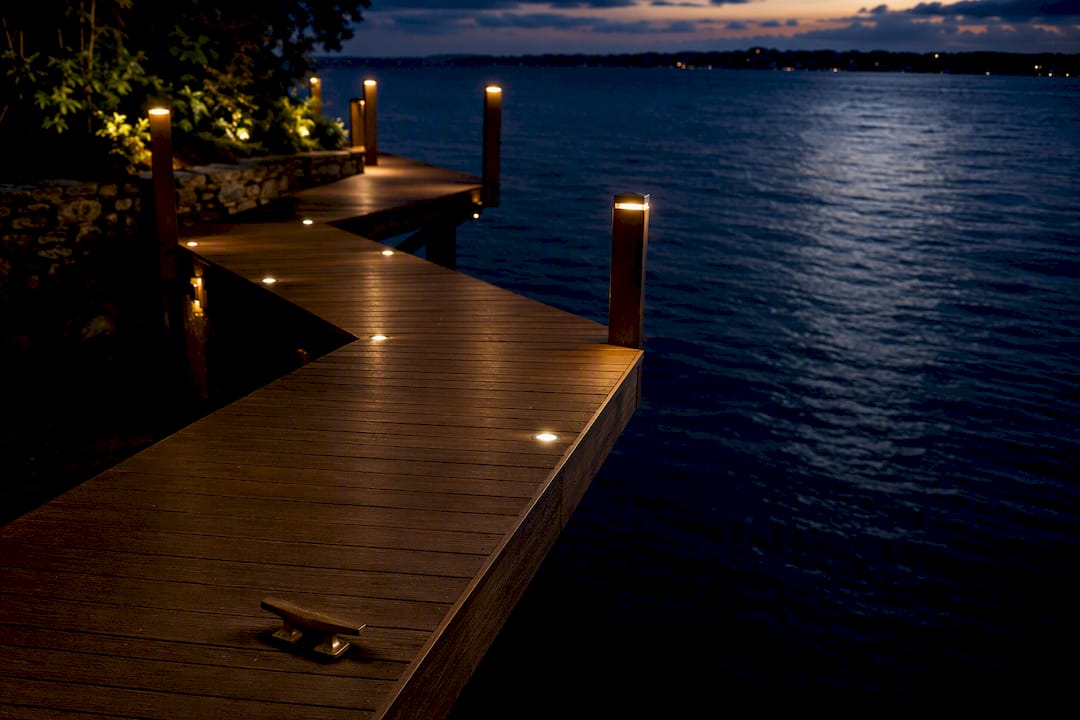
The most effective dock lighting mixes piling or post-cap lights for navigation, recessed step lights for footing, and one accent layer, such as underwater or bistro lights, for atmosphere. Wired low-voltage systems deliver the most reliable output for underwater and high-traffic areas, while solar fixtures work well for remote pilings or seasonal setups where running wire isn’t practical.
TL;DR:
- Proper dock lighting relies on layering different fixtures, with piling lights and underwater LEDs providing critical safety and functional benefits.
- Underwater fixtures require IP68 waterproof ratings and marine-grade materials to withstand saltwater exposure, with professional installation recommended.
- Wired low-voltage systems deliver consistent output for underwater and slip lights, while solar fixtures are suitable for perimeter markers and seasonal use.
- Local regulations often dictate fixture positioning, requiring downward-facing, shielded lights to prevent glare and ensure compliance.
- DIY installation of complex underwater systems can lead to failures; professional services ensure durability, code compliance, and long-term performance.
Table of Contents
- 9 Dock Lighting Ideas Worth Considering
- Types of Dock Lights and Where Each One Fits
- Placement and Layering: Building a Dock Lighting Plan
- Materials and Waterproof Ratings That Actually Hold Up
- Power Options and Smart Controls
- Color Temperature and Underwater Color Choices
- Keeping Dock Lights Working Season After Season
- What Most Dock Lighting Advice Gets Wrong
- How Forever Glow Lighting Handles Dock Lighting Projects
- Sources
9 Dock Lighting Ideas Worth Considering
A good dock lighting plan rarely relies on one fixture type. It layers a few, each solving a different problem. Here’s a practical starting menu, ordered roughly from safety-critical to purely decorative.
- Piling or post-cap lights. Mounted on top of dock posts, these mark the dock’s edge for boaters approaching at night. Safety-critical. DIY-friendly for solar versions; pro-recommended for wired.
- Recessed deck and step lights. Flush-mounted into decking or stair risers, they light footing without creating glare. Safety-critical. Best left to a pro for clean cutouts.
- Underwater LEDs. Submersible fixtures that light the water column below the dock. Ambient, with a functional bonus for anglers. Always pro-recommended given the wiring and sealing involved.
- String or bistro lights. Draped overhead along a pergola or boat lift frame, these set a relaxed, party-ready mood. DIY-friendly.
- Solar path markers. Small stake or cap lights along a walkway to the dock. DIY-friendly and useful where trenching wire isn’t an option.
- Motion-activated security lights. Bright, wide-beam fixtures near the dock entrance or boathouse. Safety-critical for deterring unwanted visitors. Pro-recommended for hardwired versions.
- Slip lights. Mounted along boat slips to help with nighttime docking and line handling. Pro-recommended.
- Handrail-integrated strips. Low-profile LED strips run along railings for continuous, glare-free guidance. Pro-recommended.
- Color-changing accent fixtures. Smart RGB lights on pilings or under eaves that shift for events or seasons. DIY-friendly for low-voltage kits, pro-recommended for full smart integration.
Retailers and lighting specialists often point to recessed lighting, piling caps, and colored underwater LEDs as the highest-impact starting points, and that lines up with what most waterfront homeowners actually use once they see their dock at night for the first time.
Types of Dock Lights and Where Each One Fits
Every fixture category on a dock does a specific job, and mixing up their placement is the most common mistake homeowners make.
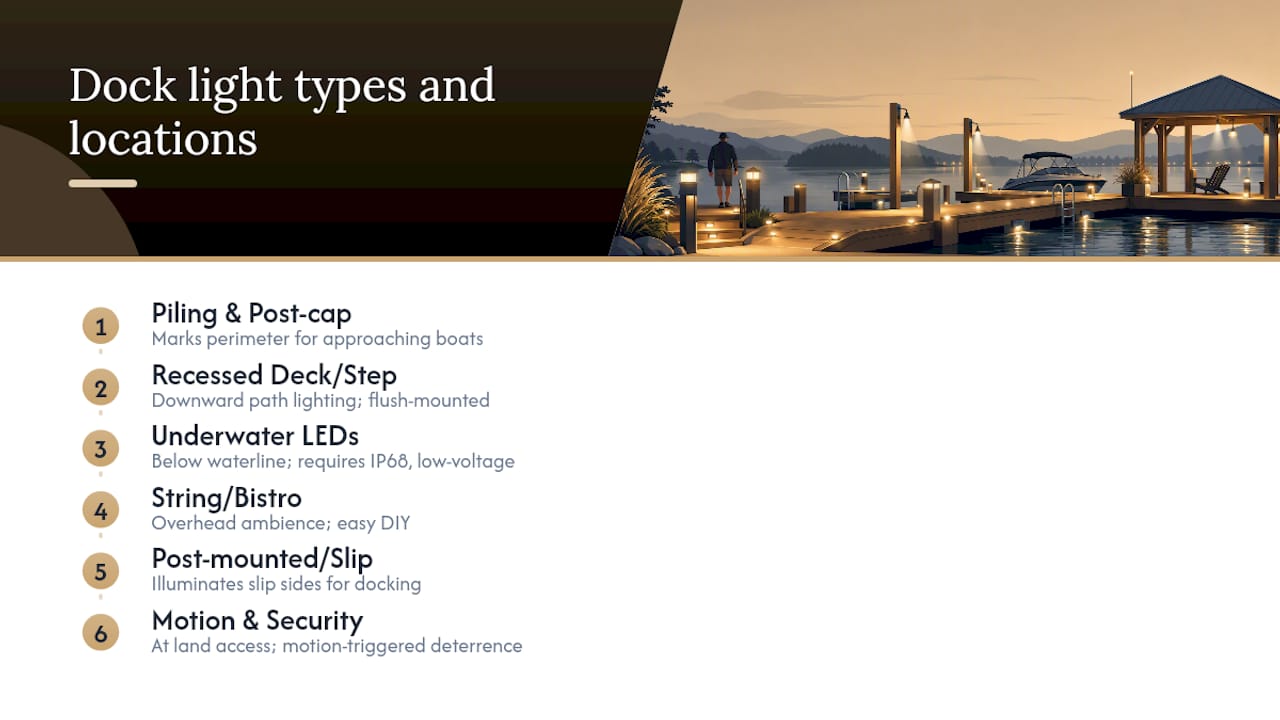
Piling and post-cap lights sit atop dock posts and mark the dock’s perimeter for approaching boats. They typically run on low-voltage wiring or standalone solar cells, and they need weather-sealed housings rated for constant exposure.
Recessed deck and step lights sit flush in the decking surface, aimed downward to eliminate glare while still lighting the walking path. These almost always run on low-voltage wire because consistent output matters more here than anywhere else on the dock.
Underwater LEDs mount below the waterline and need the highest waterproofing standard on the dock. Expert guidance consistently points to IP68-rated, low-voltage LED fixtures for this application, since anything less risks early failure.
String and bistro lights hang overhead on a boat lift canopy or pergola. They’re strictly ambient, low-voltage, and among the easiest fixtures for a homeowner to install without professional help.
Post-mounted and slip lights illuminate the sides of boat slips to aid docking at night. Motion and security fixtures near the dock’s land access point serve a different purpose entirely: deterrence and quick illumination when something moves.
The regulations governing dock lighting in many waterfront communities specifically require certain fixtures to face downward or shield their beam, so check local rules before finalizing fixture selection.
Placement and Layering: Building a Dock Lighting Plan
Layering means combining three distinct light jobs rather than relying on one fixture type to do everything. Task lighting covers steps and ramps, navigational lighting marks the dock’s perimeter for boaters, and ambient lighting, like underwater or string fixtures, sets the mood once the practical work is done. Skip a layer and you either get a dock that’s technically safe but lifeless, or one that looks great but is hard to walk at night.
A simple checklist works well when planning fixture positions or briefing an installer:
- Mark every step, ramp transition, and elevation change for a recessed or step light.
- Space piling or post-cap lights regularly along the dock’s outer edge.
- Identify one accent zone, underwater, string, or both, for ambiance.
- Confirm no fixture points directly outward at boater eye level.
- Test the full layout after dark before finalizing wiring runs.
Pro Tip: Aim fixed lights downward and choose shielded optics wherever boaters approach the dock. A bright, unshielded light at eye level can blind someone piloting a boat at night far more than darkness ever would.
Materials and Waterproof Ratings That Actually Hold Up
IP ratings tell you how much water and debris a fixture can handle, and dock lighting demands the top of that scale. Fixtures exposed to spray or rain need at least an IP65 to IP67 rating, while anything fully submerged, underwater lights especially, should carry IP68 certification with documented submersion testing from the manufacturer.
Material matters just as much as the rating on the box. Marine-grade stainless steel, brass, and heavy-duty polymer housings hold up in fresh and saltwater far better than standard aluminum or painted steel, which corrode quickly once the finish scratches. In saltwater settings, ask about corrosion-resistant fixture construction before buying anything.
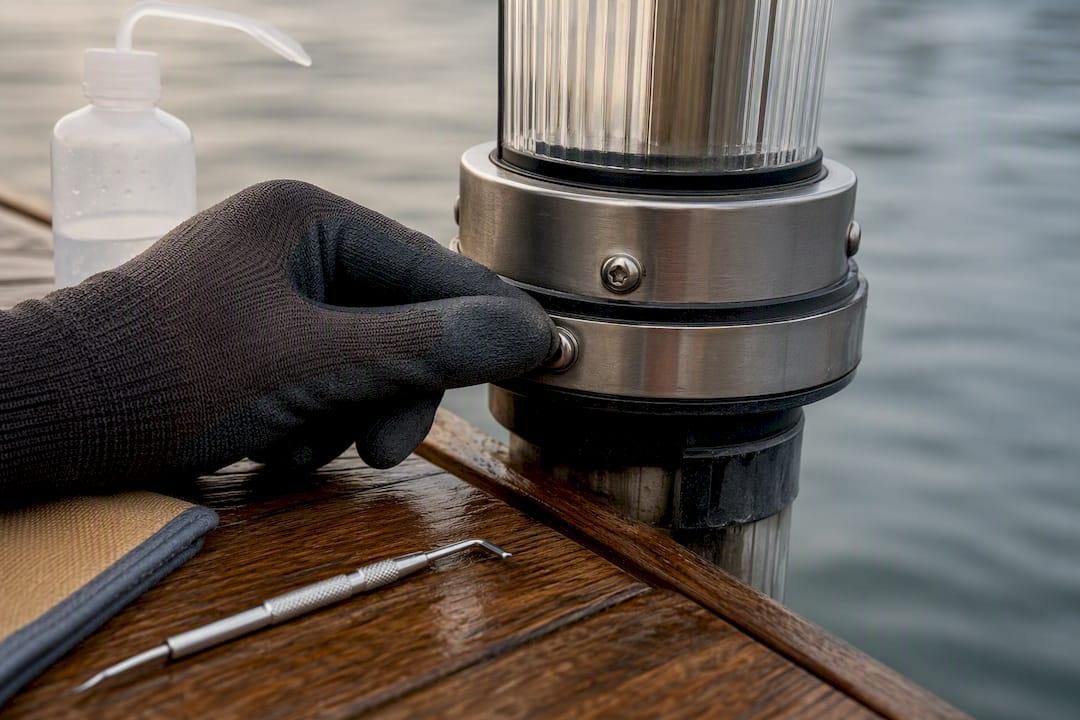
A quick annual habit pays off: check fasteners for rust, inspect gaskets for cracking, and if your dock has a sacrificial anode for corrosion protection, confirm it hasn’t worn down completely.
Power Options and Smart Controls
Solar fixtures work well for perimeter markers, path lights, and any location without easy access to shoreline power; for design tips, check out this guide to a distinctive coastal look for your shore house. Newer solar dock lights have gotten noticeably better at holding dusk-to-dawn output through mixed weather, though they still lag wired systems in raw brightness.
Low-voltage wired systems are the better call for underwater lights, slip lights, and any fixture where consistent, high output actually matters. A transformer-fed wired system simply doesn’t dim at dawn or struggle after three cloudy days the way solar can.
Smart controls add scheduling, dimming, and color scenes on top of either power source, letting you switch between a bright navigation mode and a low, ambient entertaining mode with a phone tap. Any hardwired dock system involving underwater fixtures should go through a licensed marine electrician. Water and electricity are a serious combination, and code compliance isn’t optional.
Color Temperature and Underwater Color Choices
Warm white in the 2700K to 3000K range is the standard recommendation for dock ambiance, while cooler temperatures work better wherever task clarity matters more than mood, like steps or a work bench area.
Underwater color is more functional than decorative. Green light penetrates freshwater more effectively than other colors and is widely used by anglers because it attracts plankton and baitfish, which draws in larger fish behind them. Blue tends to get chosen purely for looks. Either works, but green is the better pick if fishing is part of why you’re lighting the water in the first place.
- Warm white string lights for a dinner-on-the-dock evening
- Cool white recessed steps when guests are moving around after dark
- Green underwater LEDs for an evening fishing session
- Blue underwater LEDs when the goal is pure visual effect, not fish activity
Keeping Dock Lights Working Season After Season
Solar panels need a quick wipe every few weeks since pollen and dust cut output fast. Check gaskets and seals on any wired fixture twice a year, and test battery packs on solar units before peak season starts.
Before winter, rinse saltwater fixtures with fresh water to slow corrosion, and pull any temporary or string lights that weren’t built for freezing conditions. If a wired fixture flickers or won’t turn on, check the transformer and breaker first. If the problem persists, especially near underwater or submerged wiring, it’s time to call a licensed marine electrician rather than troubleshoot further yourself.
What Most Dock Lighting Advice Gets Wrong
Most dock lighting guides treat every idea on the list as equally viable for a weekend project. They aren’t. A string of solar path lights is genuinely something any homeowner can install in an afternoon. An underwater LED system with a transformer, marine-grade wiring, and an IP68 housing is a different category of project entirely, and treating it like a DIY weekend job is where most dock lighting failures start.
The bigger blind spot, though, is HOA and code compliance. Homeowners often pick fixtures based on looks alone, then find out later that the beam angle or brightness violates a local dock ordinance. Professional installers catch that before a single fixture goes in the water, not after.
Dave, Forever Glow Lighting
The gap between a Pinterest-inspired dock and a dock that actually holds up isn’t the idea. It’s the wiring, the sealing, and the fixture-grade decisions happening below the surface, literally and figuratively, of what a photo shows you.
— Dave
How Forever Glow Lighting Handles Dock Lighting Projects
A professional service is the alternative to piecing a dock lighting system together yourself, fixture by fixture, and hoping the wiring holds up through a Charlotte summer storm season. Custom dock lighting services can include marine-grade underwater fixtures, piling caps, and recessed step lights, with options for smartphone control featuring dimming and color scenes.

Hardwired underwater lights, complex wiring runs along a dock, and HOA-compliant fixture placement are situations where professional installation is recommended. The typical installation process starts with a site visit, followed by a design estimate, then installation using materials built to hold up against water and salt exposure.
If your dock needs lighting that’s genuinely built for the water it sits over, not just weather-resistant on paper, you can see how professional installation processes work and request a free estimate.
Sources
- Dock Lighting Ideas for Safety and Nighttime Use | Craigen Marine
- Residential Dock Lighting: Expert Advice for Lighting Contractors – LumenWholesale
- Dock Lighting Guide | Safety, Design & Installation For SWFL
- 6 Brilliant Boat Dock Lighting Ideas | DEKOR® Lighting