
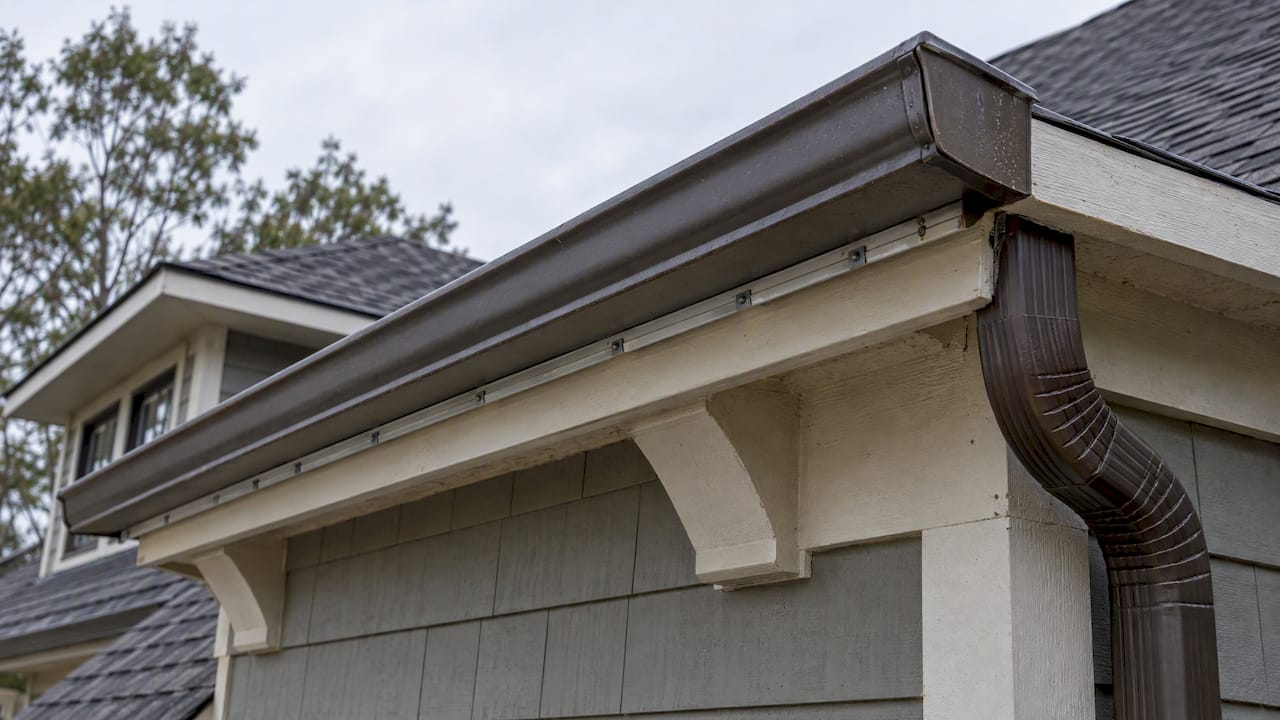
Permanent roofline lights can work with gutters, but the gutter is rarely the right thing to treat as a simple mounting surface. Whether a system fits depends on your gutter profile, whether you have gutter guards, the condition of the fascia behind them, and how the installer plans around nails, hangers and water flow. This guide explains each of those factors so you can judge a design before you sign anything.
TL;DR
- Permanent track lighting is usually planned around the gutter: below it, along the fascia or soffit, or in a channel, depending on the home.
- Gutter guards and permanent lights can coexist, but the guard type and how it is fastened must be checked before work starts.
- Gutter shape, nail and hanger locations, and the condition of the fascia decide the mounting method more than the light itself.
- Water has to keep flowing. Any method that blocks drainage or leaves open fastener holes is a red flag.
- Because this is anchored exterior hardware with electrical work, hire a licensed professional and ask who handles the power side.
Table of Contents
- Why gutters complicate permanent lighting
- The three common mounting approaches
- How gutter material and shape affect fit
- Gutter nails, hangers and layout
- Gutter guards and permanent lights
- Do you need gutter clips?
- Protecting drainage and avoiding damage
- What to inspect before you call an installer
- Electrical and code considerations
- DIY versus professional installation
- What this costs
- Our perspective on gutters and permanent lights
- Lighting built around your roof edge
- FAQ
- Sources
Why gutters complicate permanent lighting
A temporary string of holiday lights hangs on clips and comes down in January. A permanent system is different. It is a track or channel with LEDs built in, fastened to your house and expected to stay for years through Carolina summers, ice storms and heavy rain.
The roof edge is crowded. The gutter, its hangers, the drip edge, the fascia board, the soffit and any guard all share a few inches of space. Each has a job. The gutter has to move water away from your foundation. The fascia has to stay solid enough to hold weight. The lights need to sit where they are visible from the street but still look tidy in daylight.
That is why the question is not just “will the lights fit?” It is “where do they go so nothing else on the roof edge stops working?” The sections below take that in order.
The three common mounting approaches
Installers generally choose among three approaches, and the right one depends on the house.
| Approach | Where the track sits | Best suited to | Main watch-out |
|---|---|---|---|
| Below the gutter | Fascia or soffit, under the gutter line | Homes with guards, tight gutter lips or older gutters | Needs sound fascia and clean alignment with trim |
| On or in the gutter | Gutter lip or crease, sometimes with a cap | Homes with standard, sturdy gutters and visible space on the front | Drilling and fastener holes must be planned and sealed |
| Separate channel | Aluminum channel fastened to the roofline | Rooflines with no gutters, or surfaces that cannot take a direct mount | Spacing of screws and color matching |
Manufacturers do not agree on this. Some systems are designed to stay clear of the gutter entirely and mount to the trim below it. Others are built to attach to the gutter itself, using the gutter lip or crease. Both can be done well. Both can be done badly. What matters is that the installer picks the method for your gutters instead of using one method on every house.
If you want to compare track styles before thinking about mounting, our guide to permanent roofline lighting types covers the options, and our page on permanent roofline track materials explains why weather ratings and materials matter on a roof edge.
How gutter material and shape affect fit
Not all gutters are alike. Aluminum, steel, copper and vinyl behave differently. Seamless gutters, K-style gutters and half-round gutters present different edges. Some have a thin, crisp lip. Others have a thick or rounded edge.
That matters most when a system is designed to clip or fit over the gutter lip. Manufacturer instructions for lip-mounted systems warn that thick or rounded edges can require careful reshaping, and that pulling the lip the wrong way can leave visible waves in the metal. Waves are cosmetic, but they are also permanent. A crew that rushes this step leaves you with a roof edge that looks worse in daylight than before.
Here is what to check on your own gutters before an estimate:
- Material and thickness. Soft aluminum bends easily. Thicker or older metal may not.
- Profile. K-style, half-round and box gutters each need a different approach.
- Lip condition. Dents, sagging sections and loose seams show up in photos from the ground.
- Color. A color-matched track disappears into the roof edge. A mismatch does not.
We design tracks to blend into the roofline, so we look at gutter color and trim color together. For the track itself, we use commercial-grade, climate-optimized hardware.
Gutter nails, hangers and layout
Every gutter is held up by something: spikes and ferrules, hidden hangers, or brackets. Those fasteners are usually spaced every couple of feet, and they are in the way of any mounting method that touches the gutter.
Manufacturer instructions for gutter-mounted systems say the same thing in different words: lay out the full run first, find the nails and clips, and plan around them before drilling. Hangers can often be shifted a little. Gutter nails should not be moved, and installers are told to keep working distance from them. If a fastener hole is left open after a change, it should be sealed.
This is the reason a walk-around matters more than a phone quote. The installer is mapping fasteners, corners, downspout outlets and section ends before choosing where lights, joints and power feeds will land.

Layout also decides how the finished lights look. Spacing between light points, how corners are handled and where the run starts and stops change the visual result. For general principles on adjusting spacing when gutter features interfere, this overview of outdoor lighting layout planning is a good companion, and our own string light spacing guide covers spacing for patio and bistro runs.
Gutter guards and permanent lights
This is the question homeowners ask most. The short answer: yes, in most cases they can coexist, because a guard and a light track occupy different parts of the roof edge. The longer answer is that the guard type decides how much planning is needed.
Guards come in several styles. Screens and mesh sit on top of the gutter. Reverse-curve or surface-tension guards run from under the shingles to the front lip. Some are fastened to the gutter, the drip edge or the fascia with screws. Foam and brush inserts sit inside the trough.
A few practical points follow:
- Check how the guard is fastened. A below-roofline guard may be screwed into the gutter, drip edge or fascia. The installer needs to know where those screws are before placing anything.
- Respect the front edge. One guard manufacturer’s installation guide says the front frame should sit flat against the gutter lip, with the trough at least 1/8 inch below the lip so water does not run over the front. A light fixture that pushes or lifts that frame can undo that detail.
- Do not remove or bend a guard to make room. If the lights cannot be placed without disturbing the guard, the answer is a different mounting position, not a modified guard.
- Tell the installer who put the guards in. If guards are installed by another company, the lighting installer should assess how they are mounted before starting. If a guard still has a warranty, ask the guard company what is allowed near the front lip.
Temporary lights are a separate case. For seasonal strings, mesh guards can use hooks designed for the mesh, or shingle clips, and the same guide recommends outdoor-rated lights and cords, GFCI protection and inspection for damage. That advice helps if you hang lights yourself each December. It does not apply to a permanent track, which is fastened differently and is not meant to come down.
Do you need gutter clips?
For permanent lights, usually not. Clips are for temporary strings that sit on the outside of a gutter and get removed. A permanent track uses its own fasteners, such as screws, caps or a channel, and is placed to look like part of the house.
If you see clips on a bid for a permanent system, ask why. It may mean the product is a hybrid, or that the quote is for something other than a true permanent installation.
Protecting drainage and avoiding damage
The biggest risk with any roof edge project is water. A gutter that no longer drains correctly can rot fascia, stain siding and push water toward the foundation. Some manufacturers go as far as saying gutters and drip edges should remain untouched for that reason. Others accept drilling when it is done correctly.
Whichever approach your installer uses, these are the standards to hold them to:
- No blockage. Lights and tracks should not sit where they narrow the gutter opening or catch debris.
- No unsealed holes. Any hole that is no longer in use should be sealed.
- Correct drip edge position. If the track sits near the drip edge, its position should be measured, not guessed.
- Clearance from edges. Lights placed too close to an edge are more likely to be knocked or to look crooked.
- No fastening into weak material. This is the most overlooked point. Permanent lighting is anchored hardware, and the real failure risk is screws going into rotted fascia or a gutter that is already pulling away.
That last point is why condition matters before lights go up. A gutter company that installs guards will often clean the system, check problem areas, realign sections and make repairs first. One national guard installer says its process includes cleaning gutters and downspouts, checking areas of concern and realigning gutters if needed, and that guards cannot be installed on a faulty system. The same logic applies to lighting: if the roof edge is failing, fix it first.
What to inspect before you call an installer
Spend ten minutes with binoculars or a phone camera and a ladder you do not climb. Look for:
- Soft, dark or peeling fascia, especially under gutter seams and corners
- Gutters that sag, separate from the house or hold standing water
- Gaps between the gutter and fascia
- Existing guards, and any brand or paperwork you can find
- Where exterior outlets and your electrical panel sit
- Any HOA rules about visible hardware or color
Send what you find with your request. It saves time and gives the installer a head start on layout.
Electrical and code considerations
A permanent lighting system is low-voltage at the track, but it still needs a power supply, and that supply connects to household current. The Association of Outdoor Lighting Professionals’ landscape lighting guidelines say installers should verify site conditions and power needs before work, use listed products made for the application, and have 120-volt electrical work done by a licensed electrician unless local law says otherwise. The same document says exterior receptacles that feed plug-in transformer cords should be GFCI-protected with in-use covers, and that local codes should be checked. Those guidelines date from 2012, so confirm current requirements with your local code office or electrician.
In Charlotte, ask your installer who handles the 120-volt connection and whether permits or HOA approval apply to your address. Our safety article on permanent lighting walks through a homeowner code check.
DIY versus professional installation
Gutter-mounted and fascia-mounted systems both involve ladder work at the roof edge, drilling or fastening into your house, and electrical connections. That is the main reason we recommend a professional. There is also a warranty reason. Some manufacturers state plainly that a do-it-yourself install voids their product warranty because the work was not done by an authorized dealer. Before you buy any system, read the warranty terms on who is allowed to install it.
Our own installation process page describes how we move from consultation to completion.
What this costs
Price depends mostly on linear footage and roof complexity. Story height, power access, track material and any fascia or gutter repair add to it. We do not publish a price list because two homes with the same square footage can have very different rooflines. We provide a free estimate after reviewing your home, and it will say what is included and what is not.
Our perspective on gutters and permanent lights
We get this question on nearly every Charlotte-area consultation, and our answer is consistent: the gutter should not decide the look of your lighting, and the lighting should not compromise your gutters.
Here is how we think about it. A permanent system is part of your home’s exterior for a decade or more. That means it has to be mounted to sound material, color-matched so it disappears by day, and planned around the things on your roof edge that already do important work. We use commercial-grade hardware designed for the Carolinas’ heat, humidity, storms and temperature swings, and we design with HOA and municipal requirements in mind.
We would rather spend extra time on the walk-around than fix a problem later. If your fascia or gutters need repair, we will say so, because lights fastened to failing material will not last. And because lights are only half of ownership, our GlowCare maintenance subscription exists to keep the system performing after installation.
— Dave
Lighting built around your roof edge
If you want permanent lighting in Charlotte and are unsure how it will work with your gutters or guards, we start with the roofline itself: gutter type, guard type, fascia condition and where power will come from. From there we design a color-matched, smartphone-controlled system that suits your home and your HOA.

See how our permanent lighting for year-round and holiday use works, or request a free estimate and we will assess your gutters in person. You can also read our guides on installing permanent lights on gutters without extra drilling and roofline lights near gutters. For homes that want accents beyond the roofline, see our architectural lighting work, and our soffit and roofline lighting page for Charlotte specifics.
FAQ
Can permanent lights be installed on a house with gutter guards?
Usually yes. The light track and the guard sit in different places on the roof edge, so they can coexist. The installer should check how the guard is fastened and where its front edge sits before choosing a mounting position. If another company installed the guards, check their warranty terms too.
Do you need gutter clips for permanent outdoor lights?
No, not for a true permanent system. Clips belong to temporary Christmas lights. A permanent track is fastened with its own hardware, such as screws, caps or a channel, and sits where it looks like part of the trim or gutter line.
Will permanent lights damage my gutters?
They should not if the installer plans around gutter nails and hangers, avoids blocking drainage and seals any unused holes. The bigger risk is fastening into weak fascia or a gutter that is already pulling away. Have the roof edge inspected first.
How much does permanent roofline lighting cost?
It depends on the length of your roofline, its complexity, story height, power access and any repairs needed. We do not publish set prices because each home is different. We offer a free estimate based on your actual roofline.
Can I install permanent lights myself?
You can buy some systems, but installation involves roof-edge ladder work, fasteners and electrical connections. Some manufacturers also void their product warranty on do-it-yourself installs. A licensed professional is the safer choice.
Sources
- How To Hang Christmas Lights on Gutters, This Old House
- Gutter guard installation guide
- Landscape Lighting Guidelines, Association of Outdoor Lighting Professionals
- Gutter protection installation overview