
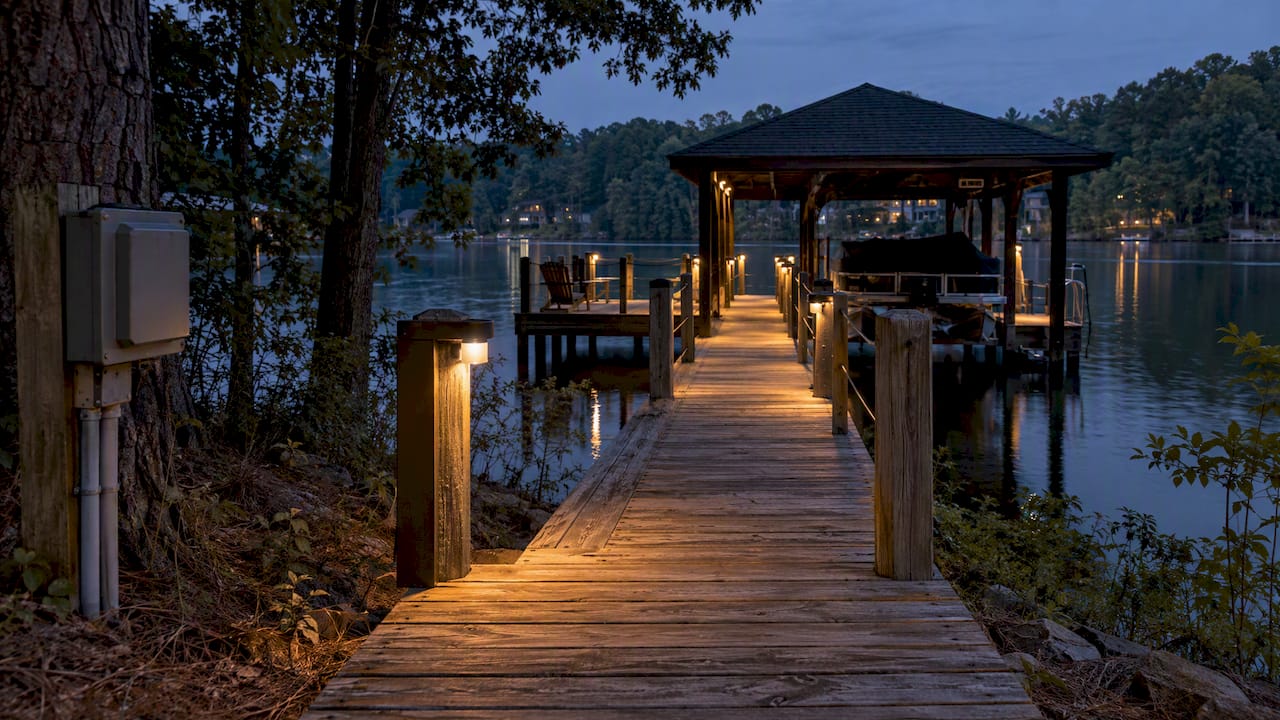
North Carolina has no single statute that says how a private dock must be lit. Instead, several sets of rules overlap: the state electrical code, coastal permit conditions, local building inspection, boating law for vessels, and, for workplaces, federal OSHA standards. Most of what you need to get right is the electrical work and any conditions written into your dock permit.
This guide walks through each layer so you know which one applies to your dock, whether you own a lake house near Charlotte or a waterfront lot on the coast.
TL;DR
- No general North Carolina law sets hours or required fixtures for a private dock light. Your obligations come from the electrical code, your permit and local inspectors.
- Electrical work on a dock follows the National Electrical Code as adopted in North Carolina, with GFCI protection in wet locations and, in some cases, an emergency power-off switch on the feeder.
- Navigation lights are a rule for boats, not docks. Dock lights should never be confused with, or interfere with, the lights a vessel must show.
- Coastal permits can limit a dock’s footprint and placement in sensitive areas, so check conditions before you add structures or fixtures.
- OSHA lighting standards apply to workplaces such as marine terminals, not to a private residential dock.
Table of Contents
- Is there a North Carolina law that requires dock lights?
- Electrical rules: the part most owners get wrong
- Permit conditions: coastal docks and local floodplains
- Lights on boats are a separate rulebook
- Public boating access areas
- Are dock lights required by OSHA?
- A practical compliance checklist
- What good dock lighting looks like in practice
- Our perspective
- Planning a dock or waterfront lighting project
- FAQ
- Sources
Is there a North Carolina law that requires dock lights?
For a private residential dock, no. The state’s electrical guidance says dock lighting should follow navigation safety where the Coast Guard requires it, or whatever your local site permit dictates, and that no general state law sets “dock light” usage hours. The electrical side is covered by the National Electrical Code as amended by North Carolina, as laid out in the 2026 Electrical Guidelines and Policies from the Department of Administration.
That means the questions to ask are practical ones:
- Does my dock permit say anything about lighting, shading or structures?
- Does the wiring I am adding need a permit and inspection?
- Is my dock part of a business, marina or public facility, where other rules apply?
- Will my lights create confusion for boaters or harm the shoreline environment?
The rest of this article answers those four in turn.
Electrical rules: the part most owners get wrong
Dock lighting is an electrical installation in about the worst environment for one: water, humidity, salt in coastal areas, and people who are often barefoot. That is why the electrical rules carry the real weight.
NEC, GFCI and the state’s 2026 guidelines
The state’s guidance says dock lighting must be installed according to the National Electrical Code as adopted by North Carolina, including GFCI protection in wet locations. It also covers emergency shut-off provisions for pier feeders. See the Department of Administration guidelines for the exact text.
One detail matters for larger docks. Under those 2026 guidelines, a feeder that supplies power to a pier, fixed dock or floating dock must include an emergency power-off switch that the public can reach and that shunt-trips the feeder circuit breaker. An exemption exists for installations that do not exceed ten single GFCI-protected 120-volt branch circuits. A typical single-family dock with a few lights and a receptacle will usually fall under that exemption, but the inspector, not the installer’s assumption, decides how your dock is classified.
When you need a permit for the wiring
Electrical work, including new wiring for lighting, typically requires a permit from the local building inspection department. Rules differ by town. In Pinehurst, for example, the town’s permit guide says adding or altering electrical wiring requires a permit, while changing a light fixture does not. Your own town or county may draw the line elsewhere, so call the inspection office before work starts.
Swapping a failed fixture is one thing. Running a new circuit out to the end of a pier is another, and it is the second case that gets inspected.
Construction standards for the dock itself
North Carolina’s building code requires docks, piers, bulkheads and waterway structures to be built to Chapter 36 of the North Carolina Building Code, with electrical installations governed by the applicable code provisions, according to the Rules Review Commission’s code documents. In practice, wiring has to be routed, supported and protected as part of the structure, not tacked on after the fact.
What this means for fixture choice
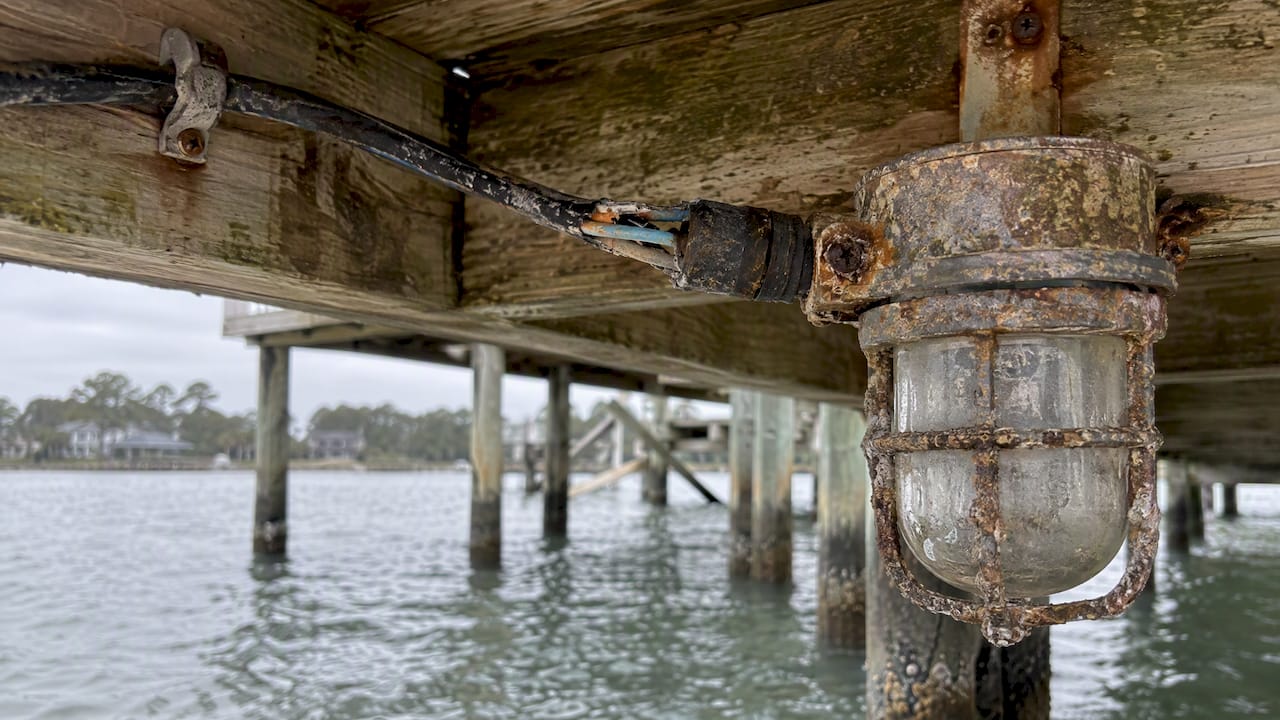
Code compliance sets the floor. Fixtures also have to survive the environment, and that is where installations quietly fail. Corrosion at connections, water intrusion in cheap housings and exposed splices cause most callbacks. Our guide to what to demand from any coastal fixture covers materials and sealing in more detail.
Permit conditions: coastal docks and local floodplains
Lighting is rarely the headline of a dock permit, but the permit still shapes what you can do.
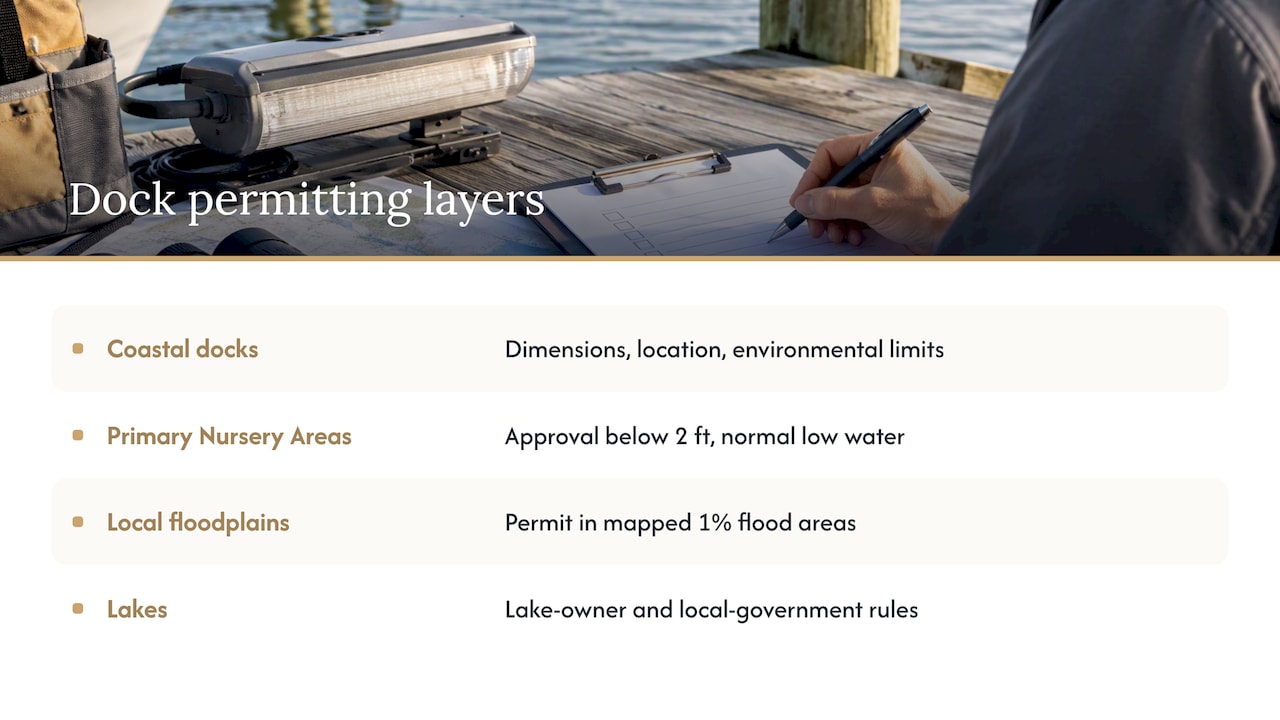
In the twenty coastal counties, the general permit conditions for piers and docking facilities are in 15A NCAC 07H .1205. They set limits on dimensions, locations and environmental impacts. If you plan to add a roofed shelter, a platform or a new structure to carry lights, those limits can apply to it.
Sensitive areas get extra attention. In designated Primary Nursery Areas where water is under two feet at normal low water, docking facilities need prior approval from Marine Fisheries or the Wildlife Resources Commission, per the same rule. The Division of Coastal Management’s approach focuses on footprint, shading and placement to protect estuarine health, so check with them before assuming a change is minor.
Floodplains are another local layer. Some towns require a floodplain development permit for work in a federally designated area with a 1% or greater annual chance of flooding. Pinehurst’s permit guide states this requirement, and many other North Carolina communities have similar ordinances. Ask whether your lot is mapped in one.
On lakes, including the Catawba River chain around Charlotte, shoreline rules are set by the lake’s owner or manager and local government. That is a different process from coastal permitting, so confirm your lake’s dock rules before you design the lighting.
Lights on boats are a separate rulebook
Much of what ranks for this search is about vessel lighting, which is easy to mix up with dock lighting. They are different.
The Wildlife Resources Commission’s Vessel Operator’s Guide says vessels operating at night must display navigation lights between sunset and sunrise, with arrangements varying by vessel type and length. Those requirements belong to the boat and its operator. Docking lights, spotlights and accent LEDs on a boat are not a substitute for them.
What does this mean for your dock?
- Do not mount colored lights that could be mistaken for a boat’s red, green or white navigation lights, especially facing open water.
- Aim fixtures down and shield them so they do not shine into a passing boater’s eyes.
- Keep the approach to your slip readable. A boater who can see the dock edge and the water line makes fewer mistakes at night.
Glare matters for another reason: it also washes out night vision. Our page on low-glare dock lighting that protects wildlife and radios explains shielding and color choices that work for boaters.
Public boating access areas
If your dock is on a public boat ramp or at a state access area, different rules apply. The Wildlife Resources Commission maintains more than 200 access areas, and vessels within 50 yards of a state-owned or controlled access area must travel at no-wake speed, per its boating access area regulations. Those facilities are managed by the agency, and a private owner does not add lighting to them.
Federal law also touches this subject at some federal projects. The statute on lighting at docks and boat launching facilities, 33 U.S.C. 403b, directs the Army Corps of Engineers to consider the lighting needs of such facilities from sunset to sunrise. That is guidance for how the agency manages its facilities, not an obligation on a homeowner.
Are dock lights required by OSHA?
Not on a private home dock. OSHA’s standards apply to employers and workplaces. Where a dock is a place of work, the rules can apply.
The clearest example is marine terminals. OSHA’s illumination standard for marine terminals requires working and walking areas to be lit. It sets an average minimum of 5 foot-candles in active work areas such as cargo transfer points, unless specific Coast Guard conditions apply. It also says lights should be placed, as far as possible, so they do not shine in employees’ eyes.
Other workplaces, such as a commercial marina, a restaurant with a waterfront deck or a rental operation, may fall under different OSHA standards depending on the work performed. If you run a business on the water, ask your insurer or an OSHA-trained safety consultant which standard covers your operation. For a homeowner, OSHA does not dictate your fixtures. Your insurer and common sense about slip and fall liability matter more.
A practical compliance checklist
Before you light a dock in North Carolina, work through this list.
- Find your authority. Is the dock on a coastal estuary, a lake, a river or a public facility? That tells you who writes the permit conditions.
- Read your permit. Look for dimension limits, shading limits and sensitive-area conditions.
- Call the inspection office. Ask whether new wiring needs a permit and an inspection, and whether a fixture swap does.
- Specify GFCI protection. Wet locations require it. Ask your electrician how your circuits will be protected.
- Ask about the emergency shut-off. Confirm whether your dock falls under the ten-circuit exemption.
- Choose marine-grade parts. Look for sealed housings, corrosion-resistant hardware and proper cable routing.
- Aim and shield. Keep light on the walking surface and the water’s edge, not in boaters’ eyes.
- Plan maintenance. Salt, humidity, storms and wood movement all loosen connections over time.
What good dock lighting looks like in practice
The best dock designs are modest. They light the path from the house, the steps, the dock edge and the slip, and little else. Low, shielded fixtures show where to step without creating a glowing island that reflects on the water.
Some principles we follow:
- Light the route first. The walk from the yard to the dock is where most evening falls happen.
- Mark edges and level changes. Steps, cleats and the dock perimeter are the hazards.
- Keep color choices boater-friendly. Warm white or amber tones are less likely to confuse boaters than saturated colors aimed outward.
- Think about wildlife. Bright, blue-heavy light on the water can disturb the shoreline. Our piece on wildlife friendly dock lighting beyond amber LEDs goes deeper.
- Use smart controls. Schedules and dimming let you run lights at the level you need and turn them off when nobody is there.
If you are comparing options, our dock lighting ideas for homeowners lay out what a DIY approach can and cannot safely cover, and our dock lighting regulations overview offers a shorter reference for property owners.
Our perspective
Most dock lighting problems we are asked to fix were not code violations in the dramatic sense. They were small decisions that added up: a fixture not rated for the splash zone, a splice left exposed under the deck boards, glare aimed straight across the cove, or a circuit added without a call to the inspector.
We approach a dock as a safety system first and a design feature second. That means commercial-grade, weather-resistant hardware, clean cable routing, and controls that let you set a sensible schedule from your phone. It also means we tell homeowners when a permit or an inspection is likely to be needed, because it is cheaper to ask before the work than to open walls and decking afterward.
We do not treat the rules as an obstacle. They exist because water and electricity are unforgiving, and because a lit dock is part of a shared shoreline. A well-planned system respects both.
— Dave
Planning a dock or waterfront lighting project
If you want a dock lit safely, with marine-grade fixtures, clean wiring and smartphone control, our dock and waterfront lighting service is built for exactly that. We design around the permit and inspection steps for your property, and our GlowCare maintenance program keeps systems in good order season after season. Request a free estimate and we will walk the shoreline with you.
FAQ
Do I need a permit to add lights to my dock in North Carolina?
Often you do for new wiring, though not always for replacing a fixture. The state’s guidance says new wiring for lighting typically requires a local permit, and some towns, such as Pinehurst, exempt a simple fixture change. Call your town or county inspection department before you start.
Are GFCIs required on dock lighting circuits?
Yes, the state’s electrical guidance calls for GFCI protection in wet locations, which includes docks. Larger installations also need an emergency power-off switch on the feeder unless they fall under the ten-circuit exemption. Ask your electrician which category your dock is in.
Can I use colored or LED accent lights on a dock near open water?
Generally yes, but avoid anything that could look like a boat’s navigation lights, and keep fixtures shielded and aimed downward. Navigation light rules apply to vessels operating between sunset and sunrise, not to docks. Check your permit and any lake or community rules for specific restrictions.
Are dock lights required by OSHA?
Not for a private residential dock. OSHA standards apply to workplaces, and marine terminals, for example, must meet the illumination standard in 29 CFR 1917.123. If you operate a business on the water, confirm which standards cover your operation.
Do coastal rules limit dock lighting to protect wildlife?
The coastal dock rules focus mainly on dock size, shading and placement, especially in Primary Nursery Areas, rather than on fixtures themselves. Low-glare, shielded lighting is still a good practice near sensitive shorelines. Ask the Division of Coastal Management about any conditions on your permit.
Sources
- Electrical Guidelines and Policies, 2026, NC Department of Administration
- 15A NCAC 07H .1205, Specific Conditions for Piers and Docking Facilities
- Which Permit Should I Apply For?, Pinehurst
- NC Building Code technical changes, Docks, Piers and Waterway Structures
- Vessel Operator’s Guide, NC Wildlife Resources Commission
- Boating Access Area Regulations, NC Wildlife
- OSHA 1917.123, Illumination