
A well-made outdoor LED system typically lasts 10 to 17 years or more, depending on how many hours a night it runs and how well it is built and installed. The rating on the box is only the starting point. Heat, moisture, the power supply and the quality of the seals decide whether a system reaches that number or falls short of it.
This guide explains what the rating means, how to convert hours into years for your own home, what shortens LED life outdoors, and what to ask before you hire anyone to install lighting on your roofline, landscape or patio.
TL;DR
- Outdoor LED life is measured by how long the light stays bright, not by when it burns out. The common benchmark is the point where output has dropped 30%.
- A 50,000-hour rating works out to roughly 11 years at 12 hours a night and roughly 17 years at 8 hours a night, if the system is installed and cooled correctly.
- Heat is the biggest threat to LED life. Moisture, a weak power supply and poor seals come next.
- The LED chip is often not the part that fails first. Drivers, connectors and gaskets deserve as much attention as the diodes.
- Quality varies widely between products, so the installer, the hardware and the maintenance plan matter as much as the lumen rating.
Table of Contents
- What an LED lifespan number actually means
- From hours to years: a simple conversion
- How outdoor LEDs compare with older lighting
- What shortens outdoor LED life
- Fixture life, LED life and system life are not the same
- Weather ratings: what to look for
- Choosing outdoor LED fixtures for a home
- How to help your lights last longer
- Our perspective: why we focus on the system, not the diode
- Permanent lighting built for Carolina weather
- FAQ
- Sources
What an LED lifespan number actually means
An old incandescent bulb works until the filament snaps. An LED usually does not. It keeps glowing and slowly gets dimmer. For that reason, the industry defines LED life by light output. ENERGY STAR’s guide to LED lighting explains that useful life is generally defined by lumen depreciation, the point at which output has fallen by 30%, rather than a sudden failure.
You may see this written as L70, meaning the light has dropped to 70% of its starting output. The U.S. Department of Energy and the Next Generation Lighting Industry Alliance define L70 and a related B50 measure: B50 is the time by which half of a population of products has fallen below that level. In plain terms, a 50,000-hour rating usually describes the median product, not a guarantee for every unit. Half of a batch may reach the rating later, and the other half sooner.
Two practical consequences follow:
- A light that is 30% dimmer than new still works, and most people will not notice the change gradually. Replacement often happens because of a failed component, not because the light fell to L70.
- The rating comes from controlled testing. Your roofline, your summer attic heat and your coastal or lake humidity are not a lab.
From hours to years: a simple conversion
Manufacturers quote hours. Homeowners live in years. The conversion is simple: divide the rated hours by the number of hours the lights run each year.
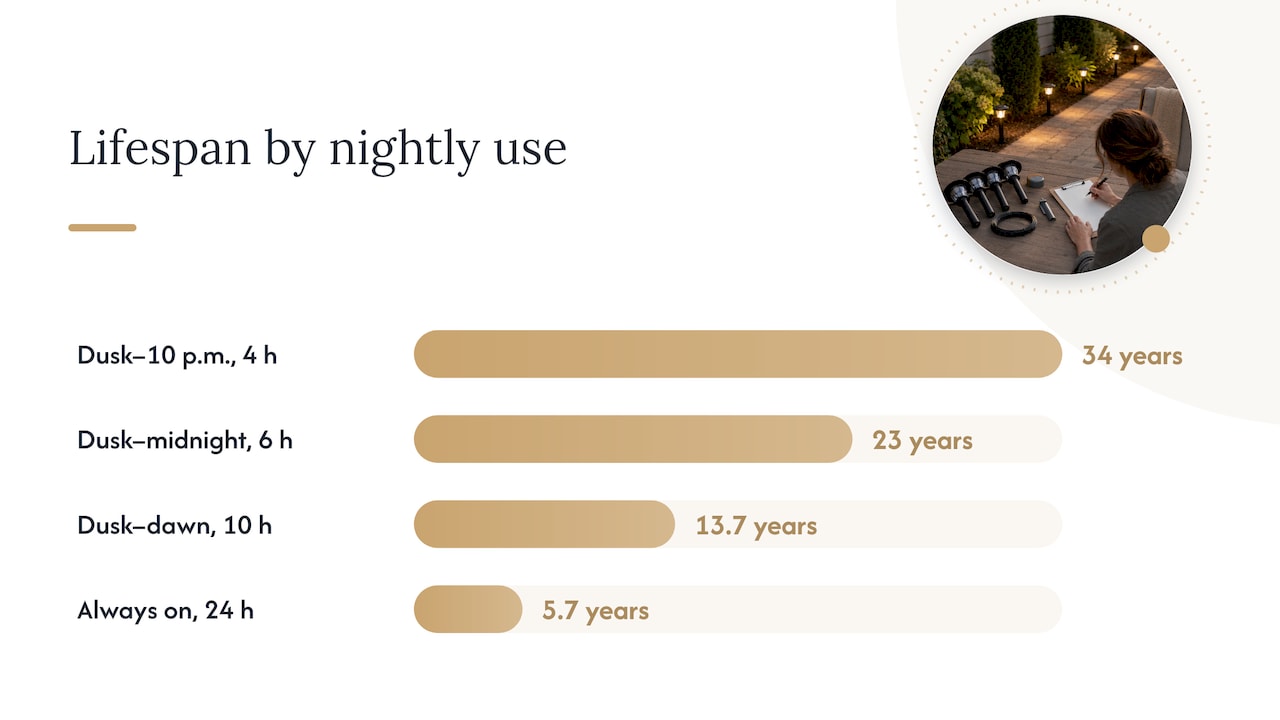
TME’s U.S. guide gives two examples for a 50,000-hour rating: about 17 years at 8 hours per day and about 11 years at 12 hours per day, assuming correct installation, cooling, power supply and an ambient temperature within the permitted range. Those assumptions carry a lot of weight, and we return to them below.
Here is the same arithmetic extended to a few common outdoor patterns. These figures are our own calculation from the hours, not a promise for any product:
| Typical use | Hours per year | 50,000-hour rating lasts about | 100,000-hour rating lasts about |
|---|---|---|---|
| Dusk to 10 p.m. (about 4 hours a night) | 1,460 | 34 years | 68 years |
| Dusk to midnight (about 6 hours a night) | 2,190 | 23 years | 46 years |
| Dusk to dawn security lighting (about 10 hours a night) | 3,650 | 13.7 years | 27 years |
| Always on (24 hours a day) | 8,760 | 5.7 years | 11.4 years |
A few notes on reading this table:
- Permanent holiday and accent lighting is usually on for a few hours in the evening, so the math is generous. The component limits, not the diodes, tend to set the real lifespan.
- Landscape lighting on a dusk-to-dawn schedule uses more hours. Putting it on a timer or photocell, or dimming it, stretches the years.
- Long rated lives of 100,000 hours or more exist but should be read cautiously. The Department of Energy notes that some outdoor LED luminaires are designed for useful lives of 100,000 to 150,000 hours, and also points out that estimating LED life is difficult because testing a product for its full life is impractical.
How outdoor LEDs compare with older lighting
The gap with older technology is large. The same Department of Energy fact sheet says well-designed LED outdoor luminaires may provide 50,000 hours or more, compared with 15,000 to 35,000 hours for metal-halide and high-pressure-sodium systems. For a homeowner, this means fewer bulb changes, fewer ladder trips and lower upkeep over the life of the system.
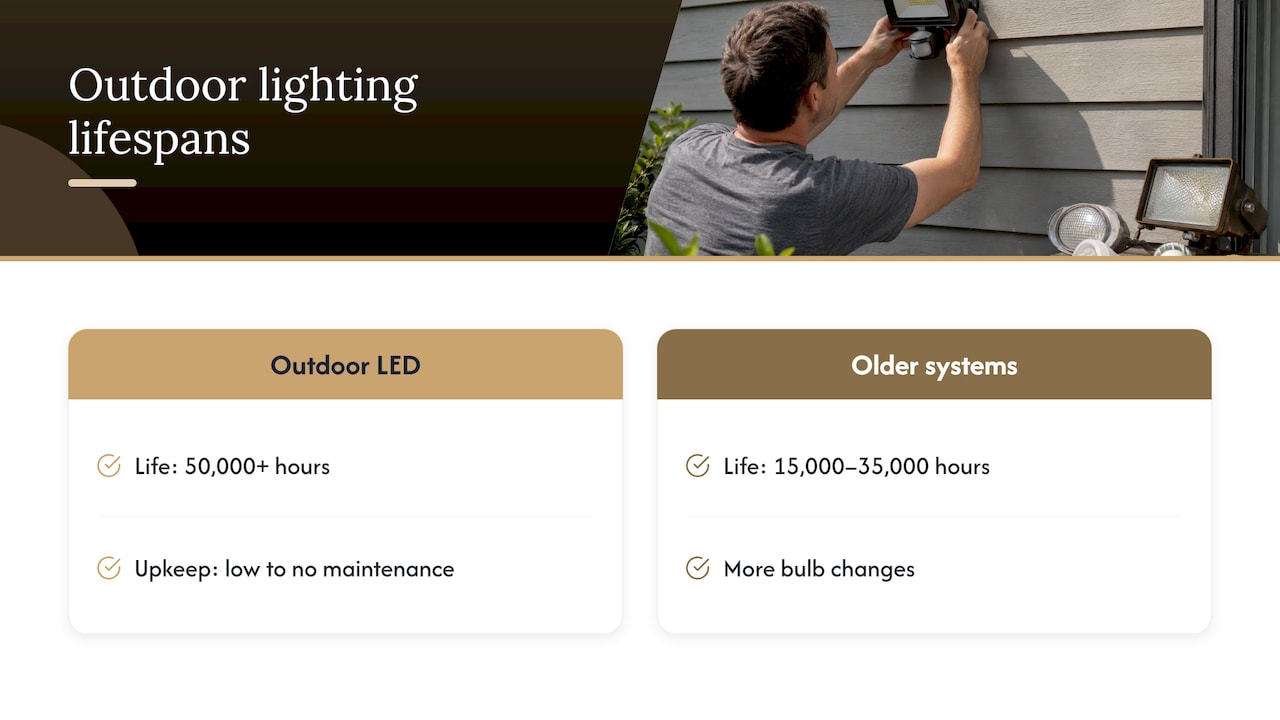
Kichler, a U.S. fixture manufacturer, describes outdoor LEDs as offering around 15 years of life with low to no maintenance, while noting that the right outdoor rating depends on where the fixture is installed. That is a realistic planning number for a quality residential system: roughly a decade and a half, with the caveat that location matters.
If you want to see how LED fits into the wider picture of landscape design, our homeowner’s guide to LED in landscape lighting covers the basics, and our article on what the best type of outdoor lighting is compares the options.
What shortens outdoor LED life
LED chips can last a very long time. The system around them is what usually gives out first. Four factors do most of the damage.
Heat
Heat is the central issue. ENERGY STAR states that thermal management is generally the single most important factor in how an LED performs over its lifetime, and that higher operating temperatures accelerate degradation and shorten useful life.
The Department of Energy adds that the temperature at the LED junction governs performance, so heat sinking and airflow must keep both the LEDs and the electronic power supply within an acceptable operating range. It also notes that higher drive current and higher operating temperature can shorten useful life.
Outdoors, this shows up in everyday ways:
- A fixture buried in mulch or packed in a sealed, unventilated enclosure cannot shed heat.
- A dark-colored fixture or track mounted on a sun-baked south-facing wall runs hotter than the air temperature suggests.
- Cheap products that push LEDs at high current to look bright in the showroom age faster.
In the Carolinas, long hot and humid summers put steady thermal stress on any outdoor system, so thermal design is not a detail you can skip.
Moisture
Water gets into things. The IEA 4E lifetime literature review identifies environmental effects, especially thermal conditions and humidity, along with power-supply cycling, as important failure mechanisms in LED systems. Corroded contacts, wet drivers and clouded lenses are the usual outcome.
A rating alone does not solve this. Color Kinetics, a lighting manufacturer, notes that an outdoor-rated system needs suitably rated cables, junction boxes, power and data supplies, gaskets and sealed connections, not merely an IP-rated lamp housing. It also warns that IP66 products are not waterproof and should not be installed where water can collect or in standing water, and that vents must not be removed, punctured or blocked.
The power supply and electrical design
LED drivers convert household current to the low-voltage direct current that LEDs need. They contain components that are sensitive to heat and surges. The Department of Energy states that thermal and electrical design weaknesses can cause rapid lumen depreciation or premature failure. The IEA review also flags power-supply cycling, meaning repeated switching on and off, as a stress factor.
If your system fails, the driver, a connector or a splice is a more likely culprit than the LED diodes themselves. For more on why a low-voltage layout helps with safety and longevity, see our article on why low voltage landscape lighting is the smart choice.
Product quality and installation
The Department of Energy says outdoor LED product quality varies significantly among manufacturers, so selection and application call for due diligence. It also says well-designed LED luminaires are generally more likely to depreciate gradually than fail catastrophically, while poorly designed ones may depreciate rapidly or fail outright.
Two systems with the same advertised hours can have very different real lives. The difference is in the heat sink, the driver, the gaskets, the wiring and the person who put it all together.
Fixture life, LED life and system life are not the same
When people ask how long outdoor light fixtures should last, they usually mean three different things:
- The LED source. This is the number on the box, defined by light output (L70) and measured under normal operating conditions.
- The driver and electronics. These often have a shorter life than the diodes, especially in heat.
- The housing, seals and wiring. Corrosion, UV damage, cracked gaskets and loose connectors end many outdoor systems.
The DOE and NGLIA guidance recommends defining lifetime by light output while considering all sources of light-output diminution or failure. That is a sensible way to think about your own home. Ask about the whole system, not only the chip.
Weather ratings: what to look for
Outdoor fixtures carry two kinds of labels you will run into.
Damp and wet locations. Kichler explains that damp-rated fixtures suit covered locations, while wet-rated fixtures can be exposed to direct precipitation. A fixture under a deep porch ceiling and a fixture on an exposed fascia are not in the same situation.
IP ratings. These describe protection against dust and water. As an example from Bosch’s garden lighting guide, covered wall lights exposed to splashing may need IP44, ground and garden spotlights IP65 or IP67, and fixtures meant for permanent underwater use IP68, as Bosch’s outdoor lighting tips outline. Treat those as illustrations of the scale rather than a code requirement.
The lesson from Color Kinetics applies again: weather resistance is a system-level issue. Seals, connectors, junction boxes, vents and drainage count as much as the code printed on the lamp.
Choosing outdoor LED fixtures for a home
Before you sign anything, run through these questions. They help whether you hire us or someone else.
- What is the rated life, and how is it defined? Look for an L70 figure at a stated temperature, not a vague promise of “long life.”
- What is the wet or damp rating for this exact location? Confirm it for the whole system, including the driver and connections.
- Where does the power supply live? It should be ventilated, accessible and protected from water.
- How are connections sealed and made? Ask whether they are gasketed, potted or otherwise protected, and how drainage is handled.
- What does the warranty cover? A warranty written for local weather is more useful than a generic one.
- Who services it? A system that nobody maintains ages faster than one on a plan.
For practical guidance on picking fixtures and planning outdoor lighting installation and control systems, an electrician’s perspective can help you think through the wiring side of the project. For a broader planning tool, our landscape lighting checklist for homeowners walks through the decisions in order.
How to help your lights last longer
Good installation sets the ceiling. Maintenance keeps you near it. A simple routine goes a long way.
Keep seals, vents and connections healthy
Color Kinetics advises keeping connections, gaskets and vents intact and free of debris, preventing water from pooling, and periodically cleaning the fixture. Look for cracked gaskets, discolored or loose connectors, and fixtures that now sit in a low spot where water collects.
Run the lights only when you need them
The National Park Service recommends timers, motion detectors and dimmers so outdoor lights operate only when needed, and says these controls can improve energy efficiency and reduce environmental impacts. For LED lifespan, fewer operating hours and lower drive levels mean less heat and a longer calendar life. Smart controls that let you schedule, dim and change scenes from a phone do this without any effort once set up.
The Park Service also recommends fully shielded or full-cutoff fixtures that direct light downward, reducing glare and unwanted upward light. That is good for neighbors and for visibility, and it is a reasonable design principle for any yard.
Check after storms and seasonal changes
After heavy rain, high wind or a freeze, walk the property after dark. A section that flickers, looks dimmer than its neighbors or stays off points to a connection, a driver or a moisture problem. Catching it early prevents a small issue from damaging other parts of the circuit. Our compact calendar and log for outdoor lighting maintenance gives you a simple schedule to follow.
If you want to know how much running these systems costs, our piece on outdoor LED energy use for homeowners covers the numbers.
Our perspective: why we focus on the system, not the diode
We install permanent roofline tracks, landscape lighting, patio and bistro lighting and commercial exterior systems in the Charlotte area. When customers ask how long LEDs last, we usually answer with another question: what is the whole system made of, and who looks after it?
The diodes are the easy part. Most of the hours-and-years conversation is settled by things you cannot see from the street: how heat leaves the track, where the power supply sits, how every connection is sealed and what happens to water that gets in. That is why we use commercial-grade, climate-optimized hardware and design for Carolina weather and for HOA and municipal requirements, rather than adapting a product made for a mild, dry climate.
We also think a lighting system should come with a plan. Our GlowCare maintenance subscription exists because outdoor electrical work benefits from a periodic look by someone who knows what to check. The point is not to sell a visit. It is to catch a worn gasket or a stressed connection before it costs you a section of lights.
Our advice to homeowners is simple. Judge a lighting proposal by the answers to the questions above, not by the biggest hour figure on a brochure. A system designed well for 50,000 hours will usually serve you better than a poorly built one that claims 100,000.
— Dave
Permanent lighting built for Carolina weather
If you are weighing a permanent system for your roofline, landscape or patio, we design and install custom smart LED lighting for homes and businesses across the greater Charlotte area. Systems are controllable from your phone, with multi-color options and designs that follow HOA requirements.
You can see how the process works in our permanent lighting installation guide, explore our permanent lighting services, including the GlowCare maintenance plan, or look at landscape lighting design for the yard. When you are ready, contact us through our site for a free estimate.
FAQ
How long do outdoor LED lights last in years?
For a quality system rated at 50,000 hours, expect roughly 11 years at 12 hours a night and roughly 17 years at 8 hours a night, if heat and moisture are well managed. Lights that run only a few hours each evening can last far longer on paper, though the driver and connections usually become the limiting parts. Manufacturer guidance such as Kichler’s cites about 15 years with little maintenance for outdoor LEDs.
Are LED lights good for outdoor use?
Yes, when the fixture and the whole system carry the right rating for their location. LEDs run cooler than older sources and last much longer than metal-halide or sodium lamps. Covered areas can use damp-rated fixtures, while anything exposed to direct rain needs wet-rated products with properly sealed connections.
What is the downside of LED lights outdoors?
The main downside is uneven quality. The Department of Energy notes that outdoor LED products vary significantly among manufacturers, and poorly designed units can dim quickly or fail early because of heat or electrical weaknesses. Upfront cost can also be higher than with basic bulbs, which is offset by fewer replacements over time.
Do LEDs wear out if they are left on all night?
They age with every operating hour, so a dusk-to-dawn schedule uses up rated life faster than a four-hour evening schedule. Even so, 10 hours a night on a 50,000-hour rating works out to nearly 14 years. Timers, dimmers and motion sensors reduce the hours and the heat.
What should I do when part of my outdoor lighting stops working?
Check whether the problem is a single fixture or a whole section. A single dark light may be a failed unit, while a dead run often points to a driver, a connector or water in a junction. Because outdoor circuits involve electrical work, have a licensed electrician or your installer inspect it rather than opening sealed components yourself.
Sources
- Learn About LED Lighting, ENERGY STAR
- LED Luminaire Lifetime: Recommendations for Testing and Reporting, U.S. Department of Energy
- LED Outdoor Area Lighting Fact Sheet, U.S. Department of Energy
- LED Outdoor Area Lighting Fact Sheet, energy.gov edition
- How long do LEDs actually last, TME
- Outdoor Lighting Basics, Kichler Lighting
- IP ratings for LED Lighting Systems, Color Kinetics
- Literature Summary of Lifetime Testing of Light Emitting Diodes, IEA 4E
- Outdoor Lighting Principles, National Park Service
- 11 Tips for lighting in the garden, Bosch DIY