
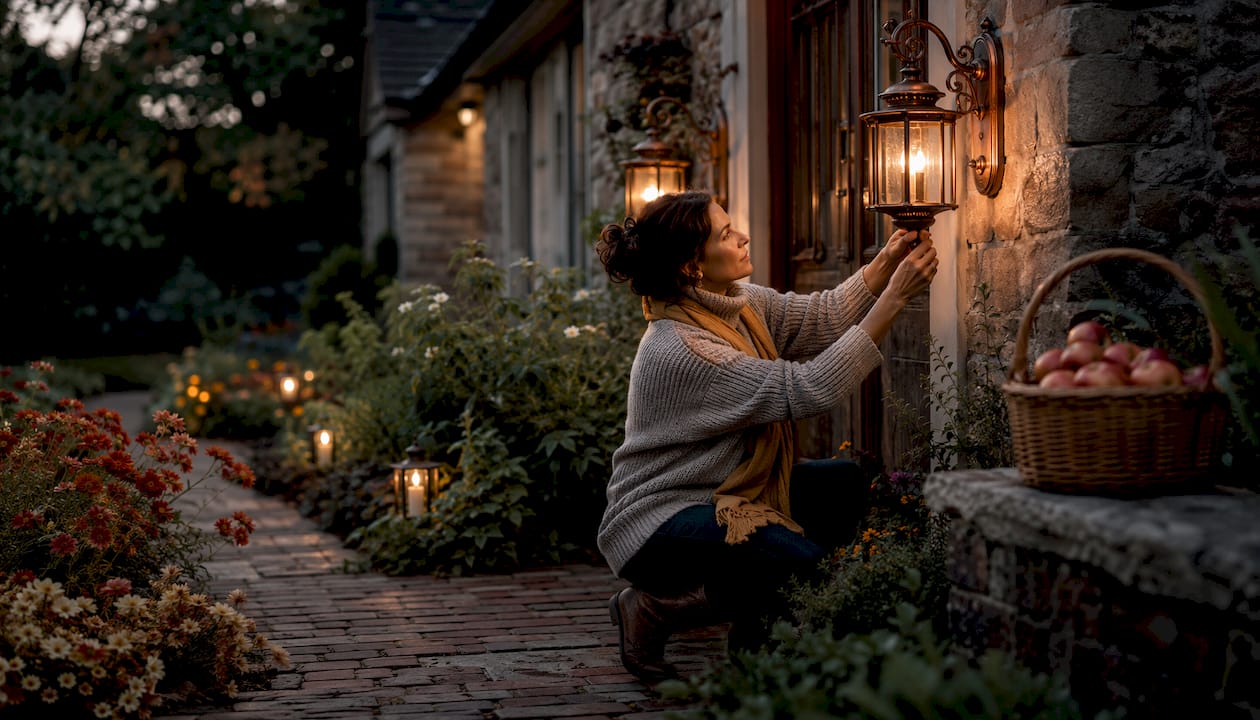
The single most effective move you can make tonight: place one warm uplight on your best tree or textured wall, add a path light at the first step, and make sure your front door glows with a warm, welcoming fixture. That three-step combination creates the layered depth that separates a designed exterior from a house that just has lights on it. Landscape lighting for curb appeal works best when fixtures are layered and the front door serves as the visual anchor the eye naturally travels to.
Quick-start checklist:
- Install one path safety light at the first step or turn in your walkway
- Add one uplight at the base of a statement tree or textured facade
- Confirm your entry fixture uses a warm bulb in the recommended color temperature range
Pro Tip: Step outside at dusk, stand at the curb, and look at your house. Then walk inside and check each room that faces the front. Both views matter. A fixture that looks great from the street can create glare inside a bedroom.
Table of Contents
- How layered lighting creates depth and curb appeal
- 15 landscape lighting ideas that genuinely boost curb appeal
- 1. Staggered path lights along the walkway
- 2. Tree uplighting on a statement specimen
- 3. Wall washing a textured facade
- 4. Moonlighting from a tall tree
- 5. Silhouette backlighting for dramatic plants
- 6. Warm lanterns flanking the front door
- 7. In-grade driveway edge lights
- 8. Step and riser lighting
- 9. Illuminated address numbers
- 10. Accent lighting on ornamental grasses
- 11. Deck and step perimeter lighting
- 12. Bistro or string lights for an entertaining porch
- 13. Motion-activated path safety lighting
- 14. Grazing a garden bed edge
- 15. Seasonal color scenes via smart control
- Which power and control system is right for your yard?
- Design rules that prevent glare and create a polished look
- How to choose fixtures that last and look intentional
- Ballpark costs and when to hire a professional
- Why professional installation produces better results
- Key Takeaways
- What installers see that most homeowners miss
- Foreverglowlighting can design and install your system
- Useful sources and further reading
How layered lighting creates depth and curb appeal
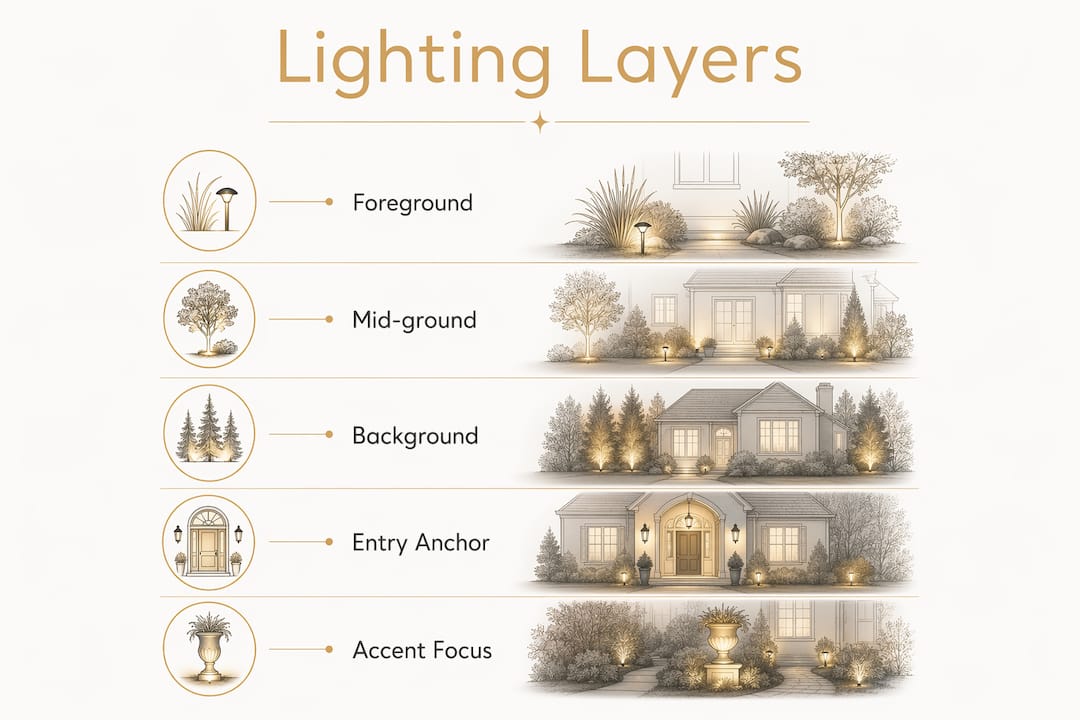
A single bright fixture does not create curb appeal. What creates it is three distinct lighting roles working together: path and task lighting in the foreground, vertical accent lighting in the mid-ground, and warm entry lighting as the background anchor.
Think of your yard in three depth zones. The foreground includes your walkway, steps, and driveway edge. The mid-ground holds your trees, shrubs, and garden beds. The background is your facade and front door. Lighting all three zones differently is what gives a yard that staged, high-end look at night rather than a flat, washed-out appearance.
Spacing matters as much as placement. Symmetrical, evenly spaced path lights produce a clinical, airport-runway effect. Stagger fixtures to follow the natural curves of your path or garden bed edges, and the lighting reads as organic and residential rather than commercial.
15 landscape lighting ideas that genuinely boost curb appeal
Pro Tip: Limit yourself to three or four focal features per view. A yard lit from every angle at equal intensity looks busy, not designed. Pick your best tree, your strongest architectural detail, and your entry, then stop.
1. Staggered path lights along the walkway
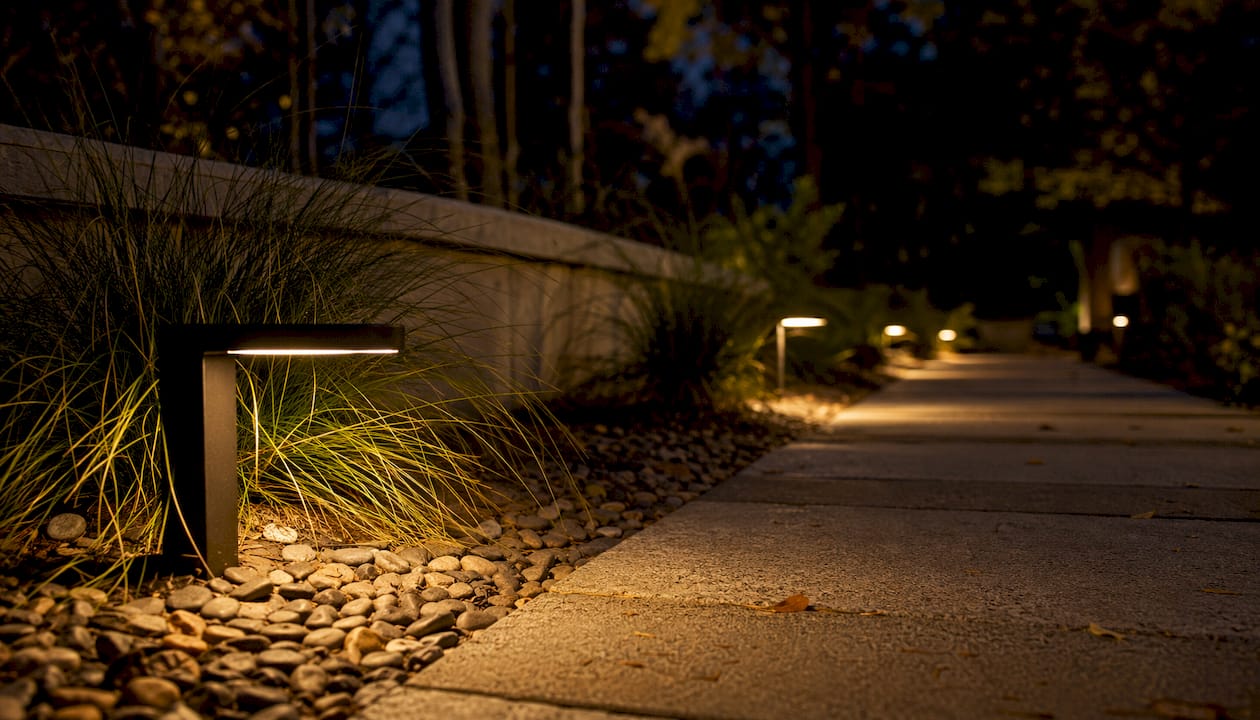
Place low-profile path fixtures on alternating sides of the walkway rather than in matching pairs. This guides visitors safely while creating a natural, flowing look. DIY-friendly with solar or low-voltage options. Look for photos where the path curves gently and lights alternate sides.
2. Tree uplighting on a statement specimen
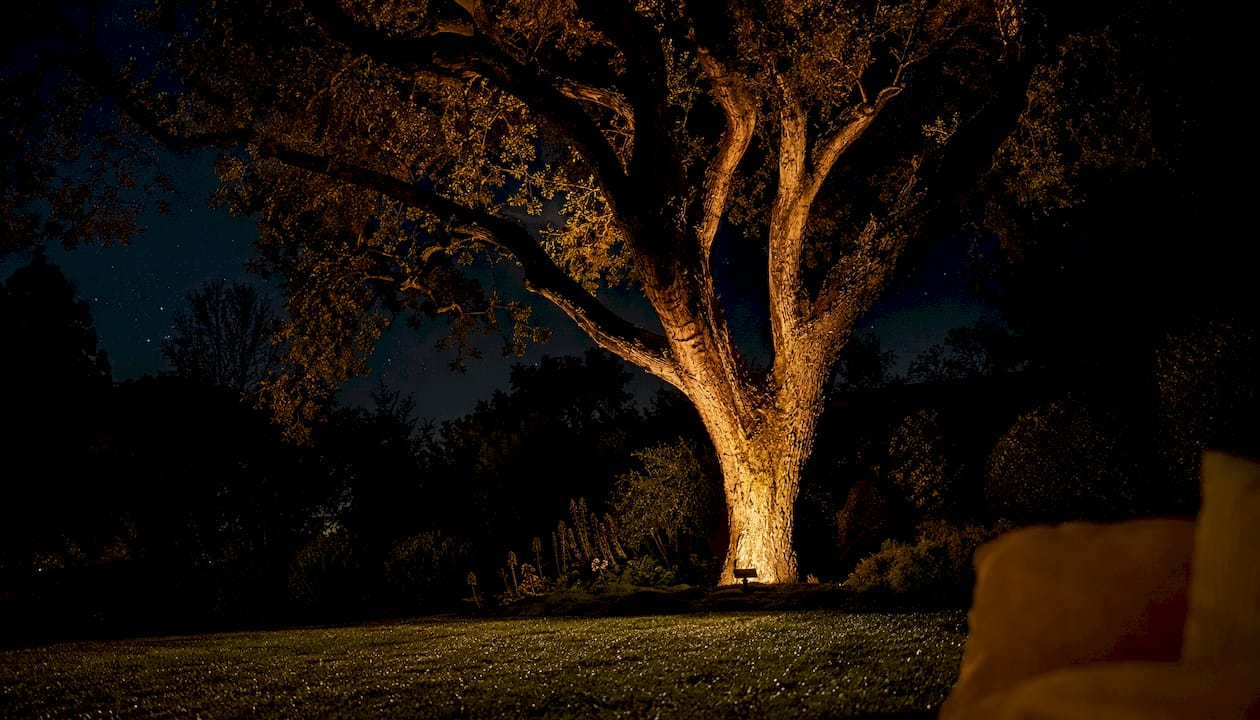
Bury a well-light or spike uplight at the base of your best tree, aimed upward to reveal branch structure and canopy texture. One well-placed uplight on a mature oak or magnolia does more for curb appeal than six mediocre fixtures scattered around the yard. Moderate DIY difficulty; low-voltage systems keep it manageable.
3. Wall washing a textured facade
A wall-wash fixture placed 12–18 inches from a stone, brick, or board-and-batten facade rakes light across the surface and reveals texture that disappears in flat illumination. This is one of the highest-impact moves for homes with architectural character. Pro installation recommended for precise aiming.
4. Moonlighting from a tall tree
Mount a downlight high in a tree canopy and aim it toward the ground. The result mimics natural moonlight filtering through leaves, casting soft dappled shadows on the lawn below. It is subtle, sophisticated, and almost impossible to achieve with DIY solar fixtures. This technique rewards professional installation.
5. Silhouette backlighting for dramatic plants
Place a fixture behind a sculptural plant (ornamental grass, agave, or a columnar shrub) and aim it at the wall behind. The plant reads as a dark silhouette against a glowing surface. Low effort, high visual impact, and works well with low-voltage LED spotlights.
6. Warm lanterns flanking the front door
Two matching lanterns at the entry, one on each side of the door, frame the visual anchor of the whole composition. The front door should be the warmest, most welcoming point in the nighttime view. Choose fixtures with a warm color temperature and a finish that matches your hardware. Easy DIY replacement if existing junction boxes are in place.
7. In-grade driveway edge lights
Flush-mount in-grade fixtures along the driveway edge define the boundary without adding visual clutter above ground. They are especially effective on long driveways or curved approaches. Line-voltage or low-voltage hardwired options; professional installation strongly recommended for in-grade work.
8. Step and riser lighting
Recessed step lights mounted into the riser of each stair illuminate the tread without shining into anyone’s eyes. They serve a clear safety function while adding a polished, architectural detail. Low-voltage systems work well here; a licensed electrician should handle line-voltage versions.
9. Illuminated address numbers
A small directional fixture aimed at your house numbers makes the address readable at night and adds a finished detail most neighbors overlook. Simple, inexpensive, and a fast DIY win with a plug-in or solar option.
10. Accent lighting on ornamental grasses
Low-angle spotlights aimed through ornamental grasses create movement and texture as the blades catch the breeze. The effect is especially striking in the foreground zone, where it adds life to what is otherwise a static composition.
11. Deck and step perimeter lighting
Recessed or surface-mounted deck step lights along the perimeter of a front porch or deck define the structure’s edges and add depth to the facade view. They work as both safety and accent fixtures simultaneously.
12. Bistro or string lights for an entertaining porch
A strand of warm bistro string lighting draped across a covered front porch adds warmth and approachability to the entry zone. This works particularly well on craftsman and farmhouse-style homes where the porch is a prominent architectural feature.
13. Motion-activated path safety lighting
A motion-activated fixture at a side gate or secondary path adds security without burning energy all night. Pair it with always-on low-level path lights so the transition from off to on is not jarring. Modern smart systems let you set sensitivity and duration from a phone app.
14. Grazing a garden bed edge
A low-angle fixture aimed along a garden bed edge highlights the texture of mulch, stone edging, or low groundcover. It defines the foreground zone without drawing attention to itself. Solar spike lights work here if the bed receives direct sun during the day.
15. Seasonal color scenes via smart control
A smart low-voltage system with color-temperature zoning lets you shift the whole yard from a warm 2700K everyday palette to a festive scene for holidays, all from your phone. Foreverglowlighting’s permanent LED systems support millions of color options, so the same fixtures that handle curb appeal year-round can also handle holiday lighting without any ladder work.
Which power and control system is right for your yard?
Three system types dominate residential outdoor lighting, and each has a clear use case.
Low-voltage LED (12V) is the professional standard for landscape lighting. It is safe to handle, energy-efficient, and expandable. The trade-off is that transformer sizing requires planning: you must total your fixture wattage and account for voltage drop on long wire runs, or you will see flicker and premature failure. This is the system type Foreverglowlighting installs for most residential landscape projects.
Solar fixtures are a practical entry point for path lights and accent spots in beds that receive direct sun. Consumer Reports’ testing of solar outdoor lights confirms meaningful differences between brands in brightness consistency and weather durability. Solar works best as a supplement, not a foundation, for a layered curb-appeal plan.
Line-voltage (120V) delivers the most consistent output and suits high-lumen applications like driveway floods or security fixtures. It requires a licensed electrician for any new circuit work and is not a DIY option for most homeowners.
For controls, the features that matter most for curb appeal are dusk-to-dawn photocells (so lights come on automatically), scheduling, dimming scenes, and color-temperature zoning. Smart app control, like the systems Foreverglowlighting installs, adds the ability to shift scenes remotely and integrate with motion sensors. The role of smart outdoor lighting goes well beyond convenience: consistent, scheduled illumination is what makes a home look maintained and intentional every night.
Design rules that prevent glare and create a polished look
Getting the fixtures right matters less than getting the aim right. These placement rules prevent the most common mistakes.
- Beam angle: Use a narrow beam for uplighting trees and walls; use a wider flood for path and step lighting where even coverage matters more than punch.
- Color temperature: Use a consistent warm color temperature for all fixtures on the front of the house to avoid mismatched lighting looks.
- Glare control: Never aim a fixture directly at a window or a seating area. Walk through the home at night and check every room that faces the front. Re-aim any fixture whose source is visible from inside.
- Uplight placement: Position uplights 6–12 inches from the base of a tree trunk or wall surface to maximize texture and minimize spill onto neighboring properties.
- Path light stagger: Alternate fixtures on opposite sides of the path, spaced to illuminate the walking surface without creating a symmetrical row.
- Step lighting: Mount step fixtures in the riser, not the tread, so the light falls forward onto the walking surface rather than upward into the face.
True sophistication in outdoor lighting comes from the interplay of light and shadow, not from sheer brightness. Resist the urge to add more fixtures when the effect feels flat. The fix is usually re-aiming, not more lumens.
How to choose fixtures that last and look intentional
The fixture type should match the visual job it is doing. Spike-mounted spotlights handle tree uplighting and accent work. Path fixtures with a downward shield keep light on the ground and off the eye. In-grade well lights disappear into the lawn surface. Wall-wash fixtures with a linear spread cover large facade areas evenly.
For durability in wet climates, look for an IP65 or higher rating on any fixture installed in a planting bed or lawn area. Bronze and matte black finishes hold up well against UV and moisture and tend to disappear against soil and mulch during the day. Avoid bright chrome or polished finishes outdoors; they corrode and draw attention to the fixture rather than the light effect.
For lumen output, choose levels appropriate for the application; tree uplights generally require higher brightness, while path lights need less to avoid glare. Low-voltage LED systems deliver these outputs efficiently and with a long service life, which reduces the maintenance burden compared to older halogen fixtures.
Ballpark costs and when to hire a professional
| Scope | Typical Cost Range | DIY Feasibility |
|---|---|---|
| Solar path lights (4–6 fixtures) | — | High |
| Low-voltage path + entry refresh | — | Moderate (kit) / Pro recommended |
| Tree uplight + facade wall wash | — | Low; pro recommended |
| Full layered plan with smart control | — | Pro required |
Costs move higher when the job involves trenching for wire runs, transformer upgrades, HOA documentation, or smart-hub integration. The value of professional landscape lighting design shows up most clearly in complex zoning and in the avoided cost of replacing mis-sized transformers or poorly aimed fixtures.
When DIY makes sense:
- Replacing existing solar path lights with better-quality models
- Adding a single plug-in accent fixture to an existing bed
- Swapping a porch fixture for a warmer-toned lantern
When to hire a pro:
- Any new low-voltage transformer installation or expansion
- In-grade or hardwired step lighting
- Smart-system integration with scheduling and dimming scenes
- HOA-required documentation or compliant fixture specs
- Complex multi-zone plans covering the full front facade
Maintenance is worth planning for from the start. Low-voltage LED modules typically last many years, but transformers need annual inspection, and fixtures in planting beds need seasonal re-aiming as plants grow. A maintenance plan like Foreverglowlighting’s GlowCare subscription handles those checks so the system performs consistently year-round.
Why professional installation produces better results
Two project examples illustrate the difference a professional process makes.
In the first case, a homeowner in the Charlotte area had six mismatched solar path lights lining a straight walkway. The runway effect made the entry look institutional. After a professional assessment, the team replaced them with staggered low-voltage fixtures, added a single uplight on a large crepe myrtle, and installed warm lanterns at the door. The nighttime view shifted from flat and commercial to warm and composed.
In the second case, a property with a stone facade had a single floodlight mounted above the garage. The light washed the driveway but left the stone completely dark. A wall-wash fixture placed 14 inches from the facade surface revealed the stone texture and made the home look substantially larger and more substantial at night.
Foreverglowlighting’s process covers on-site assessment, a layered lighting plan, transformer and wiring sizing, smart control setup, and post-install tuning. Every system is designed to be HOA-compliant, energy-efficient, and controllable from a smartphone. See recent Charlotte installations for before-and-after examples.
Key Takeaways
Well-executed landscape lighting for curb appeal requires three layers, a warm entry anchor, consistent color temperature, and correctly sized low-voltage infrastructure.
| Point | Details |
|---|---|
| Layer all three zones | Combine path, vertical accent, and warm entry lighting to create depth and a designed look. |
| Warm color temperature | Keep all front-facade fixtures in the 2700K range for a consistent, welcoming appearance. |
| Avoid the runway effect | Stagger path fixtures along natural curves rather than placing them in symmetrical rows. |
| Size the transformer correctly | Total fixture wattage and account for voltage drop to prevent flicker and premature failure. |
| Foreverglowlighting | Offers custom layered plans, smart app control, and GlowCare maintenance for Charlotte-area homeowners. |
What installers see that most homeowners miss
The most common pattern we observe is homeowners adding fixtures one at a time, without a plan, until the yard feels busy but still does not look designed. The problem is almost never a shortage of fixtures. It is a shortage of intention.
Runway rows, mismatched color temperatures, and undersized transformers account for the majority of the lighting problems we diagnose during assessments. Each one is straightforward to fix, but each one also requires knowing what to look for. A professional lighting review covers fixture aim, transformer capacity, color-temperature consistency, and glare from interior vantage points. If you are not sure where to start, the curb-at-dusk test is the fastest diagnostic: stand at the street after dark and identify the one spot your eye goes to first. If it is not the front door, that is where the plan needs work.
Foreverglowlighting can design and install your system
Foreverglowlighting brings custom-designed, permanently installed landscape lighting to homeowners across the greater Charlotte area, with every system built around a layered plan, smart LED control, and HOA-compliant fixture choices.
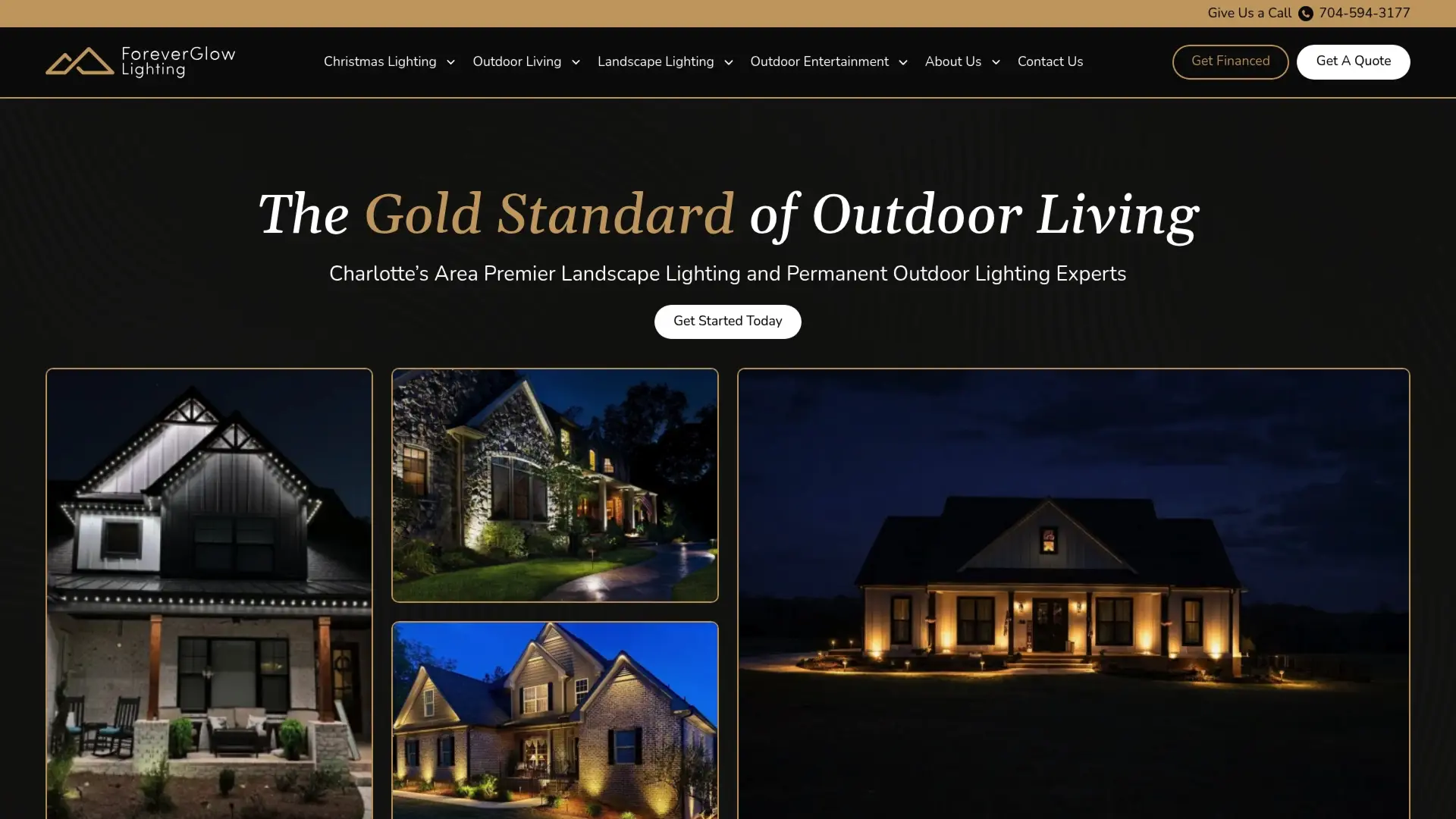
The difference between a lighting kit from a home improvement store and a professionally designed system shows up every night. Foreverglowlighting’s installations include transformer sizing, precise fixture aiming, smartphone-controlled dimming and color scenes, and an optional GlowCare maintenance plan so the system stays tuned season after season. Whether you want a focused tree-and-entry refresh or a full residential landscape lighting plan with permanent LED roofline accents, the process starts with a free on-site estimate. Contact Foreverglowlighting today to schedule yours.
Useful sources and further reading
Good outdoor lighting dramatically extends the hours when you can enjoy your yard. It can make things safer by highlighting paths and walkways, and you can use it to showcase standout features. — Consumer Reports
- Dramatic Nighttime Curb Appeal With Lighting, Dazuma: Primary source for layering principles, the runway effect, glare control, and the front-door-as-anchor concept.
- Residential Landscape Lighting Ideas for Curb Appeal, Irrigation Specialists USA: Depth-zone design framework and foreground/mid-ground/background staging guidance.
- 9 Stunning Nighttime Lighting Ideas, Nestroxe: Expert perspective on shadow-and-texture sophistication and cost snapshot examples.
- Outdoor Landscape Lighting for Yards, Tru-Scapes: Transformer sizing, voltage drop, and low-voltage system planning guidance.
- Best Solar Outdoor Lights, Consumer Reports: Lab-tested solar fixture performance data and product category definitions.
- Outdoor Lighting Design Tips, Westek Electric Corp.: Ambient, task, and accent layer functions and smart-control integration guidance.
- Lighting Design, U.S. Department of Energy: Authoritative reference for energy-efficient lighting design principles applicable to residential outdoor systems.