
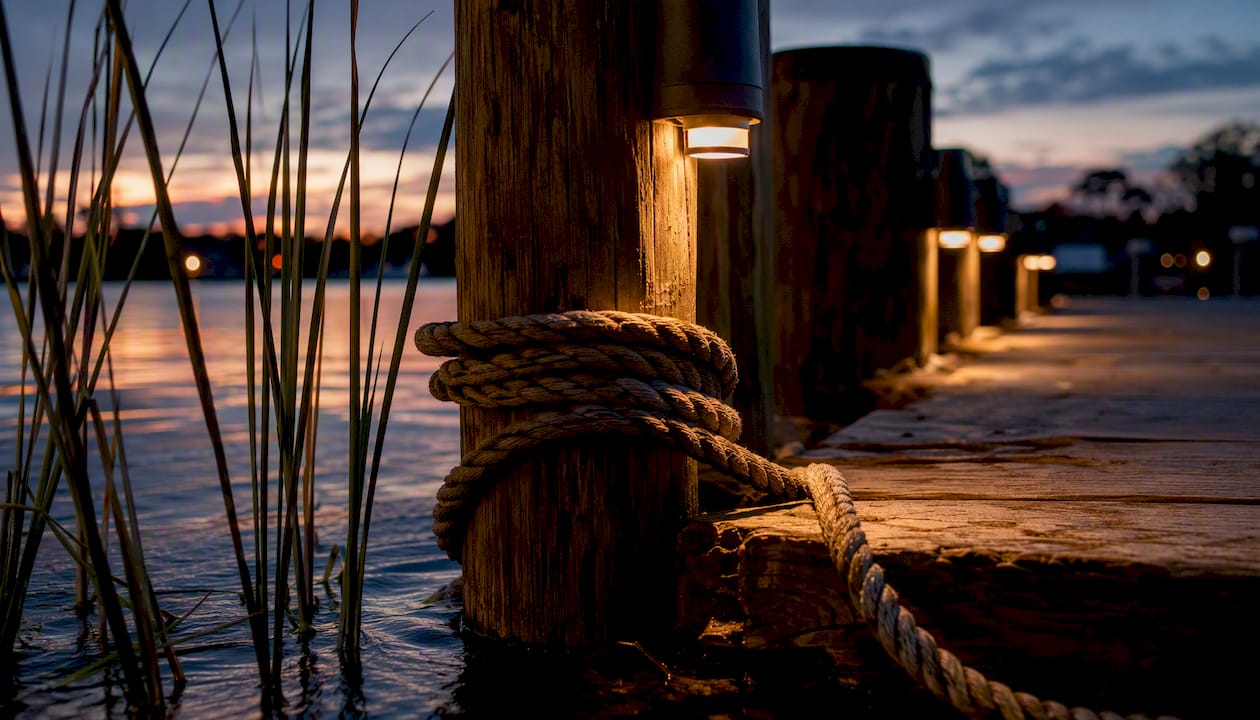
Dock lighting in the United States is governed by NEC Article 555 (NFPA 70), applicable federal wildlife rules, state DNR or DEP requirements, and local building codes or HOA rules. Before you install a single fixture, take these steps:
- Confirm which NEC edition your local Authority Having Jurisdiction (AHJ) enforces.
- Contact your local building department to determine permit requirements.
- Hire a licensed marine electrician for any hardwired or shore-power-connected lighting.
- Check state DNR, DEP, or Fish & Wildlife guidance if your dock sits near a coastal or sensitive inland waterway.
A note on safety: Electric shock drowning (ESD) is a documented hazard at docks with faulty or non-compliant wiring. Improperly installed lighting near water can energize the water column around a dock, creating a lethal risk for swimmers. Compliance is not a formality — it is a life-safety requirement.
Key Takeaways
Dock lighting compliance requires NEC Article 555 adherence, listed marine luminaires, GFCI/GFPE protection, and local permits, with wildlife rules adding restrictions in coastal and sensitive-water zones.
| Point | Details |
|---|---|
| NEC Article 555 is the baseline | All hardwired dock lighting must meet Article 555 requirements, including listed luminaires, datum plane clearances, and emergency disconnects. |
| GFCI/GFPE protection is mandatory | Ground-fault protection on dock circuits is a life-safety requirement, not optional, and must be tested regularly. |
| Wildlife rules can restrict fixtures | Coastal and sensitive-water zones may require amber-filtered, downward-shielded, low-intensity fixtures regardless of local electrical code. |
| Permits require licensed electricians | Hire a marine-experienced, licensed electrician who can submit plans, pull permits, and pass inspection the first time. |
| Foreverglowlighting handles compliance | Foreverglowlighting installs listed marine-grade dock fixtures with full permit and inspection support and ongoing GlowCare maintenance. |
Table of Contents
- Why compliant dock lighting matters more than most owners realize
- Which authorities set dock lighting regulations for your property
- Key electrical code and safety requirements you must meet
- Coastal and wildlife restrictions that can override your fixture choices
- Common dock fixture types and practical rules for choosing them
- Typical permitting steps, timelines, and cost considerations
- Actionable installation checklist and questions to ask your contractor
- Step-by-step: who to contact and how to find local rules fast
- Why professional installation is worth every dollar
- Foreverglowlighting brings code-ready dock lighting to your waterfront
- Sources
Why compliant dock lighting matters more than most owners realize
The gap between a properly lit dock and a non-compliant one is not just a code technicality. It carries real consequences across four areas.
Safety is the most urgent. ESD occurs when alternating current leaks into the water from faulty wiring or ungrounded equipment. Swimmers cannot always detect the current until it is too late. Tripping hazards from poorly placed step or pathway lights are a secondary but common cause of dock injuries, particularly at night.
Liability follows closely. If a guest is injured on your dock and an inspection reveals non-compliant lighting, your homeowner’s insurance may deny the claim. Civil liability exposure in that scenario is significant.
- Non-compliant fixtures can void manufacturer warranties.
- Unpermitted electrical work can complicate property sales and title transfers.
- Fines from local building departments or state agencies vary by jurisdiction but can accumulate quickly for ongoing violations.
Wildlife and ecological harm are a third concern, particularly on coastal properties. Artificial light at night disrupts sea turtle nesting, disorients migratory birds, and can alter fish behavior near sensitive waterways. The International Dark-Sky Association documents how unshielded, high-intensity lighting affects entire ecosystems — not just individual animals.
Navigation safety rounds out the picture. Dock lights that shine directly onto the water at high intensity can blind boaters approaching at night, masking channel markers and creating collision risk.
Which authorities set dock lighting regulations for your property
Dock lighting standards in the U.S. come from at least four distinct regulatory layers, and all of them can apply simultaneously.
Federal level. The National Electrical Code (NEC/NFPA 70), published by the National Fire Protection Association, is the baseline electrical standard adopted by most states. Article 555 addresses marinas, boatyards, and docking facilities specifically. The U.S. Fish & Wildlife Service and NOAA’s National Marine Fisheries Service impose additional restrictions where threatened or endangered species are present.
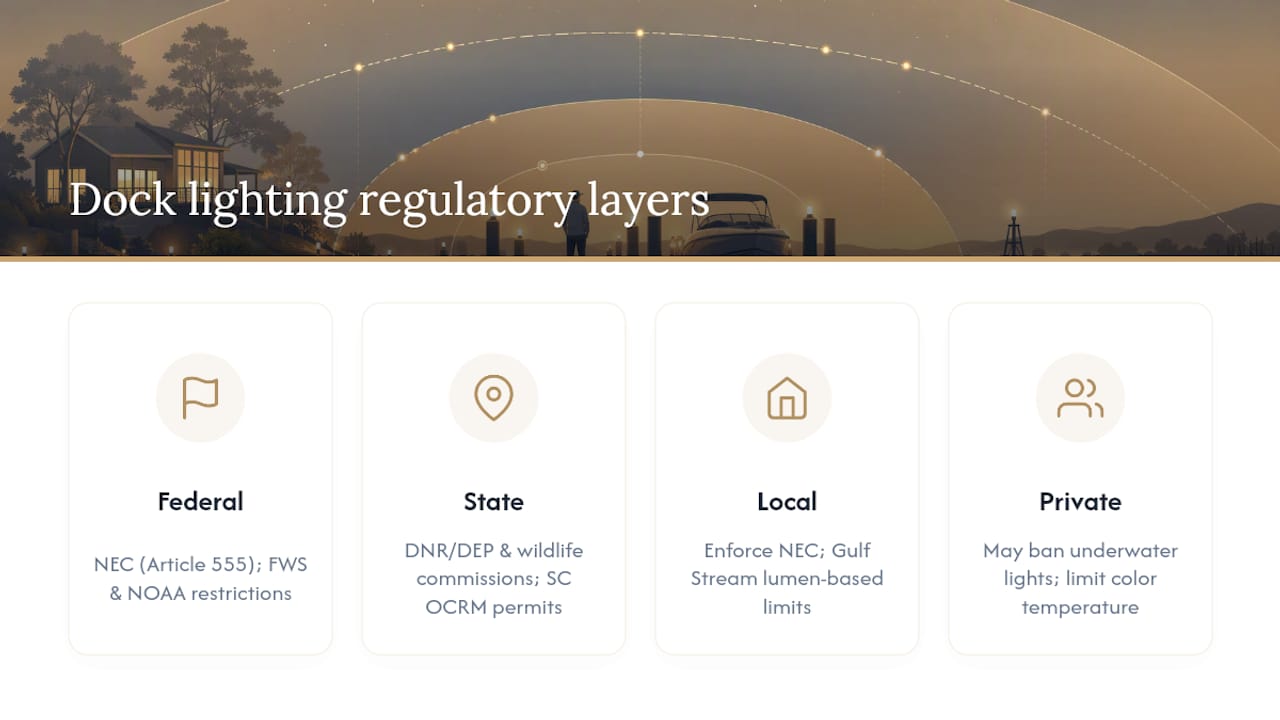
State level. State departments of natural resources (DNR), environmental protection (DEP), or fish and wildlife commissions regulate shoreline activity, coastal construction, and lighting near sensitive habitats. South Carolina’s OCRM, for example, requires critical-area permits for work in tidal and coastal zones. Wisconsin’s DNR provides shoreline recreation guidance that affects dock construction and lighting near waterways. Washington State’s administrative code goes further, explicitly recommending low-intensity, shielded fixtures to avoid disrupting fish migration in saltwater areas.
Local level. County and municipal building departments issue electrical permits and enforce whichever NEC edition the AHJ has adopted. Some municipalities have updated their codes to use lumen-based brightness limits rather than wattage, as seen in the Town of Gulf Stream’s ordinance, which prescribes fixture types, mounting heights, and shielding for residential docks.
HOA and marina rules. These private agreements often impose stricter standards than local codes. A marina may prohibit underwater lights entirely, or an HOA may restrict color temperature to preserve neighborhood aesthetics. Always request the written rules before finalizing a fixture plan.
Key electrical code and safety requirements you must meet
NEC Article 555 is the primary electrical standard for dock and marina wiring. Its requirements are more demanding than standard residential outdoor wiring, for good reason.
Core Article 555 requirements:
- Electrical datum plane: Equipment must be installed above a defined datum plane (the water surface elevation used as a reference) to prevent submersion during normal water level fluctuations.
- Listed dock luminaires (Section 555.38): Fixtures must be specifically listed for dock or marine environments, not simply rated for wet locations. A standard outdoor fixture does not meet this requirement.
- GFPE and GFCI protection: Ground-fault protection for equipment (GFPE) is required on shore power circuits; ground-fault circuit interrupter (GFCI) protection applies to receptacles and certain lighting circuits. OSHA’s GFCI guidance underscores why this protection is non-negotiable near water.
- Emergency shore power disconnect: A clearly labeled, accessible disconnect must be installed on shore so power to the entire dock can be cut immediately in an emergency.
- Bonding and grounding: All metallic components — conduit, fixture housings, dock hardware — must be bonded together and grounded per Article 555 to eliminate voltage gradients in the water.
Wiring methods and materials matter too. Conduit must be corrosion-resistant and listed for wet or marine environments. Fittings and enclosures must carry appropriate ratings. Service connections should maintain setbacks from the water’s edge as specified by the AHJ.
NEC editions are adopted by jurisdictions at different times. A jurisdiction may still enforce the 2017 or 2020 NEC while the 2023 edition is already published. Always confirm the edition in force with your local building department before specifying equipment.
Pro Tip: Ask your marine electrician for cut sheets on every fixture before purchase. Inspectors routinely reject fixtures that lack the correct listing mark for dock environments, even when the fixture looks appropriate for outdoor use.
Coastal and wildlife restrictions that can override your fixture choices
Wildlife rules can be more restrictive than the NEC, and they apply regardless of whether you have an electrical permit. The key is knowing whether your property falls within a regulated zone before you select a fixture color or intensity.
Where these rules apply most strictly:
- Sea turtle nesting beaches along the Gulf Coast and Atlantic seaboard (Florida, Georgia, South Carolina, North Carolina, and others)
- Migratory bird corridors near coastal wetlands and estuaries
- Sensitive inland waters with documented fish migration or spawning activity
- State-designated critical habitat areas
Typical restrictions in these zones:
- Low-intensity fixtures only, often with specific lumen caps
- Downward-shielded or fully shielded housings that prevent light from spreading horizontally or upward
- Amber or long-wavelength filtered light (typically 580 nm or longer) during nesting seasons, since shorter wavelengths disorient sea turtles more severely
- Prohibitions on blue, white, or broad-spectrum light during regulated periods
- Timer or motion-sensor requirements to limit hours of operation
The International Dark-Sky Association recommends downward shielding and warmer spectrum control as the most effective mitigation measures. Washington State’s administrative code reinforces this at the regulatory level, requiring low-intensity, shielded lights near saltwater areas to avoid attracting fish or disrupting migration. Understanding night-sky friendly lighting principles can help you select fixtures that satisfy both wildlife rules and neighbor concerns simultaneously.
Pro Tip: Contact your state DNR, DEP, or local coastal management office before purchasing any fixtures for a coastal or sensitive-water dock. Many offices will review a lighting plan informally before you submit a formal permit application, which can save significant time and money.
Common dock fixture types and practical rules for choosing them
Not every fixture category is appropriate for every dock location. Matching the fixture type to the application is as important as meeting the listing requirement.
Piling lights mount on top of dock pilings and provide broad downward illumination. They are among the most common dock fixtures and are available in marine-listed versions with corrosion-resistant housings. Lumen output and mounting height relative to the datum plane both affect compliance.
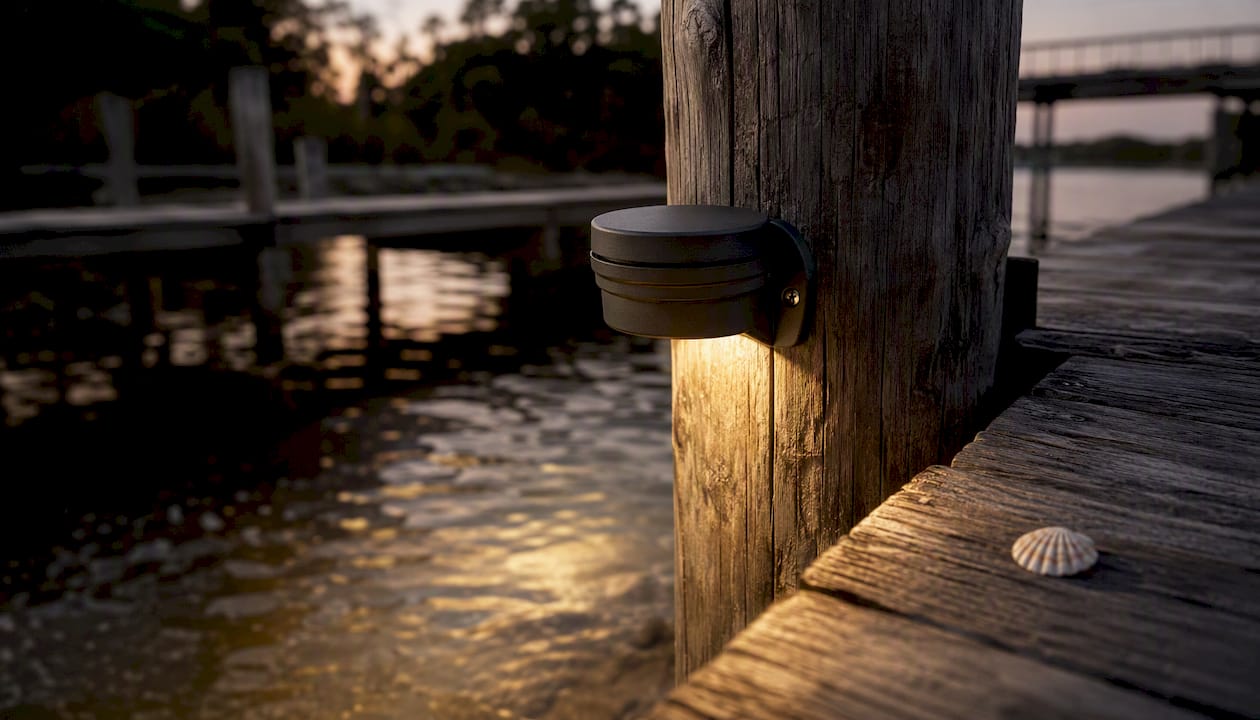
Pathway and step lights keep walkable surfaces visible without projecting light onto the water. Recessed step lights are particularly effective for this purpose because they direct light downward and inward, reducing spill. Deck and step lighting designed for marine environments uses sealed, corrosion-resistant housings that hold up against salt air and humidity.
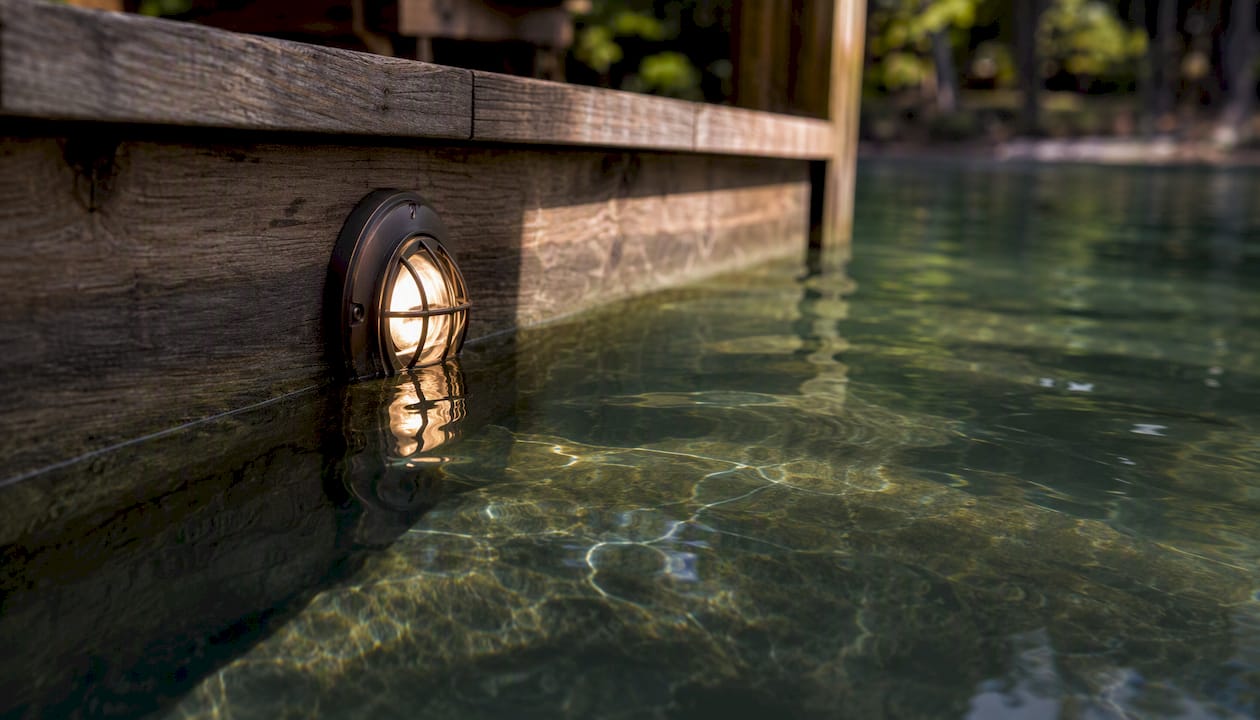
Underwater and submersible lights are the most regulated fixture category. They must be specifically listed for submersible use, bonded to the dock’s grounding system, and installed with GFCI protection. Many coastal and HOA rules prohibit them outright during nesting seasons or in sensitive zones.
Bollard lights work well for longer dock walkways, providing low-profile illumination at grade level. Marine-rated bollards with IP67 or higher ratings handle the moisture exposure typical of dock environments.
Solar vs. hardwired fixtures present a genuine tradeoff. Solar fixtures avoid the shore power permit and NEC Article 555 wiring requirements, which simplifies installation. The limitation is control: solar fixtures typically cannot be dimmed, color-tuned, or integrated into a smart lighting system, and their output depends on sun exposure. Where code requires listed dock luminaires on hardwired circuits, solar fixtures may not satisfy the listing requirement. Low-voltage landscape lighting offers a middle path for some dock applications, reducing shock risk while maintaining consistent output.
For color temperature, fixtures in the 2700K–3000K range (warm white) are generally less disruptive to wildlife and less likely to trigger complaints from neighbors or HOAs than cool-white or blue-tinted options.
Typical permitting steps, timelines, and cost considerations
The permit process for dock lighting varies by jurisdiction, but the sequence is consistent enough to plan around.
- Pre-check local code. Confirm the NEC edition in force, any local amendments, and whether a separate coastal or environmental permit is required. This step takes one to three days if you call the building department directly.
- Prepare and submit plans. Your licensed electrician should prepare a wiring diagram and fixture cut sheets. Some jurisdictions require a site plan showing datum plane measurements and fixture locations.
- Await municipal review. Standard electrical permit review runs two to eight weeks in most jurisdictions. Coastal or environmental permits from state agencies can add four to twelve weeks, depending on the agency’s workload and whether the project triggers a formal environmental review.
- Schedule electrical inspection. After installation, the AHJ sends an inspector to verify compliance. Failed inspections require corrections and a re-inspection, adding time and cost.
- Obtain final sign-off. The permit is closed when the inspector approves the installation. Keep a copy of the approved permit with your property records.
Cost considerations: Municipal permit fees for residential electrical work typically range from modest flat fees to percentage-based calculations tied to project value, and they vary widely by county. Marine-rated, listed fixtures cost more than standard outdoor fixtures, often meaningfully so, because of the materials and listing process involved. Budget for the possibility of electrical upgrades — older dock wiring frequently lacks the bonding, GFPE, or conduit standards Article 555 requires, and bringing it into compliance is part of the project cost. Proper wiring practices from the start reduce the likelihood of costly remediation after inspection.
Actionable installation checklist and questions to ask your contractor
A thorough pre-install and on-site checklist prevents the most common inspection failures.
Pre-installation:
- Complete a site survey to identify datum plane elevation and all fixture mounting locations.
- Gather cut sheets for every proposed fixture confirming the marine or dock listing.
- Develop a bonding and grounding plan covering all metallic components.
- Confirm corrosion protection strategy for conduit, fittings, and hardware.
- Verify GFPE and GFCI circuit assignments before ordering materials.
On-site during installation:
- Verify fixture mounting heights against the datum plane before securing.
- Confirm conduit routing avoids submersion below the datum plane where not permitted.
- Label the emergency shore power disconnect clearly and test it before energizing.
- Test all GFCI and GFPE devices at installation and document results.
- Install visible safety signage at the shore power connection point.
Ongoing maintenance:
- Inspect all fixtures, conduit fittings, and hardware for corrosion at least once per season.
- Test GFCI and GFPE devices monthly during the boating season.
- Clean fixture lenses and check gasket seals annually to maintain IP ratings.
- Tighten or replace corroded bonding connections before they fail.
Questions to ask any marine electrician or installer:
- Are you licensed in this state for marine or dock electrical work?
- Can you provide references for dock lighting projects you have completed?
- Do you carry the cut sheets confirming fixture listings before purchase?
- How do you handle permit submission and inspection scheduling?
- What warranty do you offer on labor and on the fixtures you install?
- Have you worked with this local building department before?
Step-by-step: who to contact and how to find local rules fast
Finding the exact rules for your dock does not require a lawyer. A focused, sequential approach gets you to the right answer within a week in most cases.
- Call your local building department first. Ask specifically: “What permits are required for dock lighting installation, and which NEC edition does your jurisdiction enforce?” Request a permit application and any handout or checklist they provide for dock or marine electrical work.
- Search your municipal code online. Most counties and cities post their codes on Municode or a similar platform. Search for “pier,” “dock,” “lighting,” or “outdoor illumination” to find relevant sections. Note any lumen limits, shielding requirements, or fixture restrictions.
- Contact your state DNR or DEP. Ask whether your property falls within a regulated shoreline, coastal zone, or critical habitat area. Request the specific permit or review process for dock lighting in that zone.
- Check with your marina manager or HOA. Request the written rules governing dock lighting, including any color, brightness, or hours-of-operation restrictions. Get these in writing before finalizing your fixture plan.
- Identify conflicts and escalate if needed. If HOA rules conflict with municipal code, or if a state environmental permit is required in addition to a local electrical permit, your licensed electrician and possibly a permit expediter can help resolve the sequence.
When to escalate: If your dock is in a designated coastal zone, near a sea turtle nesting beach, or within a state-designated critical habitat, expect the state agency review to drive your timeline. Start that process before submitting the local electrical permit, not after.
Contact template for your first call:
“I am planning to install dock lighting at [address]. Can you tell me what permits are required, which NEC edition you enforce, and whether there are any local ordinances that restrict fixture type, brightness, or color for residential docks?”
Why professional installation is worth every dollar
The instinct to save money by hiring a general electrician or handling dock lighting as a DIY project is understandable. Dock lighting looks straightforward from the outside. It is not.
The consequences of getting it wrong are not abstract. ESD incidents, failed inspections, denied insurance claims, and wildlife violations are all documented outcomes of non-compliant dock wiring. A licensed marine electrician who knows Article 555, understands datum plane calculations, and has a working relationship with the local building department will cost more upfront. That cost is almost always less than the remediation, re-inspection, and potential liability that follows a non-compliant installation.
One point that often surprises property owners: the listing requirement for dock luminaires means that a fixture must be specifically tested and certified for the dock environment. A general electrician unfamiliar with Article 555 may install a high-quality outdoor fixture that still fails inspection because it lacks the correct listing mark. Verifying installer insurance, marine electrical experience, and familiarity with the local AHJ before signing a contract is not optional — it is the single most effective risk-reduction step available to a dock owner.
Foreverglowlighting brings code-ready dock lighting to your waterfront
Dock lighting compliance is detailed work, and the margin for error is narrow. Foreverglowlighting installs marine-grade dock lighting using fixtures specifically listed for dock environments, with NEC Article 555-aware designs and licensed installers who handle permit submission and inspection coordination from start to finish.

Every installation includes a site survey, datum plane assessment, bonding and grounding design, and fixture cut sheet review before a single wire is run. The GlowCare maintenance plan covers seasonal inspections, GFCI testing, and hardware checks so your system stays compliant year after year. For property owners who want a dock that is safe, code-compliant, and built to last in a marine environment, the next step is straightforward: schedule a site evaluation and get a detailed installation plan tailored to your dock and local requirements.
Sources
The following primary sources contain the actual code text and agency guidance referenced throughout this article.
- Ground-fault circuit interrupters | OSHA
- Wash. Admin. Code § 220-660-380 – Residential and public recreational docks, piers, ramps, floats, watercraft lifts, and buoys in saltwater areas | LII / Legal Information Institute
- ORDINANCE NO. 22/4 (Town of Gulf Stream municipal ordinance) | MCC Library
- Effects of light pollution on wildlife & ecosystems | International Dark-Sky Association
This article is general information, not a substitute for advice from a qualified lawyer. Consult a qualified legal professional about your own circumstances before acting on anything here.