
Expect coverage for defective lights, controllers, and power supplies, but not necessarily free labor. Most permanent lighting warranties split parts from workmanship, with parts often running 3 to 10 years and workmanship guarantees typically capped at 1 year. Before you sign a contract, get the full written warranty and confirm who pays for diagnostic visits, ladder work, and reinstallation.
TL;DR:
- Warranties typically cover LED modules, controllers, and power supplies for 3 to 10 years, but workmanship guarantees usually last only one year.
- Confirm whether replacement parts are free and if labor, travel, or reinstallation costs are billed separately before signing a contract.
- Responsibility is generally split between the manufacturer, who covers parts, and the installer, who handles workmanship, requiring clear repair procedures and contacts.
- Weather-related damage from storms, surges, vandalism, or unauthorized repairs often voids warranties; coordinating repairs before outdoor modifications helps avoid coverage loss.
- Keeping detailed records of serial numbers, installation photos, and warranty terms ensures faster claims, and registering your system correctly is essential for warranty validity.
Table of Contents
- Permanent Christmas Lights Warranty Coverage and Duration Examples
- Key Warranty Features to Check Before You Sign
- Manufacturer vs. Installer: Who Actually Fixes Your Lights?
- Common Exclusions That Can Void Your Coverage
- Questions to Ask Before You Buy a Permanent Lighting System
- What a Professional Handover Should Include
- Read the Fine Print, Then File It Somewhere Safe
- Protect Your Investment With Forever Glow Lighting
- Where to Verify Warranty Disclosure Rules
- Sources
- FAQ
Permanent Christmas Lights Warranty Coverage and Duration Examples
A permanent lighting warranty is rarely one single promise. It’s usually a bundle of separate clocks running on different components, and vendors count on buyers not noticing that until something breaks.
Most systems separate coverage into these categories:
- LED modules — the individual light diodes embedded in the track
- Controllers — the smart hubs that manage color, timing, and app connectivity
- Power supplies — the transformers that convert household electricity to what the LEDs need
- Track and wiring — the physical housing and connections mounted to your roofline
- Connectors and app-related hardware — the smaller parts that link the system together
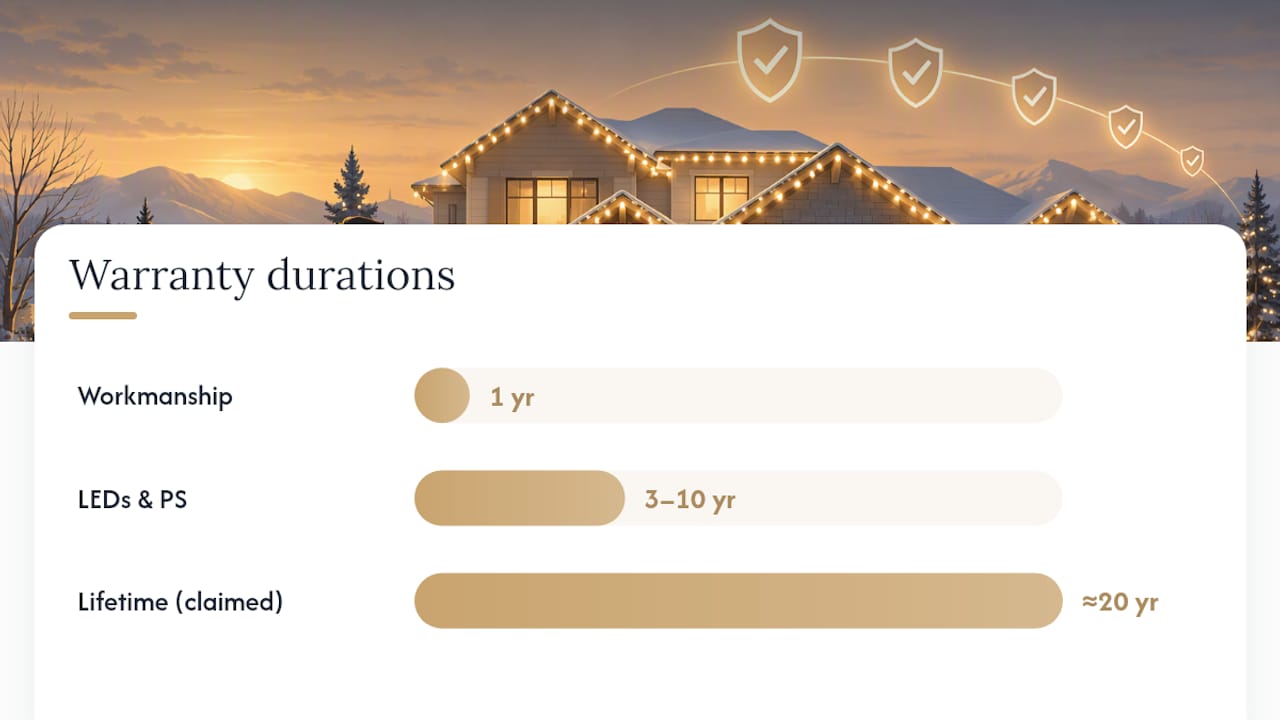
Duration patterns vary widely across the market. Workmanship, meaning the labor and installation quality, commonly carries a 1 year guarantee. Parts coverage for LEDs and power supplies often extends 3 to 10 years, and some vendors advertise “lifetime” lighting. That word deserves scrutiny.
A lifetime claim is frequently tied to tested operating hours rather than a calendar. LED strips rated for 50,000 hours of operation translate to roughly two decades of use if you run them about 6 hours a night, but only a fraction of that if you leave them on around the clock for security or accent purposes. Ask how the manufacturer calculated its “lifetime” number, because the assumption behind it changes what you actually get.
Key Warranty Features to Check Before You Sign
The fine print separates a warranty that protects your investment from one that just sounds reassuring. Four items decide which one you’re getting.
- Parts versus labor. Confirm whether replacement components ship free but diagnostic visits, ladder work, travel, and reinstallation get billed separately. A free part with a $200 service call isn’t free.
- The remedy offered. Some warranties promise repair, others promise replacement, and a few offers only a prorated credit toward a new unit. Ask whether a warranty repair resets the workmanship clock or simply continues the original term.
- Transferability. If you sell your home, does the warranty transfer to the new owner automatically, or does it require a registration fee and a deadline you might miss?
- Implied warranties. Federal consumer protections mean implied warranties can supplement written ones even when the paperwork is silent on a specific defect.
Pro Tip: Treat “lifetime parts” and “lifetime no-cost service” as two completely different promises. A replacement LED module might be free forever while every visit to install it costs you labor and a trip fee.
Manufacturer vs. Installer: Who Actually Fixes Your Lights?
Permanent lighting warranties almost always split responsibility between two parties. The manufacturer typically stands behind the parts, meaning the LEDs, controllers, and power supplies themselves. The installer typically stands behind the workmanship, meaning how well the system was mounted, wired, and sealed against weather.
That split is exactly why homeowners get bounced between companies when something fails. A strong warranty solves this in writing.
- Get the name and direct contact of whoever performs warranty repairs, not just a generic call center number.
- Insist on a written, step-by-step claims procedure rather than a verbal promise. Federal warranty law requires exactly this kind of clarity from the warrantor.
- If a claim is denied, escalate in order: the seller or installer first, then the manufacturer directly, then your state consumer protection office if neither responds.
Common Exclusions That Can Void Your Coverage
Weather-rated hardware doesn’t mean weather-proof coverage. Most warranties exclude damage from events outside the manufacturer’s control, even when the product itself survives fine under normal conditions.
- Storm damage, lightning strikes, and flooding
- Power surges from grid issues or faulty home wiring
- Vandalism or accidental damage from landscaping equipment
- Modifications or repairs performed by unauthorized third parties
Here’s the part homeowners miss: a component rated for outdoor exposure can still lose its warranty if the cause of failure traces back to an excluded event, even if the failure itself looks routine. Coordinate any roofing, gutter, or siding work with your lighting installer before it happens. Uncoordinated construction near your lighting system is one of the most common, and most avoidable, ways coverage gets voided.
Questions to Ask Before You Buy a Permanent Lighting System
Bring this list to every estimate. A vendor who answers clearly and in writing is telling you something important about how they’ll handle a claim two years from now.
- What is the exact start date of the warranty? Installation date, activation date, and purchase date aren’t always the same thing.
- What’s the duration for each component category? Get LEDs, controllers, power supplies, and workmanship listed separately, not bundled into one vague number.
- Do I need to register the system, and by what deadline? Some warranties lapse if you skip registration within a set window.
- Who performs service calls, and what do they cost? Ask specifically about diagnostic fees, travel charges, and whether ladder access is included.
- Can I get component serial numbers and photos of concealed parts? You’ll need these if you ever file a claim on a component buried behind trim or soffit.
Reputable outdoor lighting installers also follow basic safety practices during installation that reduce the odds you’ll ever need that warranty in the first place.
What a Professional Handover Should Include
A properly documented installation makes every future warranty claim faster and cheaper. When Forever Glow Lighting completes a project, homeowners walk away with more than a working light system.
- A signed, written warranty spelling out coverage per component
- The original invoice with installation date clearly recorded
- Serial numbers for LEDs, controllers, and power supplies
- Photographs of concealed wiring and power connections
- Written maintenance instructions for ongoing care
A GlowCare-style maintenance subscription matters most after the 1 year workmanship period ends, since that’s typically when service visits start becoming billable. Register your system and file this paperwork somewhere you can find it in five years, not just five days.
Read the Fine Print, Then File It Somewhere Safe
The single most useful habit a homeowner can build is treating the written warranty as a legal document worth keeping, not a sales brochure worth skimming. Photograph your installation, save every serial number, and know exactly who to call first if something fails. If a seller or installer won’t resolve a legitimate claim, your state consumer protection office is the next stop after the manufacturer.
— Dave
Protect Your Investment With Forever Glow Lighting
Forever Glow Lighting builds warranty clarity into the installation itself, not just the paperwork you get afterward. A proper installation should include a documented handover with serial numbers, photographs of concealed components, and a written warranty that spells out exactly what’s covered and for how long, so you’re never guessing who to call when something needs attention.

Pairing your installation with the GlowCare maintenance subscription means service visits after your workmanship period ends don’t turn into surprise invoices. That’s the gap that catches most homeowners off guard, and it’s exactly what a bundled installation and maintenance plan is built to close. If you’re evaluating options for your home, request a free estimate through Forever Glow Lighting’s residential holiday lighting page and ask for the full written warranty terms up front, before any contract gets signed.
Where to Verify Warranty Disclosure Rules
- FTC’s guide to federal warranty law for what warrantors must disclose
- Consumer Advice on warranties for remedies and registration rights
- 16 CFR Part 701 for the exact disclosure language required by law
Sources
- Businesspersons guide to federal warranty law | FTC
- Warranties | Consumer Advice (FTC)
- 16 CFR Part 701 — Disclosure requirements for warranties
FAQ
How Many Years Do Permanent Christmas Lights Last?
Operating life depends heavily on daily usage hours rather than calendar age alone. LEDs rated for tens of thousands of operating hours can last over two decades at typical evening usage patterns, but running lights continuously for security purposes shortens that window significantly.
What Company Has the Best Permanent Christmas Lights Warranty?
The strongest warranty is the one that discloses coverage, duration, and claims procedures clearly in writing, exactly as federal law requires. A reliable installer documents warranty terms, serial numbers, and installation photos at handover so homeowners aren’t left guessing who to contact for a claim.
Do Permanent Christmas Lights Come With a Warranty?
Most reputable permanent lighting systems include a written warranty covering components like LEDs, controllers, and power supplies, though terms vary by brand and installer. Always ask for the complete written document rather than relying on verbal assurances, since implied warranties can supplement but not replace what’s written.
How Can I Fix LED Christmas Lights That Aren’t Working?
Start by checking the power supply and controller connections, since these fail more often than the LED modules themselves. If the system is still under warranty, contact the installer or manufacturer named in your claims procedure before attempting repairs yourself, since unauthorized work can void remaining coverage.