
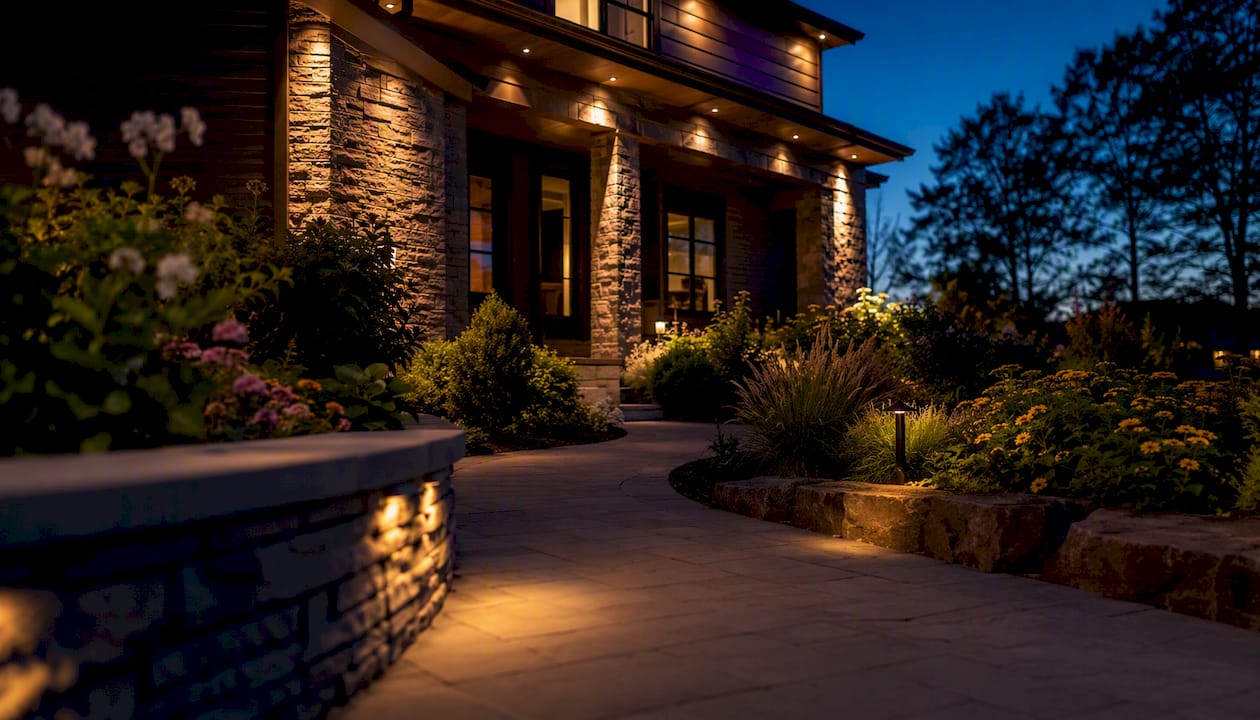
The six power types of outdoor spotlights every homeowner should know are: integrated LED (best for permanent architectural and landscape accents), low-voltage 12V (best for safe, flexible landscape lighting), line-voltage 120V (best for high-output security), plug-in (best for temporary or rental situations), battery-operated (best for portability and short-term use), and solar-powered (best for grid-free locations). Here is the one-line case for each:
- Integrated LED: The long-term standard for permanent installs; LED outdoor spotlights deliver up to 80% less energy use than halogen and rarely need bulb replacements.
- Low-voltage (12V): Safe enough to handle yourself, transformer-driven, and ideal for tree uplighting, garden accents, and pathway highlights.
- Line-voltage (120V): Required when you need serious output for security or commercial applications; always requires a licensed electrician.
- Plug-in: No wiring needed, but limited by cord length and outlet placement. Good for patios and seasonal setups.
- Battery-operated: Fully portable and quick to install, though runtime is limited and batteries need regular attention.
- Solar-powered: Zero wiring, zero electricity cost, but runtime depends on sun exposure and drops in winter months.
The tradeoff pattern is straightforward: more permanence and output generally means more installation complexity. Solar and battery types are the easiest to place but the least reliable for critical lighting. Integrated LED systems cost more upfront but pay back through lower energy bills and near-zero maintenance over time.
Key Takeaways
Permanent integrated LED spotlights deliver the best long-term value for homeowners who want reliable, low-maintenance outdoor lighting with smart control and consistent performance year-round.
| Point | Details |
|---|---|
| Match power type to permanence | Use integrated LED or low-voltage 12V for permanent installs; solar and battery for temporary or grid-free spots. |
| Lumens and beam angle together | Size lumens to the use case (50–150 lm for accents, 700+ lm for security) and match beam angle to the target size. |
| IP65 is the outdoor minimum | Any fixture in an exposed landscape position needs at least IP65 to resist moisture and dust reliably. |
| Safety requires GFCI and grounding | All outdoor circuits need GFCI protection; line-voltage work requires a licensed electrician and likely a permit. |
| Foreverglowlighting for permanent systems | Foreverglowlighting designs and installs custom permanent LED systems in Charlotte with smart control and GlowCare maintenance. |
Table of Contents
- What are the main types of outdoor spotlights?
- How fixture styles and mounting options affect your choice
- The specs that actually matter when comparing spotlights
- Which spotlight type should you choose for your specific situation?
- Installation and safety basics every homeowner should know
- Why permanent integrated LED systems are often the best long-term choice
- What most homeowners get wrong about outdoor spotlights
- Foreverglowlighting brings permanent lighting expertise to Charlotte homeowners
- Sources
What are the main types of outdoor spotlights?
Outdoor lighting options span a wide range of fixture categories, from sconces and bollards to recessed step lights and LED spotlights, each suited to specific exterior locations. Within the spotlight category specifically, the distinctions come down to power source, construction, and intended application.
Integrated LED spotlights
“Integrated” means the LED light source is built directly into the fixture housing rather than using a replaceable bulb. The driver, heat sink, and emitter are one unit. This design produces better thermal management, longer rated life (often 25,000–50,000 hours), and a slimmer profile. Because the optics are factory-set, beam consistency is predictable across every fixture in a system.
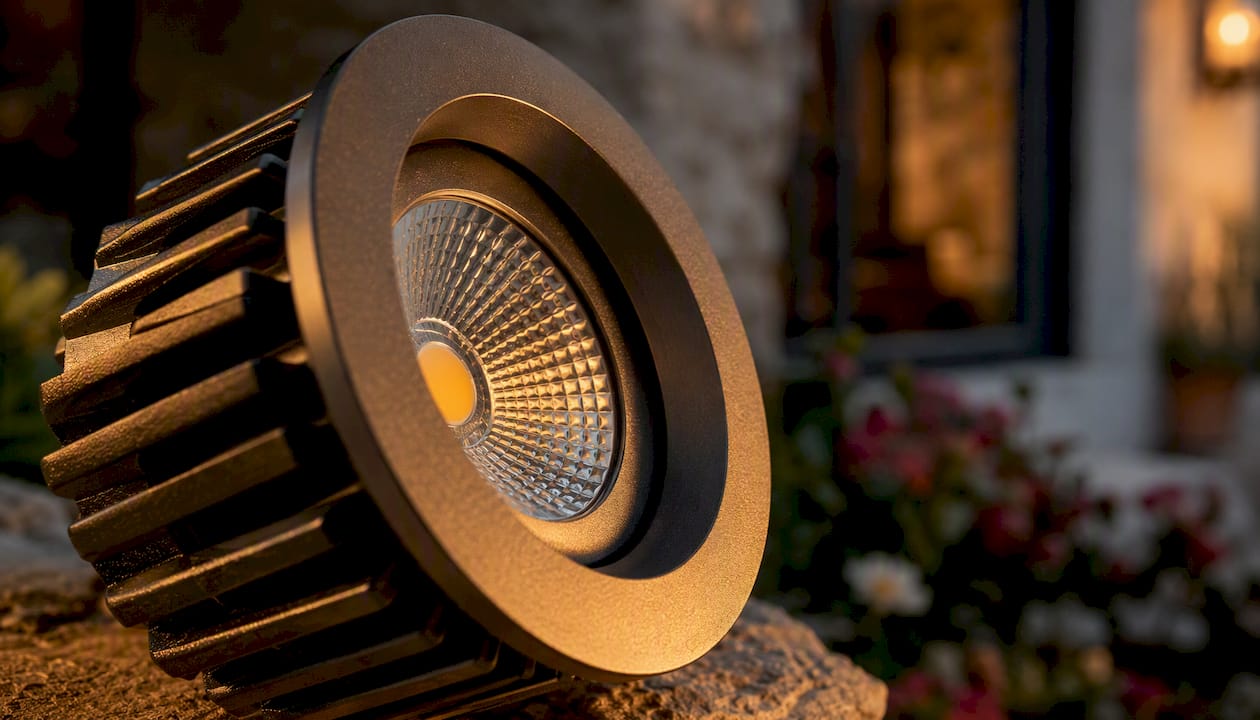
These are the preferred choice for permanent landscape and architectural lighting. They pair naturally with smart controls, dimmers, and scheduled scenes. The tradeoff: when the LED eventually dims, you replace the fixture, not just a bulb.
Pros: Long lifespan, energy-efficient, smart-control ready, low maintenance.
Cons: Higher upfront cost, full fixture replacement when the LED fails.
Low-voltage (12V) spotlights
Low-voltage systems run on 12V AC power delivered through a transformer plugged into a standard outdoor outlet. The transformer steps down line voltage to a safe level, which means the cable running through your yard carries no shock hazard. This makes low-voltage the most popular DIY-friendly landscape lighting format in the U.S.
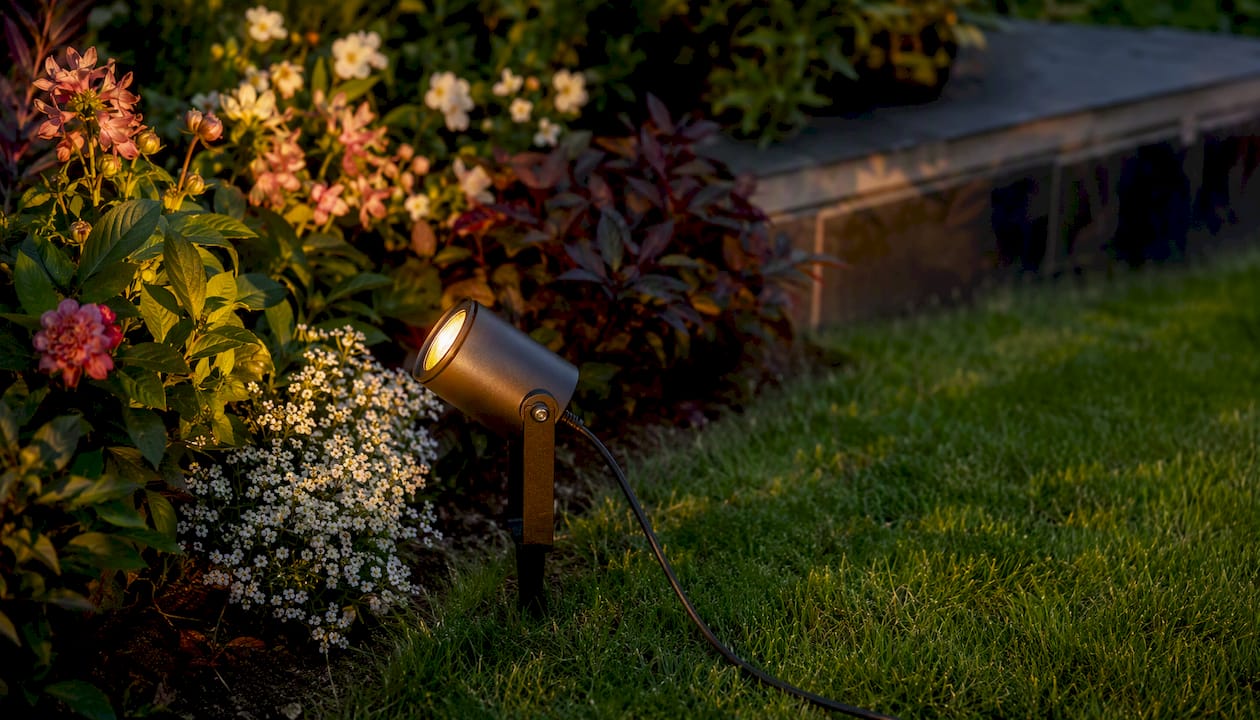
Typical lumen output runs from about 100 lm to 600 lm per fixture, which is well-suited for accent uplighting on shrubs, small trees, and garden beds. Fixture options include stake-mounted spotlights, in-ground well lights, and adjustable bullet-style heads. The main limitation is distance from the transformer: voltage drop becomes noticeable on long cable runs without proper wire sizing.
Pros: Safe, DIY-friendly, flexible layout, wide fixture selection.
Cons: Transformer required, voltage drop on long runs, lower max output than line-voltage.
Line-voltage (120V) spotlights
Line-voltage fixtures connect directly to your home’s 120V electrical system. They deliver the highest lumen output available in a spotlight form factor, which makes them the right call for security lighting, large-area illumination, and commercial exteriors. A single line-voltage LED spotlight can output 1,500 lm or more.
Installation requires conduit, weatherproof junction boxes, proper grounding, and in most jurisdictions a permit and a licensed electrician. This is not a weekend DIY project for most homeowners.
Pros: High output, no transformer needed, reliable for security and commercial use.
Cons: Requires professional installation, permit likely required, higher installation cost.
Plug-in spotlights
Plug-in outdoor spotlights use a standard grounded cord and plug into an outdoor-rated GFCI outlet. They are the fastest option to deploy: unbox, stake, plug in, aim. Outdoor-rated models carry an IP rating (typically IP44 or higher) and use weatherproof cords.
The practical limits are obvious. You need an accessible outdoor outlet nearby, the cord is visible, and the fixture is easy to move or knock over. Good for patios, seasonal accent lighting, and temporary setups. Not a substitute for a permanent system.
Pros: No wiring, instant setup, easy to reposition.
Cons: Cord visibility, outlet dependency, not suitable for permanent or buried installations.
Battery-operated spotlights
Battery spotlights run on AA, D-cell, or rechargeable lithium packs. They go anywhere: a dark corner of the yard with no outlet, a fence post, a temporary event setup. Modern rechargeable models with USB-C charging have improved runtime considerably.
The honest limitation is consistency. Runtime varies with temperature, battery age, and brightness setting. Cold winters drain batteries faster. For critical security lighting, battery models are a backup, not a primary solution.
Pros: Fully portable, no wiring or outlet needed, quick to install.
Cons: Limited and variable runtime, battery replacement or recharging required, not reliable for security-critical locations.
Solar-powered spotlights
Solar spotlights are a practical choice for locations where running wires is impractical, such as a back fence line, a detached garden structure, or a rural property. The panel charges an internal battery during daylight and powers the fixture at night.
Runtime and brightness depend directly on daily sun exposure. A fixture in full sun for six or more hours will outperform the same model in partial shade. In northern U.S. climates, winter days are short enough to cut runtime noticeably. Panel size matters: larger panels charge faster and support longer runtimes. Most solar spotlights in the consumer market output 50–200 lm, which is enough for pathway accents but not for uplighting a large tree or illuminating a security zone.
Pros: No wiring, no electricity cost, easy to relocate.
Cons: Runtime varies with weather and season, lower max output, panel placement limits fixture placement.
How fixture styles and mounting options affect your choice
The mounting style determines where a spotlight can go, how it integrates with your landscape, and how easy it is to adjust or service later. Fixture types across exterior spaces include everything from recessed well lights to surface-mounted wall fixtures, and each pairs differently with power sources.
Stake-mounted (spike) fixtures
The most common landscape spotlight format. A metal or plastic spike drives into soil, and the fixture head sits on an adjustable arm above it. These pair almost exclusively with low-voltage 12V systems and solar-powered spotlights.
- Best for: Garden beds, tree uplighting, pathway edges.
- Adjustability: High. You can reposition the stake and aim the head.
- Maintenance: Easy to access; pull the stake, service the fixture, re-stake.
- Limitation: Not suitable for hard surfaces; can shift in loose soil.
In-ground well lights
A cylindrical housing set flush with the ground, with a tempered glass lens facing up. These require excavation and conduit, and they work with both low-voltage and line-voltage systems. Well lights are the cleanest look for uplighting trees, flagpoles, or architectural columns because the fixture disappears into the ground.
- Best for: Uplighting trees, columns, flagpoles, driveways.
- Adjustability: Limited once installed; some models have adjustable lamp heads inside the housing.
- Maintenance: Requires digging or a removable cover plate for access.
Surface-mounted and wall-mounted fixtures
Surface spotlights bolt to a wall, soffit, or eave and aim downward or outward. They are common for security lighting, garage illumination, and entry accents. Line-voltage models dominate this category, though low-voltage surface fixtures exist for soffit accent lighting.
- Best for: Security zones, garage entries, architectural downlighting.
- Adjustability: Most have a pivot head for directional aiming.
- Maintenance: Straightforward; fixture is accessible without tools beyond a ladder.
Deck and step lights
Low-profile fixtures recessed into deck risers, stair stringers, or post caps. They provide subtle downward light for safe footing rather than dramatic accent. Most run on low-voltage systems. For deck and step lighting that integrates with a broader landscape system, low-voltage is the standard choice.
- Best for: Stair safety, deck perimeter, post caps.
- Adjustability: Minimal; these are fixed-position fixtures.
- Maintenance: Low; LEDs in this application rarely need attention.
Post-mounted fixtures
Fixtures mounted atop a post, typically 3–6 feet high, casting light downward over a path or driveway. They can run on low-voltage or line-voltage depending on the lumen requirement. Post lights are more of a hybrid between spotlight and area light.
Recessed and track-style fixtures
Recessed spotlights set into soffits or ceilings of covered outdoor spaces (pergolas, porticos) and track systems mounted to rooflines or beams. Track-style integrated LED systems, like those Foreverglowlighting installs along rooflines, are invisible during the day and provide programmable accent or holiday lighting at night.
Material note: For coastal or high-humidity environments, look for fixtures rated for wet locations and made from marine-grade aluminum, stainless steel hardware, or UV-stabilized polymer. Corrosion on cheaper zinc housings is a common failure point within two to three seasons.
The specs that actually matter when comparing spotlights
Reading a spotlight spec sheet can feel like decoding a foreign language. Here is what each number actually means for your yard.
Lumens, not watts
Watts measure power consumption. Lumens measure light output. For outdoor spotlights, lumens is the number that tells you whether a fixture will do the job. A 10W LED spotlight might produce 800 lm; a 10W halogen produced roughly 120 lm. The watt number alone tells you almost nothing about brightness.
General lumen guidance for outdoor spotlights:
- Subtle garden accent or pathway edge: 50–150 lm
- Tree or shrub uplighting: 200–600 lm
- Architectural accent or wall wash: 300–800 lm
- Security or large-area coverage: 700–1,500+ lm
Beam angle: spot vs. flood
Beam angle is the primary technical distinction between a spotlight and a floodlight. Spotlights typically sit in the 25°–45° range; floodlights exceed 120°. Narrow beams concentrate light on a specific target — a statue, a tree trunk, a column. Wider beams spread light across a larger surface.
Beam angle selection is as important as brightness. A 15° beam aimed at a 30-foot oak will light the trunk but leave the canopy dark. A 36° beam on the same tree gives a more natural, tapered uplighting effect. Good optics (quality lenses and reflectors) reduce glare at the edges and improve uniformity across the lit surface.
Color temperature and CRI
Color temperature (measured in Kelvin) affects how your landscape looks at night:
- 2700K–3000K (warm white): Flattering for stone, brick, wood, and most plant foliage. The standard for residential landscape lighting.
- 3500K–4000K (neutral white): Good for modern architecture and mixed-material facades.
- 4000K–5000K (cool white): Preferred for security cameras (better contrast) and commercial applications.
CRI (Color Rendering Index) measures how accurately a light source renders colors compared to natural daylight. A CRI of 80+ is acceptable for most landscape use; 90+ is worth specifying for areas where color accuracy matters, such as an outdoor kitchen or a garden with varied plant colors.
IP rating for weather resistance
IP (Ingress Protection) ratings use two digits: the first covers solid particle protection, the second covers water. For outdoor spotlights:
- IP44: Protected against splashing water from any direction. Minimum for covered outdoor locations.
- IP65: Dust-tight and protected against low-pressure water jets. The practical minimum for exposed landscape fixtures.
- IP67/IP68: Submersible ratings required for in-ground well lights and fixtures near water features.
Never install a fixture rated below IP65 in an exposed landscape position. Moisture intrusion is the leading cause of premature fixture failure.
Voltage, transformer basics, and sensor types
For low-voltage systems, the transformer is the heart of the installation. A 150W transformer can comfortably run ten 10W fixtures with room to add two or three more later.
Sensor options for outdoor spotlights include passive infrared (PIR), microwave, combination sensors, and dusk-to-dawn photocells. PIR sensors are the most common and cost-effective for general motion detection. Microwave sensors can detect movement through some obstructions but are more prone to false triggers from passing cars or wind-blown branches. Dusk-to-dawn photocells automate on/off based on ambient light, which is useful for accent and security fixtures that should run all night.
Pro Tip: Before buying a sensor-equipped spotlight for a high-traffic area, check whether the sensor’s detection angle can be narrowed or masked. A PIR with a 180° detection arc aimed at a busy sidewalk will trigger constantly, which shortens relay life and wastes energy.
Which spotlight type should you choose for your specific situation?
Theory is useful. Matching a fixture to a specific job is what actually matters. Layered lighting — combining ambient flood lighting with targeted spotlights and task lighting — produces safer, more attractive night scenes than any single fixture type alone. Here is how to apply that principle by use case.
Accent and architectural lighting
Goal: Highlight a column, facade detail, or ornamental tree.
Best choice: Integrated LED or low-voltage stake spotlight, 200–600 lm, 25°–36° beam, 2700K–3000K, IP65.
Mounting: Stake-mounted for landscape features; surface or soffit-mounted for architectural details.
Controls: Dusk-to-dawn photocell or smart scheduling.
Cost range: Low-voltage stake fixtures typically run $30–$120 per fixture; integrated LED systems are higher upfront but lower in operating cost over time.
For outdoor lighting scene setting, accent fixtures are the primary tool. The goal is to create depth and visual interest, not flood the yard with light.
Tree uplighting
Goal: Illuminate the canopy and trunk of a specimen tree.
Best choice: In-ground well light or low-voltage stake spotlight, 300–800 lm, 36°–60° beam, 2700K–3000K, IP67 for well lights.
Mounting: In-ground well light for a clean look; stake-mounted for flexibility.
Note: Position the fixture at the base of the trunk and aim upward at a slight angle to avoid a harsh straight-up beam that flattens the canopy.
Security lighting
Goal: Illuminate entry points, driveways, and dark perimeter zones.
Best choice: Line-voltage LED spotlight or floodlight, 700–1,500+ lm, 90°–120° beam, 4000K–5000K, IP65, PIR or microwave sensor.
Mounting: Surface-mounted on eaves, garage fascia, or fence posts at 8–12 feet height.
Controls: PIR motion sensor with adjustable sensitivity and dusk-to-dawn override.
Cost range: Line-voltage security fixtures run $40–$200 per fixture, plus installation labor.
Outdoor kitchen and task lighting
Outdoor kitchens need functional light, not just ambiance—explore backyard patio ideas that pair well with spotlighting for outdoor kitchens and entertaining. A 36° beam at 500–800 lm aimed at the grill surface or prep counter gives enough light to work safely without washing out the surrounding patio atmosphere. For outdoor kitchen and bar lighting, surface-mounted or track-style fixtures on the overhead structure are the most practical choice.
Best choice: Low-voltage or line-voltage surface-mounted spotlight, 500–800 lm, 36°–60° beam, 3000K–4000K, IP65.
Pathway and step highlights
Goal: Safe footing, not dramatic lighting.
Best choice: Low-voltage stake spotlight at 50–150 lm, or recessed deck/step lights at 30–80 lm, 2700K–3000K, IP65.
Spacing: Space pathway fixtures 8–10 feet apart to avoid a runway effect.
Compatibility note: If you have an existing low-voltage transformer, check its total wattage capacity before adding fixtures. Most residential transformers are rated 150W–300W. Adding high-output fixtures to an undersized transformer causes voltage drop, which dims all fixtures on the circuit and shortens driver life. For a landscape lighting upgrade that adds permanent integrated LED fixtures to an existing system, a professional assessment of transformer capacity is worth the time.
Installation and safety basics every homeowner should know
Getting the fixture selection right is half the job. Installing it correctly is the other half. Outdoor lighting safety depends on proper electrical protection, weatherproof connections, and correct fixture ratings for the location.
Safety checklist before you install
- GFCI protection: All outdoor outlets and any line-voltage outdoor circuit must be GFCI-protected. This is a code requirement in the U.S., not optional.
- Grounding: Line-voltage fixtures must be properly grounded. Never skip the ground wire on a metal fixture housing.
- Weatherproof connections: Use weatherproof wire nuts or gel-filled connectors for all outdoor splices. Standard indoor wire nuts will corrode and fail.
- IP rating match: Verify the fixture’s IP rating matches its installed location. A fixture rated IP44 belongs under a covered porch, not in an exposed garden bed.
- Buried cable depth: Low-voltage landscape cable should be buried at least 6 inches deep to protect it from shovels and foot traffic. Direct-burial rated cable is required.
- Conduit for line-voltage: Any 120V wiring run outdoors must be in weatherproof conduit. Underground runs require UF-B cable or conduit per local code.
Transformer sizing in plain language
Add up the wattage of every fixture you plan to connect. Multiply that total by 1.25 to get your minimum transformer capacity. If your ten 8W fixtures total 80W, you need a transformer rated for at least 100W. Buy the next size up (150W is a common residential option) to leave room for future additions.
Place the transformer in a dry, ventilated location near an outdoor GFCI outlet, ideally at least 12 inches off the ground. Most low-voltage transformers have a built-in timer or photocell. Use it.
Pro Tip: Run your low-voltage cable before connecting fixtures. Lay the full run, measure voltage at the far end with a multimeter, and confirm it reads 10.8V–12V. If it drops below 10.8V, you have too much resistance on the run and need heavier gauge wire or a second circuit.
When to hire a licensed electrician or professional installer
- Any 120V line-voltage outdoor circuit, new or extended.
- Permits are required in most U.S. jurisdictions for new outdoor electrical circuits.
- Complex control integrations (smart home systems, multi-zone transformers, automated scene controllers).
- In-ground well light installation that requires excavation near existing utilities.
- Any work near a pool, spa, or water feature (NEC Article 680 governs these and requires licensed work).
Common troubleshooting issues
- Fixture not powering on: Check transformer timer/photocell setting, verify cable connection at the transformer tap, and test outlet GFCI.
- Flickering: Usually voltage drop. Check wire gauge and run length; consider splitting the circuit.
- Weak solar runtime: Panel may be shaded. Reposition the panel for better sun exposure, or clean the panel surface.
- Battery spotlight dims quickly: Cold temperature reduces battery capacity. Switch to lithium batteries in winter, or move to a wired solution.
Why permanent integrated LED systems are often the best long-term choice
The case for permanent integrated LED systems comes down to three factors: energy efficiency, longevity, and control. LED technology delivers up to 80% less energy consumption than halogen alternatives, and integrated fixtures rated at 25,000–50,000 hours of life rarely need attention between installation and the end of a decade.
For homeowners who want reliable, year-round curb appeal without seasonal setup and teardown, permanent systems are the practical answer. The benefits stack up clearly:
- Lower operating cost: The energy savings over a 10-year period typically offset the higher upfront fixture cost, often significantly.
- Smart control integration: Permanent integrated LED systems pair with smartphone apps, scheduling platforms, and scene controllers. You can shift from warm accent lighting to bright security mode without touching a fixture. Foreverglowlighting’s systems support millions of color options controlled directly from your phone.
- HOA compliance: Professional installations can be designed to meet HOA aesthetic requirements, with fixtures that are invisible during the day and consistent in appearance at night.
- GlowCare maintenance: Foreverglowlighting offers ongoing maintenance subscriptions so the system stays calibrated and any fixture issues are addressed without the homeowner managing service calls.
- Predictable light distribution: Factory-set optics in integrated fixtures mean every fixture in a system produces the same beam pattern and color, which matters for architectural lighting where consistency is visible.
The upfront cost of a professionally installed permanent LED system is higher than a DIY low-voltage kit. The operating cost over five to ten years, combined with the elimination of seasonal labor and bulb replacement, makes the math favorable for most homeowners who plan to stay in their home. For smart outdoor lighting that works year-round without manual intervention, permanent integrated LED is the category to start with.
What most homeowners get wrong about outdoor spotlights
Most homeowners focus on wattage when they should be focused on beam angle. A 20W fixture with a 60° beam will wash a wall with flat, even light. A 10W fixture with a 25° beam on the same wall will create depth, shadow, and visual interest. The lower-wattage fixture does the better job because the optics are right for the application.
The second common mistake is treating solar spotlights as equivalent to wired fixtures for security or accent lighting. Solar is a genuinely useful technology for low-stakes pathway accents and grid-free locations. It is not a reliable substitute for a wired system in a security zone or for a feature that needs to look consistent every night of the year. Winter runtime on most consumer solar spotlights drops enough to leave fixtures dark by midnight in northern states.
The third mistake is under-sizing the transformer on a low-voltage system and then adding fixtures over time until the whole circuit dims. Size the transformer for your planned final load from the start, not just the fixtures you are installing today.
One practical tip worth using before you buy anything: take a flashlight outside at night and aim it at the feature you want to light. Move it closer, farther, and at different angles. You will immediately understand whether you need a narrow or wide beam, and whether the fixture needs to be 3 feet from the target or 15 feet away. That five-minute test saves more bad purchasing decisions than any spec sheet.
Foreverglowlighting brings permanent lighting expertise to Charlotte homeowners
Choosing the right spotlight type is one decision. Designing a system that works together, meets HOA requirements, handles Charlotte’s weather, and looks intentional from the street is a different project entirely.
Foreverglowlighting designs and installs custom permanent LED lighting systems for residential and commercial properties across the greater Charlotte area. Every system includes smart smartphone control, multi-color capability, and weatherproof construction built for year-round performance. The GlowCare maintenance subscription keeps your system running without you managing service calls. Whether the goal is architectural accent lighting, security coverage, landscape illumination, or permanent holiday lighting that never requires a ladder, Foreverglowlighting handles the design, installation, and ongoing care. Contact Foreverglowlighting for a free estimate and see what a professionally designed permanent system looks like on your property.
Sources
The following resources back the spec guidance, sensor descriptions, and fixture category definitions in this article:
- Flood Lights vs Spotlights: Which to Choose Outdoors – Dazuma
- Outdoor lighting designs to spark ideas
- Outdoor Spot Lighting: A Complete Guide For Your Landscape – Mr. Sparky Florence
- Outdoor Wall Lights with Sensor – Lighting-Direct