
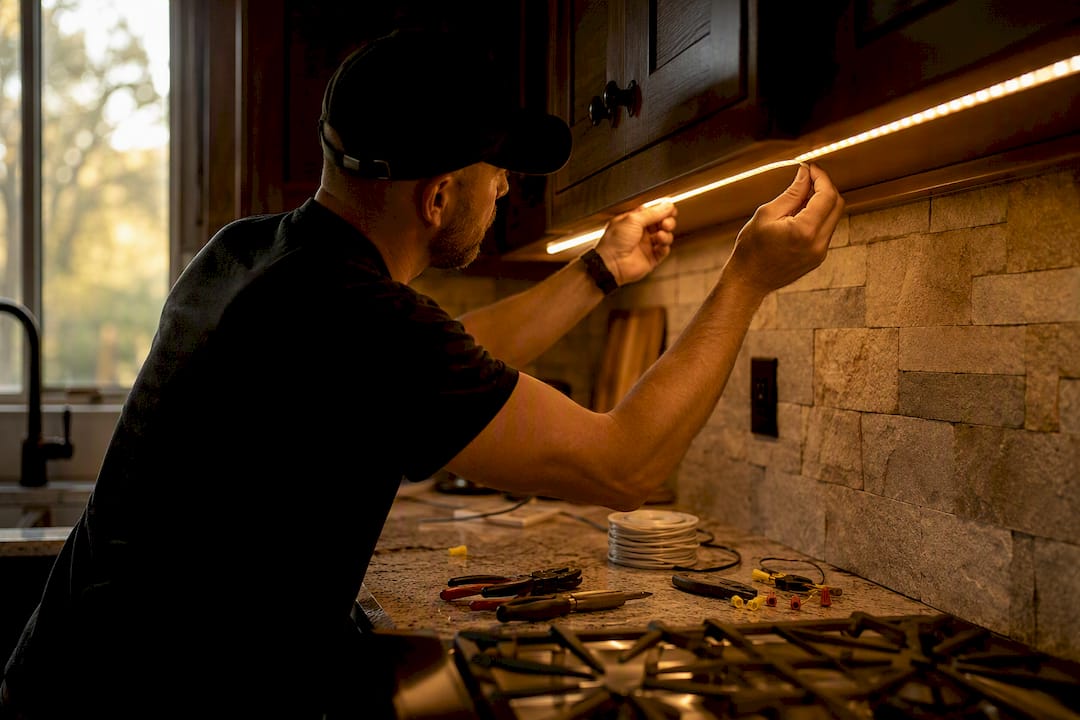
Professionally installed under-cabinet lighting typically runs several hundred dollars for a standard kitchen, with most homeowners landing near the mid-range of typical costs. The biggest swing factors are fixture type (LED strip versus puck lights), whether the run is hardwired or plug-in, total linear footage, and whether new circuits or permits enter the picture. A useful rule of thumb: budget a few tens of dollars to around one hundred dollars per linear foot installed, then adjust up for dimmers or smart controls.
TL;DR:
- Larger kitchens with 20 or more feet of cabinetry, or smart lighting systems, can cost $800 to $1,500 or more for installation.
- Costs vary significantly based on fixture type, with LED strips averaging $20 to $50 per foot and puck lights costing $10 to $50 each, affecting total price.
- Labor costs can comprise 40 to 60% of total expenses, with electricians charging $50 to $120 per hour and additional charges for circuits, permits, and smart controls.
- DIY kits may be inexpensive but have drawbacks like shorter lifespan, visible cords, and potential code violations, making professional installation generally more reliable.
- Getting at least three detailed quotes ensures transparency, with comprehensive estimates including fixture specifics, wiring, permits, and warranties, saving money and avoiding surprises.
Table of Contents
- How much does under cabinet lighting cost by kitchen size?
- What does under cabinet lighting cost by fixture type?
- What factors affect under cabinet lighting installation cost?
- Is DIY under cabinet lighting cheaper than hiring a pro?
- How do you get an accurate quote for under cabinet lighting?
- What should a professional under cabinet lighting estimate include?
- Why the “cheapest quote” mindset backfires on lighting projects
- Get a Free Estimate for Under Cabinet Lighting
- Sources
How much does under cabinet lighting cost by kitchen size?
Kitchen size and cabinet layout drive most of the variation in a final quote. Here’s how the math typically breaks down across three common scenarios.
Small kitchen (5 to 8 linear feet). A galley kitchen or single-wall layout with one or two short runs often costs $150 to $350 installed, using budget LED strip lighting or a handful of puck lights. Materials alone might run $100 to $200, with the rest going to labor.
Average kitchen (10 to 20 linear feet). This is where most quotes land, and it’s the range Angi’s cost data uses as its baseline. At $20 to $100 per linear foot installed, a 15-foot run costs $300 to $1,500, though most homeowners with mid-grade LED strip fixtures and standard access see totals closer to $400 to $700.
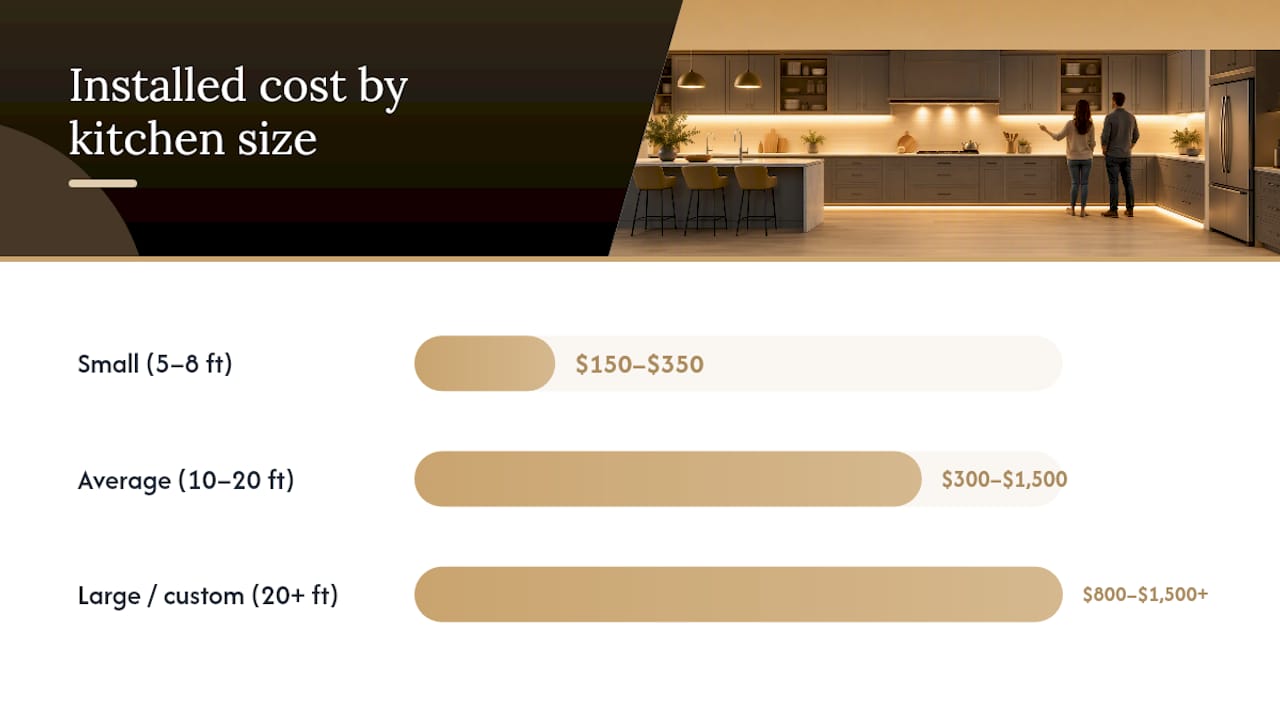
Large or custom kitchen (20+ feet, smart systems). Larger kitchens, islands with secondary runs, or homes upgrading to color-changing smart fixtures push installed costs to $800 to $1,500 or more once you add a dimmer, app-based controls, or a dedicated circuit.
A few things move these numbers regardless of size:
- Metro-area labor rates run higher than rural or suburban rates in most states.
- Local sales tax applies to both materials and, in many jurisdictions, labor.
- Cabinet construction (face frame versus frameless) affects how much time an electrician spends fishing wire.
- Existing outlet placement can save or cost you an hour of labor per run.
What does under cabinet lighting cost by fixture type?
Fixture choice affects both price and the quality of light you get, so it’s worth understanding what you’re actually paying for.
LED strip lighting costs $20 to $50 per linear foot for the fixture itself, according to Builds and Buys’ cost guide. Installed, expect $20 to $100 per foot once labor is added. Strips deliver continuous, shadow-free task light across the entire counter, which is why most kitchen remodels default to them.
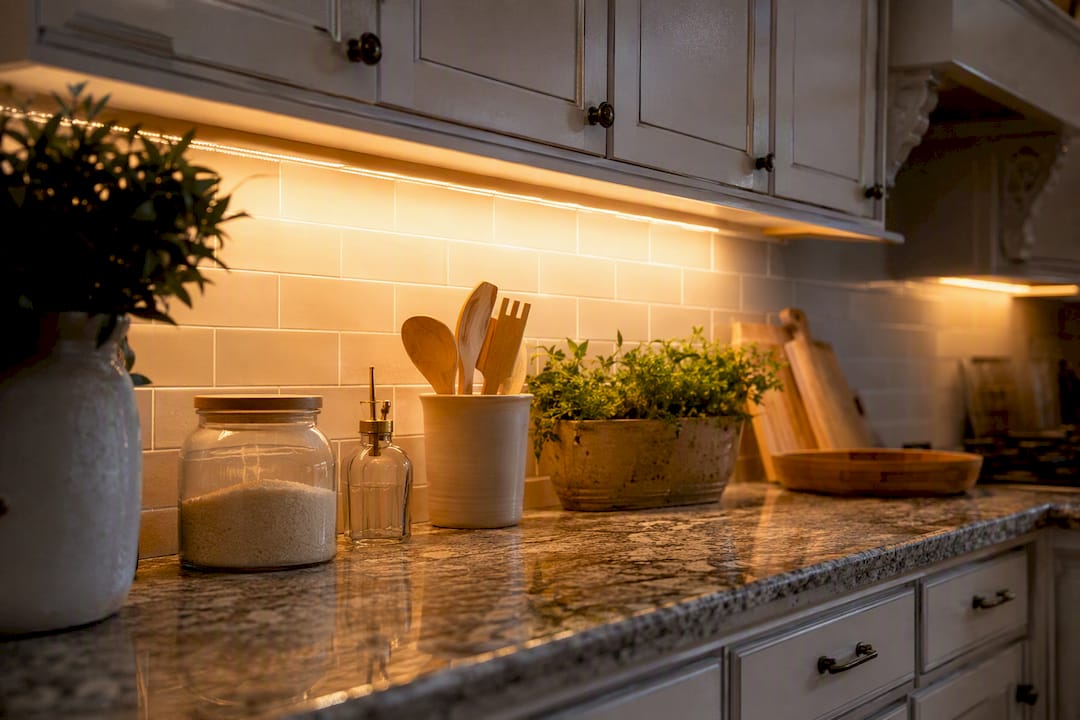
Puck lights run $10 to $50 each for materials. A typical run needs three to five pucks per 8 feet of cabinet, so the per-foot cost can rival strip lighting once you factor in the extra units and connection points. Pucks create pools of light rather than an even wash, which works for accent lighting but leaves dimmer spots between fixtures.
Light bars and legacy fixtures (including older xenon or fluorescent under-cabinet units) range from $25 to $150 per bar. They’re brighter per fixture than a puck but less flexible to install around obstacles like outlets or vents.
Smart and color-changing systems carry the highest per-foot material cost and add installation complexity, since they typically require a hub, app pairing, and sometimes a dedicated low-voltage transformer. Expect a premium of several hundred dollars over a standard hardwired LED strip job.
For side-by-side comparison:
| Fixture type | Material cost | Best for |
|---|---|---|
| LED strip | $20–$50/ft | Continuous task lighting |
| Puck lights | $10–$50 each | Accent lighting, spot coverage |
| Light bars | $25–$150/bar | Brighter, fixed-point lighting |
| Smart/color-changing | Higher per-foot cost | Ambiance, app control |
What factors affect under cabinet lighting installation cost?
Once you get past the fixture itself, labor and code compliance make up the rest of your quote. Builds and Buys reports that labor alone often accounts for 40 to 60% of a professional installation’s total cost, which is exactly why comparing electrician rates matters as much as comparing fixtures.
- Electrician labor rates generally run $50 to $120 per hour depending on your region, according to HomeAdvisor’s installation data.
- New circuits or junction boxes add roughly $200 to $600 when panel access is limited or the existing circuit is already loaded, per KraftMaid’s lighting guide.
- Dimmers or smart integration typically add $150 to $300 to the job.
- Permits and inspections run $25 to $150 depending on your city or county, and most jurisdictions require one for new hardwired circuits.
- Cabinet access and material (frameless versus face-frame, existing outlet proximity) can add or subtract an hour of labor.
Sales tax applies to materials in most states and sometimes to labor, so ask your installer whether their quote is tax-inclusive before comparing bids.
Is DIY under cabinet lighting cheaper than hiring a pro?
A plug-in or battery-powered LED strip kit can cost as little as $30 to $100 in materials, and installation is genuinely a weekend project for anyone comfortable with a drill and double-sided mounting tape. That’s the appeal, and for renters or anyone testing out a layout before committing, it’s a reasonable starting point.
The trade-offs are real, though:
- Battery units need regular recharging or battery swaps, and brightness tends to fade faster than hardwired LEDs.
- Plug-in strips leave a visible cord running up the backsplash or through a cabinet, which undercuts the clean look most homeowners actually want.
- DIY hardwiring without an electrician risks code violations, voided homeowner’s insurance claims, and no warranty if something fails.
A hybrid option splits the difference: have an electrician install a switched outlet or in-cabinet junction box, then plug in your own fixtures. You get code-compliant wiring and a wall switch without paying for full fixture installation.
Pro Tip: If you’re planning any kitchen renovation, ask your electrician to pre-wire for under-cabinet lighting while walls and cabinets are already open. Retrofitting later almost always costs more than doing it during an existing remodel.
How do you get an accurate quote for under cabinet lighting?
Start by measuring every run you want lit, in linear feet, and note which sections are continuous versus broken up by a sink, stove, or corner cabinet. Take photos of your cabinet undersides and existing outlets. This is the information an installer needs to quote by the foot rather than guess.
Your written quote should include:
- Fixture model and brand, not just “LED strip” or “puck lights”
- Material cost per linear foot or per unit
- Estimated labor hours and hourly rate
- Permit fees, if applicable
- Switch or dimmer type, and whether it integrates with existing switches
- Warranty terms on both the fixture and the labor
Collect three bids minimum before deciding. If one quote comes in dramatically lower than the others, ask specifically what’s excluded. Confirm whether the price covers wire concealment, cleanup, and a final walkthrough before signing anything.
What should a professional under cabinet lighting estimate include?
A properly scoped estimate goes beyond a price per foot. HomeAdvisor’s guidance notes that professional installation is generally the safer route for hardwired or smart systems, since it guarantees code compliance and a finish where wiring and transformers stay hidden inside cabinetry.
Look for these deliverables in any quote:
- Concealed wiring and, where needed, a remote-mounted transformer or driver rather than a bulky visible box
- Dimmer or smart-switch compatibility confirmed before installation day, not after
- Full cleanup and a walkthrough demonstrating the finished system
- Written warranty covering both fixtures and labor
- Proof of license and insurance, plus examples of comparable indoor projects
Forever Glow Lighting’s kitchen under-cabinet and toe-kick installation in Gastonia shows what this looks like finished: no visible cords, fixtures tucked flush against the cabinet lip, and controls that integrate with the rest of the home’s smart lighting.
Why the “cheapest quote” mindset backfires on lighting projects
The instinct to chase the lowest number on a quote is understandable, and it’s also the single most common way homeowners end up paying twice for the same project. A rock-bottom bid usually means one of three things: cheaper fixtures that dim or yellow within a couple of years, a shortcut on wire concealment that leaves cords visible, or labor time that gets rushed to hit a number.
What the math actually supports is different. Energy shows LED systems running $1 to $5 a year in electricity, against $10 or more for older fluorescent or xenon setups. That gap is small in isolation, but it reflects a bigger truth: LED fixtures last longer and hold their brightness, which means the “premium” installer quote often costs less over a five-year window than the bargain one.
My advice: prioritize the written scope over the sticker price. A quote that names the fixture model, specifies wire concealment, and includes a warranty is worth more than one that’s $100 cheaper but vague on details. Get three bids, compare them line by line, and let the most transparent one win, not the smallest number.
— Dave
Get a Free Estimate for Under Cabinet Lighting
If you’ve done the math above and want a real number instead of an estimate range, Forever Glow Lighting offers free, no-pressure estimates for interior under-cabinet installations across the Charlotte area, the same custom approach used on our outdoor and landscape lighting projects.

A single professional estimate visit covers what a written quote should: a scope review of your exact cabinet runs, fixture recommendations suited to your kitchen’s layout, a wiring plan that keeps everything concealed, and guidance on any permit requirements in your jurisdiction. That’s the same attention to detail behind how our permanent lighting installation process works on every project we take on, indoors or out. Getting one clear estimate up front, instead of guessing at DIY costs, is what prevents the hidden charges and mid-project surprises homeowners run into most often.
Ready to see what your kitchen would actually cost? Schedule a free estimate and get a quote built around your exact cabinet layout, not a national average.
Sources
- How Much Does Under-Cabinet Lighting Cost? | HomeAdvisor
- How Much Does Under-Cabinet Lighting Cost? | Angi
- Under Cabinet Lighting Cost Guide – Builds and Buys