
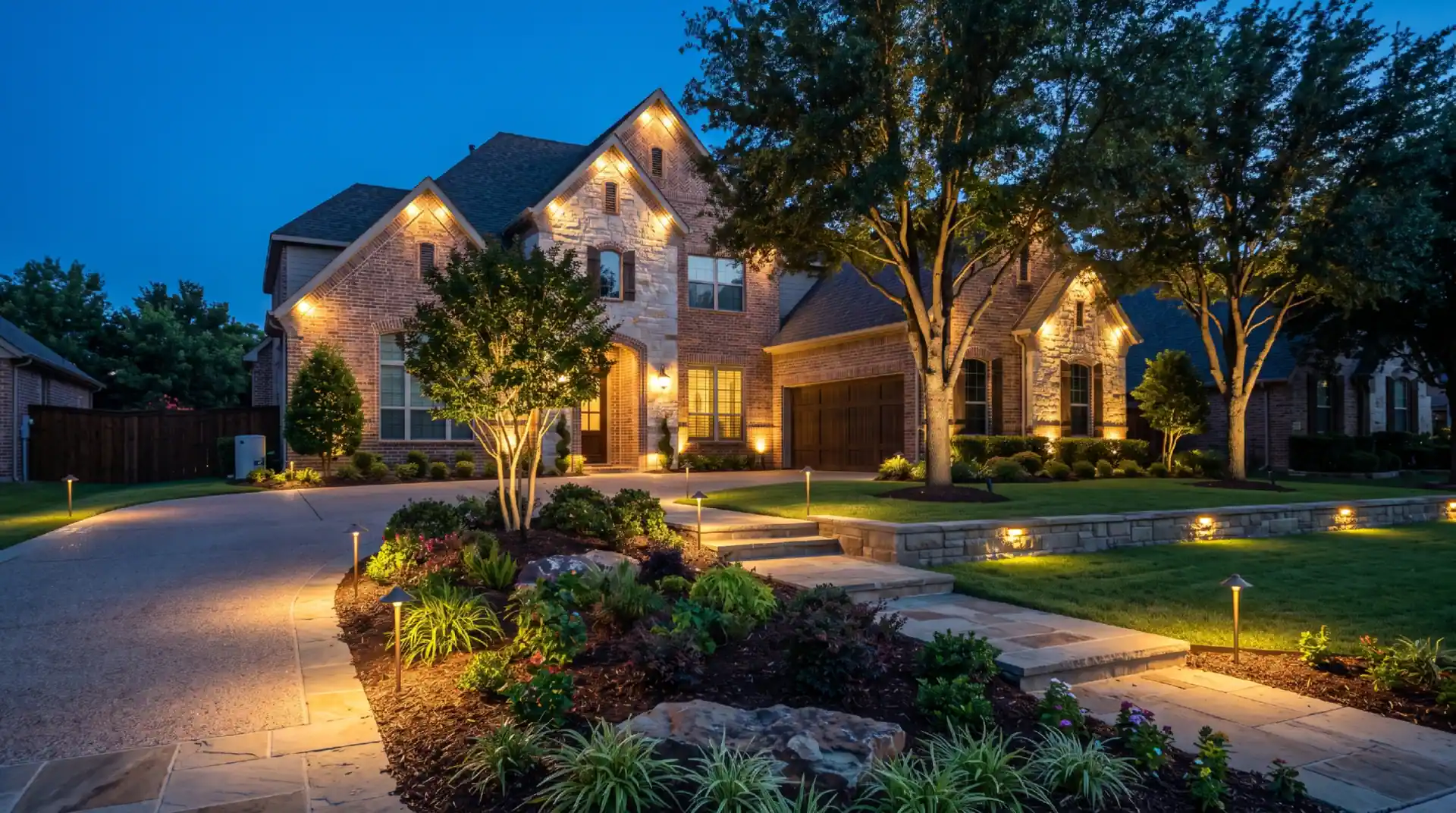
What is the average cost of outdoor lighting?
- Standard Residential Investment ($2,500 – $6,000): Covers a complete professionally designed low-voltage system (typically 12 to 25 fixtures) illuminating front architectural peaks, primary walkways, and focal landscape trees.
- Comprehensive Estate Systems ($15,000 – $30,000+): Encompasses 50+ commercial-grade luminaires, multi-zone smart dimming controls, backyard living spaces, perimeter acreage, and custom hardscape integration.
- Per-Fixture Installed Cost ($150 – $300 per light): Represents a turn-key industry metric that bundles the solid brass or copper housing, LED lamp, underground direct-burial cabling, waterproof splices, and trenching lbor.
- Power & Smart Control Infrastructure ($400 – $1,500+): Includes commercial stainless-steel multi-tap transformers to prevent voltage drop, paired with astronomical timers or app-based Wi-Fi automation.
- Installation Labor & Site Work (35% – 50% of total budget): Accounts for surgical turf trenching, directional boring beneath driveways or sidewalks, tree canopy mounting, and night-time optical aiming.
- Ongoing Operating & Maintenance Costs ($3 – $7/month in electricity): Reflects the high efficiency of modern LED boards (rated for 40,000–50,000 hours), alongside an optional $150 to $350 annual preventative service visit.
The average investment for a professionally designed outdoor illumination system ranges between $2,500 and $6,000, while comprehensive estate installations featuring multi-zone controls can reach $15,000 or more. Individual commercial-grade low-voltage luminaires typically run $150 to $300 per installed fixture, depending on material quality, transformer capacity, cable routing, and architectural complexity.
While a quick national average gives you a baseline, a single price bracket rarely tells the full story of what happens on a specific property. On the modest end, a targeted curb-appeal package might sit comfortably around $2,000. On the expansive end, large estates requiring custom masonry integration, high-canopy moonlighting, and astronomical smart controls regularly exceed $25,000.
When calculating budgets, professional designers rely on that $150 to $300 per-fixture turn-key metric because an outdoor lighting system is an interconnected electrical grid. You are not just buying the physical light in the box; you are investing in a proportional share of the transformer capacity, heavy-gauge underground copper cabling, waterproof connections, surgical trenching labor, and night-time aiming adjustments. Understanding where your project falls within these pricing tiers requires looking beneath the turf at the materials, engineering, and design philosophies that separate a short-lived retail kit from a permanent architectural asset.
Project Tiers: How Scope Drives Your Final Investment
Because every property features a unique footprint and architectural vernacular, comparing outdoor lighting costs is most accurate when segmented by fixture count and coverage goals.
Starter / Curb Appeal Package ($2,000 – $3,500 | 8 – 12 Fixtures) Designed to establish immediate street presence and safe navigation to the front door. This tier typically illuminates the primary architectural peaks or stone columns of the front facade, places 3 to 4 shielded path lights along the main entry walkway, and highlights 2 to 3 ornamental specimen trees in the front beds. It relies on a single stainless-steel transformer and an integrated astronomical timer.
Standard Residential System ($3,500 – $6,500 | 15 – 25 Fixtures) The most common residential investment. This scope provides comprehensive front-of-home architectural and botanical lighting while extending into the primary backyard entertaining area. It covers deck stairs, patio perimeters, and key focal trees visible from indoor living room windows, creating visual depth that draws the eye outward at night.
Premier Full-Property Illumination ($6,500 – $12,000 | 25 – 45 Fixtures) Built for homeowners who treat their exterior grounds as an extension of their interior square footage. This tier offers 360-degree property coverage, incorporating specialized task lighting for outdoor kitchens and pergolas, core-drilled hardscape lights under retaining wall caps, and independent zoning so the backyard can be dimmed for quiet evenings while the front facade remains bright.
Custom Estate & Acreage Installation ($15,000 – $30,000+ | 50+ Fixtures) Engineered for expansive properties, long winding driveways, poolside pavilions, and mature tree canopies. Systems of this scale often require multiple transformers across the property to manage electrical loads, directional boring beneath wide hardscapes, high-canopy downlighting, and microprocessor-driven RGBW color-tuning systems.
Deconstructing the Cost: The Four Pillars of an Illumination Budget
When you review an itemized proposal from a specialized landscape lighting designer, your investment is distributed across four primary categories: luminaire metallurgy, optical complexity, power distribution, and specialized labor.
1. Luminaire Metallurgy and Build Quality
Outdoor lights operate in one of the most punishing environments around—baked by UV rays, blasted by mineral-heavy lawn irrigation, buried in acidic mulch, and subjected to freeze-thaw soil shifting. The metal used to forge the fixture housing dictates both its upfront price and whether it will survive past year five.
Lower-cost systems use powder-coated cast aluminum ($50 to $120 in raw hardware cost). While lightweight and serviceable in mild, dry climates, coastal salt air, fertilizers, and wet soil eventually cause the finish to blister, leading to oxidation and structural failure within 5 to 8 years.
Professional design-build firms standardize on solid cast brass, bronze, or copper ($120 to $250+ in raw hardware cost). Solid brass and copper never rust or corrode; instead, they oxidize naturally into a rich, dark bronze patina that blends seamlessly into mulch and foliage. Brass housings can withstand accidental impacts from commercial lawnmowers and string trimmers, and they almost always carry lifetime manufacturer warranties. Inside the housing, professional fixtures utilize high-output LED boards or modular drop-in lamps calibrated to warm color temperatures (2700K to 3000K) with a high Color Rendering Index (CRI 85+), ensuring stonework and botanical greens look vibrant rather than sterile.
2. Fixture Types and Optical Engineering
Your per-fixture average will shift depending on the specific mix of luminaire styles required to light your architecture and terrain:
- Path and Area Lights ($150 – $250 installed): Engineered to cast downward pools of glare-free illumination across walkways, garden steps, and driveway borders.
- Directional Uplights and Wash Lights ($175 – $275 installed): Positioned at the base of brick facades, stone pillars, or tree trunks to graze textures and establish vertical drama.
- In-Grade Well Lights ($225 – $350 installed): Recessed completely flush into turf, gravel, or concrete so the fixture is invisible during daylight hours. Because they sit below grade, installation requires digging a deep sump Pit filled with pea gravel to ensure water drains away from the housing.
- Hardscape and Under-Cap Lights ($150 – $250 installed): Slim linear LED bars tucked beneath stone seat walls, outdoor kitchen counters, and stair treads. Retrofitting these onto existing masonry requires diamond-blade sawing and core drilling to conceal the low-voltage wire.
- Canopy Downlights / Moonlighting ($250 – $400 installed): Mounted 25 to 40 feet high inside mature deciduous trees to cast soft, natural shadows through the branches onto the lawn below. This requires specialized tree-climbing gear and stainless-steel standoffs that allow the tree trunk to expand without damaging the bark or wire.
3. Power Infrastructure: Multi-Tap Transformers and Cabling
A low-voltage system steps your home’s 120V current down to a safe 12V to 15V current. While retail kits utilize lightweight plastic power packs, professional installations rely on heavy-duty stainless-steel multi-tap transformers ($400 to $1,000+).
As electricity travels down a copper wire, it naturally loses pressure—a phenomenon known as voltage drop. If a transformer only outputs 12 volts, the lights closest to the house will burn overly bright while the lights 150 feet away at the end of the driveway will look dim and yellow. Multi-tap transformers provide dedicated 12V, 13V, 14V, and 15V terminal blocks. Combined with thick 12/2 or 10/2 direct-burial copper cable, technicians mathematically balance each hub so every single LED on the property operates within its optimal voltage window, protecting the internal electronics from premature burnout.
4. Surgical Installation Labor
Labor typically represents 35% to 50% of the total project investment. A professional installation crew focuses on permanent infrastructure and invisible execution. Wires are trenched 6 to 8 inches beneath the turf using specialized slit-trenching tools that slice a narrow seam into the lawn, lay the cable, and press the sod back together without leaving muddy scars.
Where wiring must cross existing concrete walkways or paver patios without pre-installed PVC sleeves, crews use hydro-tunneling or mechanical boring rods to pass conduit directly beneath the slab. Every underground connection is crimped with solid brass sleeves and encapsulated inside waterproof silicone pods or heavy-wall heat-shrink tubing to prevent ground moisture from wicking into the copper strands.
Smart Controls, Zoning, and Automation
Modern control options allow you to tailor how your property functions throughout the night, adding anywhere from $150 to $3,500+ to the system architecture:
- Astronomical Timers ($150 – $300): Built inside the transformer, these digital units use your geographic coordinates to track the exact daily sunset and sunrise times year-round, eliminating reliance on external photocells that fail when covered by dirt or triggered by neighborhood streetlamps.
- Smart Wi-Fi Controllers ($300 – $700): Connect your transformer to your home network, enabling smartphone scheduling, voice control integration, and automated midnight dimming to conserve energy when the household is asleep.
- Digital Zoning & Color-Tuning ($1,500 – $4,000+): Advanced systems assign a digital address to every individual fixture on a single wire run. Through an app, you can adjust the exact brightness percentage of a single patio spotlight that feels too bright during dinner, separate your security perimeter from your entertainment zones, or shift the color spectrum across the property for holidays and game days.
Ongoing Ownership Costs and Long-Term ROI
Once installed, a commercial-grade low-voltage LED system is remarkably inexpensive to operate. Because modern LEDs consume up to 80% less wattage than legacy halogen bulbs, an entire 20-fixture landscape system typically draws only 80 to 120 watts total—roughly the same electrical load as a single old-fashioned incandescent floodlight. Running the system for 6 hours every evening generally adds just $3 to $7 per month to your utility bill.
With LED lamp lifespans rated between 40,000 and 50,000 hours (roughly 18 to 22 years of nightly operation), your only recurring expense is an optional annual preventative maintenance visit ($150 to $350). Because landscapes are living environments, an annual tune-up ensures mineral deposits from sprinklers are cleaned off glass lenses, encroaching shrubbery is pruned back, fixtures tilted by winter frost heave are leveled, and uplights are re-aimed as your trees grow taller. Ultimately, a permanent brass or copper illumination system transforms unusable night-time acreage into functional living space while returning 50% to 70% of its installation cost in tangible real estate value and curb appeal.
Have more Questions?