
Where is the best place to buy outdoor lighting?
- Professional Landscape Lighting Design-Build Firms (Best Overall Value & Longevity): Provides access to trade-exclusive solid brass and copper luminaires, commercial stainless-steel multi-tap transformers, custom optical engineering, and lifetime-warranted installation.
- Wholesale Electrical & Irrigation Distributors (Best for Trade Contractors & Experienced DIYers): Supplies commercial-grade manufacturers (such as FX Luminaire, Kichler Pro, andWAC Landscape) alongside bulk 12/2 direct-burial cable and professional waterproof connectors.
- Dedicated Architectural Lighting Showrooms (Best for Decorative Sconces & Entry Fixtures): Ideal for sourcing high-end 120V line-voltage wall lanterns, pendant lights, and statement porch fixtures that coordinate with your home’s interior hardware.
- Specialty Online Pro-Grade Retailers (Best for DIY Solid-Brass Component Sourcing): Offers direct-to-consumer solid cast brass fixtures, replaceable high-CRI LED drop-in lamps, and stainless-steel transformers without requiring a contractor license.
- Big-Box Hardware Stores & Mass Online Marketplaces (Best for Temporary or Budget Decor): Stocks inexpensive solar stakes, string lights, and thin-wall aluminum kits ($100–$400), though these systems typically fail within 12 to 36 months due to moisture intrusion and corrosion.
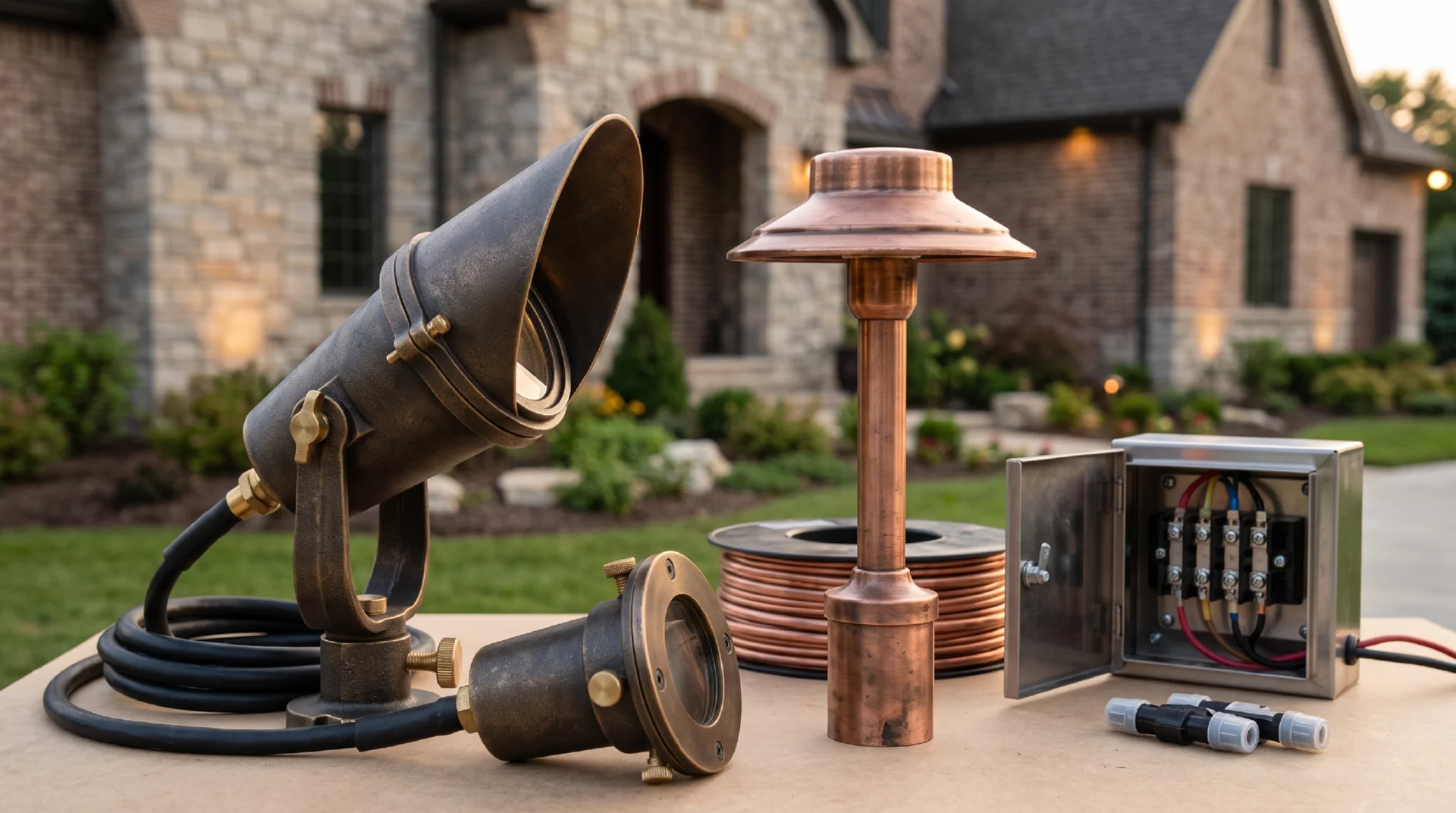
The best place to buy outdoor lighting is through a specialized landscape lighting design-build firm or an authorized architectural lighting distributor, rather than a traditional big-box home improvement store. While retail chains sell consumer-grade aluminum and plastic kits designed for temporary curb appeal, professional lighting specialists and trade supply houses provide heavy-duty, solid cast brass and copper luminaires engineered to withstand decades of harsh weather, lawn maintenance equipment, and subterranean moisture.
When homeowners set out to purchase exterior illumination, they quickly discover that the market is divided into two completely different ecosystems: the consumer retail market and the commercial specification-grade market. Where you choose to buy your hardware dictates not only how your property looks at midnight, but whether you will be digging up and replacing corroded wires two summers from now.
Understanding the pros, cons, and hardware standards of the five primary purchasing channels will help you invest your budget in a system that lasts.
Comparing Outdoor Lighting Purchasing Channels
Not every vendor sells the same caliber of equipment. Even when a recognizable brand name appears in both a retail store and a professional showroom, the internal components, housing metallurgy, and warranty terms are rarely identical.
| Purchasing Channel | Typical Material Quality | Expected Lifespan | Ideal Buyer Profile |
| Big-Box Hardware & Mass Retail | Plastic, thin die-cast aluminum, solar batteries | 1 – 3 Years | Renters, temporary event setups, or ultra-tight DIY budgets under $500. |
| Decorative Lighting Showrooms | Powder-coated aluminum, seeded glass, decorative brass | 5 – 12 Years | Homeowners selecting 120V coach lights, porch pendants, and architectural sconces. |
| Specialty Online Pro-Direct Stores | Solid cast brass, stainless steel transformers, replaceable LEDs | 10 – 20 Years | Handy DIY homeowners willing to trench wire and calculate voltage drop themselves. |
| Wholesale Landscape Supply Houses | Commercial brass, copper, anodized aluminum, heavy-gauge wire | 15 – 25+ Years | Licensed contractors, landscapers, and advanced property owners sourcing pro brands. |
| Turn-Key Design-Build Specialists | Architectural-grade brass/copper, custom optics, potted electronics | 20+ Years (Lifetime Hardware) | Homeowners seeking a custom-engineered, zero-maintenance nocturnal estate aesthetic. |
1. Big-Box Home Improvement Stores & Mass Online Retailers
For many homeowners, the first instinct is to walk down the lighting aisle at a local home improvement warehouse or search major online marketplaces. While these stores offer instant gratification and low upfront prices, their inventory is built around a price point rather than architectural longevity.
- What They Sell: Pre-packaged 6-to-10-light starter kits, solar-powered pathway stakes, plastic-housed transformers, and thin 16-gauge or 18-gauge wire with “pierce-point” clip connectors.
- The Hidden Drawbacks: Retail fixtures are almost exclusively manufactured from thin, powder-coated die-cast aluminum or UV-stabilized plastic. When exposed to pressurized sprinkler water, lawn fertilizers, freeze-thaw cycles, and weed-whackers, powder coating chips and blisters. Once water penetrates the housing, the non-replaceable integrated LED board shorts out. Furthermore, the snap-on pierce connectors included in retail kits puncture the wire insulation without sealing it, allowing ground moisture to wick directly into the copper strands and corrode the line within 12 to 24 months.
- When It Makes Sense: Buying commercial-grade café string lights for a seasonal patio cover, or picking up temporary pathway markers while saving for a permanent low-voltage system.
2. Dedicated Architectural Lighting Showrooms
Local brick-and-mortar lighting showrooms bridge the gap between interior design and exterior curb appeal. If you are building a custom home or remodeling your facade, a lighting showroom is an essential stop—for half of your exterior lighting needs.
- What They Sell: High-end 120-volt (line-voltage) decorative fixtures mounted directly to the structure of your home, including flanking garage coach lanterns, front entry chandeliers, soffit recessed cans, and patio ceiling fans.
- The Limitations for Landscape Lighting: While showroom consultants excel at matching a decorative bronze wall sconce to your front door hardware, most interior-focused showrooms treat in-ground landscape lighting as an afterthought. Their low-voltage landscape displays are often limited to a single catalog brand, and showroom sales reps rarely visit your property at night to calculate beam spreads, tree canopy heights, or underground cable routing.
- When It Makes Sense: Sourcing decorative 120V wall-mounted fixtures that act as daytime architectural jewelry around your doors and garage bays.
3. Wholesale Irrigation and Landscape Supply Houses
If you want access to the exact equipment used on luxury resorts, golf courses, and high-end estates, look toward regional wholesale distributors (such as SiteOne Landscape Supply, Ewing Outdoor Supply, or dedicated electrical supply houses).
- What They Sell: Specification-grade low-voltage hardware from industry titans like FX Luminaire, Kichler, Unique Lighting Systems, Vista Professional Outdoor Lighting, and WAC. They also stock heavy-duty 12/2 and 10/2 direct-burial copper cable, stainless-steel multi-tap transformers, and grease-filled or heat-shrink waterproof splices.
- The Buyer Experience: Some wholesale branches sell strictly to licensed trade professionals, while others allow homeowners to purchase over the counter at retail list pricing. Keep in mind that supply houses are logistics centers, not design studios. The counter staff expects you to walk in with a complete bill of materials—knowing exactly which degree of MR16 lamp, which wattage load, and which voltage tap your layout requires.
- When It Makes Sense: Experienced DIYers, master electricians, or estate managers who already understand low-voltage electrical engineering and want to buy commercial-grade components locally.
4. Direct-to-Consumer Online Pro-Grade Retailers
Over the past decade, a specialized niche of online retailers (such as Volt Lighting and Total Outdoor Lighting) has emerged to sell commercial-grade solid brass fixtures directly to homeowners, bypassing traditional contractor distribution tiers.
- What They Sell: Solid cast brass path lights, spotlights, hardscape bars, and stainless-steel transformers backed by robust manufacturer warranties, alongside replaceable LED drop-in bulbs in 2700K and 3000K color temperatures.
- The Trade-Off: Buying from a pro-direct website solves the hardware problem of big-box stores, giving DIY homeowners access to heavy brass housings that will not rust. However, buying great paint does not automatically paint a masterpiece. The homeowner is still entirely responsible for the aesthetic design, optical selection, turf trenching, sidewalk boring, and electrical load balancing. Many DIY buyers inadvertently purchase kits with identical 36-degree flood bulbs for every fixture, resulting in washed-out lower walls and dark upper gables.
- When It Makes Sense: Hands-on homeowners who enjoy weekend excavation projects, have straightforward property layouts without complex masonry obstacles, and want professional-grade brass hardware at direct pricing.
5. Turn-Key Landscape Lighting Design-Build Firms
For homeowners who view outdoor illumination as a permanent architectural investment rather than a weekend hardware project, purchasing through a specialized outdoor lighting design-build company delivers the highest return on investment.
- Access to Trade-Only Architectural Lines: Dedicated lighting designers source from elite, specification-only manufacturers (such as Coastal Source, Garden Light LED, StereoStone, and Hudson Valley Lighting’s landscape divisions) that do not sell to the general public or online discounters. These fixtures feature proprietary hermetically sealed connections, aircraft-grade internal optics, and custom modular shrouds.
- Optical Engineering Over “Fixture Counting”: When you buy from a specialist, you are paying for nighttime choreography. A designer evaluates how light interacts with your specific brick mortar, stone clefts, and tree bark. Instead of using one generic spotlight across the whole yard, they specify a 10-degree narrow spot with a hex louver for a two-story column, a 60-degree wide wash for a Japanese maple, and a 2700K warm under-cap bar for stone steps.
- Surgical Installation and Bumper-to-Bumper Warranties: If you buy fixtures online and hire a general handyman or electrician to install them, you fall into a “warranty gap”—if a light fails, the installer blames the manufacturer, and the manufacturer blames the installer’s wiring voltage. A turn-key design-build firm owns the entire ecosystem: the transformer, the underground splices, the brass housings, and the LED lamps, providing single-source accountability and proactive annual maintenance.
The Buyer’s Checklist: 5 Non-Negotiable Specs to Demand Before You Buy
Regardless of which vendor you choose, never purchase outdoor lighting hardware without verifying that the components meet these five commercial benchmarks:
- Solid Brass, Copper, or Marine-Grade Stainless Steel Housings: Avoid thin-wall aluminum and composite plastics. If a magnet sticks to the fixture body or the paint can be scratched off with a key, leave it on the shelf.
- Serviceable vs. Integrated LEDs: Ensure the fixture either uses high-grade modular drop-in lamps (such as commercial MR16 or G4 bi-pin LEDs encapsulated in conformal coating against moisture) or features a replaceable integrated LED module board so you never have to dig up and throw away a brass fixture just because a diode reached the end of its lifespan.
- Color Temperature Consistency (2700K – 3000K, 85+ CRI): Verify that the vendor bins their LEDs tightly so every lamp across your property emits the exact same warm, golden-white hue without green or purple tint shifts.
- Multi-Tap Stainless Steel Transformer (12V – 15V): Never buy a fixed 12V plastic power pack. Ensure the power supply features multiple voltage taps to compensate for voltage drop over long wire runs, housed in a NEMA-rated weatherproof stainless enclosure.
- 12/2 Direct-Burial Copper Cable & Waterproof Splices: Insist on pure stranded copper wire (never copper-clad aluminum) paired with brass mechanical crimps sealed in silicone gel capsules or adhesive-lined heat-shrink tubing.
Have more Questions?