
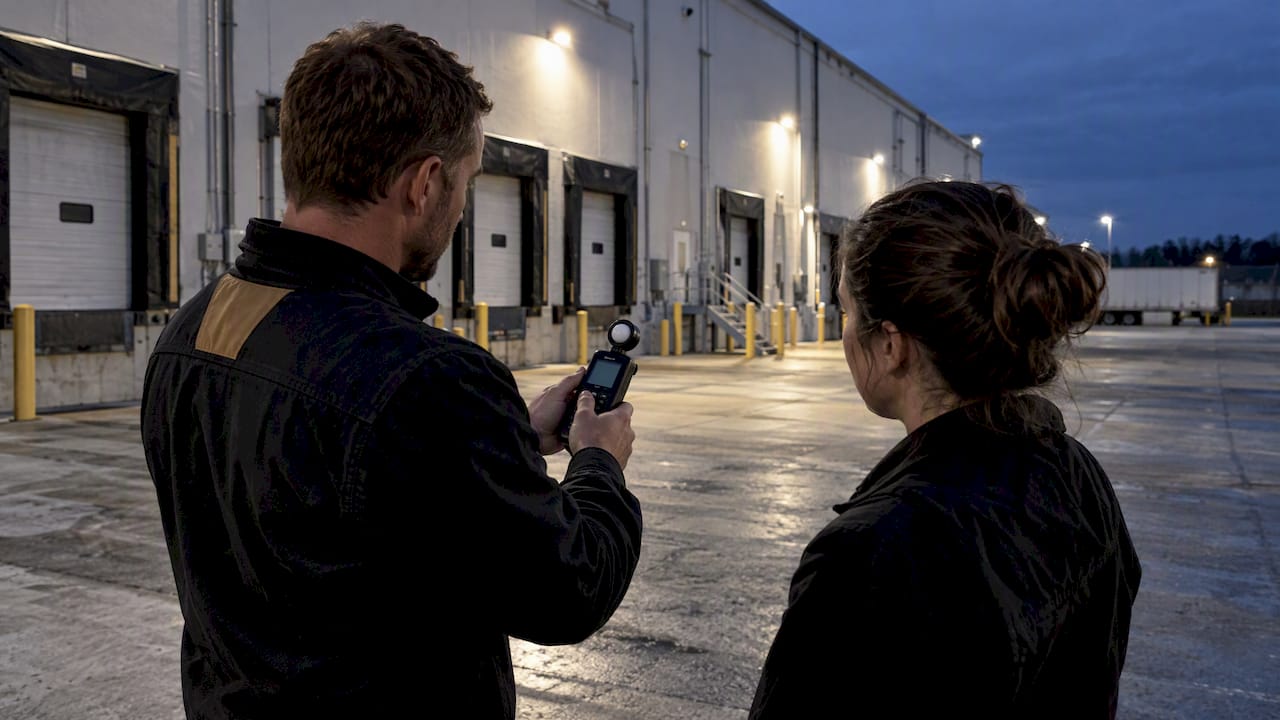
Hire a contractor who delivers documented photometrics, follows NECA/IES installation guidance and NEC safety practices, commissions the controls system, and backs the work with a maintenance subscription that includes after-dark checks and reporting. We built our own commercial process around these same requirements. The sections below explain what to request from bidders and how to compare proposals on outcome rather than fixture count.
TL;DR:
- Bidders should provide photometric layouts and simulation data, not just fixture counts, to ensure proper light levels and avoid glare.
- A comprehensive retrofit includes design documentation, electrical scopes, controls commissioning, and detailed closeout packages, not merely hardware installation.
- Maintenance plans must account for regular inspections, fixture cleaning, vegetation trimming, and control system re-commissioning to sustain lighting performance.
- Contracts should explicitly require compliance with electrical codes, weatherproofing standards, and signed acceptance testing before final payment.
- Asking for references, detailed scopes, and documented procedures helps identify contractors committed to long-term performance and adherence to lighting standards.
Table of Contents
- What a Commercial Exterior LED Retrofit Should Include
- What To Request From Bidders Before Pricing
- Maintenance Expectations and What a Service Plan Should Cover
- Installation Quality and Code Expectations To Put in Writing
- Contractor Evaluation Checklist: Eight Questions and Red Flags To Watch
- Why We Design Around Photometrics and Controls First
- Request a Free Estimate for Your Commercial Retrofit
- FAQ
- Sources
What a Commercial Exterior LED Retrofit Should Include
A professional retrofit is a coordinated package of design, electrical work, and controls, not a parts list. Before signing anything, look for these deliverables in the proposal.
- Design documents: lighting criteria, photometric plans, fixture and control schedules, and target illuminance and uniformity values based on IES exterior lighting principles.
- Electrical and structural scope: conduit and trenching plans, surge protection, mounting and structural supports, and a clear plan for maintenance access.
- Controls and commissioning: programmed photocells or astronomical time schedules, scene settings, and acceptance testing prior to system activation.
- Closeout package: as-built drawings, operations and maintenance manuals, warranty documents, commissioning reports, and a defined change-order process for any mid-project additions.
Property managers and business owners often focus on how many fixtures a bid includes. That number tells you almost nothing about the result. A system with fewer, well-placed fixtures and a properly commissioned controls schedule will outperform a system with more fixtures and no documented design intent. Our installation process follows this same sequence: design first, then electrical scope, then commissioning, then closeout documentation.
What To Request From Bidders Before Pricing
Comparable quotes require comparable information. Before you ask for a price, send bidders this list and request written answers.
- A site assessment that documents access, staging areas, and any traffic-control windows needed during installation.
- Photometric layouts or simulation output showing projected illuminance levels, not just a fixture count, following IES site lighting planning guidance.
- Manufacturer cut sheets with IP rating and lifetime data, along with full details on the control system being proposed.
- A detailed electrical scope, clear statement of who handles permits, and a written process for pricing and approving change orders.
Bidders who resist providing these items are usually planning to sell you on price alone, and price alone tells you nothing about long-term performance. Our landscape lighting checklist walks through a similar set of questions for smaller properties, and the logic carries over directly to commercial sites.
Maintenance Expectations and What a Service Plan Should Cover
A retrofit is only as good as the plan behind it. Preventive maintenance guidance aligned with ASHRAE practices calls for a defined set of recurring tasks, not just emergency repair calls.
- After-dark lamp-out walks to identify lighting failures that might not be visible during daytime inspections.
- Lens and fixture cleaning along with trimming vegetation that obstructs light distribution.
- Controls validation ensuring that lighting schedules and scenes remain consistent with original design intent.
- Group relamping planning and maintaining documented service histories for all maintenance visits.
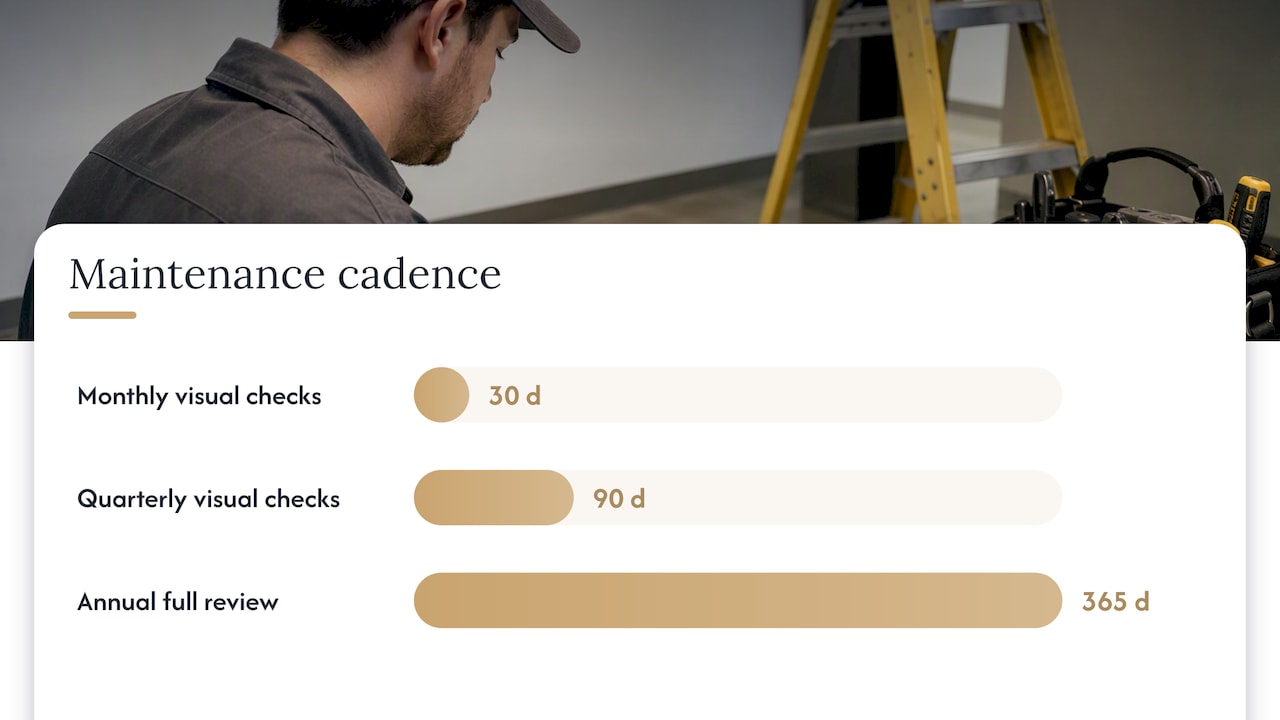
A reasonable cadence pairs monthly or quarterly visual checks with an annual full system review, including controls recalibration. Service agreements should spell out emergency response times, what parts are covered, and what documentation you receive after each visit, including inspection logs and any corrective-action records.
Pro Tip: Ensure the maintenance plan covers re-commissioning of controls systems in addition to replacing failed modules, since sensor drift and schedule drift can degrade performance over time.
Our GlowCare maintenance subscription, described on our permanent lighting page, is built around this same idea: preserve the design, not just the hardware.
Installation Quality and Code Expectations To Put in Writing
Workmanship quality and code compliance are two different things, and a contract should require both. NECA/IES 501 guidance recommends installations follow the National Electrical Code, applicable state and local codes, manufacturer instructions, and the contract documents themselves, and it suggests spelling out permits, inspections, grounding, and testing in writing rather than assuming they are covered.
Put these items explicitly in the contract:
- Require compliance with the National Electrical Code and relevant electrical safety standards.
- Specify weatherproofing requirements including appropriate IP ratings, sealed connections, grounding, and surge protection.
- Include commissioning sign-off with functional testing and acceptance criteria before final payment.
- Ensure fixtures are placed to allow safe technician access, with maintenance instructions included in closeout documentation.
A bid that skips any of these items is a bid that is planning to skip the work behind them too.
Contractor Evaluation Checklist: Eight Questions and Red Flags To Watch
Comparing contractors gets easier once you have a fixed list of questions. Ask each bidder the following, in writing if possible.
- Can you provide a photometric layout for this project, not just a fixture count?
- Can you share references from commercial clients with a similar scope?
- Who handles permits and inspections, and is that spelled out in the contract?
- Will you commission the controls system and provide staff training on it?
- What does the warranty cover, and what does the maintenance plan include?
- What surge protection and UL or IP ratings apply to the fixtures you are proposing?
- How will technicians access fixtures for maintenance after installation?
- Is there a written change-order process for scope added after signing?
A contractor who follows ANSI/IES RP-43-22 builds around glare control, spectrum, and lighting zones rather than raw brightness, which is a meaningfully different design outcome than a low-bid fixture swap.
Red flags include missing photometrics, a vague electrical scope, no mention of commissioning, no maintenance plan at all, and a closeout package that amounts to an invoice and nothing else. Trust signals run the other direction: documented adherence to NECA/IES guidance, a commissioning report, sample inspection logs, and a written maintenance SLA.
Why We Design Around Photometrics and Controls First
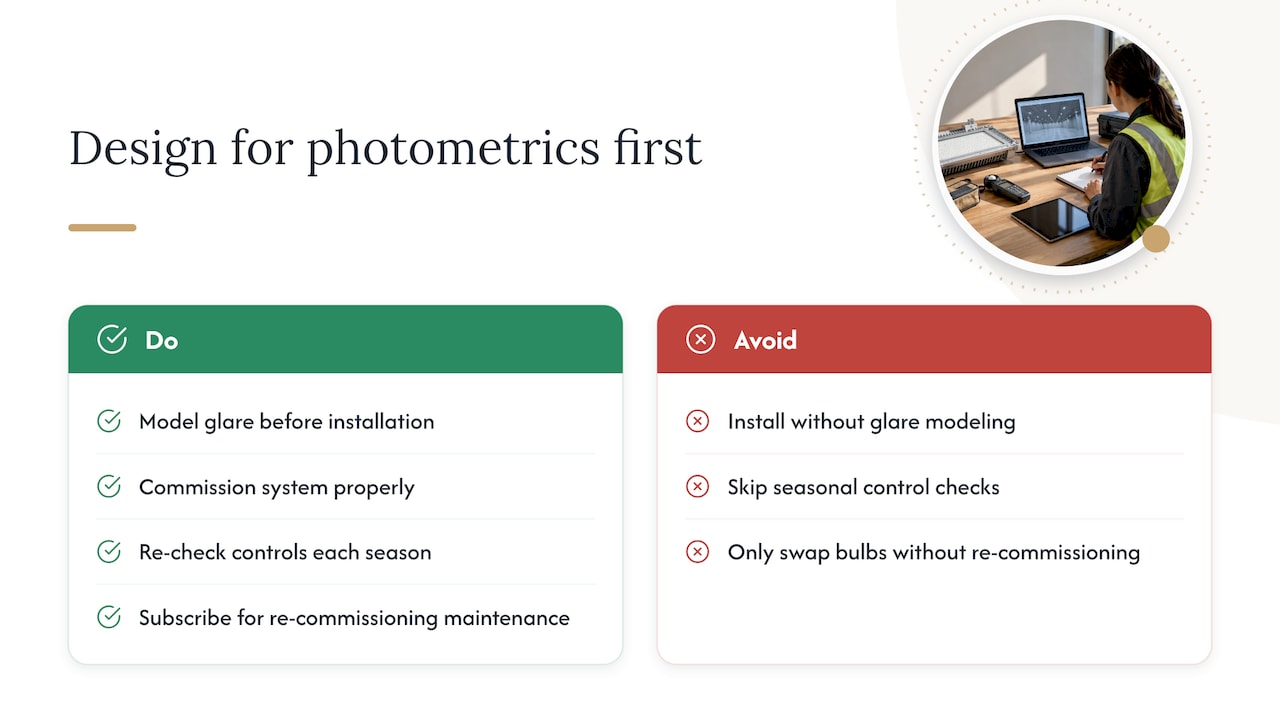
In our experience, most complaints about exterior lighting trace back to two things: glare that was never modeled before installation, and controls that were never re-checked after the first season. A system commissioned properly and maintained on a schedule rarely generates either complaint.
A maintenance subscription that re-commissions controls, not just one that swaps bulbs, is what keeps a retrofit looking and performing the way it was designed to, years after the crew leaves the site.
— Dave
Request a Free Estimate for Your Commercial Retrofit
We design and install custom permanent roofline LED tracks, landscape and architectural exterior systems, and commercial lighting for commercial properties, with commissioning and maintenance built into the process from the start. A site visit from our team includes photometric evidence, a defined electrical scope, and maintenance options. These are the same items this guide recommends you request from any bidder.

| What you get | Why it matters |
|---|---|
| Photometric-based design | Confirms light levels and glare control before installation |
| Controls commissioning | Verifies schedules and scenes work as designed |
| GlowCare maintenance subscription | Preserves design intent with scheduled checks and reporting |
- Custom-installed smart LED roofline, landscape, and architectural systems.
- HOA and municipal compliant design, engineered for weather resistance.
- Site assessment and estimate before any commitment.
Request your free estimate and site assessment to see a design and maintenance plan built around your property.
FAQ
What does a commercial LED lighting retrofit usually include?
A professional retrofit includes a documented design with photometric plans, the electrical and structural work to support new fixtures, controls programming and commissioning, and a closeout package with as-built drawings and warranty documents. Proposals that skip photometrics or commissioning are missing core parts of the scope, as outlined in NECA/IES installation guidance.
How long does a commercial exterior lighting project take?
Timelines vary by site size and electrical scope, running from an initial assessment and design phase through installation and final commissioning. A written proposal should state the assessment, design, installation, and commissioning phases separately so you know what to expect at each stage.
What should a maintenance agreement for exterior lighting cover?
A solid maintenance agreement covers after-dark lamp-out walks, fixture cleaning, vegetation trimming, and controls validation on a defined schedule, plus documented service history, following preventive maintenance guidance for lighting systems. Our GlowCare subscription, described on our permanent lighting page, is built around these same recurring tasks.
Why does a photometric plan matter more than a fixture count?
Fixture count says nothing about where the light actually lands, while a photometric plan shows projected illuminance levels and helps avoid glare, light trespass, and uneven coverage, consistent with IES exterior lighting practice. Two bids with the same fixture count can produce very different lighting outcomes.
What questions should I ask before hiring a lighting contractor?
Ask whether the contractor will provide photometrics, commission the controls system, handle permits directly, and offer a maintenance plan with defined response times. A contractor who answers all four clearly, in writing, is following the same procurement framework recommended in site lighting planning guidance.
Sources
- NECA/IESNA 501-2006 (preview) — Installing Exterior Lighting Systems
- Lighting checklist — Preventive maintenance (ASHRAE-aligned guidance)
- Establish design criteria — AGi32 / site lighting planning