
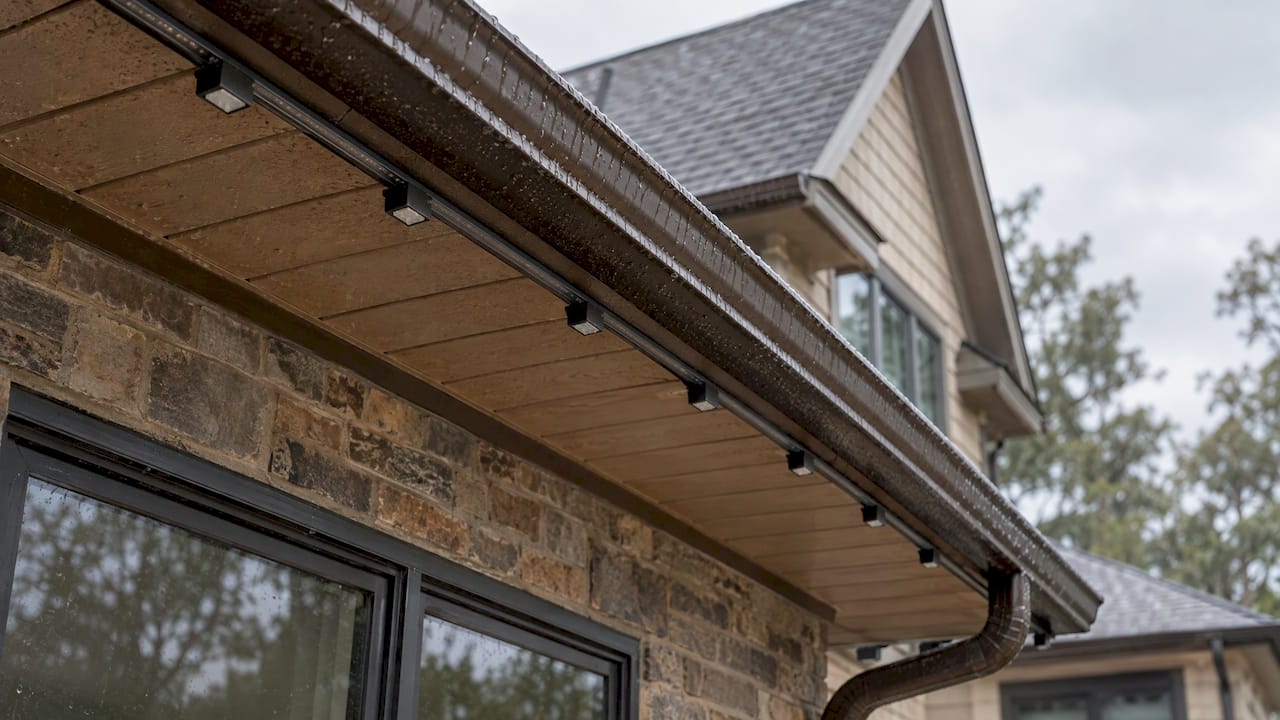
IP66 and IP68 are not a good rating and a better one. They are two different tests. IP66 means the fixture is dust-tight and survives powerful water jets, which is what rain, storms and a garden hose deliver. IP68 means it is dust-tight and survives continuous submersion, which matters for fixtures that sit underwater. For a roofline, soffit, patio or landscape system in Charlotte, IP66 describes the exposure. IP68 describes a different one. In the U.S., though, the rating on the box is only part of what makes a fixture approved for the outdoors, and that is where professional design and installation pay off.
We design and install permanent lighting for Charlotte homes and businesses, including landscape illumination, roofline tracks, patio lighting and marine-grade dock lighting. Here is how to read the two ratings and what to ask about beyond them.
TL;DR
- IP66 = dust-tight plus protection from powerful water jets. It suits rain, storms and hose or pressure-wash exposure, but it is not a submersion rating.
- IP68 = dust-tight plus continuous immersion, to a depth and time the manufacturer sets. It suits fixtures that sit underwater or in standing water.
- A higher second digit is not automatically better. An IP68 product may never have been tested against a water jet, so look for dual marking (IP66/IP68) where both threats exist.
- In the U.S., inspectors look at wet-location listings, not just IP codes. Salt, UV and heat are not covered by an IP number at all.
- For most permanent lighting on a Charlotte home, the right answer is a wet-location-suitable, weather-engineered system, installed correctly.
Table of Contents
- What the two digits in an IP rating mean
- What IP66 actually tests
- What IP68 actually tests
- Why IP68 is not “IP66 plus more”
- Side by side: IP66 vs IP68
- Which one fits a Charlotte property
- Why a bigger number can cost more and protect less
- What the IP code does not tell you
- The U.S. wrinkle: wet-location listings
- How to read a spec sheet before you sign
- Our perspective
- Get the right rating without decoding the spec sheet
- FAQ
- Sources
What the two digits in an IP rating mean
IP stands for ingress protection, a code defined in the international standard IEC 60529. The first digit after “IP” covers solids such as dust. The second covers water. A 6 in the first position means dust-tight. So IP66 and IP68 are both dust-tight, and the only difference is the water test.
The second digit runs like this, as summarized by a technical guide on IP and NEMA ratings:
| Second digit | Water protection |
|---|---|
| 6 | High-pressure water jets from all directions |
| 7 | Temporary immersion, up to 1 m |
| 8 | Continuous immersion, up to 2 m or as the maker specifies |
| 9K | High-pressure steam jets |
If you see an X, as in IPX4, it means that characteristic was simply not rated. It does not mean zero protection.
What IP66 actually tests
The IP66 water test sprays a 12.5 mm nozzle at 100 liters per minute (about 26 gallons per minute) from roughly 2.5 to 3 meters, for at least three minutes, according to a compliance lab’s description of the test. That is far more water than a heavy storm puts on a fascia board. UL’s guide to IP testing for lighting products describes an IP66 luminaire the same way: dust-tight and protected against powerful water jets.
The practical translation for a homeowner:
- Wind-driven rain, thunderstorms and the remnants of a Gulf or Atlantic tropical system are all within what the test represents.
- A garden hose or a pressure washer aimed at the fixture is within the test’s scope, though the U.S. standard for roadway and area luminaires warns that cleaning solvents or high-pressure cleaning may negate test results.
- Submersion is not covered. An IP66 fixture is not rated for being underwater.
What IP68 actually tests
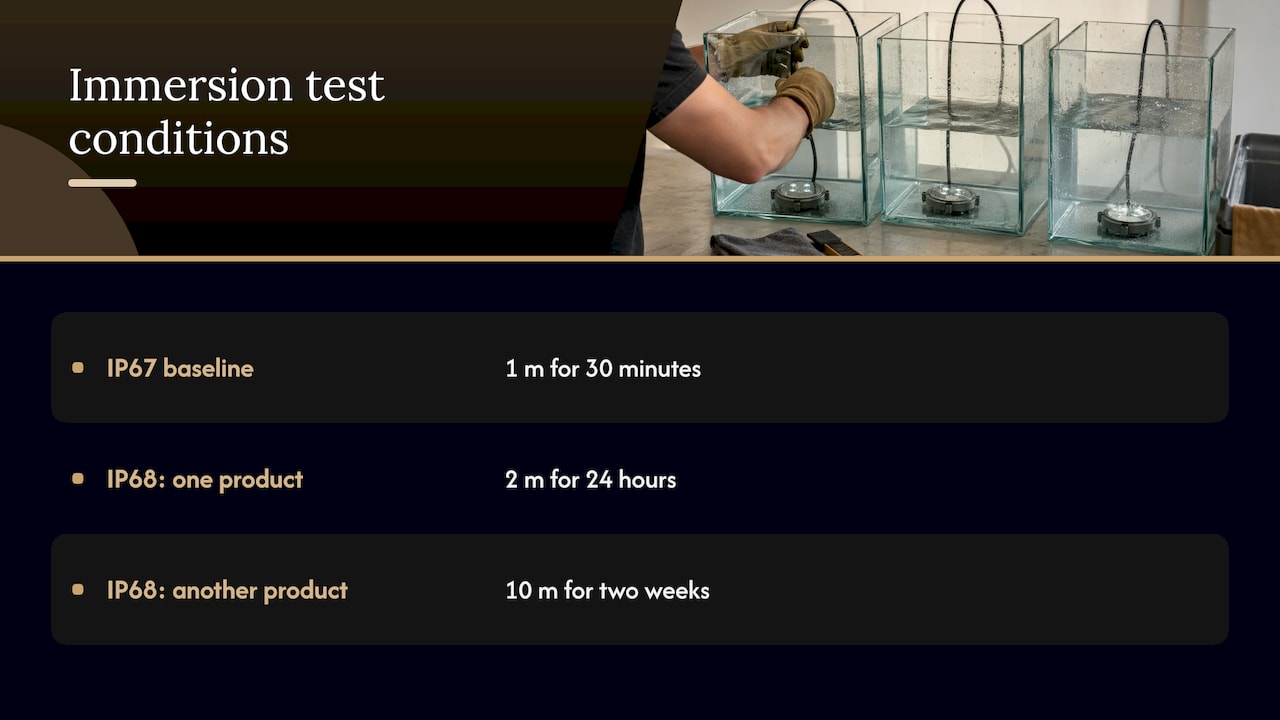
IP68 has no fixed depth or time. Under the standard it means continuous immersion under conditions the manufacturer states, and those conditions must be more severe than IP67’s one meter for 30 minutes. One enclosure guide gives the range: one product may be tested at 2 meters for 24 hours, another at 10 meters for two weeks. Another manufacturer’s technical article lists 2 m for 24 hours as its own IP68 spec.
So “IP68” on its own tells you very little. The number that matters is the depth and duration on the datasheet. For a fixture that will sit in a pond, a fountain basin or a flood-prone low spot, that datasheet line is the one to read.
Why IP68 is not “IP66 plus more”
This is the point most comparison pages miss, and the main reason the keyword is worth a close read. Water ratings 1 through 6 are cumulative: a product rated for jets generally handles the lighter tests below it. But 7 and 8 sit on a different branch. Submersion applies steady pressure. Jets apply dynamic, directional force. A seal can handle one and fail the other.
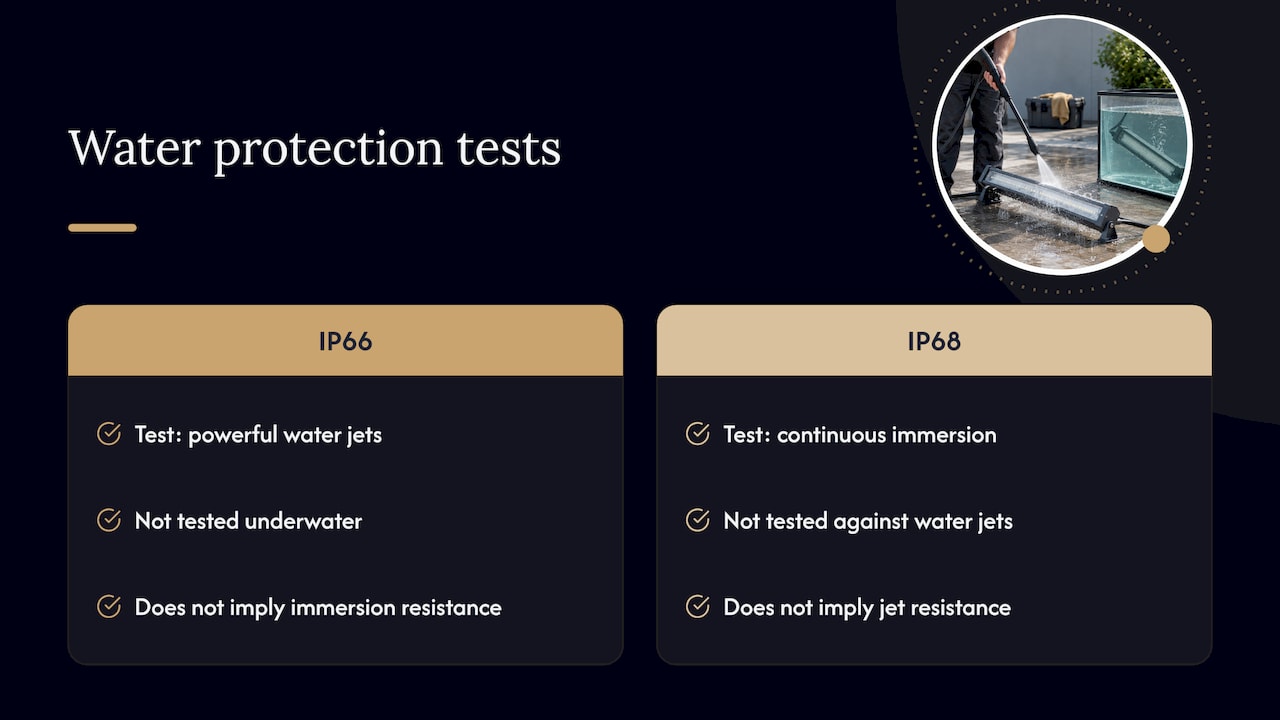
SizeMarker’s 2026 analysis puts it bluntly: an IP68 enclosure has never been tested against a water jet, and an IP66 enclosure has never been tested underwater. The U.S. standard for roadway and area luminaires says the same thing in its own terms: an enclosure designated only with a second numeral of 7 or 8 is considered unsuitable for water jets and need not pass the jet tests unless it is dual coded.
The fix is dual marking. A product that passes both is labeled IP66/IP68. When a fixture could face both a hard rain and standing water, that is the label that covers the real exposure.
Side by side: IP66 vs IP68
| IP66 | IP68 | |
|---|---|---|
| Dust | Fully dust-tight | Fully dust-tight |
| Water test | Powerful jets, 100 L/min, at least 3 minutes | Continuous immersion, depth and time set by the maker |
| Typical exposure | Rain, storms, hose-down, pressure rinsing | Underwater, standing water, pond or basin placement |
| Submersion rated | No | Yes, as specified on the datasheet |
| Jet rated | Yes | Only if also marked IP66 |
| What to verify | The mark and the listing | Depth, duration and a jet rating if exposed to spray |
Which one fits a Charlotte property
Match the rating to the real exposure, not to the biggest number. Charlotte’s weather is humid, with heavy summer thunderstorms, occasional tropical remnants, ice and freezing rain in winter, and a lot of pollen and pine debris that homeowners wash off in spring. That is a jet-and-spray environment, which is exactly what IP66 describes.
Here is how the common locations break down:
- Roofline, soffit and eave lighting: exposed to rain and wind-driven water, never submerged. This is IP66 territory. Our permanent roofline lighting systems are built around that exposure.
- Patio, pergola, deck and step lighting: splash, rain and cleaning. Spray protection matters more than immersion. See our patio lighting work.
- Landscape fixtures above ground: rain, sprinklers and irrigation overspray. Jet protection again.
- In-ground well lights and low spots: these can sit in water after a heavy storm, so they are the one place where immersion ratings come into play. One landscape lighting guide advises IP67 or IP68 for in-ground or well lights, with direct-burial-rated cable and gel-filled splices.
- Docks and waterfront: water contact is constant and salt or brackish conditions are possible, so the immersion question is real here. Our dock and waterfront lighting is marine-grade for that reason.
- Pools, spas and fountains: the fixture must be specifically listed for underwater use under UL 676, because an IP68 enclosure rating by itself is not a pool-light approval.
The same logic applies inside the house. If you want to see how exposure changes room by room, this lighting plan breakdown of layers, rooflights and circuits shows how fixtures get matched to where they sit.
Why a bigger number can cost more and protect less
Choosing IP68 “to be safe” can backfire in two ways. First, you may pay for immersion protection a roofline will never use. Second, if the product is IP68 only, you may have bought a fixture that was never tested against the spray it will see every storm. The sensible target is the rating that matches the exposure, confirmed by the marks the product actually carries.
A useful habit: read the rating as two questions. What water will hit this fixture, and from which direction? Then check the product against each answer, rather than against a single number.
What the IP code does not tell you
An IP rating is a lab result for solids and liquids. It says nothing about several things that decide whether a lighting system survives Carolina conditions:
- UV exposure, chemicals and temperature extremes. These depend on materials and mechanical design, not on the IP code. Years of summer sun on a south-facing roofline is a materials question.
- Salt air and corrosion. Relevant for lake and coastal properties. We cover this in more depth in our guide on why IP ratings don’t cover salt air.
- Connections and splices. Most water failures start at a joint, not in the middle of a sealed fixture.
- Thermal cycling. Fixtures heat when energized and cool fast when rain hits. Which brings us to the U.S. approval question.
The U.S. wrinkle: wet-location listings
IP is an international system. In the U.S., electrical approval runs through the National Electrical Code and safety listings from nationally recognized testing laboratories. The Illuminating Engineering Society notes that the NFPA electrical code and ANSI/UL safety standards do not allow an IP rating in place of wet-location markings. It also points out that the listing test energizes the luminaire for at least 30 minutes before the water test, a thermal-shock step the IP protocol does not include.
That has a direct consequence for homeowners. A fixture can carry a strong IP number and still lack the marking an inspector or your HOA reviewer expects. UL 1598, the standard for luminaires in non-hazardous locations on circuits of 600 V or less, is the one covering these products under the National Electrical Code.
In NEC terms, a wet location is one exposed to weather or saturation with water. A damp location is protected from weather but subject to moderate moisture. Your roofline, landscape beds and patio edges are wet locations. Our guide to wet versus damp location rules for homeowners and installers walks through how each is classified.
How to read a spec sheet before you sign
Whatever you are comparing, these five lines tell you most of what you need:
- The full IP code, including any dual mark. IP66, IP68 or IP66/IP68, not just “waterproof.”
- For IP68, the stated depth and duration. No numbers, no meaning.
- The wet-location listing. Look for suitability for wet locations under the U.S. listing standard.
- The materials. UV-stable and corrosion-resistant for the site.
- The warranty terms. Who covers weather damage, and for how long.
A professional designer reads these against your property: where water collects, where sprinklers hit, where the lake is. That matching is the real work behind the rating.
Our perspective
Homeowners usually ask us which number is better. The honest answer is that the question is slightly off. IP66 and IP68 answer different questions, and the right choice depends on where the fixture lives.
On a roofline in Charlotte, the threats are storm-driven rain, summer heat, UV and the occasional pressure wash. We design systems around those conditions, using commercial-grade, climate-optimized hardware with color-matched tracks, so the lighting disappears into the roofline by day and holds up through the seasons.
Where a fixture truly sits in water, such as a dock or a low in-ground location, we use marine-grade lighting made for it. The rating is one input. Placement, connections, materials and code compliance matter just as much, and our designs are engineered for strict HOA and municipal requirements.
That is also why we back installations with a climate-specific warranty and the GlowCare maintenance program. A weatherproof label is a starting point. A system that is designed, installed and maintained for the Carolinas is what keeps it working.
Dave
Get the right rating without decoding the spec sheet
If you are planning permanent lighting for a home or a commercial property in the Charlotte area, we handle the specification for you: the weather exposure of each location, the right fixtures for it, and a design built for HOA and municipal compliance. Our systems are smart LED tracks and landscape fixtures controlled from your smartphone, and GlowCare is our maintenance subscription for keeping them in shape year after year.
Start with a free estimate on our permanent lighting page, or look at our landscape lighting design service for beds, paths and facades. For a deeper look at what holds up locally, read our guide to storm-proof outdoor lighting in Charlotte.
FAQ
Is IP68 more waterproof than IP66?
It is more protected against submersion, but it is not tested against powerful jets unless it is also marked IP66. The two ratings measure different things, so neither is simply “more waterproof.” For rain, storms and hose exposure, IP66 is the relevant test.
Can IP66 lighting survive rain and a hose?
Yes. IP66 is defined by protection against powerful water jets from any direction, a heavier test than typical rain. It is not intended for being submerged, so it is not the rating for fixtures that sit underwater.
Is IP68 overkill for outdoor lights on a house?
For a roofline, soffit or patio, immersion protection is rarely the exposure. IP68 makes sense for in-ground fixtures that may sit in water, docks and similar placements. Even then, the datasheet depth and duration, and a jet rating where sprayed, are what count.
Does an IP rating mean my lighting is code compliant?
No. U.S. electrical codes and safety standards do not accept an IP rating in place of a wet-location marking. Final approval rests with the local authority, and inspectors often look for the wet-location listing. Your installer should specify listed products for exposed locations.
Does the IP rating cover UV and salt?
No. IP ratings address solids and liquids only. UV, chemical and temperature resistance come from materials and design, which is why lake, coastal and high-sun locations need that checked separately.
Sources
- Gore: IP and NEMA ratings and what they mean
- Castle Compliance: IP66 testing services
- UL: IK and IP Testing for Lighting Products
- ANSI/NEMA C136.25-2025
- The Enclosure Company: IP ratings explained
- Integra Enclosures: IP66, IP67 and IP68 meanings
- SizeMarker: IP68 vs IP66 water jet test
- LED Lighting Info: Low voltage landscape lighting and fire
- LED Light Expert: Waterproof IP rating
- IES: Safety, how to stay dry
- UL Standards: UL 1598
- Hyperlite: IP ratings and NEC code for wet locations