
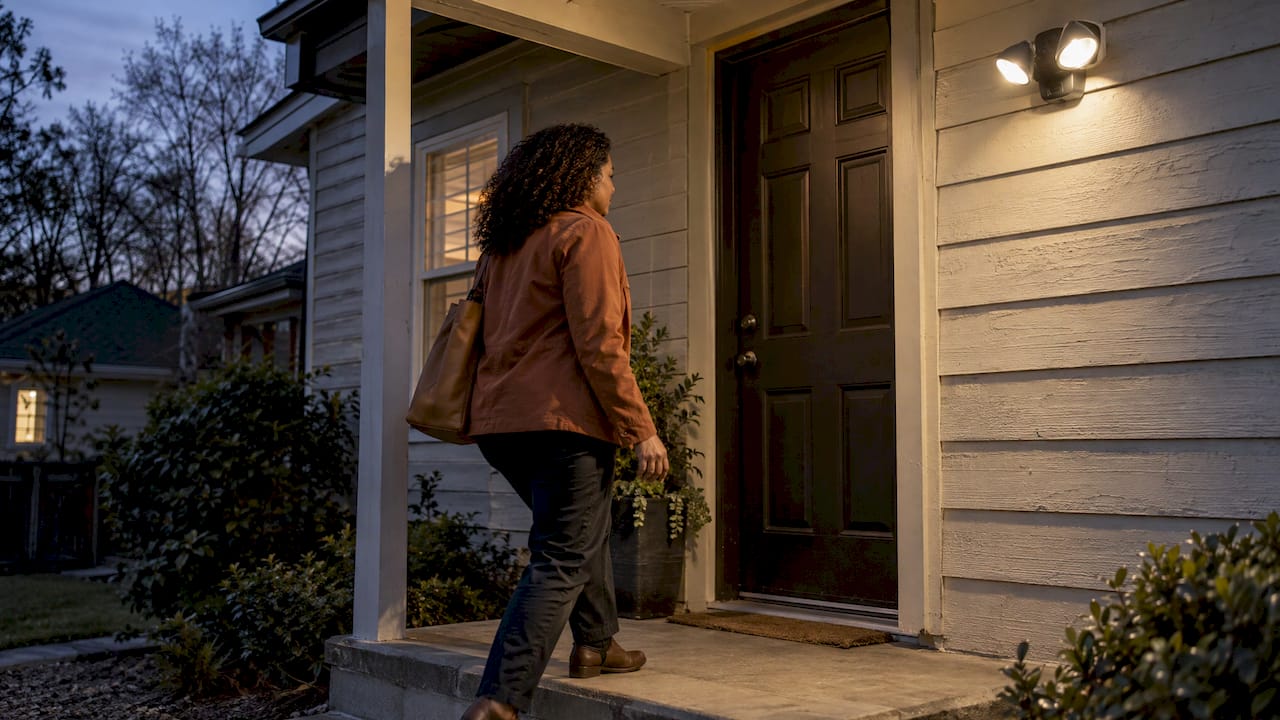
The best motion-activated exterior lighting is a hardwired, weather-rated system that is placed, aimed and set up for your property, so it lights the right zones and ignores the wrong triggers. Retail floodlights are a fair starting point, but battery and solar units lose power and their range is short. A professionally designed install is the option that holds up year-round in Charlotte weather. Below we compare each type on price, range, power and upkeep, then show where to mount a sensor and how to set it.
TL;DR
- Five kinds of motion-activated exterior lights are on the market: hardwired floods, battery spotlights, solar floods, floodlight cameras and smart designer fixtures. Each trades price against range and upkeep.
- Hardwired lights are the most reliable for all-night, every-night use. Battery and solar units need regular attention and are limited by weather.
- Where a sensor sits, how high it is mounted, and how it is set decide whether it works. Most complaints come from false triggers caused by placement.
- A custom-installed system from Forever Glow Lighting is designed for Carolinas weather and HOA rules and is controlled from your phone.
Table of Contents
- The main types of motion-activated exterior lights
- Hardwired LED floodlights
- Battery-powered spotlights
- Solar motion lights
- Floodlight cameras
- Smart designer fixtures
- Custom-installed lighting from Forever Glow
- How to choose: the features that matter
- Where to mount and aim a motion sensor
- Setting it up so it stops cycling
- Can you add a motion sensor to an existing light?
- Our perspective
- Plan your lighting with Forever Glow
- FAQ
- Sources
The main types of motion-activated exterior lights
A motion sensor light uses a passive infrared (PIR) sensor, which reads heat moving across its field of view and switches the light on. Everything else, from brightness to power source, differs by product. The five categories below cover what most homeowners will find in stores and online.
| Type | Typical price | Range and brightness | Power | Upkeep |
|---|---|---|---|---|
| Hardwired LED flood | About $25 to $80 for non-camera floods | Up to 3,500 lumens, 70 ft range on some models | Home wiring | Low |
| Battery spotlight | $12 to $20 | 200 lumens, 30 ft | Batteries | Frequent checks |
| Solar flood | $25 to $80 | Often 15 ft detection | Sun | Weather dependent |
| Floodlight camera | $120 to $180 | 2,000 lumens, 30 ft | Hardwired | Low, plus app |
| Smart designer fixture | $199.99 sale price | 2,000 lumens, 32 ft | Permanent or temporary | Low |
The price range for non-camera floods comes from Reviews.com’s outdoor security light guide, which also puts premium wired floodlight cameras at roughly $180 to $300 or more. The rest of the figures are from the tested products described below.
Hardwired LED floodlights
A hardwired flood is the workhorse. It connects to your home’s electrical system, so there is nothing to recharge. Wired floodlights are the most reliable all-night option and the brightest per dollar, according to Reolink’s floodlight guide. The catch is that they need a nearby junction box or new wiring.
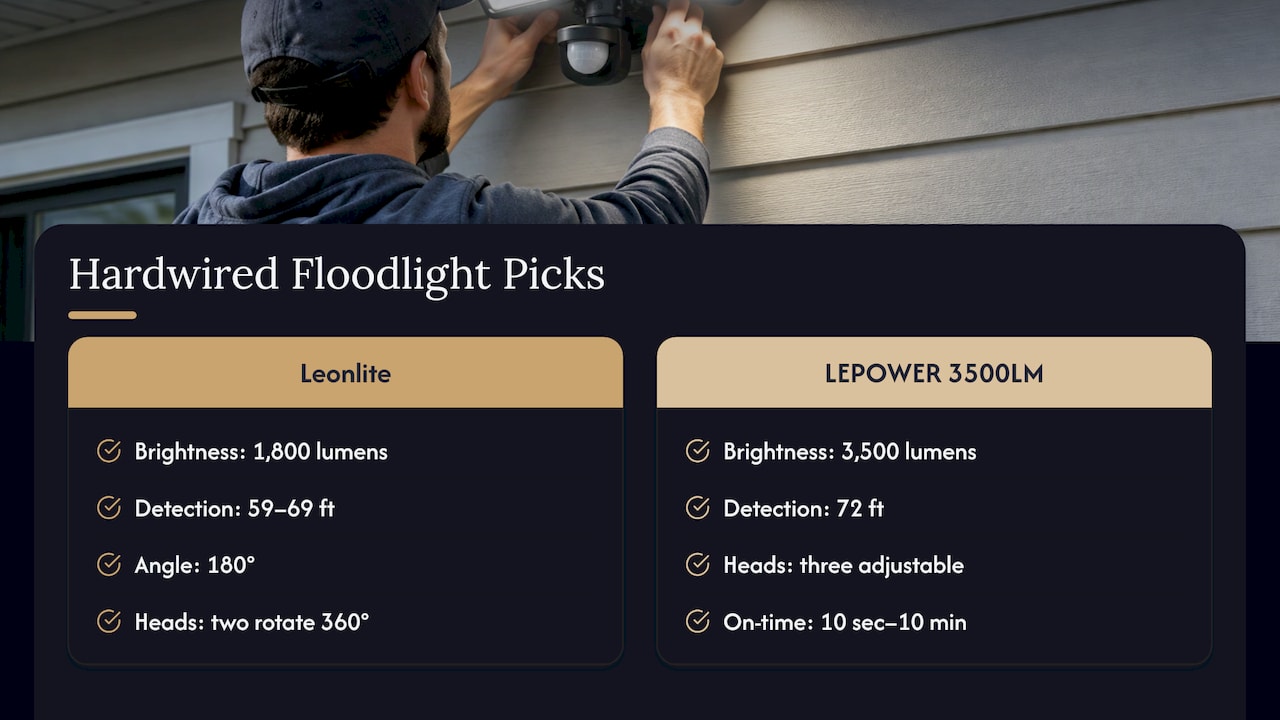
The Leonlite LED Motion Sensor Floodlight is named best overall in People’s yard tests. It lists 1,800 lumens, a 59 to 69 foot detection range, a 180° angle and two heads that rotate 360°. People puts the price at $40 at Amazon, and installation takes about 15 minutes when you are replacing an existing fixture. The Spruce lists it at $33 on sale ($40 regular).
For larger yards, Reviews.com highlights the LEPOWER 3500LM model. It has a 72-foot range, three adjustable heads and an on-time you can set from 10 seconds to 10 minutes. The same guide advises mounting to a wet-location rated box.
Where new wiring is needed, The Spruce says a professional electrician should be involved. Replacing an existing fixture is the straightforward case.
Battery-powered spotlights
Battery lights mount anywhere, which suits sheds, fences and small spots with no power nearby. The Beams Motion Sensing LED Spotlight is the budget pick in People’s tests: $12 to $20, 200 lumens, 30 foot detection, a 120° angle and an auto-off after around 20 seconds.
That is plenty for a dark corner. It is not enough for a driveway. Reolink notes that battery units need recharging on a schedule that gets worse in cold weather, so you have to remember to check them.
Solar motion lights
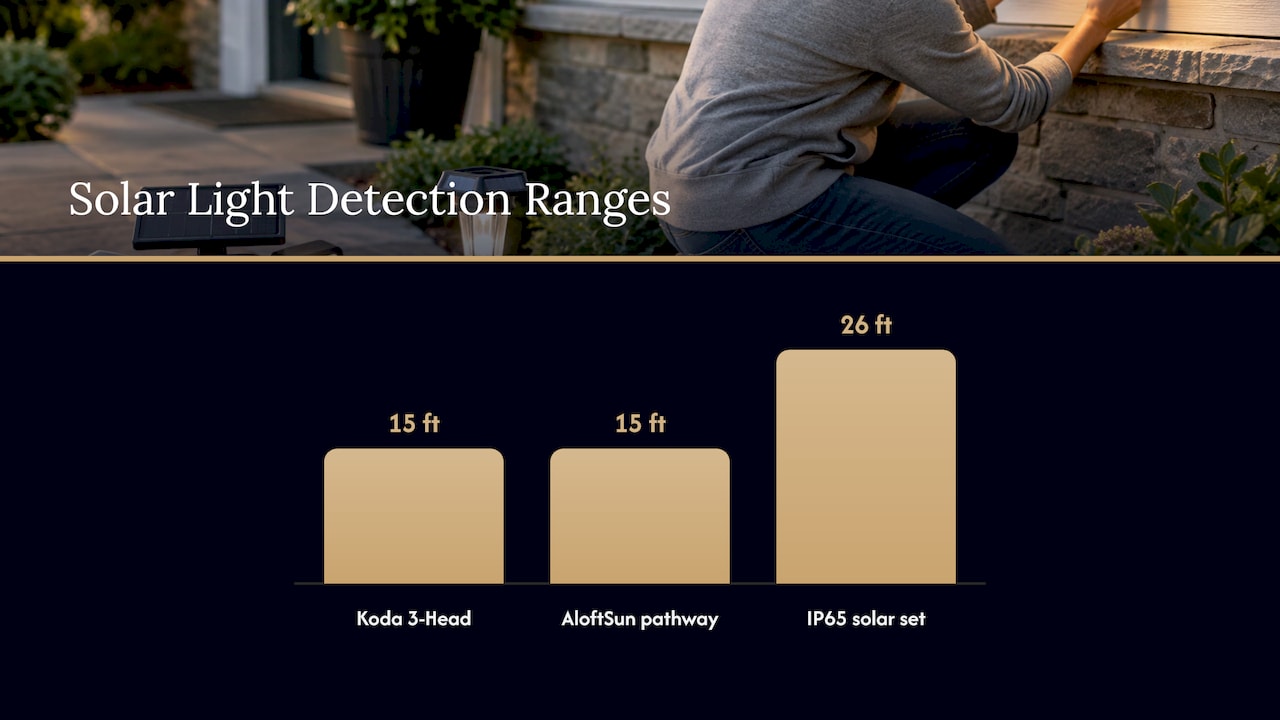
Solar lights avoid wiring and battery swaps, but they are only as good as the sun they get. Reolink says they need real daily sun and that performance follows the light the panel actually receives. The Spruce’s tested solar picks include the Koda 3-Head flood at $80 and the AloftSun pathway lights at $25, with a 15 foot detection distance listed for both.
Durability is the other question. Bob Vila’s review of an IP65-rated solar set that costs about $35 for four found 26 foot detection and up to nine hours per charge. After nearly a year of snow, rain, hail and wind, one light took on water and failed. IP65 is an ingress rating, meaning how well the housing keeps out dust and water.
Floodlight cameras
If you want video with your light, the Ring HD Motion-Activated Floodlight Camera is the benchmark. People lists it at $180 at Amazon and Wayfair or $120 at Target, with 2,000 lumens, 30 foot detection, a 140° horizontal angle, hardwired power and app and Echo Show live view. Reviews.com puts budget wired camera lights such as the Wyze Floodlight v2 at about $80 to $120.
A camera light solves a different problem. If your goal is the right light in the right place at night, the camera is an extra. If you want recorded video, it is the right tool.
Smart designer fixtures
Some newer fixtures treat motion as one feature of a lighting design. The Verge reported in June 2026 that Govee’s outdoor lamp post light sold for $199.99, 23% off its $260 list price. It lists 2,000 lumens, 32 foot reach, 360° spread, six color zones and an IP66 rating. The motion sensors can welcome guests or flash red at intruders. A sale price like that moves with promotions, so check the retailer.
This category shows where the market is heading: color, app control and a fixture that looks designed rather than bolted on. It is also where a custom install goes further.
Custom-installed lighting from Forever Glow
Retail lights are sold as individual fixtures. You choose the product, find the box, set the sensor and fix it when it misbehaves. Forever Glow Lighting designs and installs the whole system. We specialize in permanent outdoor lighting for Charlotte homes and businesses: smart LED track systems along the roofline, landscape and architectural lighting, patio and deck lighting, and dock lighting. Every system is controllable from your smartphone with multi-color options.
Three things set that apart from a box-store flood:
- Hardware chosen for the Carolinas. Our installs use commercial-grade, climate-optimized components, with color-matched tracks that blend into the roofline.
- HOA-compliant design. Our systems are engineered for strict HOA and municipal compliance, so you are not guessing about what your neighborhood allows.
- Warranty and maintenance. We back installs with a climate-specific warranty and offer the GlowCare maintenance subscription.
Our guide on the role of motion sensors outdoors explains how sensing fits with the rest of a lighting plan, and our driveway lighting guide covers one of the zones that matter most.
How to choose: the features that matter
This Old House lists the things to compare: detection range, brightness when triggered, power source, appearance, installation ease and bulb type. Here is how to use that list for your property.
Brightness by zone
Reolink gives targets of 400 to 800 lumens for doorways and porches and 1,000 to 3,000 lumens for driveways and backyards. Reviews.com suggests 2,000 to 3,000 lumens for driveway and yard coverage. Lumens measure total light output, so more is not always better at a front door, where glare can make it harder to see.
Angle and range
A 120° sensor covers a third of a circle and a 180° sensor covers half, per Reolink. Match the angle to the wall you are mounting on. A 180° sensor on a flat wall covers the whole face of the wall with little wasted.
A long range is not automatically a benefit. LightIssues notes that a 30 to 70 foot range can cause nuisance cycling when a front walk needs only 10 to 20 feet and a driveway 20 to 35 feet.
Weather rating
In the U.S., fixtures sold for outdoor use should carry a UL listing for their location. This Old House says dry-rated lights are not suitable outdoors, while damp- or wet-rated fixtures use drain holes, seals and gaskets to keep water off live parts. Reolink says IP65 handles normal rain, while IP66 suits exposed coastal or storm-prone spots. Our article on why IP ratings do not cover salt air is worth a read if you are near the water.
Color temperature
Reviews.com recommends warmer light of about 2700K to 3000K where possible, and aiming heads downward to limit glare and light trespass, following International Dark-Sky Association principles. Warm light looks better against brick and siding, and it is easier on your neighbors.
Where to mount and aim a motion sensor
Placement matters as much as the product.
- Height. Bob Vila advises 6 to 10 feet off the ground near an entrance, and under-eave mounting keeps the fixture high and harder to tamper with. Cooper Lighting’s installation sheet for one fixture calls for 8 to 12 feet, so follow the manual for the model you own.
- Angle. The same sheet says to aim 5° to 15° below horizontal and keep the sensor away from heat sources, windows, white walls, water and moving objects.
- Direction of travel. PIR sensors detect motion across their view better than motion straight toward them, so aim the sensor to cross the path someone would walk, not look down it.
- Overlap. Cottageventure recommends overlapping coverage so a person triggers more than one light, and lighting within 10 feet of every door.
- Priority zones. Home-SecurityGuide names the front entrance and the gate or driveway as the two priority zones.
Setting it up so it stops cycling
Most frustration with motion lights is a setup issue rather than a product defect. SolarVision AI’s engineer explains in the company’s field guide that false triggers are usually the sensor correctly detecting a temperature difference from the wrong source, such as an AC condenser or a tree branch.
Try this order:
- Let it warm up. The Cooper sheet says about 40 seconds after power-up, and 48 hours of power for maximum range.
- Walk the test. Walk the farthest detection distance and adjust the aim.
- Lower the sensitivity. Medium works outdoors, according to Home-SecurityGuide. LightIssues suggests cutting sensitivity by 25 to 50% if the light cycles.
- Set the on-time. Home-SecurityGuide suggests 1 to 2 minutes at an entrance and about 30 seconds on a low-traffic path.
- Clear the view. Trim vegetation at least 2 to 3 feet out of the sensor’s view and aim away from roads, vents and windows, per LightIssues.
- Use a dusk threshold. A lux setting keeps the light off in daylight.
For how coverage and false triggers work in rooms inside your home, this motion-sensor lighting coverage guide applies the same logic.
Can you add a motion sensor to an existing light?
Often yes, but it depends on the light. There are three common routes: a motion-sensing bulb, a socket adapter, or replacing the fixture or switch with a sensor-equipped one. The Spruce notes that swapping an existing fixture for a hardwired one is straightforward, while a new location should involve a licensed electrician. Check that the existing fixture is wet-location rated, that the bulb is compatible, and that any dimmer or smart switch will work with the sensor. For lighting you want to last, a planned system avoids stacking add-ons on a fixture that was never designed for them.
Our perspective
Most motion lights fail for one reason: they are bought as a single product and installed as an afterthought. A floodlight screwed above the garage covers one area, and the owner then fights it for years.
We think about light as a system. Where does the path of travel start? Where do you want a soft glow all night, and where do you want light to come on only when needed? Where do HOA rules and your neighbors’ windows come into it?
That is why we build custom-installed systems on commercial-grade, climate-optimized hardware, with smart controls you run from your phone. In Charlotte’s heat, humidity and storms, a system that was designed for the weather is worth more than a cheaper fixture you will replace.
Pick the right light for each zone, mount it properly and set it carefully. Do that and it works every night.
Dave
Plan your lighting with Forever Glow
If you live in the Charlotte area and want exterior lighting that works as a system, we design and install permanent lighting for homes and commercial properties. That includes landscape lighting design, architectural lighting, and deck, step and patio lighting. Our systems are controllable from your smartphone, and the GlowCare maintenance subscription keeps them running.
Contact Forever Glow Lighting for a free estimate on our homepage.
FAQ
What is the best motion sensor light for outdoor use?
For a standalone retail light, People’s yard testers picked the hardwired Leonlite LED floodlight as best overall. For a property-wide result with warranty and maintenance, a professionally designed system is the stronger choice because every zone is planned together.
What are the downsides of motion sensor lights?
The common issues are false triggers from branches, vents and passing cars, and nuisance cycling when the range is longer than the area needs. Both are fixed by aiming, lowering sensitivity and setting the on-time. Battery and solar models also need power checks.
How high should I mount a motion sensor light?
Most guides say 6 to 10 feet near an entrance, and some fixture manuals specify 8 to 12 feet. Follow the manual for your model and aim it slightly downward so it crosses the path people will walk.
Do I need an electrician to install motion sensor lights?
Replacing an existing hardwired fixture is a straightforward swap. For a new location that needs new wiring, a licensed electrician should do it. Our team handles wiring for the systems we install.
Sources
- The 9 Best Outdoor Motion Sensor Lights, The Spruce
- The 10 Best Outdoor Lights We Tested in Our Yards, People
- Best Outdoor Security Lights of 2025, Reviews.com
- Best Outdoor Motion Sensor Lights, This Old House
- Outdoor Floodlights with Motion Sensor: Ultimate Guide, Reolink
- Small Solar Security Lights Make a Big Impact, Bob Vila
- 7 Best Outdoor Motion Sensor Lights, Bob Vila
- Govee’s all-weather smart lamp post, The Verge
- Halo Outdoor FT18VC Instruction Sheet
- Outdoor Security Lighting: Your Complete Guide, Cottageventure
- Security Lighting: The Complete 2026 Guide, Home-SecurityGuide
- Outdoor Motion Light Keeps Turning On and Off, LightIssues
- Solar Security Lights: What Actually Works, SolarVision AI