
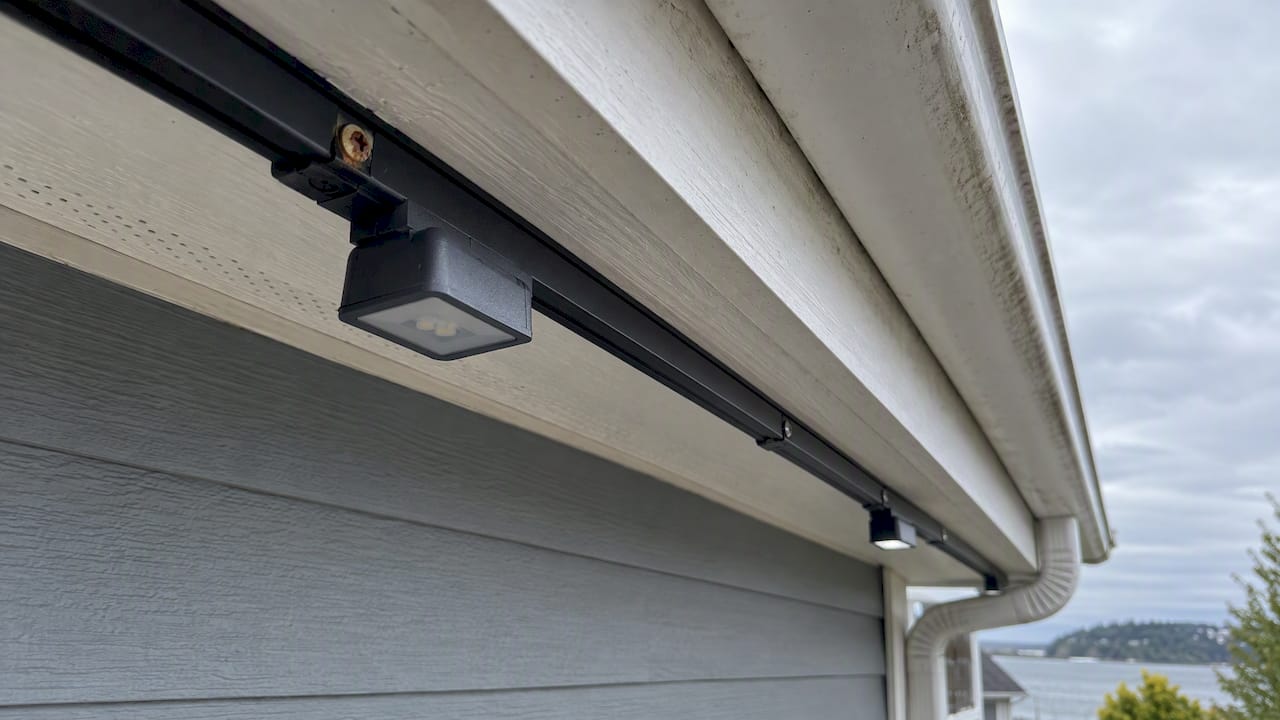
Properly specified and installed permanent lights can stay outdoors, and key specs that affect their durability include the IP rating and the listed operating temperature range. Your climate matters too. Coastal air, heavy snow and strong sun all raise the bar. So does the installation, and a written installer-backed warranty is the best proof that someone stands behind the work.
TL;DR:
- IP ratings do not measure UV resistance, corrosion, or impact, so request a separate IK rating, explicit material claims, and location specific manufacturer guidance.
- The COVELINE XL WET 1.5 is rated from 40°F below zero to 104°F, so check roof temperatures and confirm the rating includes its driver.
- Coastal sites need finishes explicitly rated for marine use and stainless fasteners, because an IP code does not measure resistance to salt corrosion.
- Water often enters at junctions, penetrations, or connectors, so require sealed entries, protected wiring, drip loops, and written confirmation of installation requirements.
- Inspect seals, connectors, fasteners, and housings in spring and fall and after major storms; written installer warranties should cover labor and workmanship.
Table of Contents
- What do IP ratings actually tell you about permanent lights?
- How do temperature ratings work on a spec sheet?
- Which other durability specs matter besides IP?
- How do rain, snow, sun and salt air change what you should buy?
- How do installation details change weather performance and warranty coverage?
- How often should you inspect permanent lights, and what should a warranty cover?
- What should your weather-rating checklist include?
- What do weather rating failures look like in real climates?
- Why does professional specification beat guesswork on weather ratings?
- How do we help you get weather-rated permanent lighting?
- FAQ
- Sources
What do IP ratings actually tell you about permanent lights?
An IP code has two digits. The first covers solids and dust, while the second covers liquids. The International Electrotechnical Commission defines these degrees of protection and describes the tests that verify them.
Here is what the common values mean in plain terms:
- IP ratings: indicate degrees of protection against dust and water ingress. Check the manufacturer’s application-specific data to determine whether a product suits the installation.
The limits matter as much as the numbers. IP does not measure UV resistance, corrosion or mechanical impact. The IEC itself advises consulting manufacturers for application-specific data, because an IP code is not a catch-all for stressors like salt air or vibration. Impact resistance has its own scale, called IK, which we cover below. When a label says “waterproof” without an IP number, ask for the number.
How do temperature ratings work on a spec sheet?
The operating temperature range tells you the ambient conditions in which the fixture is meant to run. Storage or transport limits are a different line on the sheet and say nothing about how the light performs on your roof in January or August. Mixing the two up is one of the easiest mistakes to make when comparing products.
The datasheet for the COVELINE XL WET 1.5 lists an operating temperature of -40°F to 104°F, IP66 for wet exterior locations and IP68 connectors.
That range covers a hard northern winter but stops at 104°F, which a dark roofline in full sun can exceed on a hot afternoon. Read the range against both ends of your climate, not just the cold one.
Some low-temperature claims also assume conditions that may not match your install. Ask these questions before you buy:
- Where is the driver, and is it inside the fixture or in a separate enclosure?
- Is the fixture rated with its driver installed?
- Does the low-temperature rating assume the system is continuously powered?
- What happens to the rating if the driver sits in an attic or a sealed box that heats up?
Thermal and endurance testing is part of how luminaires are evaluated. IEC 60598-1 includes endurance and thermal sections plus maximum temperature tables, which is why a spec sheet that cites it deserves more trust than one that only prints a range.
Which other durability specs matter besides IP?
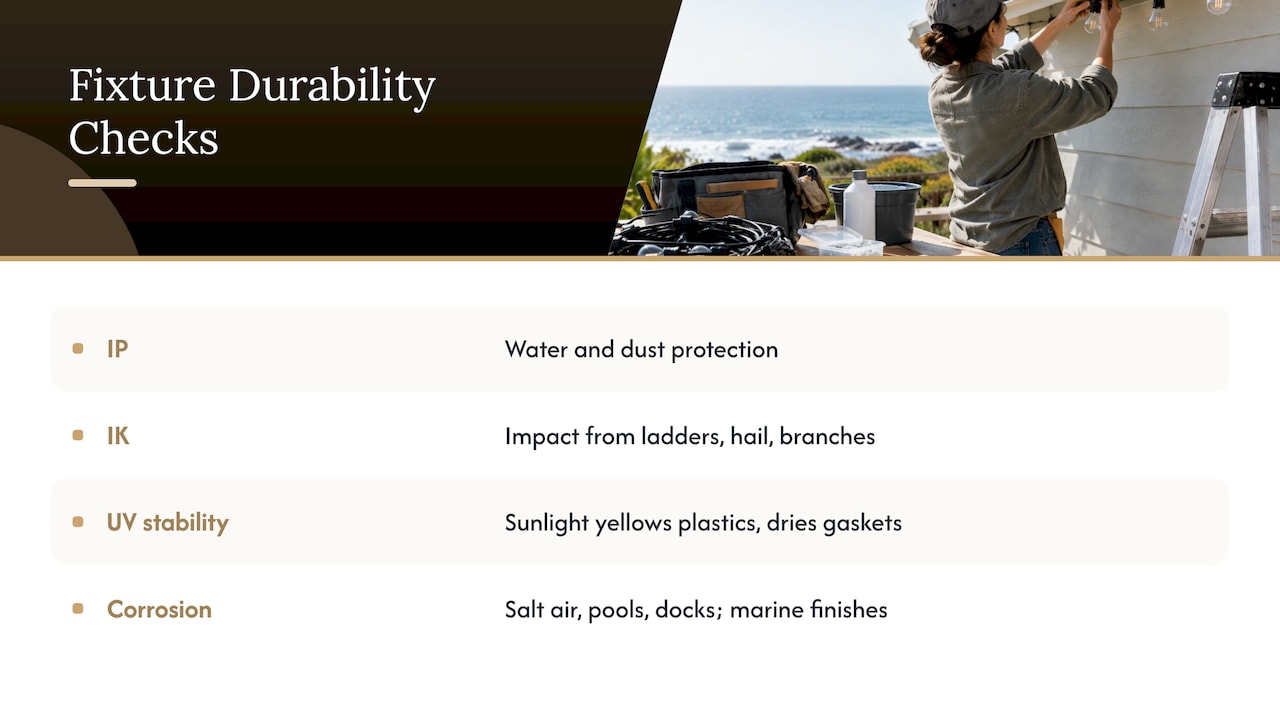
IP covers water and dust. Three other things decide how a fixture ages.
Impact resistance (IK). Exposed fixtures can be hit by ladders, hail, branches and other objects. Check the product’s impact rating alongside its IP rating. For example, ANL Lighting’s batten lists both ratings.
UV stability. Sunlight yellows cheap plastics and dries out gaskets. Look for UV-stabilized polymers and finishes described as such on the spec sheet.
Corrosion resistance. Powder-coated or marine-grade finishes and stainless hardware slow corrosion, which matters most near salt air, pools and docks.
The practical rule is to look for IP and IK together, plus an explicit statement about UV and corrosion. If a product is silent on the last two, assume nothing.
Pro Tip: For docks, waterfront installs or anything within reach of salt spray, ask the manufacturer which hardware and connector ratings suit the application.
How do rain, snow, sun and salt air change what you should buy?
Each season attacks a different weak point, so match the product to your site exposure.
- Rain and wind-driven water: check the manufacturer’s application-specific data for a suitable liquid-protection rating, and make sure cable entries are sealed, because water can enter through gaps.
- Snow and ice: mounting has to carry the load and shed it. Poor pitch lets water pool, and ice dams along the roofline push meltwater where it should not go.
- Freeze-thaw cycles: moisture that gets in freezes, expands and works the seal a little looser each cycle. Gaskets that harden in the cold lose their grip over time.
- Sun and UV: expect color shift in unstabilized plastics and dried-out gaskets, so favor UV-stabilized materials, especially on south and west exposures.
- Salt air: ask for finishes explicitly rated for coastal use and stainless fasteners, since a standard IP code says nothing about corrosion.
The lighting industry’s own guidance treats outdoor residential lighting as a system. The Illuminating Engineering Society’s RP-11-20 recommends planning it as a cohesive whole, and it warns that mixing different Kelvin temperatures can reduce perceived value. Weather planning follows the same logic: pick for the whole site, not one fixture.
How do installation details change weather performance and warranty coverage?
A well-rated fixture can still fail from a poor install. Water enters through the weakest point, and that is usually a junction, a penetration or a connector, not the housing.
Details that separate a durable install from a short-lived one:
- Sealed junctions and connectors, with ratings suited to the installation conditions.
- Protected wiring routes that keep cable away from standing water and sharp edges.
- Properly sealed penetrations wherever wiring passes through the building envelope.
- Drip loops that send water away from entries.
- Drivers placed so they stay within their operating temperature range.
Proximity to gutters and rooflines changes exposure as well, since those are the paths water takes. We cover that in our guide to installing roofline lights near gutters. For the full sequence from design to commissioning, see how the installation process works.
Ask your installer how they mount, how they test, and what the written warranty says. Warranty outcomes often depend on whether the install followed the manufacturer’s requirements, so get those terms in writing.
How often should you inspect permanent lights, and what should a warranty cover?
Plan on an inspection in spring and fall, plus one after any major storm. Each visit should be quick and specific:
- Check seals and gaskets for drying, cracking or hardening.
- Inspect connectors for moisture, discoloration or corrosion.
- Confirm fasteners are tight and show no rust.
- Look for color shift or brittleness in housings after a hot summer.
- Clear debris where water should drain.
A good warranty reflects how the product is meant to be used. The COVELINE XL WET 1.5 datasheet, for example, lists a 5-year limited warranty alongside its weather specs. An installer-backed warranty adds the piece manufacturers do not: labor and workmanship. We explain why that matters in our guide on insisting on installer-backed warranties. Our GlowCare maintenance subscription takes the inspection schedule off your plate.
What should your weather-rating checklist include?
Use this when you compare spec sheets or interview installers. Match the rating to the exposure: the harsher your site, the higher every line should sit.
- IP rating: check the manufacturer’s application-specific guidance for exposed mounts.
- Operating temperature range that covers your coldest and hottest days.
- IK rating for fixtures within reach of impact.
- UV-stabilized and corrosion-resistant materials, stated explicitly.
- Sealed connectors, with ratings suited to the conditions where water may collect.
- Driver location and whether the rating assumes it is installed.
- A written installer warranty and a maintenance plan.
| Check | What to look for |
|---|---|
| Ingress protection | Check the manufacturer’s application-specific guidance |
| Connectors | Check the manufacturer’s application-specific guidance |
| Impact | An explicit IK rating |
| Temperature | A range covering your climate extremes |
| Warranty | Written, installer-backed, with maintenance |
Two questions worth asking: “What finish and hardware do you use for coastal or salt-spray exposure?” and “How do you mount for snow load and shedding on our roof pitch?” The answers tell you quickly whether the installer designs for your weather. Our landscape lighting checklist covers the planning side.
What do weather rating failures look like in real climates?
Failures follow patterns, and the patterns map directly onto the specs above. These are common scenarios, not specific customer cases.
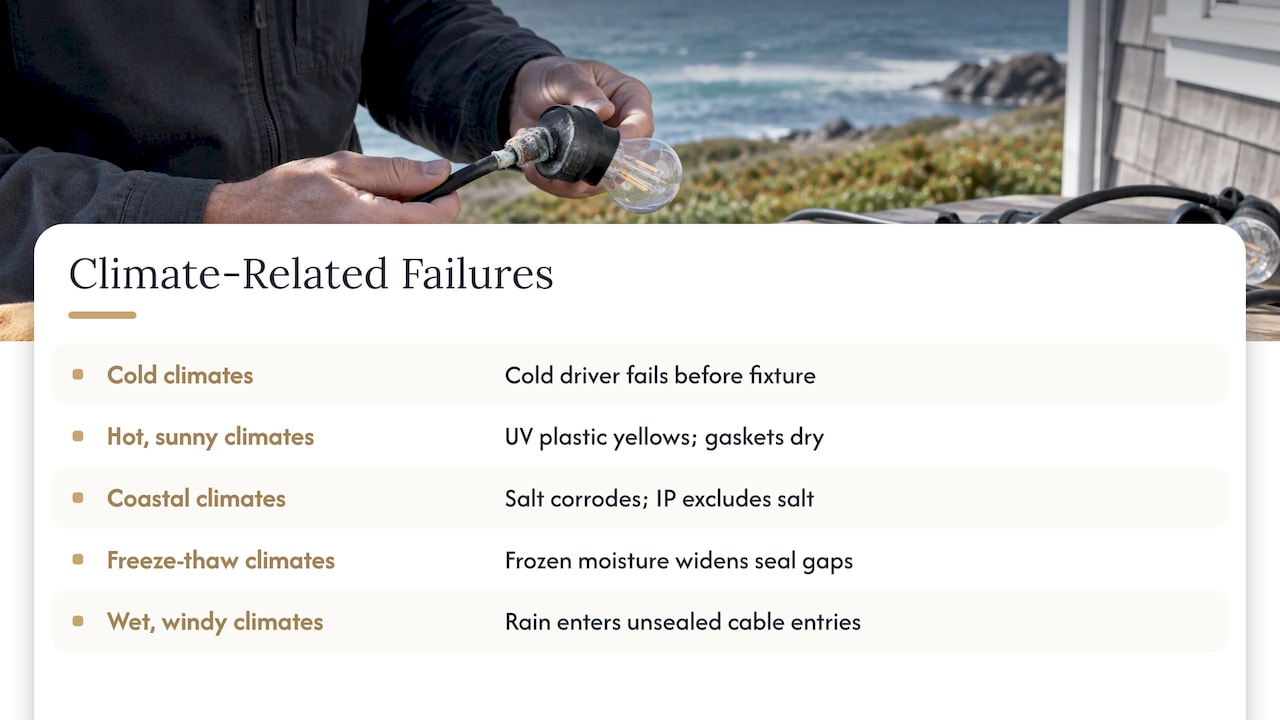
Cold climates. A fixture is rated for a modest low-temperature range, but the driver sits in a sealed box that never warms. Cold-soaked components fail first, and the fixture is blamed when the driver’s placement was the real problem.
Hot, sunny climates. Plastic housings without UV stabilization may yellow or become brittle. Gaskets can dry out and stop sealing, allowing moisture to enter.
Coastal climates. A fixture with a solid IP rating still corrodes, because IP does not test for salt. Unprotected fasteners rust first, then the connectors follow.
Freeze-thaw climates. A small amount of trapped moisture freezes, expands and widens the gap in a seal, so each winter lets in a little more water than the last.
Wet, windy climates. Fixtures not suited to wind-driven rain may be vulnerable, particularly at unsealed cable entries.
These examples do not necessarily mean a product “lost” its rating. An IP rating does not cover every possible stressor, so check the product information for other relevant durability details and specify the installation to match.
Why does professional specification beat guesswork on weather ratings?
I have seen enough permanent lighting jobs to say this plainly: the lights themselves are rarely what fails. Failures come from a mismatch between a decent product and a site it was never specified for, or from a rushed install that left one connector unsealed. A fixture’s rating is a promise about a test, not about your roof. That gap is closed by someone who reads the spec sheet, asks where the driver goes and stands behind the work in writing. Before you sign any quote, ask for the IP, IK and temperature numbers and the warranty terms.
— Dave
How do we help you get weather-rated permanent lighting?
Our systems are climate-optimized from the start: commercial-grade hardware, custom roofline and landscape installations, and a maintenance program built around the Carolinas’ weather. We ask you to request IP, IK and operating temperature specs and a written warranty with your estimate. Our permanent lighting service and GlowCare maintenance subscription are available. Request a free estimate and we will walk you through the specs for your home.
FAQ
What are the highest rated permanent outdoor lights?
Look for the highest ingress protection that fits the location, with IP65 as the floor for exposed mounts and IP68 for connectors. Pair that with an IK impact rating, a wide operating temperature range and UV and corrosion claims on the spec sheet. A single rating never tells the whole story.
How far away from the house should permanent lights be?
Roofline track lights mount directly on the structure, so distance is not the issue. What matters is mounting position relative to gutters and rooflines, which affects water flow and exposure. Partner pages on permanent outdoor lighting describe typical installation steps.
Are permanent outdoor lights worth it?
For many homeowners, yes, when the system is specified for the local climate and backed by a written warranty. The value comes from year-round use and not climbing a ladder each season, as we explain in permanent versus seasonal lights. A weak spec or a poor install is what turns it into a poor purchase.
Are 10,000 Kelvin lights bad?
Not unsafe, but they produce a very cool, bluish light that rarely suits a home exterior. The Illuminating Engineering Society’s RP-11-20 guidance warns that mixing different Kelvin temperatures can reduce perceived value, so choose one consistent color temperature across the system.