
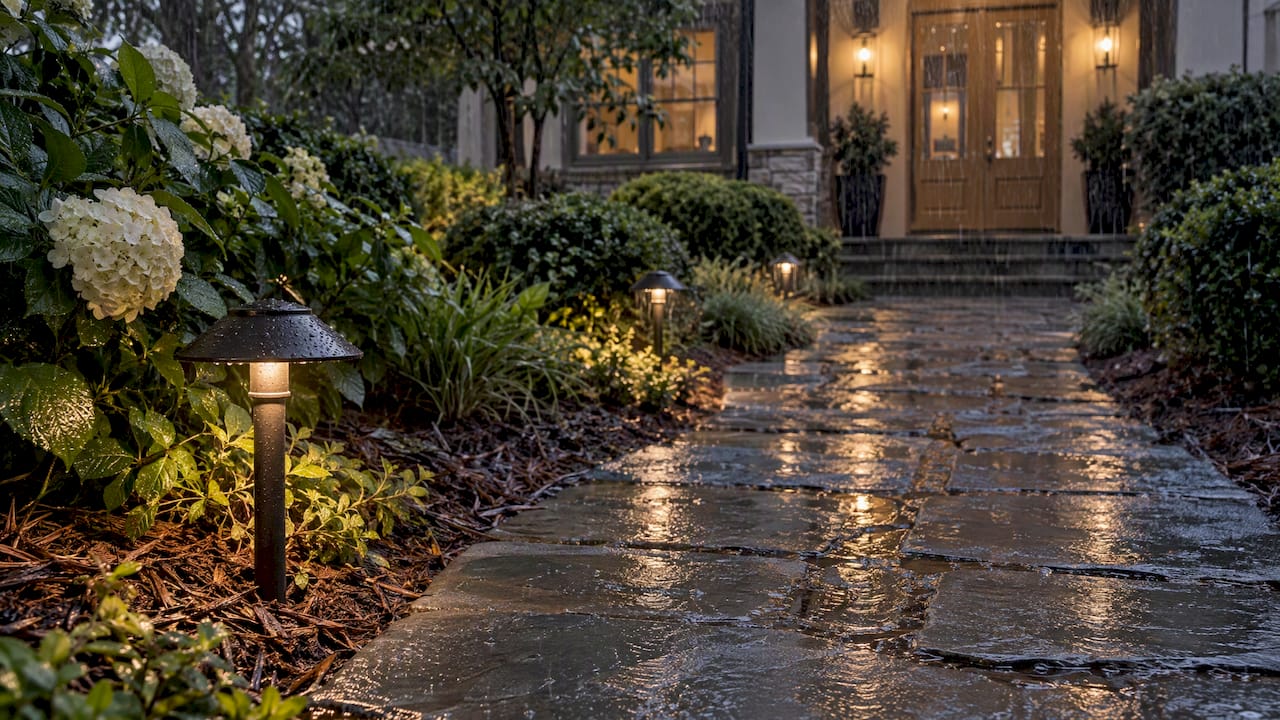
No outdoor light is truly storm proof, but a well-specified system can come through Carolina thunderstorms, wind-driven rain and humid summers with little more than a quick check afterward. What separates the two outcomes is not a “weatherproof” label. It is the safety listing on the fixture, the materials around the electronics, the way connections are sealed, and how the circuit is protected.
This guide explains what to look for, which marketing claims to discount, and what to do after a serious storm. It is written for Charlotte-area homeowners and property managers who plan to hire a professional installer.
TL;DR
- Look for fixtures listed by a Nationally Recognized Testing Laboratory as suitable for wet locations. An IP rating alone does not tell you the same thing.
- Stainless steel hardware, sealed housings and good heat management matter more in Charlotte’s humid climate than a high lumen count.
- Outdoor outlets in North Carolina need GFCI protection and in-use (bubble) covers, so the power side of the system counts as much as the fixtures.
- After a flood or direct lightning event, do not re-energize wet equipment. Have a licensed electrician inspect it first.
- Coastal, dock and poolside installations call for a stricter standard than a typical front yard.
Table of Contents
- What “storm proof” really has to survive
- Why “weatherproof” on a box means very little
- Wet, damp and dry: where your lights actually sit
- Materials that matter in Charlotte’s climate
- The wiring side: outlets, GFCIs and connections
- Special cases: docks, lakes, pools and the coast
- Our perspective: what we see in the Carolinas
- A buyer’s checklist before you sign
- During and after a storm
- What a storm-ready permanent lighting system looks like
- Work with us on a storm-ready system
- FAQ
- Sources
What “storm proof” really has to survive
A storm is several different stresses arriving together: rain driven sideways, a sudden temperature drop on a hot fixture, wind that flexes cables and mounts, debris, and power surges. Charlotte has seen this firsthand. One local restoration company’s overview notes that Hurricane Helene produced wind gusts of about 66 mph at Charlotte Douglas International Airport, and flooding along the Catawba-Wateree lakes affected homes in Mecklenburg County.
Then there is the slower enemy: humidity. Moisture, big temperature swings and airborne contaminants wear on a fixture every day, not only during storms. A light that survives one hurricane remnant but fails after three summers of condensation is not storm proof in any useful sense.
So think in three layers:
- The fixture and its listing: how it was tested for water.
- The materials and construction: what keeps corrosion and heat from killing it slowly.
- The electrical system behind it: wiring, connections, GFCI protection and controls.
Why “weatherproof” on a box means very little
The words “weatherproof” and “weather-tight” are not a standard. According to the Illuminating Engineering Society’s lighting design magazine, the reliable indicator is a luminaire marked as suitable for wet locations by a Nationally Recognized Testing Laboratory (NRTL). That article also explains that the U.S. standards involve an energized thermal shock test, in which a fixture is powered for at least 30 minutes before moisture exposure, and that IP testing does not include it.
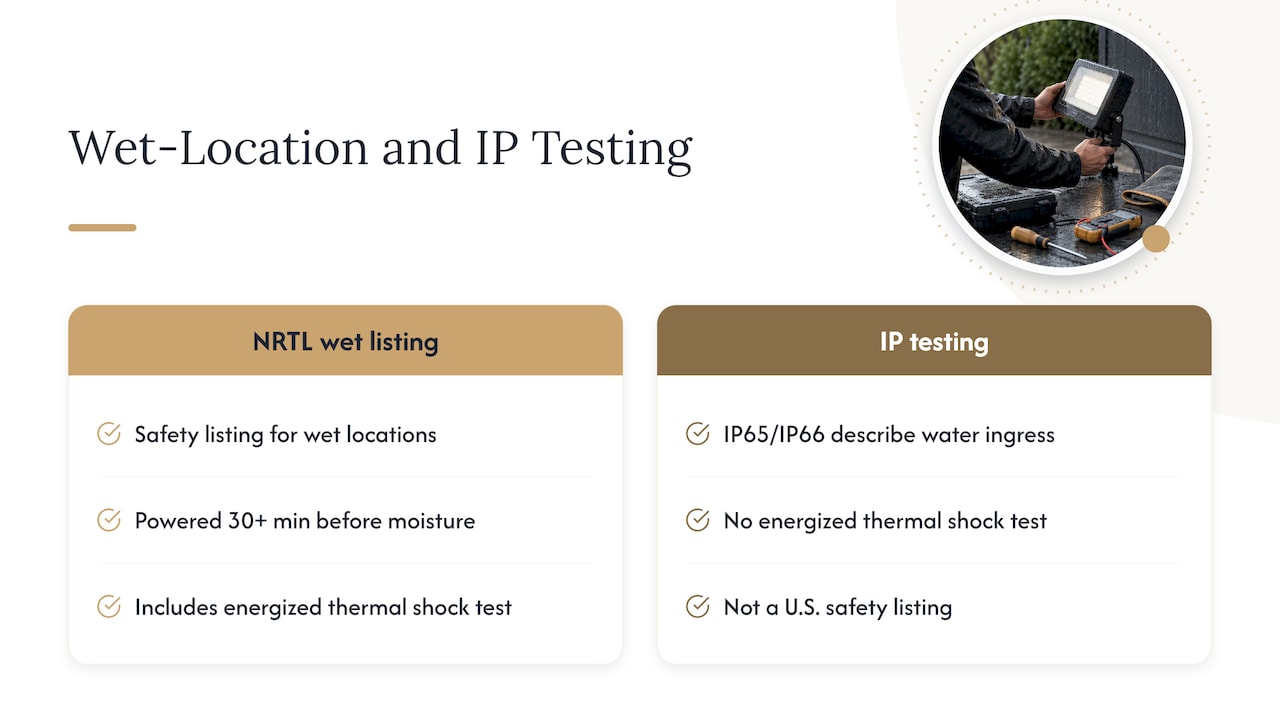
This is the most common confusion in the outdoor lighting aisle. An IP rating such as IP65 or IP66 describes how well a housing keeps water out. It is useful information. But it is not the same as a safety listing under U.S. standards, and a fixture can carry one without the other.
What to ask for instead
- A listing mark from an NRTL on the fixture or its documentation, with the words “suitable for wet locations.”
- For saltwater or marine exposure, UL 1598A, which the same source ties to marine environments.
- The IP rating as a secondary detail, not the headline.
If you want the code language behind wet and damp classifications, we explain it in our guide to wet versus damp location rules. For the salt-air and humidity side of the rating question, see why IP ratings do not cover salt air.
Wet, damp and dry: where your lights actually sit
Most of what you install outside is a wet location in the practical sense: anything that rain can reach directly, including roof edges, soffits that are open to the weather, ground-level path lights and deck steps. A covered porch ceiling may be a damp location, but a fixture in a damp-rated housing placed on an open roofline will not last.
A simple rule: if you would be unsurprised to see rain on it, buy and specify it as wet-rated. The cost difference between wet-listed and damp-listed products is usually small compared with the cost of tearing out failed fixtures.
| Location | Typical exposure | What to specify |
|---|---|---|
| Roofline, gutters, eaves | Rain, wind, UV, ice | Wet-location listed track or fixtures, UV-stable finish |
| Ground-level landscape | Splash, irrigation, standing water | Wet-listed, sealed connections, stainless hardware |
| Deck and step lighting | Foot traffic, pooling water | Wet-listed, recessed or low-profile, sealed |
| Covered patio ceiling | Humidity, blown rain | At least damp-listed; wet-listed if open on sides |
| Dock, lakefront, pool edge | Constant moisture, corrosion | Wet-listed, marine-appropriate materials |
Materials that matter in Charlotte’s climate
Charlotte is humid and sees wide temperature swings. Experts quoted in a Crouse-Hinds catalog page for wet and marine locations point to stainless steel hardware and robust heat sink design as ways to protect internal components from the stress of moisture, temperature change and contaminants. That catalog describes industrial luminaires, so treat it as an indication of the construction principles rather than a product recommendation for your home.
In practice, here is what we check on any exterior fixture:
- Fasteners and mounting hardware. Plated steel screws rust and stain stone, stucco and siding. Stainless steel does not.
- Housing material. Corrosion-resistant metals such as aluminum or stainless steel, or UV-stabilized polymers designed for outdoor use.
- Seals and gaskets. These are the first thing to harden and crack. Quality gaskets and sealed cable entries are not optional.
- Heat management. LEDs fail early when heat has nowhere to go, and a hot fixture hit by cold rain is stressed. Good heat sinks matter.
- Finish. Powder coat or anodized finishes should be color-matched to the structure so the system disappears by day.
For a deeper look at corrosion, our page on what to demand from any coastal fixture walks through the specifics.
The wiring side: outlets, GFCIs and connections
Fixtures get the attention, but many outdoor lighting failures start in the power supply or at a connection. Water finds the weakest joint.
North Carolina’s electrical code guidance is clear on outdoor receptacles. The state fire marshal’s office states that 15 and 20 ampere outdoor receptacles in wet locations must be GFCI-protected and use in-use (bubble) covers that keep a weatherproof seal even when a plug is inserted. The state also publishes a note on outdoor outlet GFCI requirements in the 2023 code. If your lighting transformer or controller plugs into an outdoor outlet, that outlet needs to meet these rules.
A storm-ready installation also means:
- Transformers and controllers mounted off the ground and in suitable enclosures.
- Connections made with sealed, outdoor-rated connectors, not wire nuts and tape.
- Cable runs secured so wind and ice do not tug at fittings.
- Power supplies sized with headroom, so nothing runs hot.
- Smart controls that you can switch off remotely during an event.
Note that code requirements are the minimum. They are also about the home’s electrical system as a whole, so a licensed electrician should handle anything that touches the panel or outlets.
Special cases: docks, lakes, pools and the coast
If you live on Lake Norman, Lake Wylie or Mountain Island Lake, or you are specifying lights near a pool, your standard is higher. Constant moisture, splash and sometimes brackish or treated water are harsher than rain.
A marine lighting white paper from Phoenix Lighting says true marine-grade lighting should be built for extreme temperature ranges and corrosive conditions, and recommends that buyers verify UL 1598A or ABS compliance rather than rely on a brochure’s claims. Ask for the documentation. A reputable installer will have it.
Pools have their own electrical rules. Mecklenburg County’s code enforcement office notes that incorrect pool installations can lead to serious injury or death, which is why lighting near water should only ever be installed by licensed professionals.
Our perspective: what we see in the Carolinas
We install permanent lighting on rooflines, landscapes, docks and commercial buildings around Charlotte, and the same lesson comes up repeatedly. Storm resistance is decided at the specification stage, not after the first bad night.
First, we build with commercial-grade, climate-optimized hardware, and we color-match tracks to the home so that a more rugged system does not look rugged. Second, we treat the controller and power supply as part of the storm plan, not an afterthought. Being able to see and manage the system from your phone matters most when you are already dealing with a storm. Third, we believe a system needs a maintenance plan, because seals, connections and mounts age. That is why we offer our GlowCare maintenance subscription alongside a climate-specific warranty.
The mistake we see most often is a homeowner buying on the word “weatherproof,” then discovering the fixtures were never listed for wet locations. Ask for the listing first. Everything else follows from it.
— Dave
A buyer’s checklist before you sign
Use these questions with any installer, including us.
- Are all exterior fixtures and tracks listed for wet locations by an NRTL? Can you show me the listing?
- For dock, lake or pool areas, is the equipment documented to UL 1598A or equivalent marine standards?
- What hardware is used for mounting and fastening?
- How are connections sealed, and where are transformers and controllers located?
- Are all outdoor outlets feeding the system GFCI-protected with in-use covers?
- What does the warranty cover, and does it address storm and moisture damage specifically?
- Is there a maintenance program, and what does an inspection include?
- Is the design compliant with my HOA and local rules?
If an installer cannot answer the first two, keep looking. Our landscape lighting checklist for homeowners goes further into planning, and our guide to the best type of lighting for outdoor use compares the main options.
During and after a storm
Preparation helps, but behavior during a storm matters just as much.
Before severe weather
- Use your app or controller to turn off decorative or accent circuits you do not need.
- Check that gutters are clear so water does not pour over fixtures and tracks.
- Walk the property for loose cable runs or fixtures that have shifted.
- Take dated photos of the system in good condition. They will help later if you need to file a claim.
After flooding
The guidance here is blunt. The City of Gastonia’s electrical safety sheet advises that equipment exposed to floodwater should not be re-energized until a qualified technician has inspected it, and that submerged items such as breakers, GFCIs and receptacles often have to be replaced because silt and contaminated water cause hidden damage. Do not touch debris or equipment that is in contact with downed power lines or standing in flooded areas. Call a licensed electrician for post-storm checks.
After a lightning event or damage
If a strike hits your home or a nearby tree, or you see scorched fixtures, tripped breakers or dead zones in the system, stop using the affected circuits and call a licensed electrician. Then document everything. Photos, dates, receipts and the installer’s inspection notes make an insurance claim easier to support. For homeowners dealing with insurance, this overview of lightning strike insurance claims covers why documentation matters.
For safety during the storm itself, the North Carolina Department of Public Safety lists lightning safety tips including checking the forecast and postponing outdoor plans when thunderstorms are likely.
What a storm-ready permanent lighting system looks like
Permanent roofline lighting is a good example, because it sits in the most exposed place on the house. A well-built system uses a low-profile track mounted into the roofline, finished to match the trim, with sealed LED nodes and smart controls. It does not hang loose like seasonal strings that can snap in wind. Because the track is fixed, there is no annual ladder work, and the lights can be dimmed or turned off from your phone when weather rolls in.
The same principles apply across the property:
- Roofline and architectural accents: fixed, sealed, color-matched. See our architectural lighting work.
- Landscape lighting: wet-listed fixtures, stainless hardware, balanced coverage that also improves visibility and security. See landscape lighting design and our notes on safety benefits for homeowners.
- Patio, deck and step lighting: low-profile and sealed, since these zones get wet constantly. See patio lighting.
- Docks and waterfront: the harshest environment, where marine-appropriate specification is essential.
Work with us on a storm-ready system
Forever Glow Lighting designs and installs permanent outdoor lighting for homes and commercial properties across the Charlotte area, including landscape illumination, architectural accents, patio and bistro lighting, and dock and waterfront systems. Our installations use commercial-grade, climate-optimized hardware with smartphone control, and our GlowCare maintenance subscription keeps the system inspected over time. If you want a system specified for Carolina weather, request a free estimate through our permanent lighting page and we will walk the property with you.
FAQ
Is an IP65 rating enough for outdoor lights in storms?
It is a good sign, but not enough on its own. IP ratings describe water ingress, while U.S. safety listings include an energized thermal shock test that IP testing lacks, according to the Illuminating Engineering Society. Look for an NRTL listing as suitable for wet locations, then treat the IP rating as extra detail.
Can outdoor lights stay on in heavy rain?
Properly listed wet-location fixtures on GFCI-protected circuits are designed to operate in rain. The risk comes from fixtures that are only damp-rated, damaged seals or poor connections. If you are unsure about an older installation, have an electrician check it.
What is the best marine-grade outdoor lighting for a lake dock?
Choose fixtures documented to UL 1598A or ABS compliance, with corrosion-resistant materials and sealed construction, as the Phoenix Lighting white paper advises. Have a licensed professional install them, since water and electricity leave no room for error.
What should I do with outdoor lights after a flood?
Keep them off until a licensed electrician inspects them. Submerged breakers, GFCIs, receptacles and other electrical components usually need to be replaced, even if they look fine once dry.
Sources
- Storm & Hurricane Damage Restoration in Charlotte, NC
- Safety: How To Stay Dry (Illuminating Engineering Society)
- 406.8(B) In-Use Type Receptacle Covers In Wet Locations (NC OSFM)
- 2023 NCEC Section 210.8 Outdoor Outlets (NC OSFM)
- Crouse-Hinds Hazard-Gard EV LED catalog page
- Choosing Long-lasting Exterior Lights (Phoenix Lighting)
- Swimming Pools, Wading Pools and Similar Installations (Mecklenburg County Code Enforcement)
- Electrical Safety During and After Electrical Storms (City of Gastonia)
- Safety Tips for Lightning Awareness Week (NC DPS)