
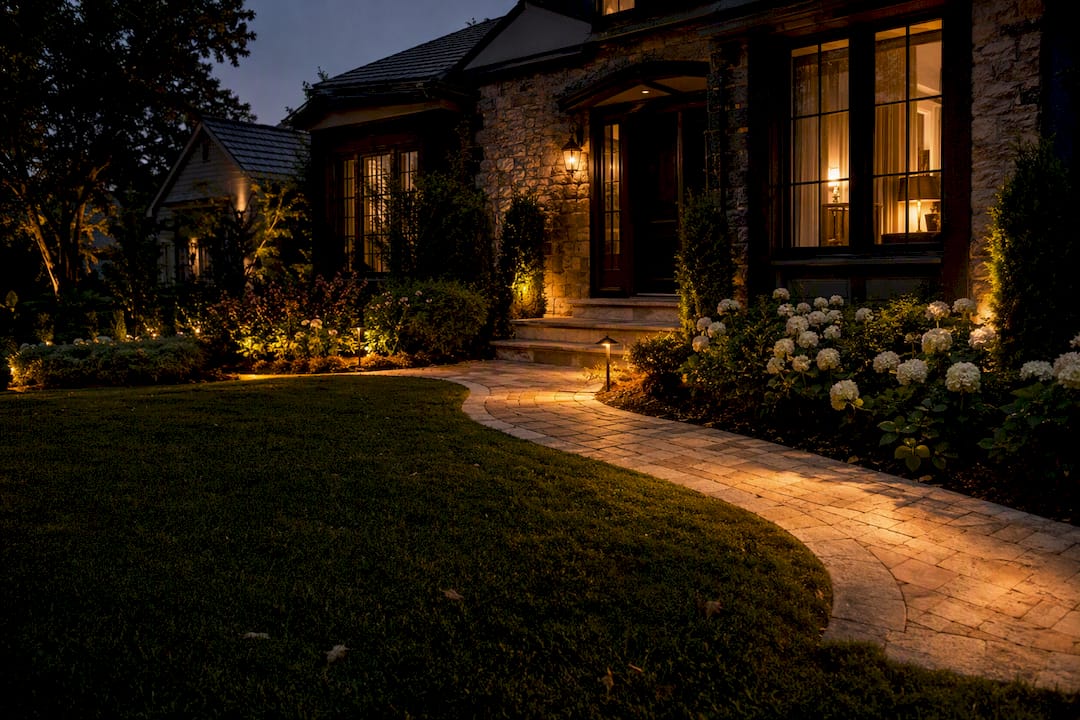
Most homeowners pay $2,000 to $4,500 for a professionally installed landscape lighting system, with a national average around $3,250, and $100 to $200 per installed fixture once labor and wiring are factored in. A basic 8 to 12 fixture package typically lands between $2,000 and $6,000, while estate-scale properties with 20 or more fixtures can push past $10,000.
Prices swing this widely because of fixture quality, how much trenching the yard requires, transformer and controller choices, and local labor rates. Low-voltage LED is the standard most licensed installers, including Forever Glow Lighting, build around, since it sidesteps the permitting and conduit requirements the National Electrical Code applies to line-voltage outdoor circuits.
- DIY starter kit: $100–$500 for a handful of stake lights
- Small pro job (6–8 fixtures): roughly $1,200–$2,400
- Standard residential (10–15 fixtures): $2,000–$4,500
- Large home (15–20 fixtures): $4,500–$8,000
- Estate-scale (20+ fixtures): $10,000 and up
The number that matters most for budgeting: at $100–$200 per installed fixture, a 12-fixture front yard plan sits close to the $1,500–$2,900 mark before you add design work or premium controllers.
Key Takeaways
Landscape lighting cost in the U.S. depends far more on fixture count, cable run length, and transformer sizing than on any single “average price” figure.
| Point | Details |
|---|---|
| National average cost | Professional installs run $2,000 to $4,500, averaging about $3,250 for a standard residential job. |
| Per-fixture math wins | At $100 to $200 per installed fixture, multiplying your fixture count is the fastest way to sanity-check any quote. |
| Trenching drives variance | Cable burial costs $1 to $8 per linear foot, and soil or hardscape conditions can swing labor costs significantly. |
| Low-voltage LED is the default | It avoids most permitting costs tied to line-voltage work and uses up to 80% less energy than older bulb types. |
| Forever Glow Lighting reduces lifetime cost | Custom-sized smart LED systems with free estimates and GlowCare maintenance avoid the voltage-drop and early-failure issues common in DIY installs. |
Table of Contents
- How Much Does Landscape Lighting Cost by Project Size?
- What Actually Drives the Price of a Landscape Lighting Quote?
- Solar, Low-Voltage LED, or Line-Voltage: Which Power Source Costs Less?
- DIY Kit or Licensed Installer: What’s the Real Price Difference?
- How Do You Compare Quotes and Pick a Contractor?
- Does a Permanent Professional System Lower Long-Term Cost?
- What a Real Homeowner Should Take Away From These Numbers
- Get a Free Estimate for a Permanent Lighting System
- Where to Verify These Numbers and Get a Local Quote
- Sources
How Much Does Landscape Lighting Cost by Project Size?
Budgeting gets a lot easier once you stop thinking in one lump sum and start thinking in fixture count. Every quote you get will ultimately break down to a per-fixture rate multiplied by however many lights your property needs, plus the fixed costs of a transformer and controller.
| Project size | Fixture count | Typical installed cost |
|---|---|---|
| Small accent job | 6–8 fixtures | $1,200–$2,400 |
| Standard front yard | 10–12 fixtures | $2,000–$4,500 |
| Full residential package | 12–20 fixtures | $2,000–$6,000 |
| Large or estate property | 20+ fixtures | $8,000 and up |
These ranges track closely with the $2,000–$6,000 typical range for an 8–12 fixture low-voltage LED install that most residential jobs fall into, with premium estate work climbing well past $10,000 once you add uplighting for mature trees or long paths.
Per-fixture pricing varies by type, and this is where a lot of homeowners get surprised by their quotes:
- Path lights: $100–$180 installed, usually the cheapest fixture per unit but often the highest count in a job.
- Spotlights (uplighting for trees or facades): $120–$250 installed, priced higher for aiming precision and mounting.
- Well lights (flush-mounted, in-ground): $150–$300 installed, since they require more excavation.
- Deck and step lights: $130–$220 installed, with wiring routed through structural elements.
- String and bistro lighting: $8–$15 per linear foot installed, a different pricing model entirely since it’s sold by run length rather than fixture count.
Here’s a worked example. Say you want a 10-fixture front-yard package: six path lights along the walkway, two spotlights on a tree and the entryway column, and two well lights uplighting the garage facade. At $100–$200 per fixture, that’s roughly $1,000–$2,000 in fixture and labor cost, before the transformer and controller. Add a mid-size transformer and a smart controller, and the realistic total lands between $1,600 and $2,700, comfortably inside the “small pro job” bucket. Our landscape lighting checklist for homeowners walks through how to map your own layout before requesting quotes.
What Actually Drives the Price of a Landscape Lighting Quote?
A landscape lighting quote isn’t one number. It’s four cost categories stacked together, and knowing the rough share of each helps you spot a quote that’s out of line.
- Fixtures: roughly 35–45% of the total, driven by how many lights you want and their build quality (cast brass vs. aluminum, for example).
- Labor: roughly 30–40%, and most mid-size installations take 6–18 hours with a two-person crew.
- Transformer and cable: roughly 15–20%, covering the power supply and the direct-burial wiring that runs to every fixture.
- Controller: roughly 5–10%, though a smart controller with zoning and app control adds $100–$400 up front.
Trenching is usually the biggest hidden line item. Cable burial runs $1 to $8 per linear foot depending on soil type and whether the crew has to work around hardscape, tree roots, or irrigation lines. A property with heavy clay soil or a lot of existing pavers will cost noticeably more to wire than a flat, open lawn, even with the exact same fixture count.
Long cable runs push costs up two ways: more copper, and a bigger transformer needed to prevent voltage drop at the far end of the run. This is one reason two homes with identical fixture counts can get quotes $500 or more apart.
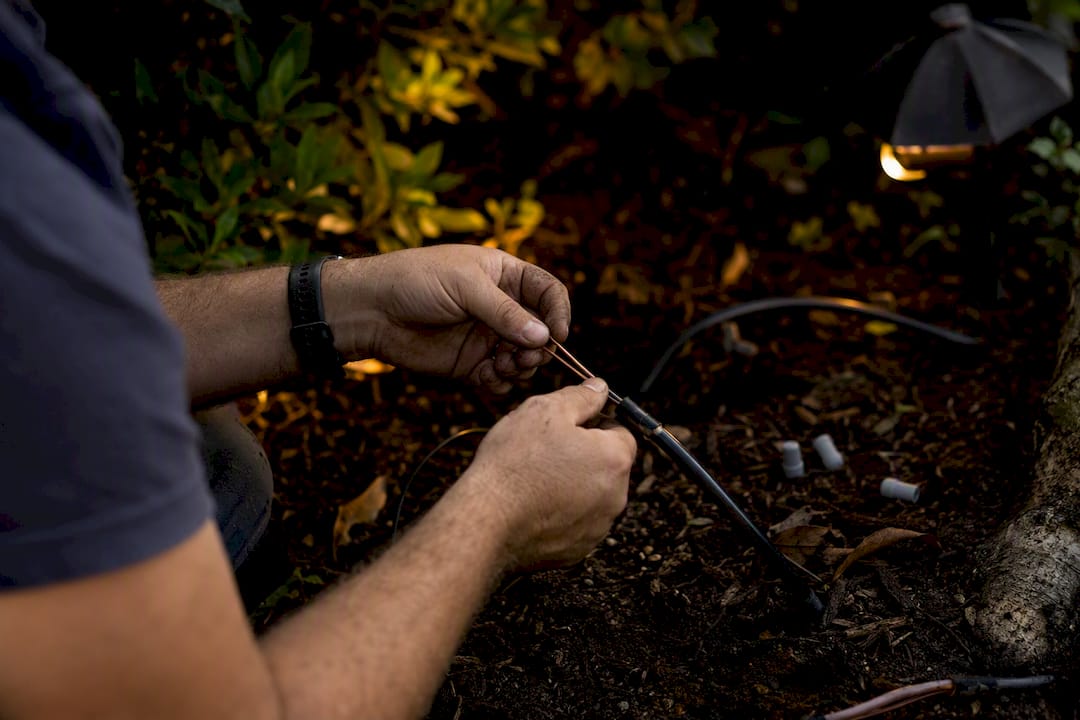
Pro Tip: Ask your contractor for the linear footage of wire in the quote, not just the fixture count. It’s the single best predictor of whether a bid is realistic.
Permits rarely apply to low-voltage systems, but if your project includes a new outdoor outlet or any line-voltage fixture, the National Electrical Code requires GFCI protection on those circuits, and that typically means pulling a permit and hiring a licensed electrician.
Solar, Low-Voltage LED, or Line-Voltage: Which Power Source Costs Less?
Low-voltage LED is the power class most professional installers default to, and for good reason. It runs on a 12-volt transformer instead of your home’s full 120-volt line, which means it avoids most of the permitting and conduit costs that line-voltage work triggers under most local codes. It also uses up to 80% less energy than incandescent options and the bulbs themselves last 25,000 to 40,000 hours, so you’re not replacing them every season.
- Low-voltage LED: the standard choice for most residential yards, balancing upfront cost, safety, and a 20 to 25 year fixture lifespan.
- Solar: cheapest to install since there’s no wiring at all, but light output drops in shaded yards or after cloudy stretches, and most solar fixtures underperform wired LED for consistent brightness.
- Battery-powered: useful for temporary or rental-property applications, but batteries need periodic replacement and rarely match the output of a wired system.
- Line-voltage: reserved for high-output security lighting or commercial applications, and it requires a licensed electrician, a permit, and GFCI-protected circuits under the National Electrical Code.
Operating cost tells a similar story. A typical low-voltage LED system running 5 to 6 hours a night costs somewhere in the range of a few dollars a month in electricity, while annual maintenance across any system runs about 5 to 15% of the original install cost, covering bulb swaps, transformer checks, and cleaning fixture lenses. Solar systems skip the electric bill entirely but tend to need more frequent panel cleaning and battery swaps to keep performance consistent.
DIY Kit or Licensed Installer: What’s the Real Price Difference?
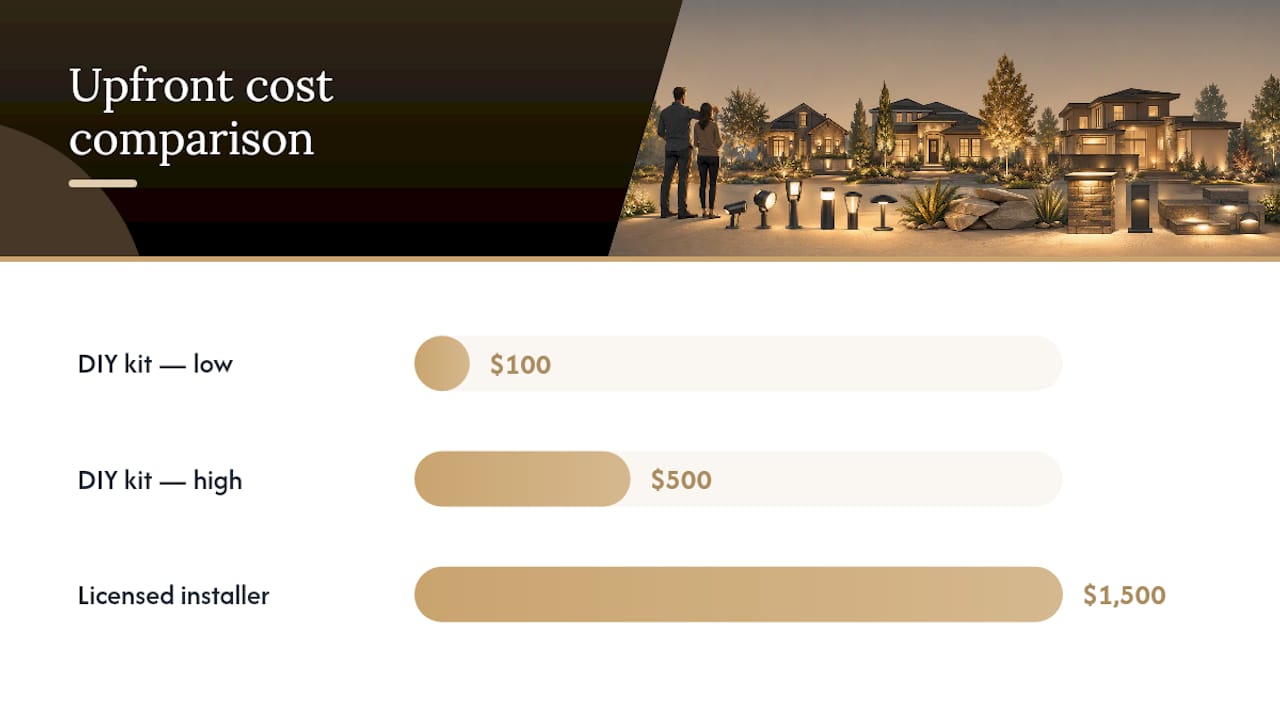
A big-box DIY kit runs $100 to $500 for a small project, and on paper that looks like an easy win over a $1,500 professional quote for the same fixture count. The gap closes fast once you account for what those kits leave out.
- Transformer sizing is rarely calculated correctly. Kits ship with a fixed-wattage transformer that doesn’t account for your specific run length, and an undersized transformer causes voltage drop, where fixtures at the end of the line glow noticeably dimmer than ones near the source.
- Cable quality is often inadequate for permanent burial. Direct-burial-rated cable with gel-filled connectors keeps moisture out of splices; many DIY kits use lighter-gauge wire that degrades faster underground.
- Aiming and layering take practiced judgment. Professional installers know how to angle uplighting to avoid glare and hot spots, something that usually takes a few rounds of trial and error to learn on your own.
- Early LED failure is common with DIY wiring mistakes. Fixtures run on inconsistent voltage burn out well before their rated 25,000 to 40,000 hour lifespan.
Pro Tip: If your DIY layout needs more than 100 feet of total cable run, get a voltage-drop calculation done first. It’s the single most common reason DIY installs look great for six months and then start flickering.
Hire a licensed electrician anytime the project touches line-voltage fixtures, requires a new outdoor outlet, or involves trenching near existing utility lines. Our guide on landscape lighting wiring best practices covers the burial depths and cable specs worth confirming before signing any contract.
How Do You Compare Quotes and Pick a Contractor?
Every landscape lighting quote should reduce to the same math: total installed cost divided by fixture count. That number lets you compare bids apples to apples, even when contractors format their quotes differently.
Run through this checklist before you sign anything:
- Fixture specs (brand, wattage, material) listed by name, not just “path light x8”
- Transformer size matched to your total wattage plus a buffer for future additions
- Cable gauge and burial depth specified in writing
- Estimated labor hours or a flat labor line, not a vague “installation” lump sum
- Warranty terms on both fixtures and labor
- What ongoing maintenance costs, if any, are included after year one
Watch for these red flags:
- A bid that’s 30% or more below every other quote you received, with no clear explanation for the gap.
- No proof of liability insurance or an electrical license, especially for jobs that involve line-voltage work.
- A scope of work that doesn’t name specific fixture brands or transformer wattage.
- No written warranty on either the fixtures or the installation labor.
- Vague or nonexistent answers when you ask about maintenance plans.
Ask for photos of past installs on properties similar to yours, and call at least one reference. A contractor confident in their work will have both ready without hesitation.
Does a Permanent Professional System Lower Long-Term Cost?
A properly sized system costs more upfront than a DIY kit, but the math changes once you look past year one. Forever Glow Lighting builds custom smart LED systems designed around your property’s actual wattage needs, not a one-size-fits-all kit, and every estimate is free before you commit to anything.
Correct transformer sizing and voltage-drop calculations prevent the dim, uneven lighting that shows up in DIY installs within the first year. Direct-burial-rated cable and professional aiming reduce the callback rate for repairs, and a documented warranty means replacement costs don’t fall back on the homeowner when a fixture fails early.
- Custom-designed layouts sized to your actual property, not a generic kit
- Free estimates before any commitment
- GlowCare maintenance subscriptions for ongoing service, bulb checks, and seasonal adjustments
- HOA-compliant design for neighborhoods with lighting restrictions
Pro Tip: If you’re comparing a $400 DIY kit against a $2,500 professional quote, ask what the kit’s warranty covers. Most cover the fixture only, not labor, which means every future fix is on you.
This approach fits best for homeowners who want year-round automation, permanent holiday lighting that never requires a ladder, or a system built to last two decades instead of two seasons.
What a Real Homeowner Should Take Away From These Numbers
The conventional advice on this topic treats landscape lighting cost like a single sticker price, and that’s the biggest disservice done to homeowners trying to budget honestly. The real number is a function of decisions you control: fixture count, cable run length, and whether you’re paying for a transformer sized correctly the first time.
What’s overrated is the DIY kit as a genuine cost-saving move. The $300 you save upfront routinely gets eaten by voltage-drop failures, replaced fixtures, and a redo within two or three years. What’s underrated is asking a contractor to show their per-fixture math before you sign anything. That single question exposes more bad quotes than any amount of online research.
Prioritize this: get the fixture count and layout right first, then request quotes broken into fixtures, labor, and transformer costs separately. A homeowner who understands that breakdown negotiates from a position of knowledge instead of guessing whether $3,500 is fair for their yard.
— Dave
Get a Free Estimate for a Permanent Lighting System
Forever Glow Lighting removes the guesswork this whole cost breakdown is built to solve. Instead of piecing together a DIY kit and hoping the transformer sizing works out, you get a custom-designed low-voltage LED system sized to your actual property, installed by a crew that handles the trenching, wiring, and aiming for you.
Every estimate is free, and there’s no obligation to move forward before you know your real number. The process itself is straightforward: a site visit, a custom design based on your home’s layout, and an installation timeline you agree to upfront. You can see exactly how the permanent lighting installation process works before requesting anything. For homeowners who want ongoing peace of mind, the GlowCare maintenance subscription keeps the system serviced year after year, so bulb replacements and transformer checks never fall on you. If you’re ready to see what a professional layout would cost for your specific yard, request your free estimate and get real numbers instead of national averages.
Where to Verify These Numbers and Get a Local Quote
Cross-checking a quote against independent data is worth the ten minutes it takes. Start with a few reliable references before you sign anything:
- LawnStarter’s landscape lighting cost guide for national per-fixture and total project averages.
- UseCalcPro’s installation cost calculator for a fixture-by-fixture cost breakdown by project size.
- Current Cost’s regional cost estimate tool for wiring, transformer, and labor line-item detail.
For a quote specific to your property, Forever Glow Lighting’s landscape lighting page offers a free estimate built around your actual layout rather than a national average.
Sources
- How Much Does Landscape Lighting Cost in 2026?
- Landscape Lighting Installation Cost Calculator — 2026 Quote Estimator | UseCalcPro
- Landscape Lighting Cost Estimate for U.S. Homes 2026 – Current Cost