
No, outdoor LED lights do not use much electricity. A typical residential roofline system, pathway package, or security floodlight setup running on LEDs draws far less power than the incandescent and halogen fixtures they replaced. The math below shows exactly how little, using Department of Energy and ENERGY STAR benchmarks alongside real cost scenarios you can run against your own utility rate.
TL;DR:
- Outdoor LED lights generally consume about 80 percent less electricity than traditional incandescent or halogen fixtures, resulting in significant savings.
- The cost of running LED outdoor lights depends on fixture wattage, hours of use, and local electricity rates, with typical examples showing annual costs from a few dollars to over $175 for always-on floodlights.
- Proper controls such as timers, sensors, and dimming significantly reduce energy consumption, with some studies indicating reductions of up to 65 percent.
- Fixture efficacy and placement, including beam angle and mounting height, influence actual light output and power needs, making quality fixtures and proper design important for efficiency.
- Professional, system-based solutions with app controls simplify management and maximize savings compared to DIY timer or photocell upgrades.
Table of Contents
- How Do You Calculate Outdoor LED Energy Use?
- What Do Wattage and Lumens Per Watt Actually Mean?
- Which Controls Cut Real-World LED Energy Use the Most?
- What Do Real Outdoor LED Setups Actually Cost?
- Why Homeowners Overestimate Their Outdoor LED Costs
- If You Want a Turnkey Way to Minimize Energy Use
- Sources
- FAQ
How Do You Calculate Outdoor LED Energy Use?
The math behind outdoor LED energy use is simple enough to do on your phone while standing in your driveway. You need two numbers: the fixture’s wattage and your electric rate. Multiply watts by hours used, divide by 1,000 to get kilowatt-hours, then multiply by your rate per kWh.
The formula looks like this: Watts × Hours ÷ 1,000 = kWh, then kWh × $/kWh = cost.
Your $/kWh rate is printed right on your utility bill, usually labeled “energy charge” or “supply rate.” If you cannot find it, $0.16 per kWh is a reasonable national placeholder for sample math, though rates vary by region and season. Once you know your real rate, swap it into the calculations below and the numbers will shift to match your actual bill.
Here are three worked examples using a conservative $0.16/kWh rate:
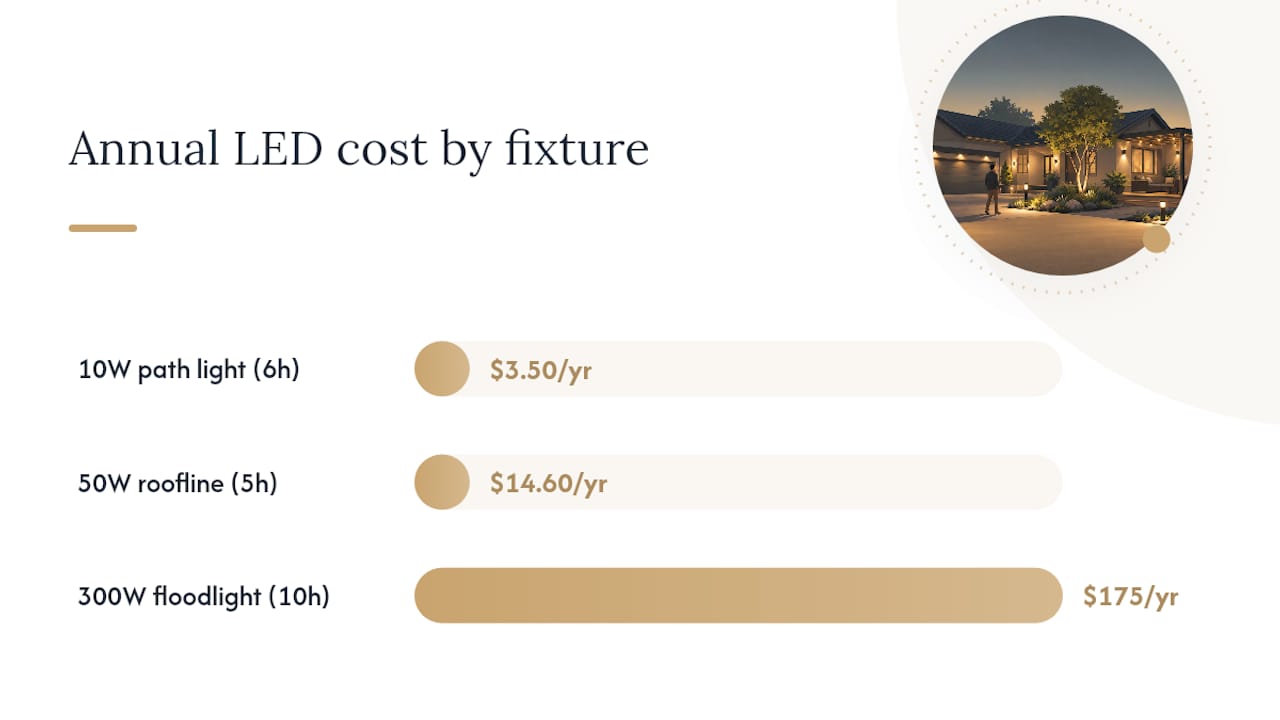
- A single 10W LED path light running 6 hours a night: 10W × 6 hours ÷ 1,000 = 0.06 kWh per night. That’s $0.0096 nightly, roughly $0.29 a month, and about $3.50 a year, according to the basic math behind most LED bulb calculators.
- A 50W roofline system running 5 hours a night at partial brightness: 50W × 5 hours ÷ 1,000 = 0.25 kWh per night. That’s about $1.20 a month and roughly $14.60 a year.
- A 300W security floodlight running dusk to dawn, 10 hours a night: 300W × 10 hours ÷ 1,000 = 3 kWh per night. That’s $0.48 a night, about $14.60 a month, and around $175 a year if it never shuts off.
Run these same steps with your own fixture wattage, your own nightly hours, and your actual utility rate. The formula never changes. Only the inputs do.
What Do Wattage and Lumens Per Watt Actually Mean?
A watt measures how much power a fixture pulls from your outlet. A lumen measures how much visible light it produces. Divide lumens by watts and you get efficacy, the number that tells you how much light you’re getting for each watt spent.
This is where LEDs separate themselves from older technology. Standard outdoor LEDs typically deliver 80 to 130 lumens per watt, while an old incandescent flood produces roughly 10 to 17 lumens per watt and halogen or HID fixtures fall somewhere in between. That gap means an LED fixture can throw the same amount of usable light using a fraction of the power draw, which is the entire reason the DOE’s LED Adoption Report tracks such steep national savings potential from the switch.
A few things beyond the wattage number on the label actually determine how much light reaches your driveway or your roofline:
- Beam angle narrows or spreads the light, so a tightly focused optic needs fewer watts to illuminate a path than a wide flood does.
- Mounting height and distance change how much of that light actually lands where you need it versus scattering into the sky.
- Fixture quality varies enough that two “10W” products can produce very different lumen output, which is why FEMP’s exterior lighting guidance recommends checking luminaire efficacy ratings rather than wattage alone.
Which Controls Cut Real-World LED Energy Use the Most?
Swapping to LEDs is only half the savings story. How and when those fixtures run matters just as much, and in many retrofit case studies, controls account for a bigger chunk of the savings than the bulb swap itself.
Retrofit studies documented in ENERGY STAR’s outdoor area lighting research show combined LED and control upgrades producing large percentage reductions in operating energy, and campus case studies cited in outdoor lighting efficiency guidance found bi-level and occupancy controls cutting energy use by 30 to 65 percent depending on the application.
The most useful control options for a home or commercial property include:
- Astronomical timers that adjust on and off times daily as sunset shifts through the seasons, so lights never run longer than necessary.
- Photocells that respond to actual ambient light rather than a fixed clock, useful on cloudy or overcast days.
- Motion and occupancy sensors that keep security floodlights dark until something triggers them, then bring them to full output.
- Dimming and bi-level settings that hold fixtures at a lower output for most of the night and jump to full brightness only when needed.
- App-based scheduling that lets you set zones, dim levels, and timing without rewiring anything, which PG&E’s efficiency guidance points to as one of the simpler upgrades property owners overlook.
Good optics matter here too. Fixtures rated for well-controlled backlight, uplight, and glare (the BUG rating system) waste less light outside the area you’re trying to illuminate, which means you need fewer watts to get the coverage you want. Proper spacing does the same job by avoiding overlap between fixtures that are each doing more work than necessary.
Pro Tip: Dimming and occupancy sensing work best as a pair, not a substitute for each other. Run pathway and accent lighting at 30 to 50 percent brightness overnight, then let motion sensors trigger full brightness only where security matters, like near doors or driveways. That combination consistently produces the deepest real-world savings in the case studies above, more than either strategy alone.
What Do Real Outdoor LED Setups Actually Cost?
Numbers mean more when they’re attached to a property you can picture. Here are three common setups, using a $0.16/kWh rate as the baseline. Adjust the rate and hours to match your own utility bill and habits.
Scenario A shows why pathway lighting rarely shows up as a line item worth worrying about. Eight fixtures running every night for a year cost less than a single dinner out.
Scenario B is where node count confuses people. A roofline system with dozens of individual LED points can still total only 50 to 150 watts across the entire house, based on typical permanent LED system specs, because each node draws a tiny fraction of a watt. Running it dimmed most nights and boosting to full brightness for holidays or events barely moves the annual number.
Scenario C is the one that actually matters. The gap between an always-on floodlight and a motion-triggered one is roughly $158 a year on this table, and it’s the single biggest lever most homeowners have not pulled yet.
Why Homeowners Overestimate Their Outdoor LED Costs
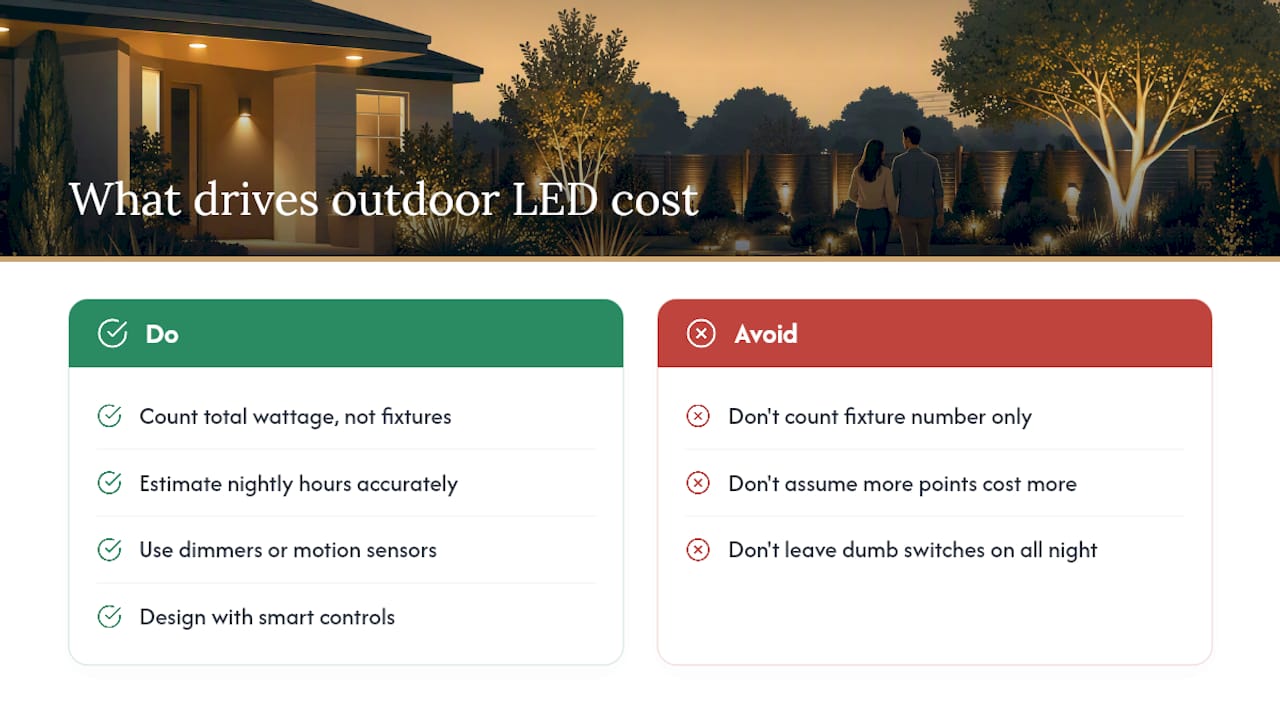
Most of the anxious energy bill questions I hear come from people counting light fixtures instead of counting watts. A roofline system with 200 individual LED points sounds like it should cost a fortune to run, but 200 nodes at a fraction of a watt each adds up to less power than one old floodlight bulb.
The real driver of your bill isn’t how many lights you have. It’s total wattage, nightly hours, and whether anything is dimming or sensing motion instead of running full blast all night. A homeowner with ten smart-controlled fixtures often pays less than a neighbor with three fixtures wired to a dumb switch that never turns off. Design and controls do more work than raw fixture count ever will.
— Dave
If You Want a Turnkey Way to Minimize Energy Use
Running your own kWh math is useful, but if you’d rather skip the spreadsheet, a professionally installed permanent system handles the energy math for you from day one. Low-voltage LED roofline and landscape systems with dimming, zone scheduling, and motion-aware settings can provide security-floodlight savings from the table above without manually programming timers or guessing at brightness levels.
This isn’t the only path to lower outdoor lighting costs. Timers and photocells on your existing fixtures will get you part of the way there. But a permanent, app-controlled system removes the guesswork: low-voltage architecture keeps distribution losses low across long runs, and smartphone-based scheduling lets you set dim levels for weeknights and full brightness for holidays without ever touching a ladder. If you’re ready to see what a custom system would look like on your property, Foreverglowlighting’s installation process starts with a free estimate.
Sources
For deeper reading, the DOE LED Adoption Report covers national savings data, ENERGY STAR’s outdoor lighting paper details control strategies, FEMP guidance explains efficacy thresholds, and PG&E’s tips offer practical control advice. For broader home efficiency context, Bayfair’s guide to green home features is a useful companion read.
- LED Adoption Report | Department of Energy
- Outdoor Area Lighting (ENERGY STAR technical paper)
- Energy-efficiency exterior lighting tips | PG&E
FAQ
Do LEDs Use Up a Lot of Electricity?
No. Outdoor LEDs typically draw around 80 percent less power than incandescent or halogen fixtures producing the same amount of light, based on efficacy comparisons from DOE research.
How Much Does It Cost to Leave an LED Light On for 24 Hours?
A single 10W LED left on for 24 hours costs roughly $0.29 a month at $0.16/kWh, based on standard LED electricity calculations. A 300W floodlight run all night costs about $14.60 a month.
What Runs Up Your Electric Bill the Most?
For outdoor lighting specifically, always-on security floodlights running dusk to dawn are the biggest driver, often costing $175 a year or more compared to $17 a year for the same fixture on motion-only mode.
Are Outdoor Lights Expensive to Run?
Not when they’re LED and controlled properly. A full pathway or roofline LED setup often costs less per year than a single always-on incandescent floodlight, and pairing dimming with motion sensors, as offered through Foreverglowlighting’s smart controls, pushes costs even lower.