
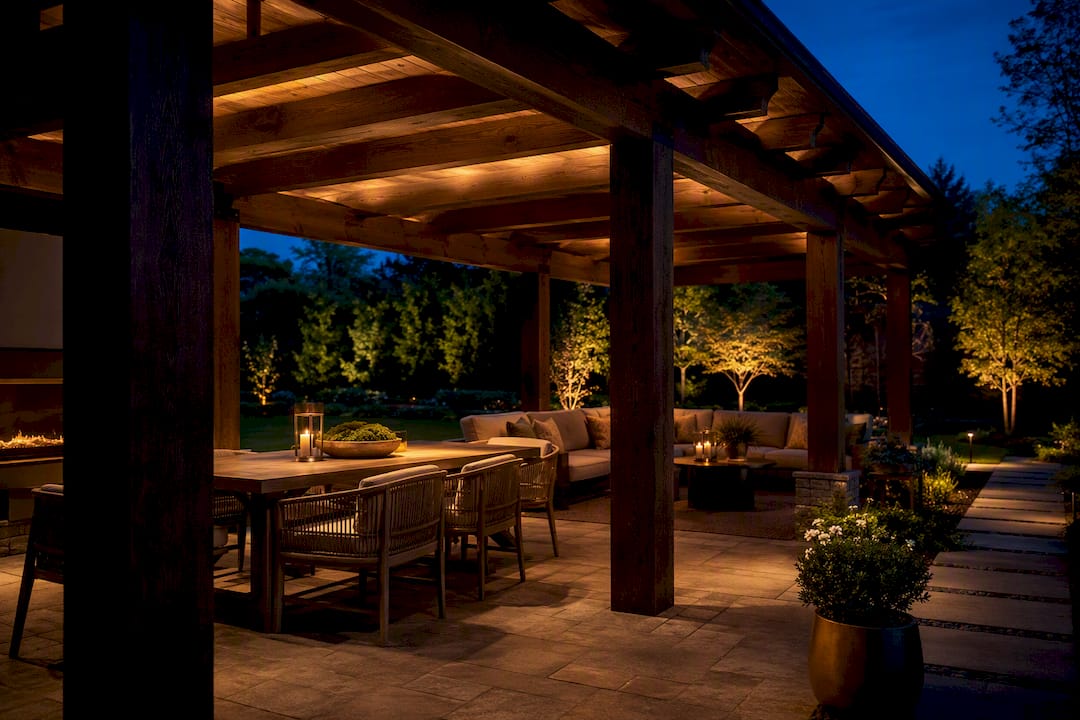
The best pergola lighting comes from layering, not a single string of lights. Combine warm LED string lights for ambiance, a task pendant over the dining table, and a few accent uplights on posts or beams, then run everything through a smart plug or dimmer. Stick with warm white (around 2700K) and outdoor-rated fixtures (IP44 minimum), and you get a space that looks finished for dinner and relaxed for a quiet Tuesday night. Below: 10 practical pergola lighting ideas, a short planning method, and when it’s worth calling a professional.
TL;DR:
- Solar and battery-powered string lights are budget-friendly but may require more frequent maintenance and have lower brightness output, especially in overcast conditions.
- Proper planning involves adding slack to strings and selecting anchors and hardware rated for outdoor use to prevent sagging and damage over time.
- High IP ratings like IP65 are essential for fixtures exposed to rain or sprinkler systems, and professional installation is recommended for complex wiring or HOA compliance.
- Maintaining a layered lighting scheme with warm white fixtures and regular weatherproofing checks ensures consistent and aesthetically pleasing illumination.
- Permanent, smart LED systems from professional providers like Forever Glow eliminate the need for seasonal ladder work and provide HOA-compliant, app-controlled lighting options.
Table of Contents
- 10 pergola lighting ideas that actually work
- How to plan lighting for your pergola
- Solar, battery, low-voltage, or line-voltage: choosing your power source
- Weatherproofing and upkeep that keeps lights working
- Smart controls, dimming, and simple scene ideas
- What pergola lighting actually costs
- When to bring in a professional installer
- Why most pergola lighting advice misses the planning step
- Forever Glow Lighting: permanent pergola lighting without the ladder
- Sources
10 pergola lighting ideas that actually work
These pergola string lighting ideas and fixture combinations cover most budgets and skill levels, from a $20 solar strand to a fully wired, app-controlled system.
- Bistro or café string lights. Hang S14 or G40 LED filament bulbs in a zig-zag for a canopy effect, a perimeter loop for a subtle frame, or an X-cross pattern for smaller square pergolas. Plug-in strands with 150 to 300 lumens per bulb work for most 10×10 to 14×14 layouts.
- Solar starburst lanterns. These clip onto rafters with no wiring at all, though output drops on cloudy days. Best for accent corners, not the dining zone.
- LED tape under the beams. Concealed strip lighting washes the underside of the pergola in soft light. Use an IP65-rated strip with a low-voltage driver, and tuck the transformer somewhere dry.
- Hanging pendants or a small chandelier. One statement fixture over the table adds task lighting fast. Mount to a structural beam, not decorative trim, and choose a rated outdoor pendant.
- Rattan or paper lantern clusters. Grouped at varying heights, these add texture without much brightness. Battery-powered LED pucks inside keep them safe; skip real candles in paper shades.
- Curtain or fairy lights. Draped along one side, these work well for privacy screening on an open-air pergola. Battery packs with a timer make installation painless.
- In-ground or post uplights. Mounted at the base of support posts, these throw light upward across the wood grain, adding depth after dark. Low-voltage 12V fixtures in the 50 to 150 lumen range suit this accent role.
- Table lanterns and flameless candles. Cheap, portable, and useful for last-minute ambiance. No installation required.
- Fire features or flame-effect bulbs. A fire bowl nearby or flicker-effect LED bulbs add warmth and movement. Keep real flame sources clear of fabric curtains or dry string-light cords.
- Rechargeable portable lamps. Cordless LED lanterns move wherever the evening takes you, from the dining table to a lounge chair. Useful as backup lighting during a power blip.
How to plan lighting for your pergola
Start by sketching your pergola’s footprint and marking activity zones: the dining table, a grill station, lounge seating, and any walkway. Assign a lighting role to each zone using the ambient, task, and accent framework designers rely on for layered pergola lighting: ambient fixtures at a typical moderate brightness, task lighting brighter over work surfaces, and accent lights generally softer. Stick to 2700K to 3000K warm white for the whole scheme.
For hanging patterns, zig-zag gives the most even canopy coverage, a perimeter run outlines the structure without crowding the middle, and parallel rows suit larger rectangular pergolas better than a single zig-zag. Whatever pattern you pick, add some slack to each run instead of stretching lights taut. Taut lines sag with heat and pull at their anchor points.
Before you buy anything, build a short checklist:
- Eye hooks or cup hooks rated for outdoor wood
- Guide wire or aircraft cable for spans over 15 feet
- Turnbuckles to adjust tension after installation
- An outdoor-rated extension cord
- A GFCI outlet or adapter
- Spare bulbs matched to your strand’s voltage
Pro Tip: Count your anchor points before ordering lights, not after. A quick sketch with measurements prevents the common mistake of buying one strand too short and ending up with a visible splice in the middle of your dining area.
Solar, battery, low-voltage, or line-voltage: choosing your power source
Each power option trades cost against permanence. Solar lights need zero wiring and work well for accents, but output drops in shade or on overcast weeks. Rechargeable battery fixtures go anywhere and move easily, though they need regular charging. Low-voltage 12V systems use a small transformer, cost less to install than line-voltage, and carry a lower shock risk since a fault won’t deliver a dangerous jolt. Line-voltage wiring gives you permanent, always-on lighting, but it has to run through an electrician for code compliance.
A few safety points apply no matter which route you choose:
- Outdoor outlets need GFCI protection, full stop.
- Match fixture IP ratings to exposure: IP44 minimum for covered areas, IP65 for anything rain or sprinkler-exposed.
- Route wiring through conduit anywhere it crosses a walkway.
- Use aircraft cable and turnbuckles for tension, never the light strand’s own cord.
Call a professional when you’re adding a permanent circuit, integrating roofline or track lighting into the pergola, or if your HOA requires a compliant install. Learn more about how low-voltage systems reduce both cost and risk before deciding which path fits your setup.
Weatherproofing and upkeep that keeps lights working
IP ratings tell you what a fixture can survive: IP44 handles rain exposure under a roof, IP65 handles direct wet weather and dust. Choose shatterproof acrylic bulbs over glass wherever there’s foot traffic or wind risk, since durable materials outlast cheaper glass bulbs through seasonal swings. Leave high-IP fixtures up year-round; pack away paper lanterns and battery units before winter humidity gets to them.
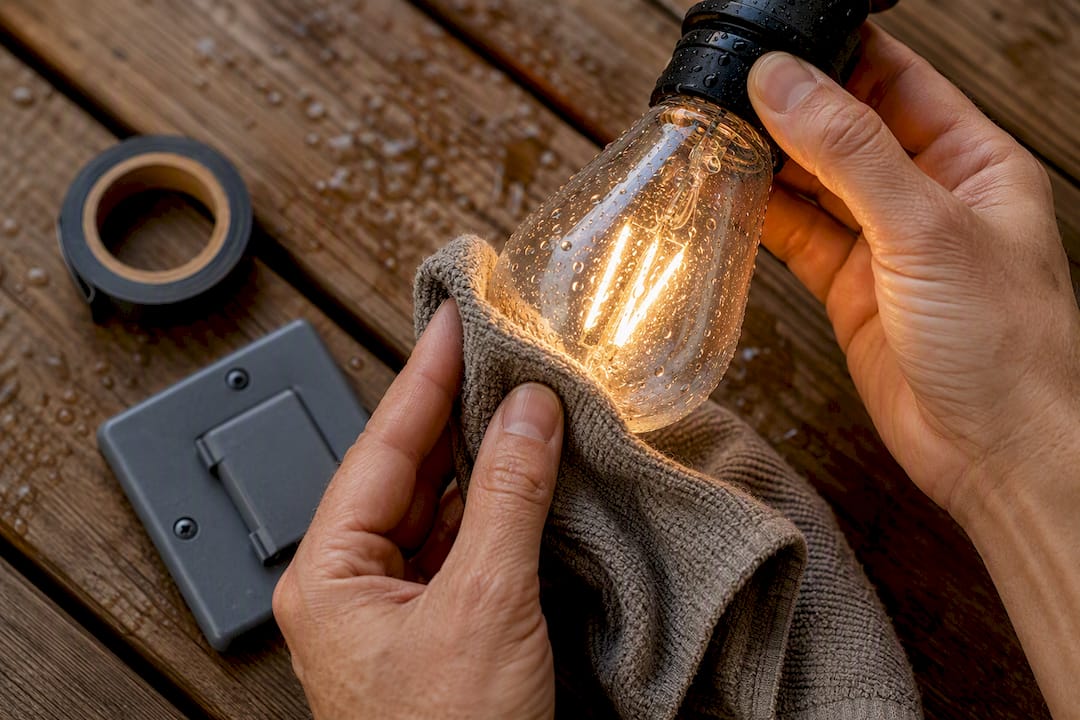
Twice a year, check guide-wire tension after freeze-thaw cycles and again after peak summer heat, and wipe down acrylic bulbs to keep light output even. Keep a small kit of outlet covers, self-fusing tape, and spare bulbs on hand so a quick fix doesn’t turn into a weekend project.
Smart controls, dimming, and simple scene ideas
Outdoor smart plugs and app-controlled RGBW string systems let you set the mood without touching a switch. Most connect through common ecosystems like HomeKit, Alexa, or Google Home, and designers increasingly treat pergola lighting as an extension of the home itself, worth automating the same way you’d automate indoor lights.
Save full-color RGBW modes for occasional parties. Everyday use should stay in warm white, since switching colors nightly wears thin fast and warm tones read better against wood and greenery anyway. Explore smart app control options if you want scheduling built in from day one.
What pergola lighting actually costs
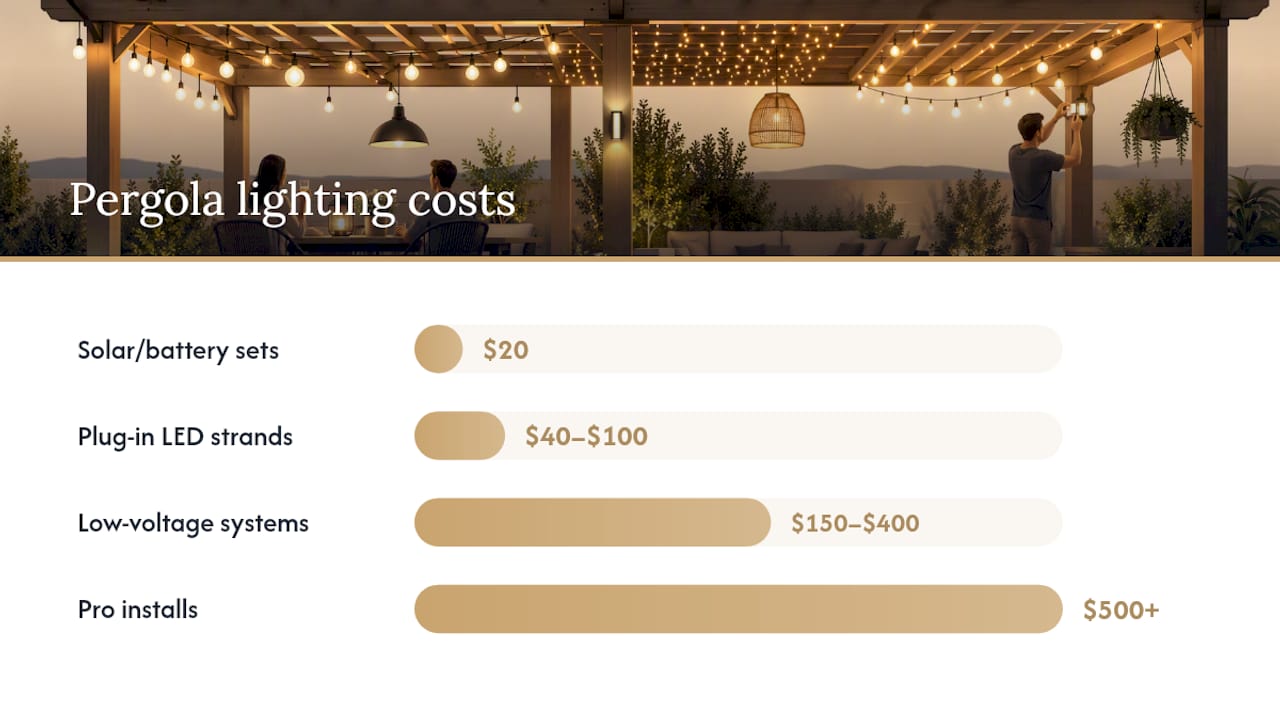
Budgets scale with permanence. Solar or battery strands start around $20 per set, quality LED plug-in strands run $40 to $100 for a 48-foot run, low-voltage transformer systems land between $150 and $400, and professional permanent installs start around $500 depending on scope.
Spend your money on IP-rated fixtures, real guide-wire hardware, and a GFCI outlet if you don’t have one. Save on decorative extras like paper lanterns or table candles, since those are cheap to replace anyway. When shopping, check IP rating, lumen output, color temperature (2700K), how many strands can connect end to end, warranty length, and whether spare bulbs are sold separately.
When to bring in a professional installer
DIY string lights handle most weekend projects fine. But a few situations call for a licensed installer instead of another trip to the hardware store.
- You want integrated roofline or track lighting that blends into the structure by day and lights up by night.
- Your HOA requires documentation or compliant fixture specs before approving any exterior lighting.
- You’re adding a new circuit or rewiring during a larger patio remodel.
- You want holiday lighting automated year-round instead of climbing a ladder every December.
Forever Glow Lighting builds custom, smart LED systems homeowners control entirely from a smartphone, with HOA-compliant design built into the plan from the start. See how the installation process works before requesting a quote, and ask about GlowCare maintenance plans if you’d rather not think about bulb replacement again.
Why most pergola lighting advice misses the planning step
Most pergola lighting content is pure inspiration: forty photos of string lights and zero mention of what happens when your run sags six months later. That gap is where DIY projects actually fail, not in the fixture choice. The idea list matters, but the planning workflow, counting anchors, adding slack, matching IP ratings to exposure, matters more, because it’s the difference between a pergola that looks styled and one that looks strung together.
The conventional advice also oversells color-changing systems; for comprehensive ideas on transforming outdoor structures into inviting spaces, see our guide to the best gazebos & outdoor structures. RGBW string lights are fun for a party, but running them nightly in full color gets tiring fast, and warm white simply photographs and lives better against wood beams and greenery. If you take one thing from this list, it should be this: buy the highest IP rating you can afford before you buy the prettiest bulb shape, and don’t skip the guide-wire hardware to save fifteen dollars.
For homeowners who want the payoff without the ladder work, that’s exactly where a professional patio lighting installation earns its cost back in fewer weekend fixes.
— Dave
Forever Glow Lighting: permanent pergola lighting without the ladder
Forever Glow Lighting is the option for homeowners who read this whole list and thought, “I don’t want to manage strand tension twice a year.” Instead of restringing lights every season, our custom LED track systems mount permanently along your pergola’s structure, invisible by day, fully controllable by smartphone at night, with HOA-compliant design handled before installation even starts.
That means no more climbing a ladder to swap a burnt bulb or reset a sagging strand before a dinner party. Our bistro and string patio lighting installs use the same layered ambient, task, and accent approach covered above, but wired permanently and backed by GlowCare maintenance so the system keeps working long after the install crew leaves. If your pergola deserves better than a seasonal string light routine, request a free estimate and see what a permanent, smart setup looks like for your space.
Sources
For more detail, see The Spruce’s pergola lighting roundup and Forever Glow’s guide to landscape lighting layering.
- Pergola lighting ideas (The Spruce)
- Pergola lighting ideas: fixture types, placement, and layered design (Build-Construct)
- Pergola string lighting ideas: 8 designs that transform your backyard (D & G Flooring)
- Pergola Lighting Planner (Crafted Motion Design)