
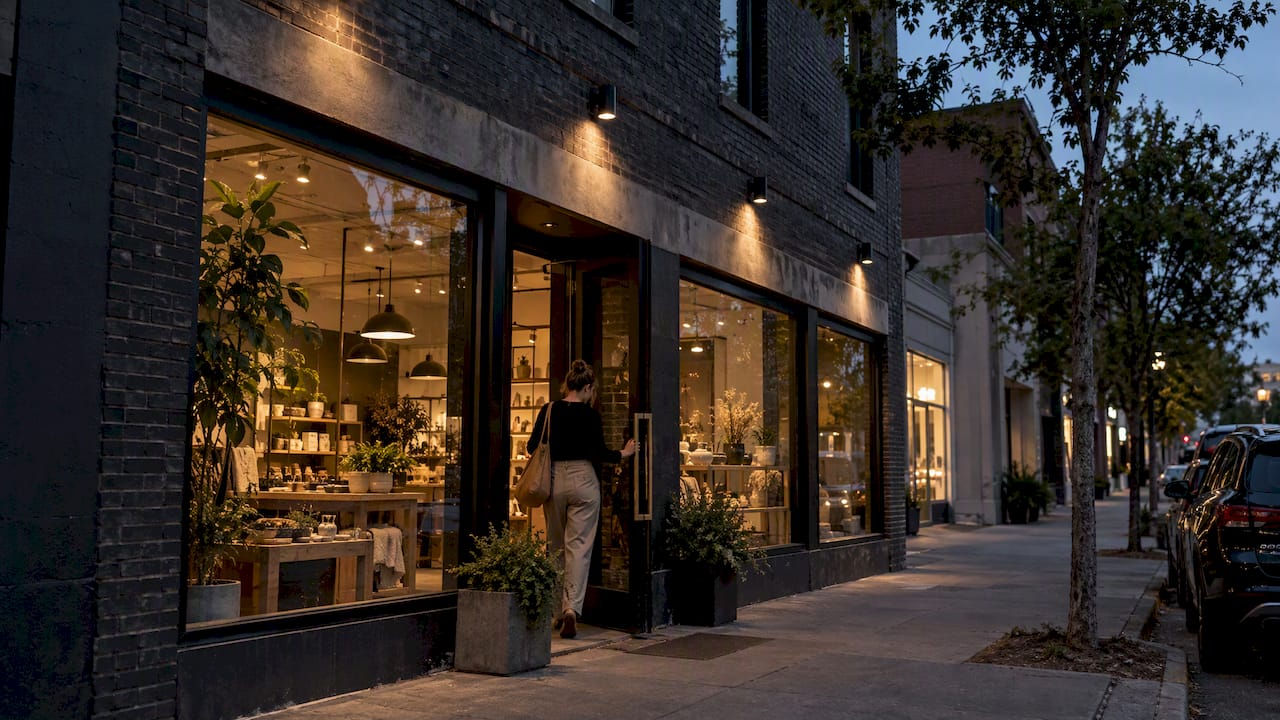
The best storefront lighting design is a layered, targeted LED scheme: warm-toned, controlled, and aimed squarely at sign and entrance visibility. Done right, it sharpens sign legibility, boosts curb appeal after dark, and cuts energy waste and glare. Guidance from DarkSky and the IES backs this approach, and a licensed professional like Forever Glow Lighting can help carry it out.
TL;DR:
- Selecting warm, shielded LED fixtures focused on sign and entrance visibility enhances legibility and reduces glare, especially when combined with proper aiming and shielding.
- Using a mix of spotlight, wall-washer, and grazer fixtures aligned with the target surface ensures an even, professional look and avoids uneven patchiness.
- Layering ambient, task, and accent lighting with consistent color temperatures supports a cohesive nighttime storefront appearance and functionality.
- Employing smart controls for staged dimming and scheduling can significantly cut energy costs and improve sign visibility without increasing brightness.
- Professional installation provides a photometric layout, code compliance, weather-resistant fixtures, and integrated smart controls, offering a durable, low-maintenance solution.
Table of Contents
- Core design principles small retailers should follow
- Which fixtures and mounting work best for storefront elements
- Layering ambient, task, and accent light for storefronts
- Choosing color temperature and CRI, and avoiding glare
- Smart controls, energy savings, and staying within local guidance
- Practical checklist: how to plan a storefront lighting update
- When a professional installation is worth it
- Prioritizing storefront lighting upgrades on a small budget
- How Forever Glow Lighting can handle your storefront update
- FAQ
- Sources
Core design principles small retailers should follow
Good storefront lighting is not about raw brightness. The Five Principles for Responsible Outdoor Lighting give small retailers a practical framework: light should be useful, targeted, kept low, controlled, and chosen with color in mind. A spotlight blasting the sidewalk instead of the sign fails the “targeted” test. A fixture left burning all night at full output fails “controlled.”
Blue-rich LEDs can also work against you. They create harsher contrast and more glare, which makes signage harder to read from a distance, not easier. Warmer, properly shielded light tends to render your storefront more clearly and comfortably.
- Useful: every fixture should serve a clear purpose, like illuminating your entrance or sign.
- Targeted: aim light at what matters, not at the street or neighboring windows.
- Low: use the minimum output needed for visibility and legibility.
- Controlled: dim or schedule lighting so it only runs at full strength when needed.
- Color: choose warm, shielded fixtures over blue-heavy, unshielded ones.
A simple rule of thumb: light your sign and entrance first, then layer in accents on architecture or landscaping once the essentials are covered.
Which fixtures and mounting work best for storefront elements
Different storefront elements call for different fixture families. Matching the fixture to the job prevents the patchy, uneven look that plagues a lot of DIY installs.
- Spotlights work well for highlighting a sign, a logo, or a single architectural feature.
- Wall-washers spread even light across a broad surface like a brick facade.
- Grazers mounted close to a textured wall emphasize brick, stone, or wood grain.
- Linear track systems run discreetly along a roofline and provide consistent, continuous light.
- String or bistro lights add warmth and personality to patios and outdoor seating.
Beam angle matters as much as fixture choice. A narrow beam mounted too far from its target creates a harsh hot spot, while a wide beam mounted too close washes out detail. Match beam spread to mounting height and distance before installing anything permanently.
Check product specs before you buy: look for an IP rating suited to outdoor exposure, a BUG rating that confirms backlight, uplight, and glare are controlled, proper shielding to keep light pointed down and out rather than into the sky, and a housing finish built to handle sun, rain, and temperature swings without degrading.
Layering ambient, task, and accent light for storefronts
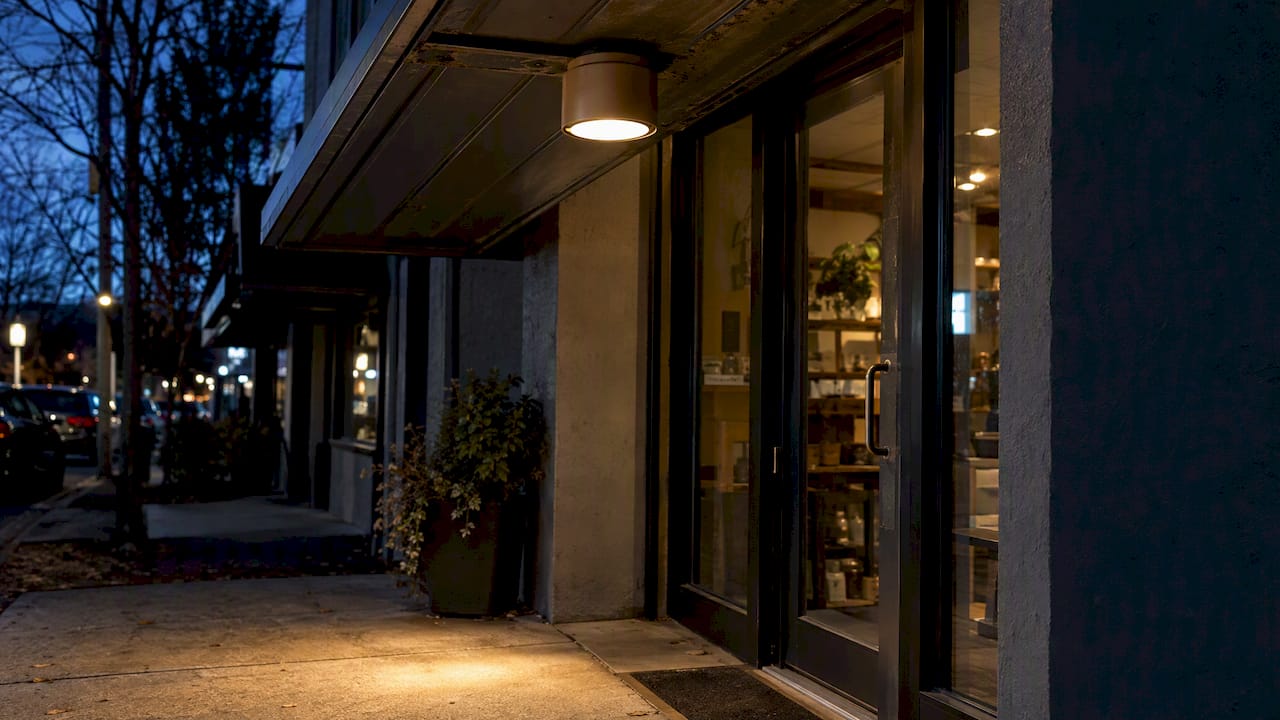
A storefront that looks good at dusk and stays legible at midnight usually has three layers working together instead of one fixture doing everything.
- Ambient light covers walkways and entry areas so customers can navigate safely and comfortably.
- Task light focuses on transaction points, like a payment window or an outdoor pickup counter, where clear visibility matters most.
- Accent light draws the eye to window displays, signage, or architectural texture that gives your storefront personality.
A small boutique might use soft ambient wash across the sidewalk, task lighting over the entry door, and tightly aimed accents inside the window display to highlight merchandise. A cafe could pair ambient path lighting with warm string lights over a patio and a single accent fixture on its sign. A convenience store, which needs higher visibility for safety and quick in-and-out traffic, might lean more heavily on ambient and task layers with modest accent lighting reserved for the entrance.
Keep color temperature consistent across all three layers. Mixing a warm 2700K accent with a cool 5000K ambient wash can make a storefront look disjointed rather than intentional, even when each layer looks fine on its own. For more on how this layering approach translates from homes to storefronts, our guide to landscape lighting layering techniques walks through the same ambient, task, and accent framework.
Choosing color temperature and CRI, and avoiding glare
Color temperature sets the mood of your storefront before a customer ever reads your sign. Hospitality spots, boutiques, and cafes generally look best in the 2700K to 3000K range, which reads as warm and inviting. Grocery and convenience stores often use 3500K to 4000K, a slightly cooler range that supports quick visual scanning and a clean, efficient feel.
Color rendering index, or CRI, matters more for retailers whose merchandise depends on accurate color, like boutiques, florists, or anyone selling products where true-to-life color sells the item. A guide to CRI and spectral quality explains why some retailers specify 90+ CRI fixtures even at a higher cost.
DarkSky’s white paper notes that light emitted near or above 80 degrees from nadir contributes disproportionately to skyglow and glare, which means aiming fixtures down and shielding the sides does more for visibility than adding wattage.
- Shield fixtures so light spills onto your facade, not into traffic or neighboring windows.
- Aim carefully rather than compensating for poor aim with more lumens.
- Favor lower, warmer color temperatures for glare-sensitive storefronts.
- Use gradual dimming at dusk instead of switching straight to full output.
Smart controls, energy savings, and staying within local guidance
Controls do more than cut your power bill. Fixture-level dimming and staged scheduling improve contrast between your storefront and its surroundings, which makes signage easier to read without raising overall brightness.
DOE research on outdoor lighting controls documents staged schedules used in large retail and property pilots: a brief full-on period right after dusk for visibility, a staged dimming step as the evening progresses, a late-night setback once foot traffic drops, and a dawn ramp-up before opening. Motion-triggered brighten events can restore full output when someone approaches after hours.
- Schedule a brief full-on period at dusk when visibility matters most.
- Step down to a dimmed setting once peak evening traffic passes.
- Set a deeper late-night setback with motion-triggered brightening for security.
- Ramp back up before opening hours.
These schedules deliver real energy and operational savings when commissioned correctly, though results vary by site. Larger installations with more total output may also need to apply a performance-based method under local lighting ordinances rather than a flat prescriptive limit, which usually requires a photometric layout.
Practical checklist: how to plan a storefront lighting update
Before you call an installer or order fixtures, walk your storefront and note what needs fixing.
- Audit your site: check sign readability distance, glare and reflections off glass, sightlines from the street, and available mounting points.
- Draft a spec sheet: note target CCT ranges, minimum CRI if merchandise color matters, fixture types needed per element, and desired control features.
- Plan for commissioning: schedule a walkthrough at dusk and after dark to confirm aiming, test your dimming schedule over a few nights, and set a maintenance plan for cleaning and replacing fixtures.
Pro Tip: Walk your storefront at dusk and again at midnight before finalizing any design. What looks right at 7 PM often looks completely different at 11 PM.
When a professional installation is worth it
A DIY string of spotlights can get you partway there, but a professional installation typically includes a photometric layout, a review against local code and HOA or municipal rules, weather-rated hardware built for outdoor exposure, and integrated smart controls backed by a warranty.
- Photometric layout planning to confirm coverage and avoid patchy spots.
- Code and HOA compliance review before installation begins.
- Commercial-grade, weather-rated fixtures suited to year-round exposure.
- Integrated smart controls with app-based scheduling and dimming.
- A maintenance plan to keep fixtures and finishes performing over time.
We offer permanent roofline and track systems, architectural accent lighting, patio and bistro lighting, and commercial exterior lighting, each backed by a free estimate for businesses exploring their options.
Prioritizing storefront lighting upgrades on a small budget
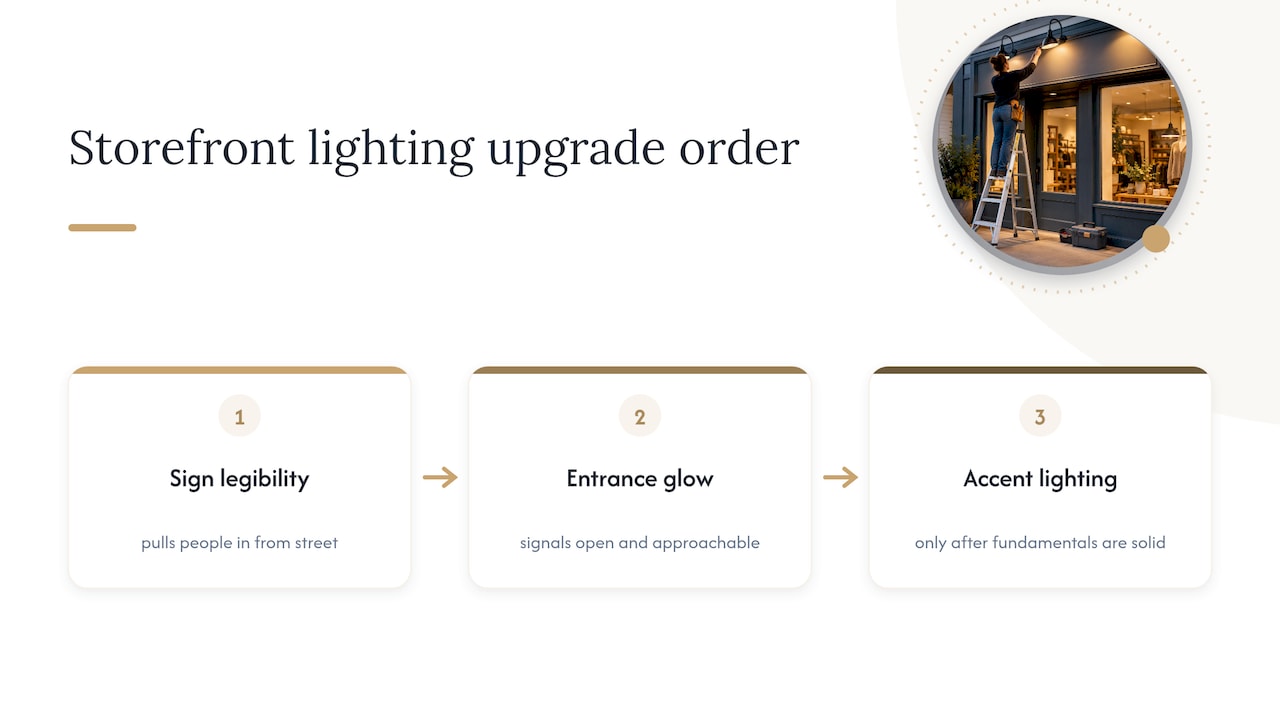
If your budget is tight, sequence matters. Sign legibility comes first since that is what pulls people in from the street. Entrance glow comes second, because a well-lit doorway signals that you are open and approachable. Accent lighting on architecture or displays comes last, worth doing well once the fundamentals are solid, but never worth rushing ahead of them.
Spend on fixtures and aiming before you spend on extra wattage. A well-placed, properly shielded light nearly always beats a brighter, poorly aimed one.
— Dave
How Forever Glow Lighting can handle your storefront update
We design and install permanent roofline and track lighting systems built for storefronts that need to look sharp every night without daily upkeep. Our systems integrate smart controls so you can schedule dimming, adjust for seasonal hours, or switch colors for a promotion, all from your phone.
- Permanent, climate-optimized track systems that stay invisible by day and precise by night.
- Architectural accent lighting designed around your facade, signage, and window displays.
- Smart app-based controls for dusk dimming, late-night setbacks, and seasonal adjustments.
- A maintenance program through our GlowCare subscription to keep fixtures performing year-round.
For owners who want a compliant, maintained system instead of a DIY setup that needs constant adjustment, our permanent lighting page covers what a professional install includes and how to request a free estimate.
FAQ
What is the best color temperature for storefront lighting?
Warm tones between 2700K and 3000K suit boutiques, cafes, and hospitality storefronts, while grocery and convenience retailers often use a slightly cooler 3500K to 4000K for quick visual scanning. The right choice depends on the mood you want and how much your merchandise relies on accurate color.
How do I avoid glare with outdoor storefront lighting?
Shield fixtures so light points down and inward rather than toward traffic or neighboring windows, and aim carefully instead of adding more wattage. DarkSky’s near-horizontal emission guidance notes that light above 80 degrees from nadir drives much of the glare and skyglow problem.
Do storefront lights need to be dimmed at night?
Yes, gradual dimming between dusk and the following hour, along with a deeper late-night setback, reduces glare and energy use while preserving visibility when it matters most. DOE research on outdoor lighting controls documents staged schedules used successfully in retail and property settings.
What fixtures work best for highlighting a storefront sign?
Spotlights with a beam angle matched to mounting distance usually work best for sign highlighting, while wall-washers suit broader facade coverage. Checking for proper IP and BUG ratings ensures the fixture holds up outdoors without creating excess glare.
Is it worth hiring a professional for storefront lighting design?
A professional installation typically includes a photometric layout, code and HOA compliance review, weather-rated hardware, and integrated smart controls, which is more than most DIY setups can match. We offer a free estimate for business owners weighing a professional, maintained system against a DIY approach.
Sources
- DOE SSL reports — Outdoor lighting controls ownership update
- DarkSky / IDA LED practical guide (2022)