
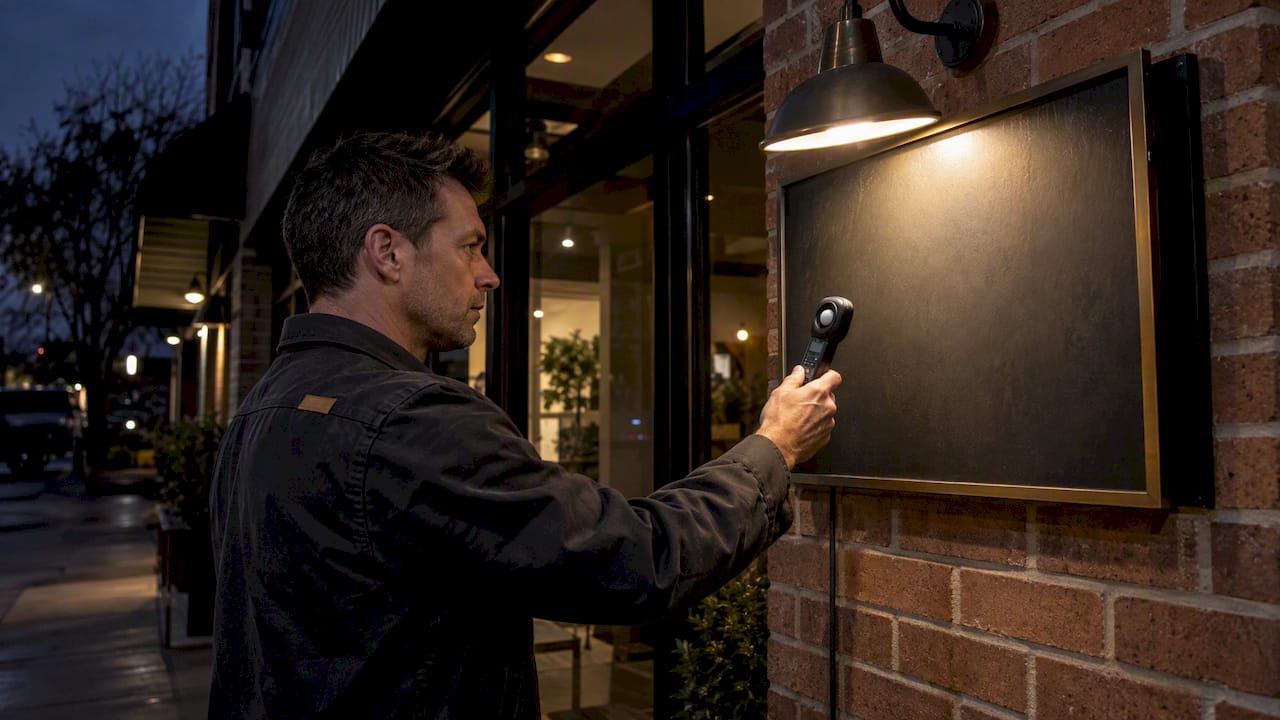
Charlotte’s exterior lighting rules require fixtures to stay shielded and aimed so light does not spill onto neighboring residential lots or public rights-of-way, with added restrictions on sign illumination, strobe effects, and brightness. Most homeowner projects do not need a separate lighting permit, but commercial work, new site plans, or tall fixtures usually trigger development review. Before you install anything, confirm your fixture type and whether your project counts as a “site plan” change under the Charlotte UDO.
TL;DR:
- Electronic message signs must stay at or below 5,000 nits by day and 500 nits from dusk to dawn, with automatic dimming controls.
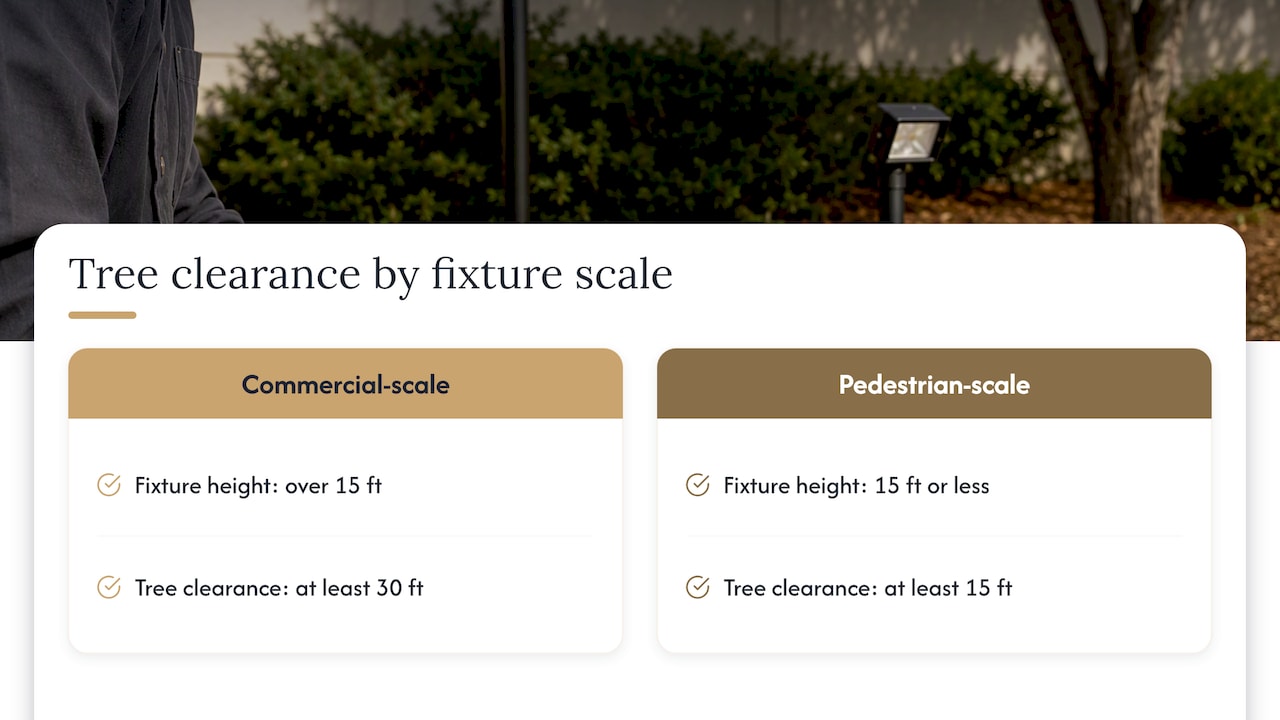
- During development review, commercial fixtures taller than 15 feet need 30 feet of tree clearance, while fixtures 15 feet or lower need 15 feet.
- Commercial and multifamily submissions typically need fixture cut sheets, a photometric plan, and site or landscape plans showing heights, locations, setbacks, and tree clearances.
- HOA approval can differ from city approval, so check both before installation; a design that meets Charlotte’s code may still violate neighborhood rules.
Table of Contents
- What Counts as Exterior Lighting Under Charlotte’s UDO
- The Core Rules: Shielding, Glare, and Sign Illumination Limits
- When Your Project Needs a Permit or Development Review
- A Compliance Checklist That Keeps Your Permit Moving
- Installation Standards That Support a Clean Inspection
- Where to Verify Rules and What Enforcement Looks Like
- What Charlotte Homeowners Often Miss About This Ordinance
- How We Help Charlotte Properties Stay Code-Ready
- FAQ
- Sources
What Counts as Exterior Lighting Under Charlotte’s UDO
Charlotte’s Unified Development Ordinance defines “exterior lighting” broadly: any fixture mounted outdoors that illuminates a site, building face, parking area, or sign. The UDO’s technical definitions also separate “external sign illumination,” meaning light aimed at a sign from an outside source, from lighting that is part of the building or landscape design. That distinction matters because sign lighting carries its own, stricter set of rules.
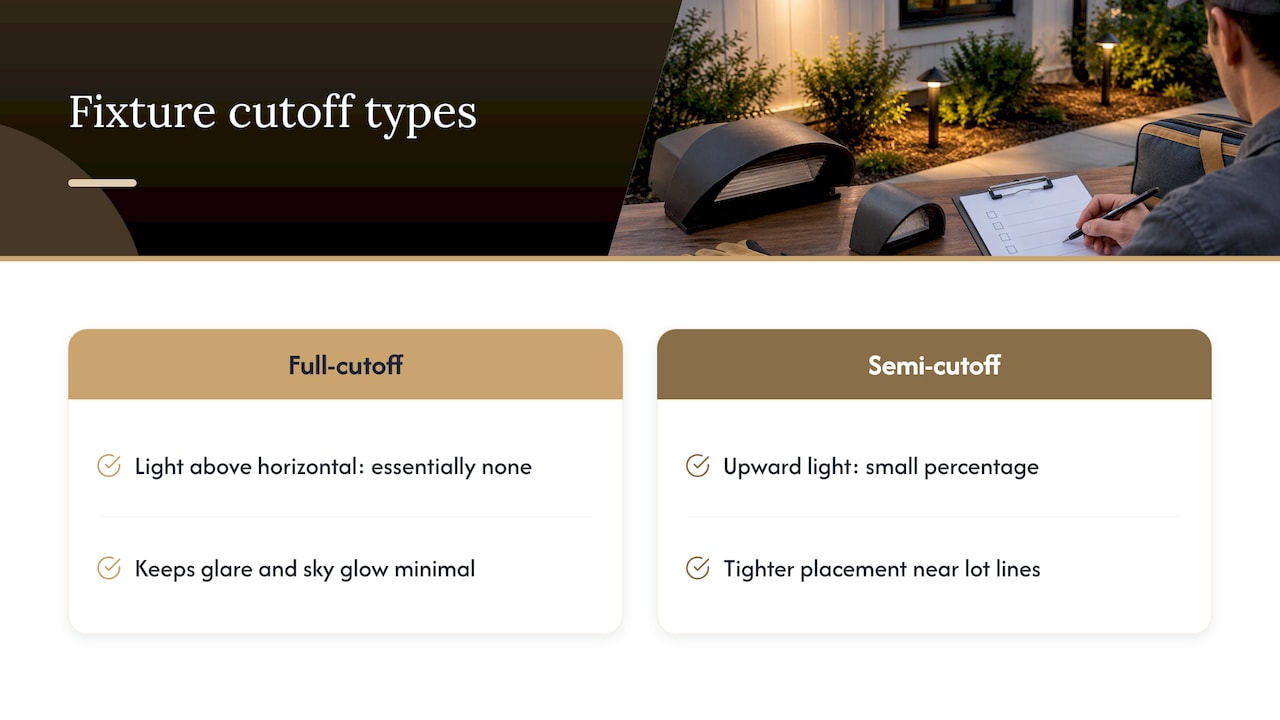
The ordinance also classifies fixtures by light distribution. A full-cutoff fixture directs essentially no light above the horizontal plane, which keeps glare and sky glow to a minimum. A semi-cutoff fixture allows a small percentage of light to escape upward, so it works for some accent applications but faces tighter placement requirements near lot lines. These classifications come straight from the UDO’s technical provisions, and checking the PDF language before you buy fixtures saves you from choosing the wrong distribution type for your lot.
Knowing which category your lights fall into is the first real compliance decision you will make, since it determines how close to the property line you can mount them and how much shielding you need.
The Core Rules: Shielding, Glare, and Sign Illumination Limits
Charlotte’s lighting rules center on one idea: keep your light on your property. The municipal code requires nonresidential outdoor lighting to be located, screened, or shielded so it does not directly illuminate an abutting residential lot, and it cannot impair a driver’s vision on an adjacent street. Sign lighting faces additional constraints under Article 22, which sets a one-footcandle limit at the lot line for externally illuminated signs, with specific measurement exceptions.
A few behaviors are off-limits almost everywhere in the city:
- Strobe, searchlight, and flashing sign lighting are prohibited outside the UC (urban commercial) district.
- Electronic message signs must comply with brightness limits during the day and at night, transitioning automatically with dimmers or ambient-light sensors.
- Lighting aimed at a sign cannot double as a way to skirt the general glare and shielding rules that apply to the rest of the property.
Fixture aim, shielding, and cutoff classification work together to satisfy these rules. A full-cutoff fixture aimed straight down and set back from the lot line clears most glare concerns before you even file paperwork. If your project includes signage, our partners at Custom Signs Today walk through sign-specific illumination basics that pair well with the UDO’s technical language.
When Your Project Needs a Permit or Development Review
Most single-family homeowners adding accent or landscape lighting to an existing house will not trigger a standalone lighting permit. Development review enters the picture once your project involves a new or amended site plan, which is common for commercial buildings, multi-family developments, and any project that already requires landscape plan approval.
Article 16 and the city’s preconstruction guidance call for site lighting to appear on landscape plans whenever a project goes through development review. That guidance includes clearance expectations: commercial-scale fixtures taller than 15 feet should sit at least 30 feet from trees, while pedestrian-scale fixtures at 15 feet or lower need at least 15 feet of clearance. These numbers protect root zones and keep light distribution from being blocked by canopy growth later.
Because ordinance language changes over time, confirm you are reading the current UDO text rather than an older code reference tied to a prior approval. The permitting office can tell you which version applies to your parcel and whether your scope counts as a minor modification or a full site plan review. For a deeper walk-through of this process, see our guide on avoiding permit delays for Charlotte outdoor lighting.
A Compliance Checklist That Keeps Your Permit Moving
Reviewers look for specific documentation, and missing even one item is the most common reason a submission stalls. Gathering these pieces before you file saves weeks:
- Fixture cut sheets showing the cutoff classification (full-cutoff or semi-cutoff) for every exterior fixture.
- A photometric plan or point-by-point illuminance drawing for commercial and multi-family projects.
- A site or landscape plan marking fixture locations, mounting heights, and setbacks from lot lines and trees.
- A citation of the relevant UDO article and your property’s zoning district, included directly in the submission narrative.
- Documented tree-clearance measurements where fixtures sit near existing canopy.
On the design side, full-cutoff fixtures, proper shielding, and conservative aiming angles clear glare review faster than semi-cutoff options placed close to a boundary. Dimming controls or timed curfews also help with sign and brightness compliance, and warmer, lower-glare color temperatures tend to draw fewer complaints from adjacent property owners. Our breakdown of how outdoor lighting reduces glare without losing curb appeal covers these choices in more detail.
Pro Tip: Label every fixture’s mounted height on your site plan in feet, since reviewers use that figure directly against the tree-clearance and setback standards.
Photometric plans, in particular, are worth handing to a professional. Getting the math wrong on a point-by-point layout is one of the most common reasons commercial submissions bounce back for revision.
Installation Standards That Support a Clean Inspection
Charlotte’s ordinance tells you where light can go; national installation standards tell you how to wire and mount it safely. NECA/IESNA 501 is the recommended practice for installing exterior lighting systems, and it explicitly calls for conformance with the National Electrical Code, published as ANSI/NFPA 70. Together, these standards cover grounding, circuit protection, and mounting practices for the fixture types most Charlotte properties use.
Following NECA/IESNA 501 and NFPA 70 does more than satisfy an inspector. It reduces the odds of a failed rough-in inspection, protects fixtures against moisture and voltage issues over time, and gives you paperwork to point to if a question comes up later about how a system was installed. When you are vetting an installer, ask for wiring diagrams, grounding details, and a written statement of adherence to these standards. Reputable installers keep this documentation on hand as a matter of course.
Where to Verify Rules and What Enforcement Looks Like
The UDO technical PDFs, Article 16, and Article 22 are the authoritative sources for current lighting requirements, and Charlotte’s permitting office can confirm which code version applies to your project. Enforcement for violations typically starts with a correction notice, which can escalate to a stop-work order on active construction or a requirement to replace noncompliant fixtures. Exact remedies vary by case, so verify specifics with the city before assuming what applies to your situation. When documentation gets complicated, a licensed installer or code professional familiar with Charlotte’s current UDO text can save you a revision cycle.
What Charlotte Homeowners Often Miss About This Ordinance
The part of this ordinance that trips people up isn’t the footcandle math, it’s the assumption that “bright” and “noncompliant” are the same thing. A well-shielded, fully aimed fixture can run brighter than a sloppy one and still pass review, because Charlotte’s rules care about where light goes, not just how much of it there is. Homeowners who fixate on wattage and skip the shielding conversation are solving the wrong problem.
The other blind spot is HOA overlap. An HOA architectural review committee can reject a design the UDO would approve without issue, and vice versa, so treating city code as the only hurdle is a mistake we see often among Charlotte property owners planning their first serious lighting project. Our guide to ARC-ready HOA outdoor lighting covers that overlap in more depth.
— Dave
How We Help Charlotte Properties Stay Code-Ready
We design and install every project with shielding, aiming, and setback rules in mind from the first site visit, so your fixtures look right and clear review without rework. 
Our landscape lighting design and architectural lighting services include full documentation support, and our permanent roofline and holiday lighting systems are engineered for Carolinas weather with HOA-compliant design built in from the start. For larger properties, our commercial and municipal holiday display installs come with the photometric and site-plan preparation that development review expects. Ongoing maintenance programs keep systems aligned with code as fixtures age.
Ready to see what a permit-aware installation looks like on your property? Request a free estimate through our permanent lighting services page and we will walk you through the design before a single fixture goes up.
FAQ
Do I need a permit for residential landscape lighting in Charlotte?
Most residential landscape and accent lighting on an existing home does not require a standalone permit, though shielding and glare rules still apply. Projects tied to a new site or landscape plan, such as new construction or major renovation, typically fall under development review.
What is the difference between full-cutoff and semi-cutoff lighting?
A full-cutoff fixture directs light downward with essentially none escaping above the horizontal plane, which minimizes glare and sky glow under the Charlotte UDO’s technical definitions. A semi-cutoff fixture allows a small amount of upward light, which means tighter placement rules near lot lines.
Are flashing or strobe exterior lights allowed in Charlotte?
Flashing, strobe, and searchlight-style sign lighting is prohibited across most of Charlotte, with an exception for the UC zoning district under Article 22. This applies specifically to sign illumination rather than general architectural or landscape lighting.
How bright can an electronic sign be under Charlotte’s rules?
Electronic message signs are capped at 5,000 nits during daylight hours and 500 nits between dusk and dawn, and they must include dimmers or ambient-light sensors to shift automatically, per Article 22. These limits apply regardless of the sign’s size or location.
What documents does the city want for a commercial lighting project?
Reviewers typically expect fixture cut sheets with cutoff classification, a photometric or point-by-point illuminance plan, and a site plan showing fixture locations, mounting heights, and setbacks. Development projects also need lighting shown directly on the landscape plan under Article 16.