
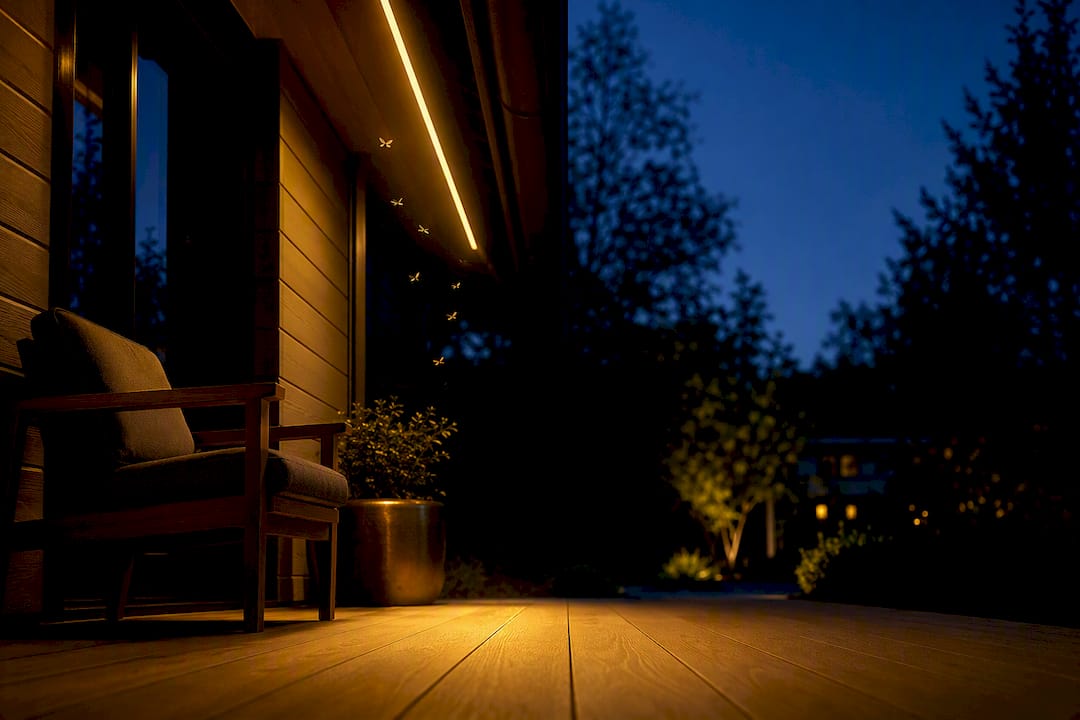
Yes, LED lights attract bugs, but usually fewer than older lamp types when the spectrum and brightness are managed well. The real drivers are wavelength (blue and UV pull in the most insects), brightness, and how the fixture is shielded and aimed. Two quick fixes matter most: choose warm or amber LED spectra, and dim or shield your fixtures so less light spills into the yard.
TL;DR:
- Using warm or amber LED bulbs in the 2000K to 2700K range significantly reduces insect attraction compared to higher color temperature options.
- Shielding fixtures and aiming them downward further decreases bug influx more than changing light color alone.
- Spectral tuning matters more than simply switching to LED; narrowband red, amber, or yellow LEDs attract the fewest bugs across most insects.
- Fixture design and placement, such as reducing horizontal and upward spill and mounting fixtures lower and aimed tightly, are crucial for minimizing bug activity.
Table of Contents
- Do LED Lights Attract Fewer Bugs Than Incandescent or CFL Bulbs?
- Why Bugs Fly Toward Light in the First Place
- Which LED Colors and Temperatures Attract the Fewest Bugs
- Fixture Design and Placement Choices That Cut Bug Counts
- Your Step-By-Step Checklist for Bug-Resistant Outdoor Lighting
- How Forever Glow Lighting Balances Curb Appeal and Bug Control
- Specify the Light, Don’t Blame the Bulb
- Get Bug-Smart Outdoor Lighting Without Sacrificing Curb Appeal
- Sources
- FAQ
Do LED Lights Attract Fewer Bugs Than Incandescent or CFL Bulbs?
Field research points to a consistent pattern: LEDs generally out-perform incandescent and compact fluorescent lamps when the goal is fewer insects at the porch light. Comparative trap studies found that domestic LEDs caught roughly half as many insects as CFLs in matched trials, and filament bulbs fared worse than both.
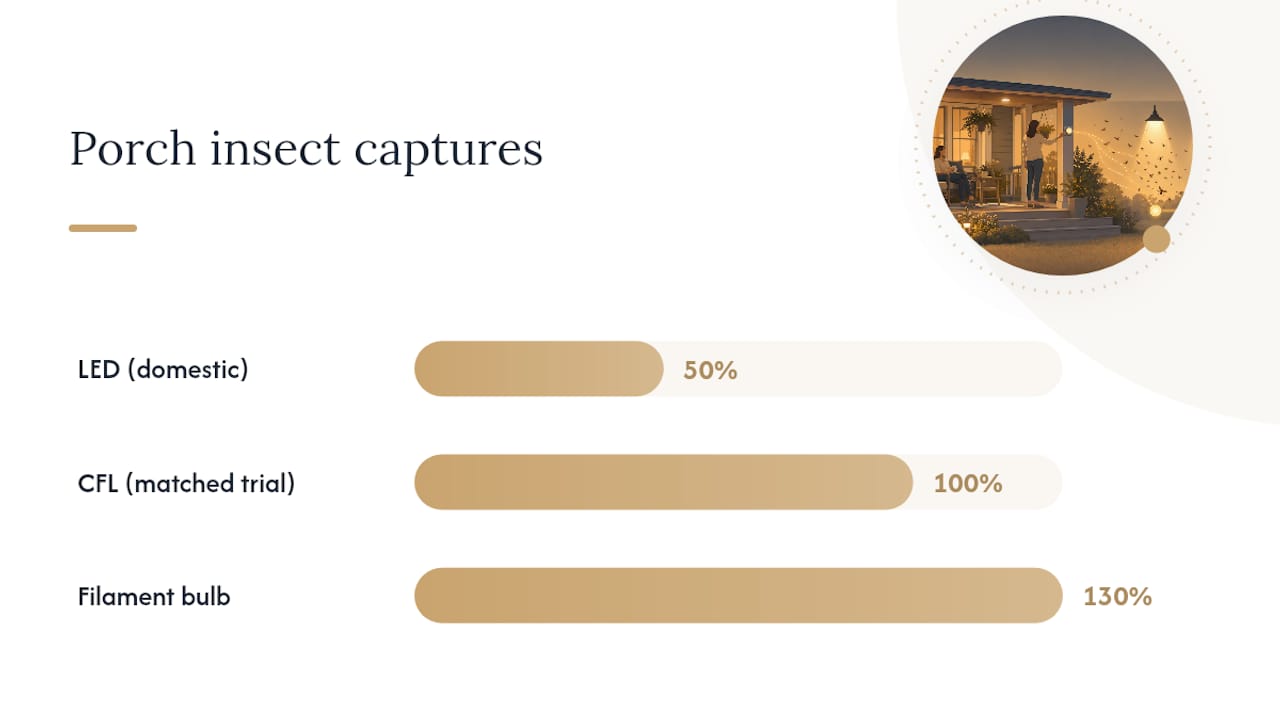
The gap comes down to spectral output, not the “LED” label itself. Incandescent bulbs and older CFLs emit a broad spectrum heavy in the blue and UV wavelengths that most flying insects key in on. LEDs can be engineered to skip those wavelengths almost entirely, which is why the technology has an advantage on paper. That advantage disappears if you buy a cool white LED that emits just as much blue light as the CFL it replaced.
Comparisons against high pressure sodium (HPS) street lamps are messier. Some large scale experiments found that LED street lighting reduced total insect captures compared with older discharge lamps, but the effect size shifted depending on the insect order being measured. Moths responded differently than beetles, and beetles responded differently than midges. That variability is the reason blanket claims like “LEDs always attract fewer bugs” don’t hold up under scrutiny.
What this means for a homeowner shopping for bulbs:
- LEDs beat incandescent and CFL in most head-to-head trap tests, especially for moths and small flying insects.
- The comparison against HPS or older municipal lighting is inconsistent and depends heavily on which bugs are common in your area.
- A cheap cool white LED can perform worse than a well-chosen incandescent bulb, because color temperature, not bulb category, is doing the real work.
- Spectral tuning, not just switching to LED, is what separates a low-attraction fixture from a bug magnet.
Why Bugs Fly Toward Light in the First Place
Insects don’t seek out light because they’re drawn to warmth or brightness the way we imagine a moth “loving” a flame. Most nocturnal species navigate by orienting to natural light sources like the moon and stars, and an artificial point source close to the ground scrambles that system. The stronger and shorter the wavelength, the more species respond to it.
Wavelength sensitivity drives most of the effect. Multi-order field tests found that UV and blue wavelengths attracted significantly more nocturnal insects than longer wavelengths, with red light drawing the fewest insects across the orders tested. That single finding explains most of what homeowners experience: a bug light that looks yellow but still spikes in the blue range will still pull in a crowd.
Color temperature is really a proxy for blue content. A bulb rated at 5000K or 6500K contains far more blue wavelength energy than one rated at 2200K, even though both are labeled “white.” Manufacturers rarely print spectral graphs on the box, so the Kelvin rating is often the only clue a shopper gets.
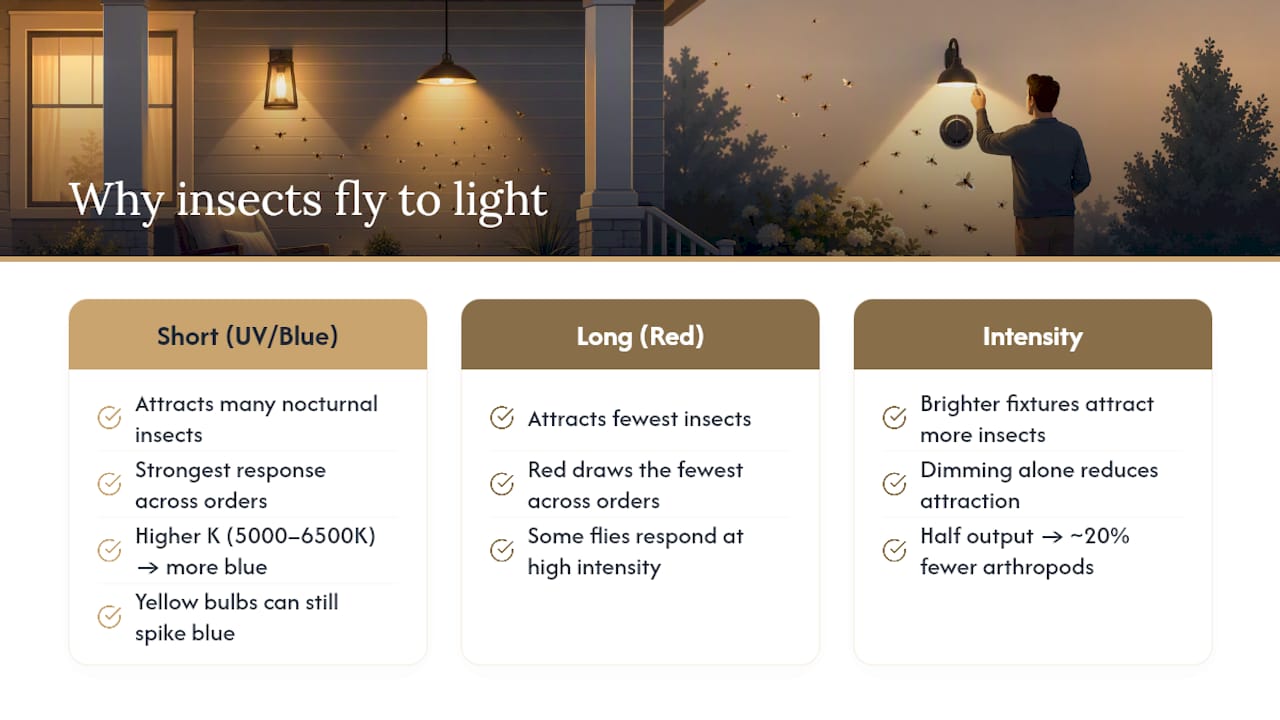
Intensity matters almost as much as color. Brighter fixtures attract more insects than dim ones running the same spectrum, which is why dimming schedules work even without changing the bulb.
Flicker, polarization, and fixture heat play smaller supporting roles. Some insects are sensitive to the rapid pulsing of poorly made LED drivers, and heat can influence which species linger near a fixture versus which ones investigate and leave. None of this changes the two dominant variables.
By the numbers: Field research on dimming and shielding found that reducing light output by half cut arthropod abundance by a notable percentage, approximately one-fifth in controlled trials, without changing the bulb color at all.
No single fix eliminates every insect. Certain flies remain responsive to green and even red light at high intensity, which is why layering spectrum changes with dimming and shielding beats relying on any one adjustment alone.
Which LED Colors and Temperatures Attract the Fewest Bugs
If you’re replacing bulbs specifically to cut insect traffic, the color temperature number on the packaging is your best quick filter. Lower is better, and true amber or near-red options beat every white LED on the market for insect avoidance.
- 2000K to 2700K “warm white” LEDs cut blue content substantially compared with 4000K+ options, and they work in almost any standard fixture without looking clinical.
- Amber and yellow “bug light” LEDs push the spectrum even further from blue, often marketed specifically for porches and patios.
- Narrowband red or near-red LEDs perform best in trials but render color poorly, so they suit security or utility fixtures more than spaces meant for entertaining.
- Tunable, custom-spectrum LEDs built to minimize short-wavelength output attracted significantly fewer arthropods than standard commercial LEDs or CFLs of similar color temperature in controlled comparisons, showing that engineering matters more than the Kelvin number alone.
The tradeoff is color rendering. A 2200K amber bulb makes your siding, plants, and outdoor furniture look flatter than a crisp 4000K fixture would. Spectral tuning often sacrifices some Color Rendering Index (CRI) performance and efficiency to hold the line on insect attraction, so professionals typically mix tuned amber fixtures in high-traffic zones with brighter, whiter accents elsewhere on the property.
One more catch: “warm white” isn’t a regulated term. Two bulbs both labeled 3000K can carry different blue spikes depending on the phosphor coating and chip design. If insect attraction is the priority, look for a published spectral power distribution chart rather than trusting the box copy alone.
Fixture Design and Placement Choices That Cut Bug Counts
The bulb only accounts for part of the equation. How the light is housed, aimed, and scheduled often moves the needle more than the color temperature does.
- Choose focused, downward-directed fixtures over globes. Diffusing globe fixtures scatter light in every direction and increased flight-active insect captures by roughly 63 percent compared with well-focused luminaires in controlled testing.
- Add hoods, louvers, or full cutoff housings. These block horizontal and upward spill, which limits how far the visible light footprint extends into the yard and keeps the glow closer to the surface you’re actually lighting. This approach also helps with glare reduction around entryways and patios.
- Set dimming schedules or motion activation for peak hours. Insect activity spikes hardest in the window shortly after sunset, so a scene that dims automatically during that stretch does more good than swapping every bulb in the house.
- Adjust mounting height and aim. A fixture mounted lower and angled tightly toward a walkway exposes far less light to passing insects than the same bulb mounted high and aimed broadly.
Pro Tip: If you’re lighting flower beds or landscaping near the house, keep fixtures aimed at foliage rather than open air above it. Pollinator-heavy zones concentrate insect activity, and a tighter beam around planted areas keeps that activity from drifting toward doors and windows.
Your Step-By-Step Checklist for Bug-Resistant Outdoor Lighting
Work through these in order. Each step builds on the last, and skipping ahead usually means redoing work later.
- Pick the bulb spectrum and fixture type together. Start with a warm or amber LED in the 2000K to 2700K range, and pair it with a directional, shielded fixture rather than an open globe.
- Set your lumen output and build a dimming schedule. Test the fixture at night, watch for insect activity in the first hour after sunset, and dial brightness down if you’re still seeing swarms near entry points.
- Add physical shielding and check your neighbors’ lights. A hood or louver on your fixture won’t help much if the house next door runs an unshielded floodlight ten feet away. For layouts with multiple zones, decks, or architectural features, a layered lighting plan designed by a professional avoids gaps that a DIY approach tends to miss.
- Troubleshoot persistent problems. If bugs are still gathering after the spectrum and fixture changes, check for a hidden blue spike in your bulb’s spectral output, swap to a narrower amber LED, or add a physical barrier like a screen near the fixture.
Most homeowners see a noticeable drop after step one alone. The remaining steps handle the outliers, the moths and flies that show up no matter what color bulb you’re running.
How Forever Glow Lighting Balances Curb Appeal and Bug Control
Permanent LED track systems give homeowners more control than swapping individual bulbs ever could. Because the fixtures are integrated into the roofline and landscape rather than bolted on as an afterthought, Foreverglowlighting can specify warmer, lower-attraction spectra in high-traffic zones while keeping brighter accents elsewhere for visual impact.
Smart controls make the dimming schedule practical instead of theoretical. A homeowner can set a bright welcome scene for evening entertaining, then let the system automatically drop to a low overnight setting once guests have gone inside, cutting both insect exposure and energy use at the same time. That level of control also means adjustments can happen through an app rather than manually changing bulbs.
Specify the Light, Don’t Blame the Bulb
The “LEDs attract bugs” debate misses the point. Spectrum, intensity, and fixture design determine insect attraction, not the underlying technology. Homeowners who treat color temperature and shielding as design decisions, not afterthoughts, get the outdoor lighting they want without turning the porch into a moth convention. Run through the checklist above, and bring in a professional for anything more complex than a single fixture swap.
— Dave
Get Bug-Smart Outdoor Lighting Without Sacrificing Curb Appeal
Choosing the right bulb is only half the battle. Permanent LED systems are engineered around the same spectral and fixture principles covered above, with climate-optimized hardware and HOA-compliant design adapted for regional climates. That means warmer, lower-attraction color temperatures where you need them, focused and shielded fixtures instead of spill-prone globes, and smartphone-controlled dimming schedules that automatically cut brightness during peak insect hours after sunset.
Whether you’re planning landscape lighting around flower beds, a patio and bistro string setup for entertaining, or a full roofline system, professional installation means the spectral tuning and fixture shielding get handled correctly the first time, no ladder, no guesswork on bulb specs. Request a free estimate and get a lighting plan designed to look good and keep the bugs down.
Sources
- Intensity and colour of artificial light at night affect insect attraction in a taxon‐dependent manner
- Mitigating light pollution impacts on arthropods based on light‑emitting diode properties
FAQ
What Type of Lights Do Not Attract Bugs?
No light is completely bug-proof, but narrowband amber, yellow, or red LEDs in the low color temperature range attract the fewest insects across most field trials. Pairing that spectrum with a shielded, downward-facing fixture cuts attraction even further than the bulb color alone.
Does LED Light Attract Roaches?
Roaches respond more to warmth, food odors, and shelter than to light itself, and they generally avoid bright light rather than seek it out. A cool white LED near a door or trash area is more likely to attract the flying insects that roaches then feed on, so spectrum and fixture placement still matter indirectly.
What Color Light Is Least Likely to Attract Bugs?
Red light attracted the fewest insects across taxa in multi-order field testing, with blue and UV wavelengths attracting the most. Warm white LEDs in the 2000K to 2700K range offer a practical middle ground between low attraction and normal color rendering.
Do LED Strip Lights Attract Spiders?
LED strips don’t attract spiders directly since spiders aren’t drawn to light. They build webs near light sources because that’s where flying insects gather, so a strip light running blue-heavy white LEDs can indirectly draw more spiders than a warm amber strip with the same brightness.