
A properly designed, code-compliant permanent LED lighting system is safe to leave installed and can run continuously when it includes GFCI protection and correct wiring. Seasonal string lights are not built for that kind of year-round duty. LEDs run cooler and draw far less power than incandescent strings, and NEC-required GFCI protection adds a critical layer of defense against shock and fire. Below, we walk through the inspection points, wiring standards, and maintenance habits that keep a permanent system safe, along with how professional installation through Forever Glow Lighting fits into that picture.
TL;DR:
- Choose outdoor products with UL or ETL marks and Supplement SD, or explicit year round certification; seasonal strings are not designed for permanent use.
- Temporary decorative lighting can stay up for 90 days under NEC Article 590; permanent fixtures generally fall under Article 410 and may require inspection.
- Test the GFCI monthly and inspect visible wiring; repeated trips, warm fixtures, flickering, or damaged cords call for a licensed electrician.
- Ask installers to verify wet location ratings, sealed junction boxes, correctly sized wiring, and GFCI protection; panel work and new circuits belong to licensed electricians.
Table of Contents
- Why LEDs and purpose-built systems lower fire and electrical risk
- Code, inspections, and required protections homeowners must check
- Installation and wiring practices that reduce risk
- Permanent systems vs. seasonal strings: what the labels actually mean
- Can permanent lights stay on? energy, timers, and practical limits
- Maintenance and testing checklist for lasting safety
- Practitioner notes on warranties and long-term reliability
- What matters most when choosing permanent lighting
- Forever Glow Lighting: safe permanent holiday lighting, designed and maintained for you
- FAQ
- Sources
Why LEDs and purpose-built systems lower fire and electrical risk
The safety case for permanent lighting starts with the bulb itself. LED holiday lights use roughly 70% less energy than incandescent strings and generate far less heat, which directly reduces both fire risk and the load placed on a household circuit, according to EnergySage.
LED strings typically cut energy use by about two thirds compared to incandescent lights, according to EnergySage, which also means significantly less heat buildup at each socket over long run times.
The failure behavior differs too. The Department of Energy explains that older incandescent sets relied on shunts that let current bypass a burned-out bulb, a design that could create its own hazards, while LED sets generally fail in ways that avoid that particular shunt-related risk.
Beyond the bulbs, system design matters just as much:
- Properly sized transformers prevent voltage drop and overheating across long runs.
- Low-voltage architecture (commonly 12 to 24 volts) reduces shock risk compared to line-voltage strings.
- Correctly matched wire gauge keeps conductors from overheating under sustained load.
A permanent installation engineered around these factors behaves nothing like a seasonal string looped over a gutter.
Code, inspections, and required protections homeowners must check
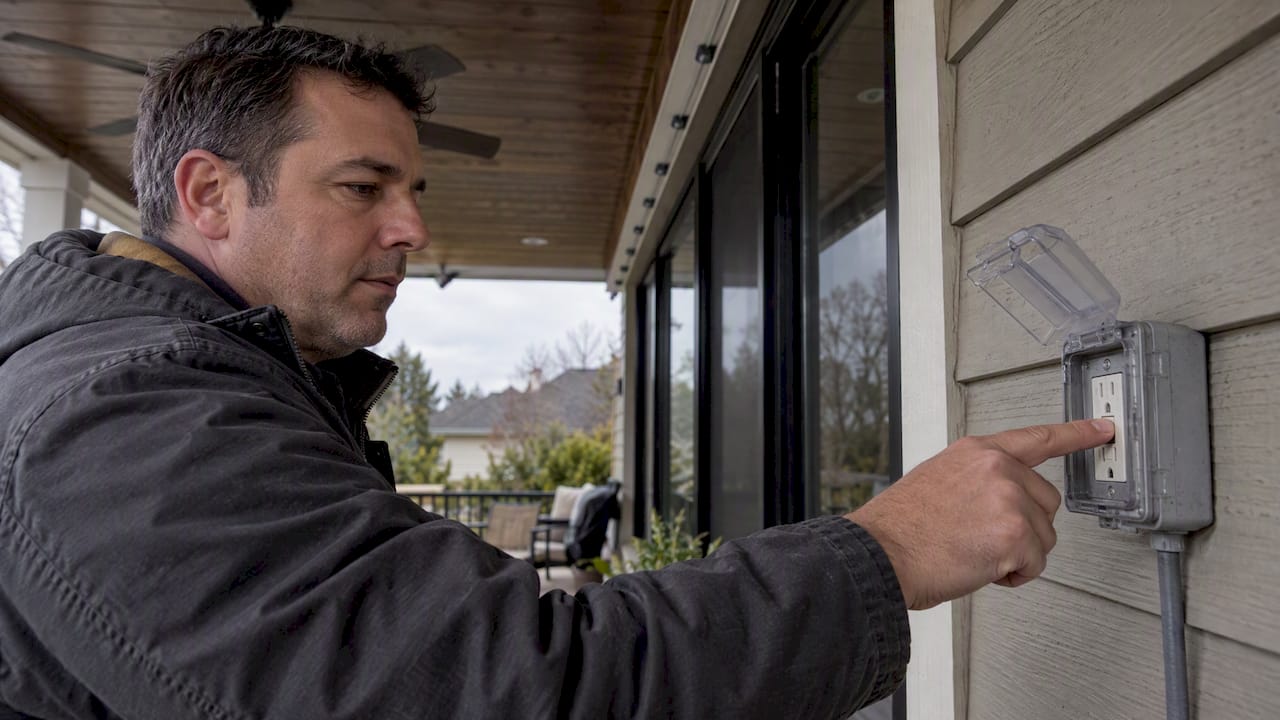
Outdoor lighting falls under specific National Electrical Code requirements, and knowing them helps you ask the right questions before signing off on an installation. NEC Section 210.8(F) requires GFCI protection for outdoor 120-volt luminaires, a safeguard the NFPA highlights as a meaningful win against moisture-related shock hazards common to exterior fixtures.
There’s also a timing distinction worth understanding:
- NEC Article 590 allows temporary decorative lighting to remain up for up to 90 days without triggering the stricter requirements of a fixed installation.
- Once lighting stays up longer or becomes a permanent fixture, it falls under Article 410 and typically needs inspection against fixed-lampholder standards.
- The NFPA notes that whether an authority having jurisdiction requires inspection often depends on the scope of the installation and whether it was designed to be permanent from the start.
Inspectors checking a permanent system look for consistent listing marks, wet-location-rated lampholders, sealed junction boxes, and hard-usage cord types where exposed to weather.
Pro Tip: Test any GFCI protecting your outdoor circuit monthly using its built-in test and reset buttons; a GFCI that won’t reset signals a problem that needs a qualified electrician.
For more on keeping GFCI-protected outdoor circuits reliable, our guide on pool area lighting safety covers similar testing routines that apply just as well to permanent holiday lighting.
Installation and wiring practices that reduce risk
What separates a safe permanent system from a liability often comes down to details most homeowners never think to check. A qualified installer should be able to speak to each of these without hesitation:
- Every exposed fixture and connector carries a wet-location rating suited to direct weather exposure.
- Circuit wattage is calculated up front, matched to appropriate breaker and conductor sizing, and backed by GFCI protection.
- Cables are secured with strain relief and routed along rooflines in a way that avoids sharp edges, gutters, or areas prone to mechanical damage from landscaping equipment, as advised by Outdoor Lighting – Divine Landscaping LLC.
- Junction boxes are sealed against moisture intrusion, not just taped or wrapped.
Panel connections, new circuit runs, and any permit paperwork belong with a licensed electrician, not a weekend project. Our own process walks through exactly how permanent lighting installation works, including where electrical work requires a licensed professional rather than a general installer.
Permanent systems vs. seasonal strings: what the labels actually mean
Not every string of lights is built for the same job, and the label tells you which category you’re holding. UL Solutions maintains UL 588 and its Supplement SD specifically to distinguish seasonal string lights from products certified for all-year outdoor use.
When you’re checking a product or a proposed installation, look for:
- A wet-location rating appropriate for permanent outdoor exposure, not just “outdoor use” for limited periods.
- UL or ETL marks paired with Supplement SD or explicit “all-year” wording on the packaging or spec sheet.
- Low-voltage components (commonly 12 to 24 volts) with both fixture and driver listings verified separately.
Using a seasonal string light permanently, even one rated for outdoor use, tends to accelerate corrosion, void code compliance, and shorten the product’s working life far faster than a system designed for the job. We’ve laid out the practical differences in more detail in why permanent holiday lights beat seasonal ones.
Can permanent lights stay on? energy, timers, and practical limits
A permanent LED system designed and installed to code can run continuously without the fire risk associated with aging incandescent strings, largely because of the lower heat output and GFCI protection discussed above. That said, “can” doesn’t mean “should run nonstop with no oversight.”
LED systems use substantially less electricity than incandescent displays, according to EnergySage, which keeps continuous operation far more affordable than it would be with older bulbs.
Smart controls make continuous operation more practical and safer in daily use:
- Timers and photocells limit run-hours to when lighting is actually useful, cutting energy waste.
- App-based scheduling lets you adjust patterns for holidays, seasons, or security needs without touching a panel.
- Any energized system carries some non-zero risk, so routine visual checks still matter even with automated controls in place.
Maintenance and testing checklist for lasting safety
A permanent system is low-maintenance, not maintenance-free. A short routine catches most problems before they become hazards.
- Monthly: test the GFCI, inspect visible cords and fixtures for damage, and confirm mounting points are still secure.
- Seasonally: clean fixtures, reseal any exposed connectors, check for corrosion at junctions, and verify timer or app schedules are still behaving as expected.
- Anytime: watch for warm fixtures, flickering, or a GFCI that trips repeatedly.
Pro Tip: A GFCI that trips more than once in a short period, or a fixture that feels warm to the touch, is a sign to call a licensed electrician rather than reset and wait.
Persistent tripping or signs of panel capacity strain are also worth flagging to a professional before they turn into a larger repair.
Practitioner notes on warranties and long-term reliability
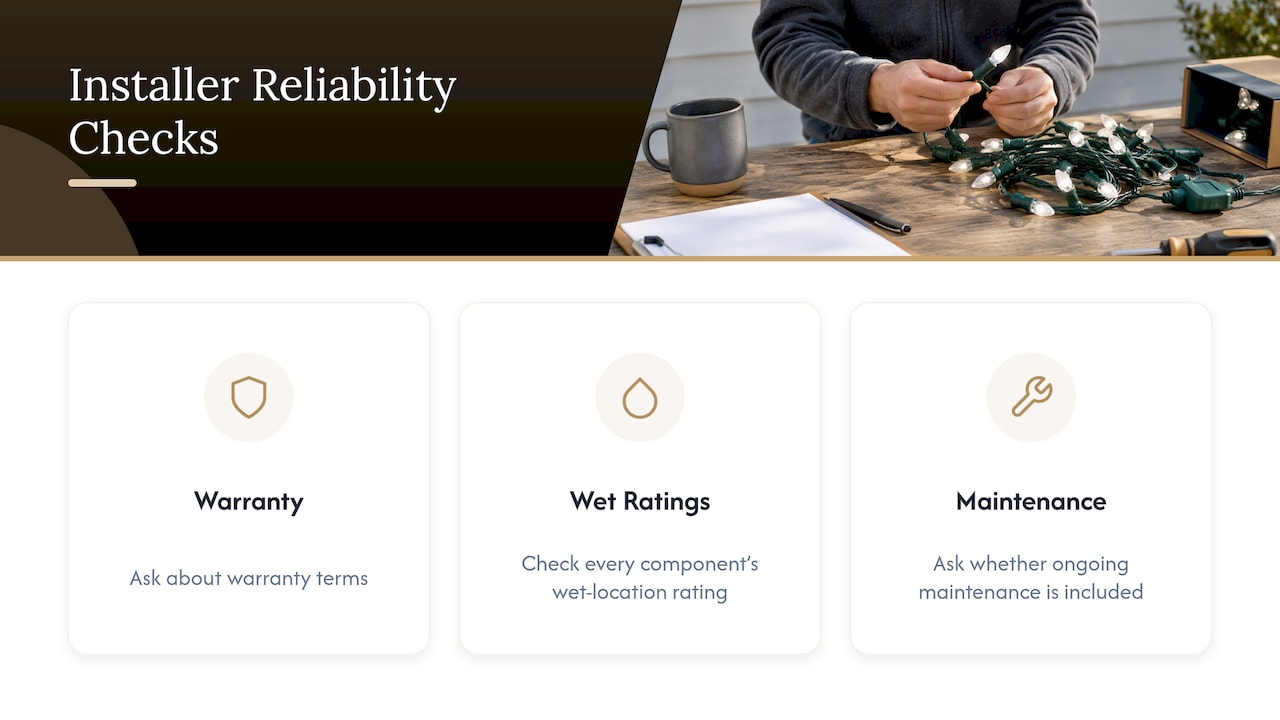
We install custom smart LED track systems designed to disappear into rooflines by day and run reliably by night, with smartphone control built in from the start. Before hiring anyone for permanent installation, ask about warranty terms, the wet-location rating of every component, and whether ongoing maintenance is included. Our breakdown of warranty questions worth asking and ideas for using permanent lighting beyond the holidays cover both angles in more depth.
What matters most when choosing permanent lighting
If you take one thing from all of this, make it this: listed components and GFCI-protected circuits aren’t optional extras, they’re the difference between a system that’s safe for a decade and one that becomes a liability after two winters. Convenience is real, but it only holds up when it’s built on code-compliant wiring and a maintenance habit, not just a nice-looking install.
— Dave
Forever Glow Lighting: safe permanent holiday lighting, designed and maintained for you
We design and install permanent holiday lighting systems built around listed, wet-location-rated components, GFCI-protected circuits, and low-voltage architecture suited for year-round Carolina weather. Testing, resealing, and inspection should happen on schedule instead of becoming a homeowner’s forgotten chore.

- Custom-installed smart LED track systems with smartphone color control for holidays and beyond.
- GlowCare Maintenance Subscription covering ongoing inspection and upkeep.
- Designs engineered for HOA and municipal compliance.
If you’d rather not climb a ladder or second-guess your wiring every winter, request a free estimate for permanent Christmas lighting and we’ll walk you through what a safe, code-compliant system looks like on your home.
FAQ
Are laser Christmas lights safe?
Laser holiday lights can pose real hazards when projected into open sky, since they can cause glare or temporary flashblindness for pilots, according to the FAA. Outdoor laser operations that project into navigable airspace may require FAA notification and must meet FDA performance standards, so aiming projectors downward and away from flight paths matters.
Is it okay to leave my Christmas lights on all the time?
A permanent LED system installed to code with GFCI protection can run continuously without the fire risk tied to older incandescent strings, largely thanks to lower heat output, according to EnergySage. Seasonal string lights, by contrast, aren’t designed for indefinite outdoor exposure and should come down or be replaced with an all-year-rated product.
Do permanent Christmas lights work?
Yes, permanent LED lighting systems are built to stay installed year-round and switch between holiday colors and everyday accent lighting through app or timer controls. They rely on low-voltage, weatherproof components rated for continuous outdoor exposure rather than seasonal strings swapped out each winter.
Do Christmas lights raise your electric bill?
LED holiday lights use roughly 70% less energy than incandescent strings, according to EnergySage, which keeps the added cost of running a permanent display modest compared to older bulb types. Using timers or photocells to limit run-hours trims that cost further.
Sources
- How much electricity do Christmas lights use? | EnergySage
- String lights for all-year use | UL Solutions (UL 588 Supplement SD)
- FAA Outdoor Laser Operations advisory circular
- How do holiday lights work? | U.S. Department of Energy