
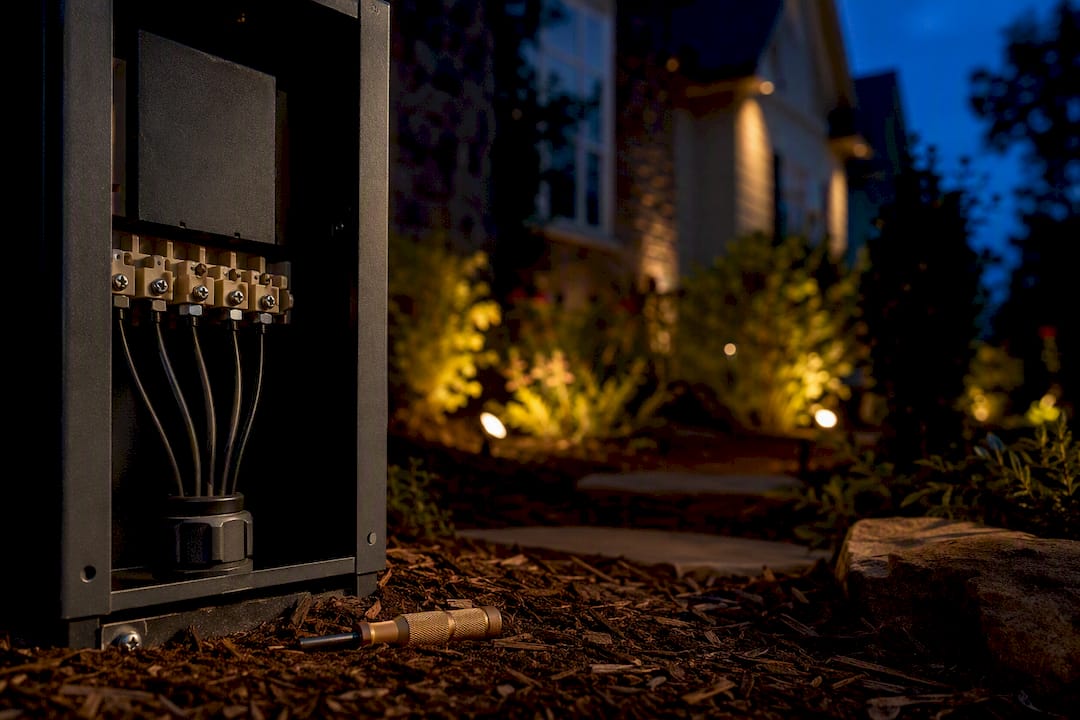
Add up the wattage or VA of every fixture, divide that total by 0.80, then choose the next standard transformer size up from the result. That 80% buffer protects the transformer from overheating, keeps voltage stable across the run, and leaves room to add fixtures later without buying a second unit. Long wire runs still shave off usable voltage, so wire gauge and tap selection matter almost as much as the transformer rating itself.
TL;DR:
- Always add the total wattage or VA of all fixtures and divide by 0.80 to find the minimum transformer size, then round up to the next standard size.
- Use wire gauges based on run length and load, with 16 AWG for short runs, 14 AWG for moderate distances, and 12 AWG for long or heavy loads, to minimize voltage drop.
- The number of fixtures a transformer can support depends on its size, with a 150W transformer typically supporting around 30 fixtures at 4 watts each under ideal conditions.
- Choosing an undersized transformer leads to overheating and early failure, while an oversized one costs more upfront but offers safer, more reliable performance.
- Opt for features such as multi-tap outputs, built-in timers, and weatherproof enclosures to ensure the system performs well over its lifespan, especially for longer or multi-zone setups.
Table of Contents
- What Is the Landscape Lighting Transformer Size Formula?
- How Do You Calculate Total Load for Landscape Lighting?
- Why Does the 80% Rule Matter When Sizing a Transformer?
- How Does Voltage Drop Affect Transformer and Wire Sizing?
- How Many Fixtures Can Each Transformer Size Support?
- What Happens if You Choose the Wrong Transformer Size?
- What Transformer Features Actually Matter?
- What Should Be on Your Installation Safety Checklist?
- Should You Size the Transformer Yourself or Call a Pro?
- Get Your Free Transformer Sizing Estimate
- Sources
What Is the Landscape Lighting Transformer Size Formula?
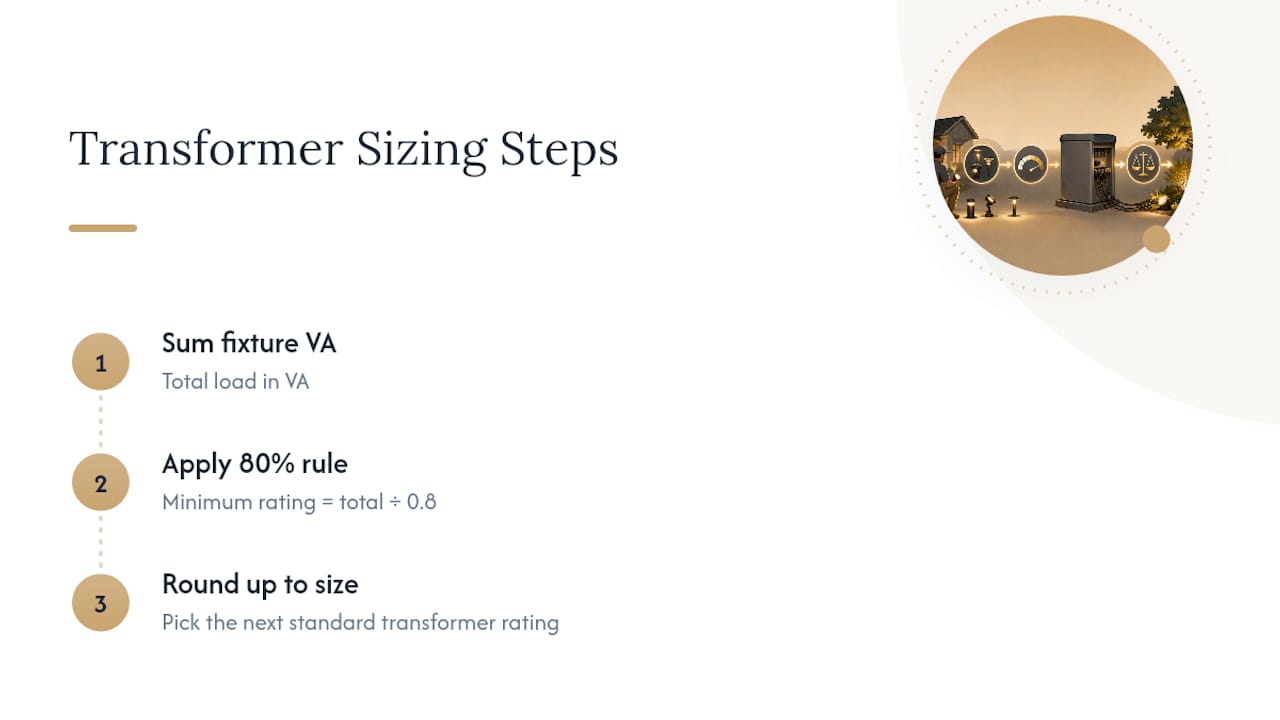
Sizing a transformer comes down to three steps, and none of them require an electrician’s math background.
- List every fixture’s wattage or VA. Add up the draw from every path light, spotlight, and well light you plan to run off that transformer.
- Divide the total by 0.80. This finds the minimum transformer rating that keeps your system inside the safe 80% load limit.
- Round up to the next standard size. Transformers come in fixed sizes (75W, 100W, 150W, and so on), so you pick the closest one above your calculated number.
Here’s a worked example. Ten path lights at 4 watts each equal 40 watts. Six spotlights at 7 watts each add 42 watts. Total load: 82 watts. Divide by 0.80 and you get a value slightly over 100 watts, so you select the next standard transformer size up, such as a 150W unit.
If a fixture’s spec sheet lists VA instead of watts, use the VA figure. VA and watts aren’t always identical for LED drivers, and VA tends to run slightly higher.
How Do You Calculate Total Load for Landscape Lighting?
Fixture wattage or VA usually appears on a sticker near the base, on the driver housing, or in the product spec sheet on the manufacturer’s site. If a fixture lists a wattage range instead of one number, count the high end. That protects you from underestimating load if you ever swap in a brighter bulb.
A few details trip people up here:
- LED drivers sometimes list both a rated wattage and a VA figure. When both appear, use VA.
- Fixtures with multiple integrated LEDs should be counted at their rated steady-state draw, not the brief inrush spike when they power on.
- Because LEDs draw far less power than incandescent equivalents, a modern low-voltage system often needs a smaller transformer than an older halogen setup covering the same yard.
Pro Tip: Keep a simple spreadsheet listing every fixture, its wattage or VA, and which wire run it’s on. That same sheet makes wire-gauge sizing per run much faster later, and it’s the first thing a contractor will ask for if you ever bring in a pro.
Why Does the 80% Rule Matter When Sizing a Transformer?
The formula is simple: minimum transformer rating = total load ÷ 0.8. That 20% margin isn’t arbitrary. Running a transformer at its full rated capacity around the clock shortens its life and leaves zero room for the extra spotlight you’ll want to add next spring.
Once you have your minimum rating, match it to the closest standard size above it by consulting a general contractor if you need broader electrical or trenching services alongside lighting installation.
If your calculated minimum lands between two sizes, always round up. A system sized this way has headroom built in from day one, rather than headroom you have to buy later as a second transformer.
How Does Voltage Drop Affect Transformer and Wire Sizing?
Voltage drop is the gradual loss of voltage as electricity travels down a wire. The farther a fixture sits from the transformer, the less voltage it actually receives, even though the transformer itself is putting out a full 12 volts.
Most manufacturers recommend keeping the last fixture on any run above roughly 10.5 volts to avoid dimming and premature bulb wear. Below that threshold, LEDs can flicker, shift color temperature, or fail early.
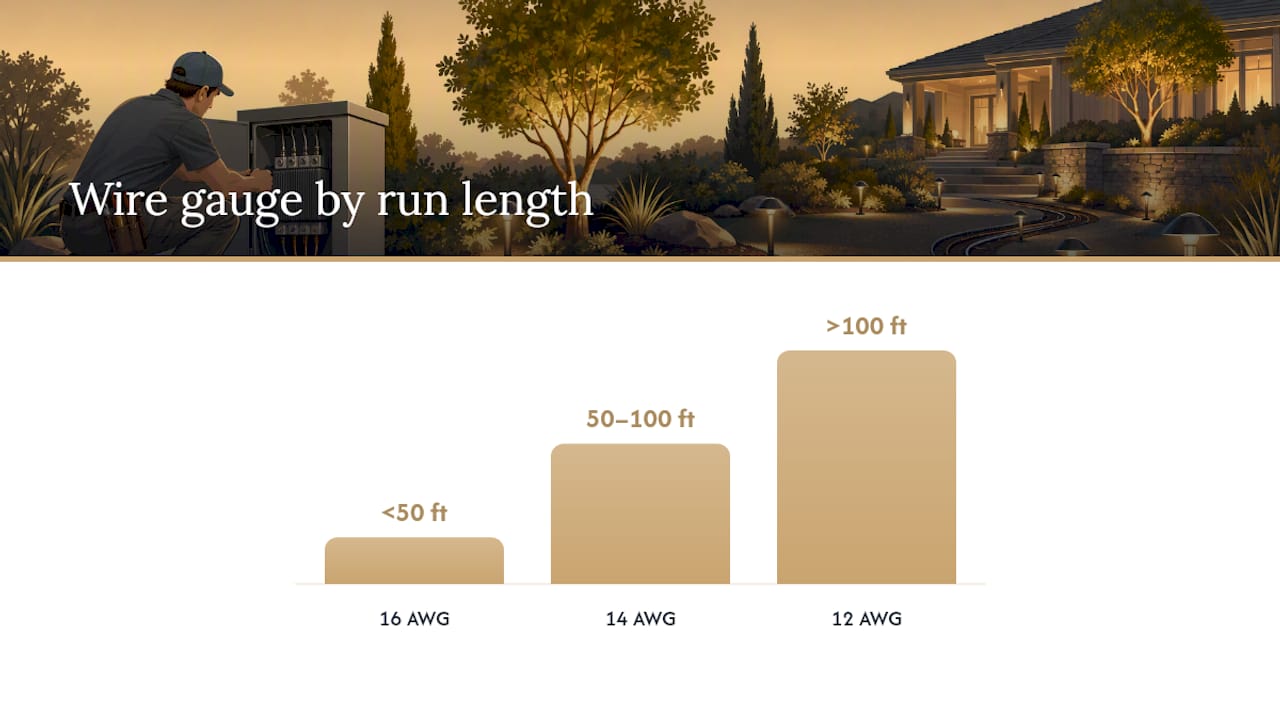
Wire gauge is your main tool for fighting this. As a practical guideline:
- 16 AWG works for short runs under 50 feet with light total loads.
- 14 AWG handles moderate runs, roughly 50 to 100 feet, or heavier total wattage.
- 12 AWG is the right call for long runs past 100 feet or any run carrying a heavy fixture load.
Most transformers also offer multi-tap outputs, typically 12V and 14V. If your farthest fixture is losing too much voltage on the standard 12V tap, switching that run to the 14V tap is often the simplest fix, cheaper than upgrading wire gauge across an entire run.
How Many Fixtures Can Each Transformer Size Support?
Once you know a transformer’s safe usable load, it’s easy to translate that into a rough fixture count. These numbers assume a single reasonably short run; add a second run or extra distance and the real count drops.
- 75W transformer (60W usable): about 15 fixtures at 4 watts each, or 8 to 9 fixtures at 7 watts each.
- 150W transformer (120W usable): about 30 fixtures at 4 watts each, or roughly 17 fixtures at 7 watts each.
- 300W transformer (240W usable): about 60 fixtures at 4 watts each, or roughly 34 fixtures at 7 watts each.
- 600W transformer (480W usable): about 120 fixtures at 4 watts each, or roughly 68 fixtures at 7 watts each.
Treat these as starting points, not guarantees. Long runs and split zones eat into usable capacity faster than the raw wattage math suggests.
What Happens if You Choose the Wrong Transformer Size?
An undersized transformer runs hot, flickers under load, trips its breaker, and wears out years ahead of schedule. An oversized unit costs more upfront and runs less efficiently at a tiny fraction of its rated capacity, but it’s the safer mistake of the two.
A few non-negotiables apply either way:
- Plug the transformer into a GFCI-protected outlet on its own dedicated circuit.
- Mount it according to the manufacturer’s clearance and height guidance.
- Keep it clear of sprinklers, downspouts, and standing water.
What Transformer Features Actually Matter?
Once wattage is settled, the features you pick shape how well the system performs day to day.
- Multi-tap outputs earn their keep on any property with a long run or multiple zones splitting off in different directions.
- Built-in photocells and timers handle dusk-to-dawn scheduling without a separate controller, though a smart app-based system gives you more control from your phone.
- Smart control compatibility matters if you want to adjust brightness or scheduling remotely rather than flipping a switch in the garage.
- A weatherproof, UL-listed enclosure with a clear warranty is worth paying for. UL testing standards for outdoor lighting equipment exist precisely because transformers live outside, year-round, in every kind of weather.
Pro Tip: If your yard has more than two zones or a run over 100 feet, budget for a multi-tap transformer from the start. Retrofitting tap changes later means re-terminating wire you already buried.
What Should Be on Your Installation Safety Checklist?
Before you bury a single foot of wire, run through this sequence:
- Map out every run and calculate the load per run, not just the whole-system total.
- Record each fixture’s spec sheet and keep the wattage totals with your project notes.
- Locate the transformer near a GFCI outlet, ideally on its own breaker, mounted at the manufacturer’s recommended height.
- Choose conduit and burial depth that match your local code, and keep the transformer well clear of pools or water features.
- Save your fixture list and calculated totals. It’s the fastest way to check whether your existing transformer has room before you add fixtures next season.
Should You Size the Transformer Yourself or Call a Pro?
Small jobs, a handful of path lights on one short run, are reasonable to size and wire yourself. Multi-run systems, long distances with voltage-drop concerns, or anything touching your home’s electrical panel call for a professional. Professional services handle the load calculations, sizing, and smart control setup so the wiring gets done right the first time.
— Dave
Get Your Free Transformer Sizing Estimate
Forever Glow Lighting is the alternative to guessing at transformer math or hiring a general electrician unfamiliar with low-voltage landscape systems. A free estimate includes a full load calculation across every run on your property, a recommended transformer size and tap configuration, a wiring plan that accounts for voltage drop, and a clear quote before any wire goes in the ground.

Whether you’re planning a full custom landscape illumination system or adding smart app control to an existing setup, Forever Glow Lighting designs the system around your actual fixture count, not a generic transformer guess. Contact us today to schedule your free estimate and get a sizing plan built for your yard specifically.
Sources
- ENERGY STAR — Learn about LED lighting
- UL — Landscape and outdoor lighting services
- Alliance Outdoor Lighting — How to size a transformer for landscape lighting