
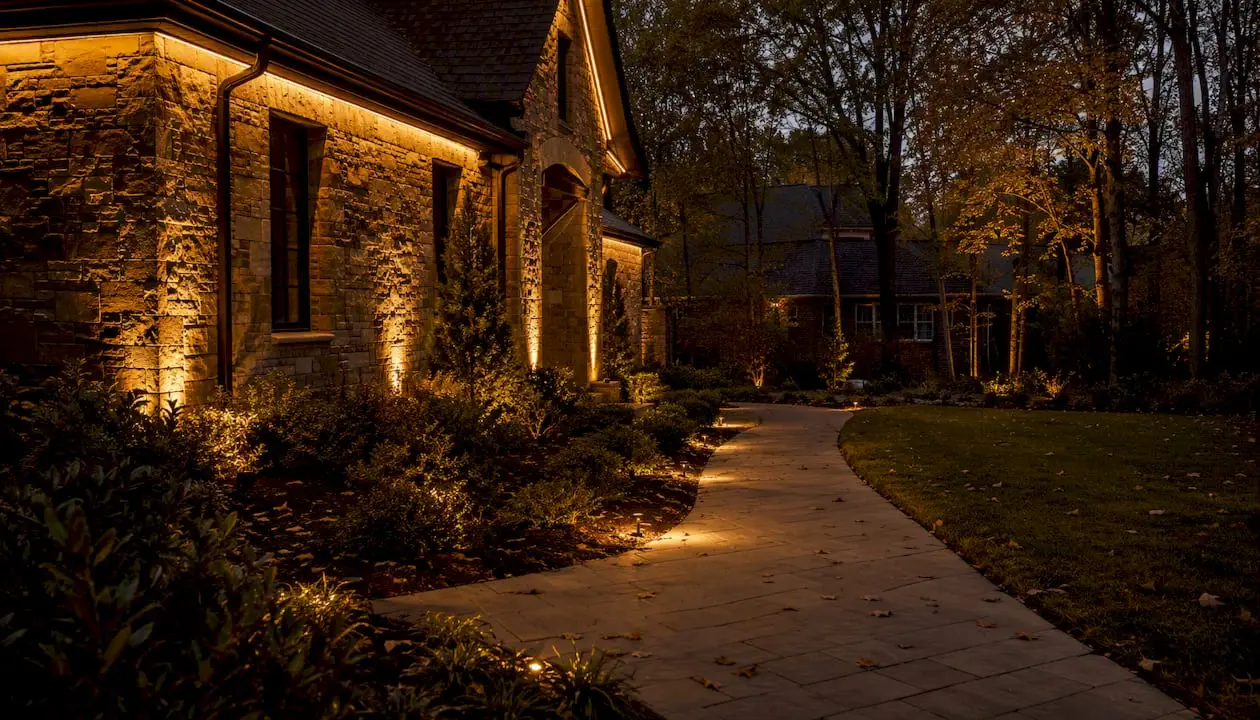
Permanently installed smart-LED systems are the top landscape lighting security solution for most homes and managed properties, followed by hardwired motion-activated flood and spotlight combos, then low-voltage pathway and accent lighting, and finally solar-powered motion hybrids for areas where running wire is impractical. Each tier delivers a different balance of deterrence, reliability, and cost.
- Permanent smart-LED systems (hardwired, professionally installed): Highest lumen reliability, programmable scenes, and full integration with cameras and smart-home controls. Best for perimeter, entry, and architectural coverage.
- Hardwired motion-activated floodlights and spotlights: Strong deterrence at specific threat zones (garage, side yard, back entry) with high lumen output and wide detection angles. Lower upfront cost than full permanent systems.
- Low-voltage accent and pathway lights: Illuminate walkways and steps to prevent accidents and remove hiding spots near entries. Best layered with the two options above.
- Solar-powered motion hybrids: Practical where trenching is impossible, with brightness and reliability depending heavily on site sun exposure.
Key Takeaways
Permanent smart-LED systems professionally installed by a credentialed contractor deliver the most reliable combination of deterrence, camera integration, and low operating cost for most residential and managed properties.
Table of Contents
- What are the top landscape lighting security solutions by fixture type?
- How landscape lighting increases security: the evidence
- Where should you place security lights for maximum effect?
- Which power source and smart controls work best for security?
- How do you choose the right fixtures or a professional installer?
- What electrical safety rules apply to outdoor lighting installation?
- How do you keep security lighting reliable over time?
- How do you align lighting with cameras and smart-home systems?
- Why permanent smart-LED installations are the recommended security-first choice
- Balancing security needs with curb appeal and neighbor relations
- Foreverglowlighting offers a free estimate for permanent security lighting
- Sources
What are the top landscape lighting security solutions by fixture type?
Security-focused outdoor lighting covers several distinct fixture categories. Understanding what each does well helps you match the right tool to each zone on your property.
Motion-activated floodlights
High-lumen output (typically 1,500–5,000 lumens), wide beam angles (90–180°), and motion sensors with detection ranges up to 70 feet make these the strongest deterrent fixture available. They work best at garages, back entries, and side yards. The tradeoff: constant on/off cycling can be jarring for neighbors if aimed poorly.
Wall-mounted entry lights
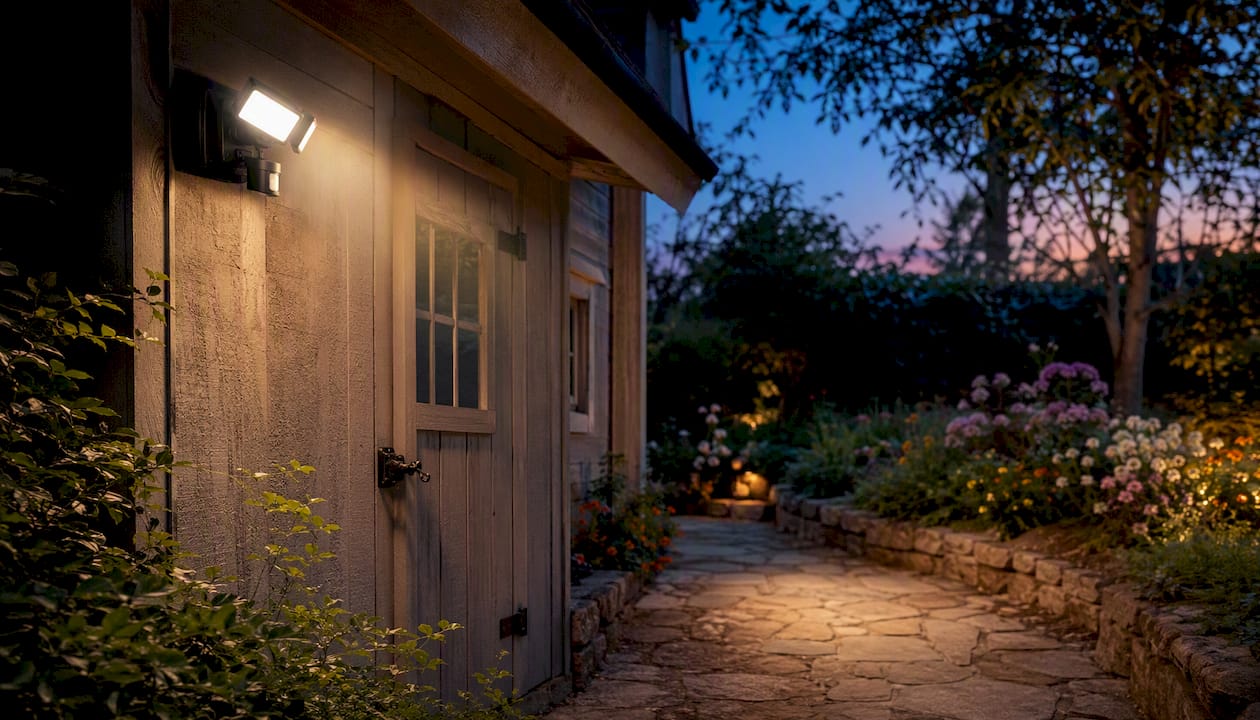
Always-on or dusk-to-dawn fixtures that frame doorways and provide consistent facial-recognition-level illumination. Lower lumen output than floodlights, but the steady light supports camera performance better than motion-only fixtures that leave cameras in the dark between events.
Spotlights and up-lights
Directional fixtures that highlight trees, architectural features, or perimeter walls. Security value comes from removing shadow bands where someone could conceal themselves. Sensor-capable versions exist, though most are used as always-on accent lights.
In-ground and well lights
Installed flush with the ground to up-light structures or trees. Harder to tamper with than surface-mounted fixtures. Best for perimeter definition and architectural accent; not a primary deterrence tool on their own.
Pathway and bollard lights
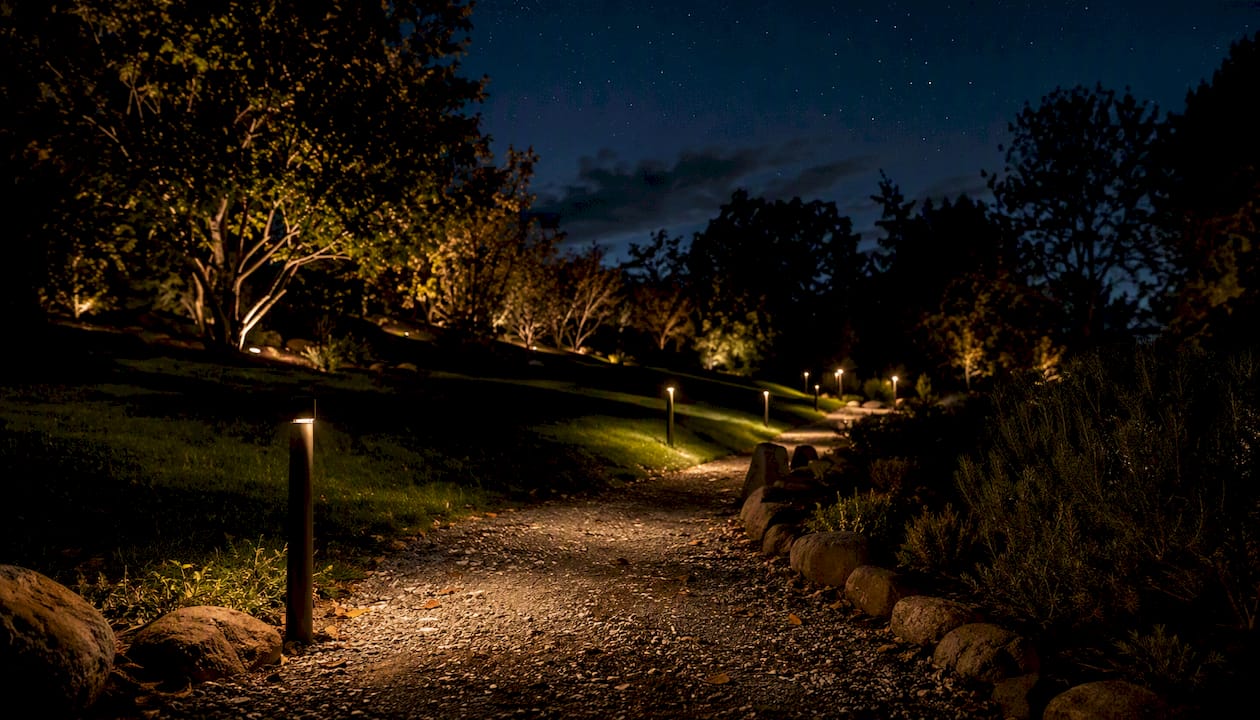
Low-profile fixtures (typically 100–400 lumens) that mark walkways and steps. They prevent trip-and-fall accidents and remove low-level hiding spots near entries. Always-on operation is standard; sensor versions exist but are less common.
Step and deck lights
Recessed into risers or deck fascia. Critical for preventing nighttime falls on stairs and for illuminating approach zones cameras cover. Low lumen output; best used as part of a layered system.
Solar-powered variants
Available in most fixture categories above. Solar lighting is practical where mains power is unavailable, but lumen output is typically lower than hardwired equivalents and performance drops on cloudy days or shaded sites. Sensor capability varies by model.
How landscape lighting increases security: the evidence
Well-designed outdoor lighting deters intrusion, reduces nighttime accidents, and improves the performance of surveillance cameras. The Department of Homeland Security classifies security lighting as physical-security equipment, noting it can both prevent intrusion and enhance responder and public safety.
The crime-reduction evidence is meaningful. Targeted lighting interventions in some program evaluations were associated with substantial reductions in certain nighttime crimes and assault-related incidents, though results are context-dependent and study-specific. A separate OJP analysis of street-lighting programs found that targeted lighting can reduce some categories of nighttime crime in field settings.
For residential properties, the practical benefits stack up quickly:
- Removes hiding spots near entry points, shrubs, and garage areas where an intruder might wait undetected
- Improves camera performance by providing even illumination rather than leaving cameras to struggle in darkness
- Supports facial recognition at approach distances when fixtures are aimed and sized correctly for doorways
- Reduces slip-and-fall accidents on walkways, steps, and driveways
- Increases the likelihood suspicious activity is seen by neighbors, passersby, or monitoring services
Statistic callout: Program evaluations cited by Virginia’s Department of Criminal Justice Services reported substantial reductions in nighttime index crimes in specific intervention areas compared with controls, though results vary by context. These figures are program-specific and should be read as directional evidence, not a guaranteed outcome for every property.
You can read more about the safety benefits of landscape lighting for homeowners in detail.
Where should you place security lights for maximum effect?
Placement determines whether a lighting system actually deters crime or just looks good in a brochure. Prioritize entry points, walkways, driveways, perimeter access routes, garages, and blind spots first.
Placement checklist:
- Front door and back door: Aim fixtures to illuminate the full approach at a level that allows facial recognition at roughly 35 feet. A wall-mounted entry light alone rarely achieves this; pair it with a spotlight or floodlight angled toward the approach path.
- Garage and side yards: High-lumen motion floodlights here cover the most common secondary entry routes. Overlap coverage zones so no single fixture failure creates a dark gap.
- Driveway perimeter: Low-voltage path lights or bollards along the driveway edge define the boundary and remove low shadow zones.
- Fence lines and back perimeter: Spotlights or in-ground up-lights along fence lines remove concealment cover. Overlapping beams prevent dark corridors.
- Steps and deck edges: Step lights prevent accidents and keep approach zones visible to cameras.
What to avoid:
- Aiming floodlights directly into camera lenses, which creates backlighting and destroys image quality
- Positioning fixtures so glare spills into neighbors’ windows or oncoming traffic lanes
- Mounting lights low enough that a person could reach and disable them without a ladder
- Placing fixtures inside concealment zones (dense shrubs, recessed alcoves) where the fixture itself becomes a tamper target
Layering techniques that combine ambient, accent, and task lighting give you balanced coverage without harsh glare.
Which power source and smart controls work best for security?
LED hardwired systems deliver the most reliable lumen output and the best sensor compatibility. Solar is a practical secondary option. Here is how the main categories compare for security use:
Key tradeoffs to know:
- Hardwired LED: Highest lumen output, consistent performance regardless of weather, full smart-home integration. Requires a licensed electrician for line-voltage work. The role of LED in landscape lighting covers the efficiency and lifespan advantages in detail.
- Low-voltage (12V): Good middle ground for pathways and accent zones. Transformer sizing must match fixture load and wire run length. Low-voltage systems are often the smart choice for homeowners who want professional results without full line-voltage work.
- Solar: Energy.gov recommends solar where running mains power is impractical, but cautions that output depends on site sun exposure. Expect lower lumen output than hardwired equivalents on most residential sites.
- Battery-powered: Useful for temporary coverage or locations where neither wiring nor solar is viable. Not a primary security solution.
For security fixtures specifically, The Spruce’s testing-informed guidance confirms that security and motion-sensor lights require higher lumen counts than pathway lights, and that mounted flood-style fixtures deliver the detection range and brightness needed for deterrence.
Pro Tip: For perimeter and entry zones, target 700–1,500 lumens per fixture as recommended in lighting best-practice guides lumens minimum per fixture. Pathway and step lights can operate at 100–400 lumens. Beam angles of 90–120° work well for open areas; narrower 30–60° beams suit spotlighting specific features or approach paths.*
How do you choose the right fixtures or a professional installer?
Start with use case, then match fixture specs to it. A perimeter deterrence fixture needs different specs than a pathway safety light.
Decision checklist:
- Assess the threat zones on your property: front entry, back entry, garage, side yards, perimeter fence lines.
- Set lumen targets for each zone (see the Pro Tip above).
- Choose power source based on wiring access, budget, and reliability requirements.
- Confirm sensor specs: detection range (feet), detection angle (degrees), and adjustable sensitivity.
- Check IP rating: Select fixtures with an IP rating of IP65 or higher to ensure protection against dust and water for outdoor use or higher for exposed outdoor fixtures; wet-location UL listing for fixtures near water.
- Verify warranty and LED-rated lifetime: quality fixtures typically carry a minimum 3-year warranty; LED drivers are generally rated for 25,000–50,000 hours hours are standard.
- Confirm UL listing for the fixture’s intended location (wet, damp, or dry).
When vetting an installer, ask these questions directly:
- Do you pull permits and comply with local NEC requirements?
- How do you size the transformer for the fixture load and wire run?
- What GFCI protection do you provide for exterior circuits?
- What is your warranty on labor and materials?
- Do you offer a maintenance plan?
- Can you provide local references and a written timeline?
Red flags: no permits offered, vague or verbal-only warranty, no local references, inability to explain transformer sizing or GFCI compliance. Professional landscape lighting design pays off precisely because these details are handled correctly the first time.
What electrical safety rules apply to outdoor lighting installation?
GFCI protection and proper clearances are non-negotiable. All exterior lights should be GFCI-protected, and anyone installing or adjusting outdoor lighting must maintain at least 10 feet of clearance from overhead power lines.
Safety checklist for installation:
- GFCI protection: Every exterior outlet and circuit serving outdoor fixtures must be GFCI-protected. This applies to both line-voltage and low-voltage transformer circuits.
- Overhead power line clearance: Maintain a minimum 10-foot horizontal clearance when working near overhead lines.
- Low-voltage cable burial: Standard guidance recommends burying low-voltage landscape cable a maximum of 6 inches deep; keep short fixture leads and splices close to structures to prevent damage.
- Transformer disconnect: A cord-and-plug landscape transformer plugged into a GFCI outdoor receptacle satisfies both the GFCI requirement and the primary disconnect requirement under common NEC interpretations. Hardwired transformers require a local disconnect if the panel is not visible from the transformer location.
- Pool clearance: UL guidance generally recommends low-voltage landscape luminaires be installed at safe distances from pools. Only landscape-listed power units (not pool transformers) are appropriate for landscape luminaires.
- Permits: Line-voltage outdoor lighting typically requires a permit in most jurisdictions. Confirm with your local authority having jurisdiction (AHJ) before starting work.
Pro Tip: When talking to an inspector about your transformer disconnect, lead with the plug-and-GFCI arrangement. It is the simplest compliant solution for most residential landscape transformers and avoids the more complex local-disconnect discussion that hardwired installations require.
For detailed wiring guidance, the landscape lighting wiring best practices resource covers burial depth, wire gauge selection, and connection methods.
How do you keep security lighting reliable over time?
A short seasonal maintenance routine preserves deterrence and prevents outages. Do this quarterly and after any major storm.
Maintenance checklist:
- Clean fixture lenses and remove debris that reduces lumen output
- Check and adjust sensor aim; sensors shift over time from wind, vibration, or settling
- Test motion detection range by walking the detection zone and confirming trigger distance
- Press the GFCI test/reset button on exterior outlets and confirm the circuit resets correctly
- Inspect fixtures for water ingress, cracked lenses, or corrosion at wire connections
- Replace LED drivers or bulbs per manufacturer guidance when dimming becomes noticeable
Seasonal schedule:
- Spring: Full inspection after winter; clean lenses, check for frost damage, re-aim sensors
- Fall: Adjust timer schedules for earlier sunset; verify all fixtures operational before the long-night season
- After storms: Check for displaced fixtures, water in junction boxes, and tripped GFCI circuits
- Holiday periods: Verify that added decorative lighting has not overloaded transformer circuits
Common troubleshooting:
- Sensor nuisance tripping: Reduce sensitivity setting or re-aim away from heat sources (HVAC vents, dryer exhausts)
- Dimming LEDs: Usually a failing driver or a voltage drop from undersized wire; check transformer output voltage at the fixture
- GFCI tripping repeatedly: Indicates moisture in a junction box or a damaged fixture; locate and replace before resetting
How do you align lighting with cameras and smart-home systems?
Coordinate light placement and beam control so cameras receive even illumination without backlighting or glare. A camera pointed toward a bright light source captures silhouettes, not faces.
Integration tips:
- Place lights to the side of or above camera mounting points, never directly in front of the lens
- Use diffuse or soft-fill fixtures in face-recognition zones (doorways, entry paths) rather than harsh directional beams
- Set motion-triggered lights to stay on for at least 2–3 minutes after activation so cameras capture the full event, not just the first seconds
- Link smart lighting scenes to camera motion alerts so lights activate automatically when a camera detects movement, even before a person enters the primary sensor zone
- Use warm-white color temperatures (2700K–3000K) in camera zones; they render skin tones more accurately than cool-white or blue-tinted LEDs
- For wide-angle cameras covering large areas, use multiple lower-intensity fixtures for even fill rather than one high-intensity spot that creates bright and dark zones in the same frame
Smart outdoor lighting systems that support scheduling, scene automation, and smartphone control make camera coordination significantly more reliable than manual timer adjustments.
Pairing strong lighting with hardened entry points compounds the deterrence effect. Quality security doors combined with well-placed lighting cover both the visual deterrence and the physical barrier sides of entry-point protection.
Why permanent smart-LED installations are the recommended security-first choice
Permanent, professionally installed smart-LED systems give the best balance of deterrence, reliability, and low operating cost for homeowners and property managers who want long-term security coverage without ongoing maintenance headaches.
Foreverglowlighting designs and installs permanent LED systems in the Charlotte area that are engineered for exactly this purpose:
- Consistent lumen output regardless of season, weather, or battery charge state
- Proper beam control from fixtures positioned and aimed during a professional site design, not guessed at during a DIY install
- Smartphone-controlled scheduling and motion scenes that integrate with camera systems and adapt to seasonal sunset times automatically
- HOA-aware design that keeps fixtures architecturally discreet while meeting security performance targets
- NEC-compliant wiring with GFCI protection, correct transformer sizing, and proper burial depths handled by credentialed installers
- GlowCare maintenance subscription for ongoing inspection, sensor calibration, and driver replacement so the system stays inspection-ready year-round
- Local references and free estimates so you can verify the work before committing
Permanent lighting and home security are directly connected when the system is designed with deterrence as a primary goal, not an afterthought.
Balancing security needs with curb appeal and neighbor relations
Security lighting works best when it is designed as part of the property’s overall aesthetic, not bolted on as an afterthought. Bright, poorly aimed floodlights can create light trespass into neighbors’ yards, generate glare that actually reduces camera performance, and make a home look institutional rather than welcoming.
A few practical principles make the difference:
- Use warm-white color temperatures (2700K–3000K) for perimeter and entry lighting. They are effective for deterrence and far more pleasant for neighbors and passersby than cool-white or daylight-spectrum fixtures.
- Layer lighting rather than relying on a single high-intensity source. A combination of pathway lights, wall-mounted entry fixtures, and targeted spotlights creates even coverage without the harsh shadows that a single floodlight produces.
- Use shrouds, shields, and directional housings to keep light on your property and off your neighbors’ windows. Most quality security fixtures include adjustable shields for exactly this reason.
- Check HOA covenants before installation. Many associations have rules on fixture visibility, color temperature, and maximum lumen output for street-facing fixtures.
The goal is a property that looks well-maintained and welcoming during the day, and clearly, evenly lit at night without broadcasting “fortress” to the neighborhood.
Foreverglowlighting offers a free estimate for permanent security lighting
Permanently lit properties in the Charlotte area do not have to choose between security and curb appeal. Foreverglowlighting’s custom-installed permanent lighting systems are designed from the first site visit with both goals in mind: reliable, high-lumen coverage at every threat zone and an architectural finish that looks intentional, not industrial.
The process starts with a no-cost site visit, a design mockup showing fixture placement and coverage zones, and a written quote with a clear installation timeline. Most residential systems are operational within one to two weeks of contract signing. The optional GlowCare maintenance subscription keeps sensors calibrated, drivers replaced on schedule, and the system inspection-ready year-round. To get started, visit the permanent lighting installation process page and request your free estimate.
Sources
These sources support the recommendations in this article and are worth referencing when speaking with an electrician, installer, or code official.
- Security Lighting | Department of Homeland Security
- Security lighting — Virginia Department of Criminal Justice Services (evidence summary & guidance)
- IntelliBrite Outdoor Landscape LED light manual (Pentair)
- The Spruce — Best landscape lighting (testing-informed consumer guidance)