
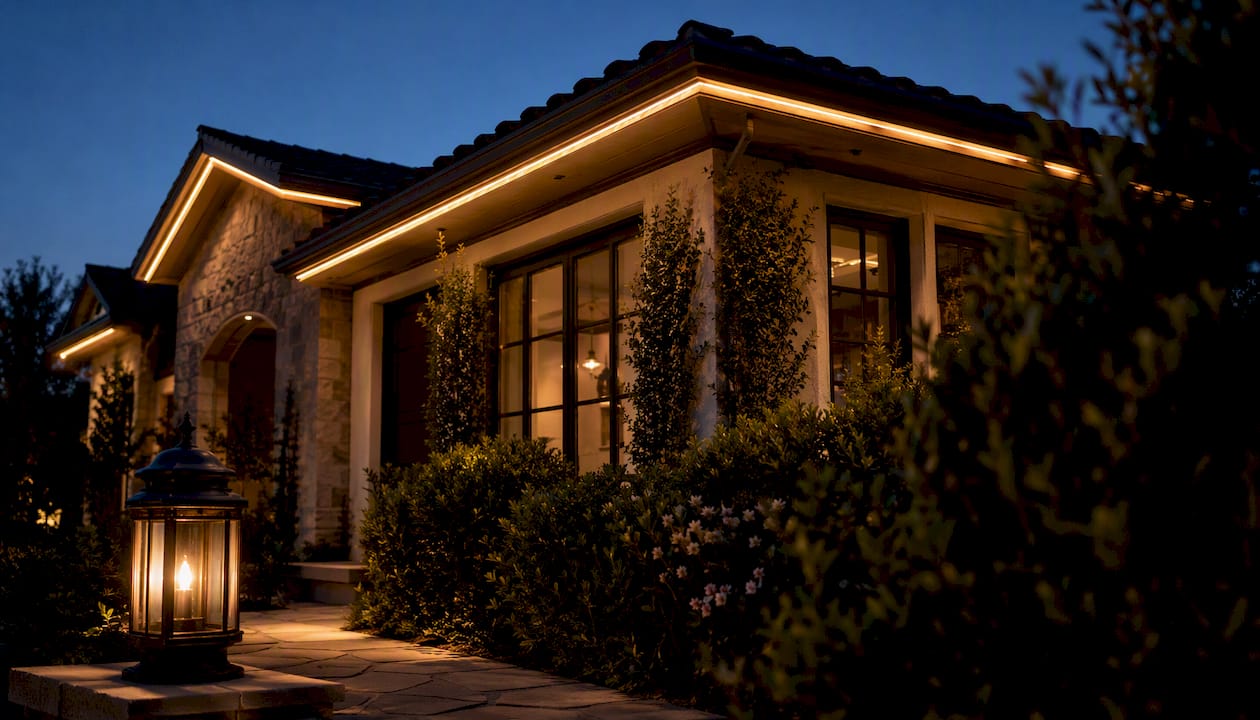
Permanent roofline lighting falls into six main categories: LED track and trim systems, addressable RGB/pixel systems, linear LED strip lights, rope or fixed-string lights, recessed and soffit-mounted linear fixtures, and integrated flood or security fixtures. For year-round architectural accent, a warm-white LED track or recessed soffit system is the most practical choice. For programmable holiday and color effects, addressable RGB pixel systems deliver the most flexibility. For security-focused coverage, integrated flood fixtures with motion sensing are the most direct solution.
Here is a quick match by common homeowner goal:
- Holiday and seasonal displays: Addressable RGB/pixel systems or LED track systems with full-color control
- Year-round architectural accent: Warm-white LED track trim or recessed soffit-mounted linear fixtures
- Security and perimeter visibility: Integrated flood or motion-activated security fixtures
- Smart color effects and gameday displays: Addressable RGBW pixel systems with smartphone or hub control
- Low-budget accent lighting: Linear LED strip or permanent rope lights along the eave line
Key Takeaways
Permanent roofline lighting delivers the most value when the system type matches your primary goal and the installation is built to last.
| Point | Details |
|---|---|
| Match type to goal | Warm-white track or recessed soffit for year-round accent; addressable pixel for holiday and color effects; flood fixtures for security. |
| Fascia condition is critical | Inspect fascia boards for rot or warping before any track is mounted; compromised wood causes premature failure. |
| GFCI protection is required | All outdoor permanent lighting circuits must connect to a GFCI-protected outlet per NEC requirements. |
| Accessible controller placement | Mount power supplies and controllers behind a removable panel so repairs stay quick and affordable. |
| Foreverglowlighting | Provides custom professional installation, HOA-compliant design, and GlowCare maintenance for Charlotte-area homeowners. |
Table of Contents
- 1. What are the main types of permanent roofline lighting?
- 2. How permanent roofline lighting is mounted and installed
- 3. Controls, colors, and smart features in modern permanent systems
- 4. How to choose the right permanent roofline lighting for your home
- 5. Pros, cons, and common trade-offs of permanent roofline lighting
- 6. Typical cost ranges and project timeline for U.S. residential installs
- 7. Why professional installation makes a difference
- What most homeowners get wrong about permanent roofline lighting
- Foreverglowlighting brings permanent roofline lighting to Charlotte homes
- Sources
1. What are the main types of permanent roofline lighting?
The six types below cover the full range of permanent outdoor roofline lighting options available to U.S. homeowners. Each one mounts differently, serves a different primary purpose, and carries its own durability and cost profile.
LED track and trim systems
LED track systems use a rigid aluminum or polycarbonate channel that mounts flush to the fascia or eave. Individual LED nodes or modules snap into the track at set intervals, typically every 4–6 inches. The track itself is nearly invisible during the day, which is the main reason this style has become the dominant format for professional permanent roofline lighting installation.
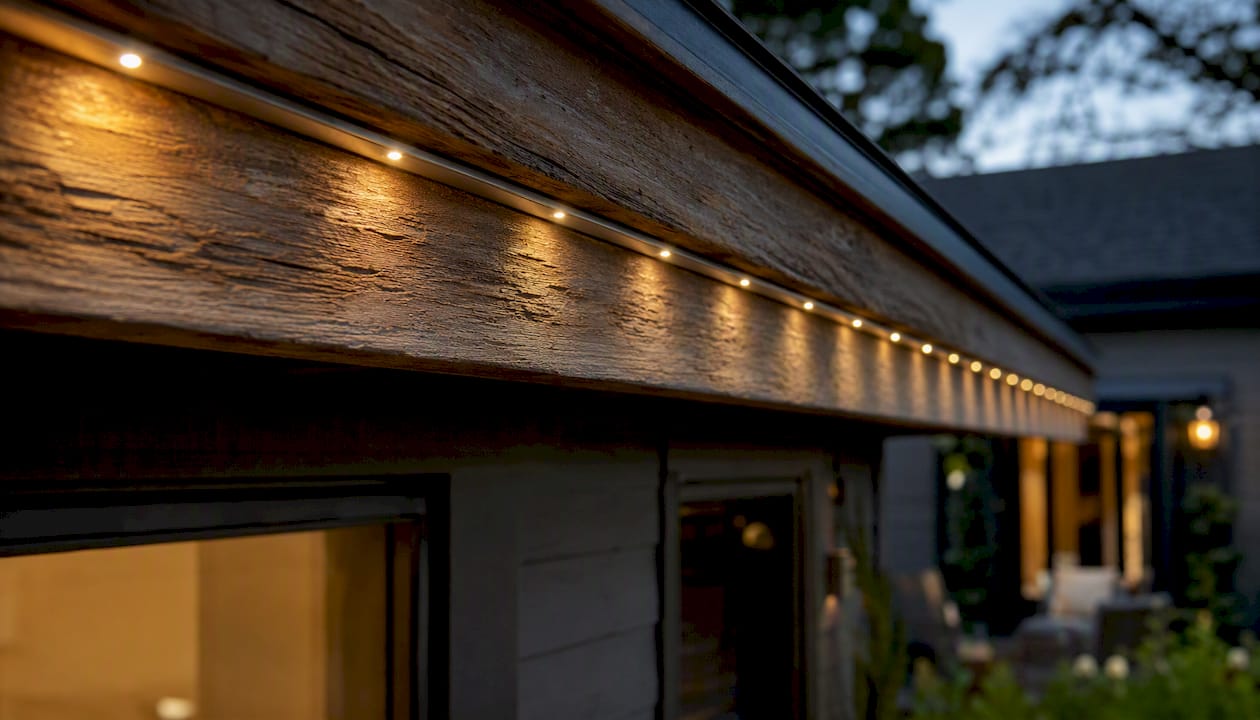
These systems are rated IP65 or higher in most contractor-grade kits, meaning they handle rain, dust, and temperature swings without issue. Color options range from warm white only to full RGBW with millions of color combinations. Cost sits in the mid-to-high range depending on track length and color capability.
Best for: Year-round accent, holiday color displays, HOA-compliant installs where daytime appearance matters.
Pros: Clean daytime profile, durable aluminum housing, modular so individual nodes are replaceable.
Cons: Higher upfront cost than strip or rope options; professional installation is strongly recommended for clean routing and concealed wiring.
Addressable RGB/pixel systems
Addressable pixel systems assign an independent signal to each LED node, so every point on the roofline can display a different color simultaneously. This is what makes flowing animations, color chases, and holiday scenes possible. The trade-off is wiring complexity: each pixel run needs accurate power budgeting, and the controller must be capable of handling the full data load.
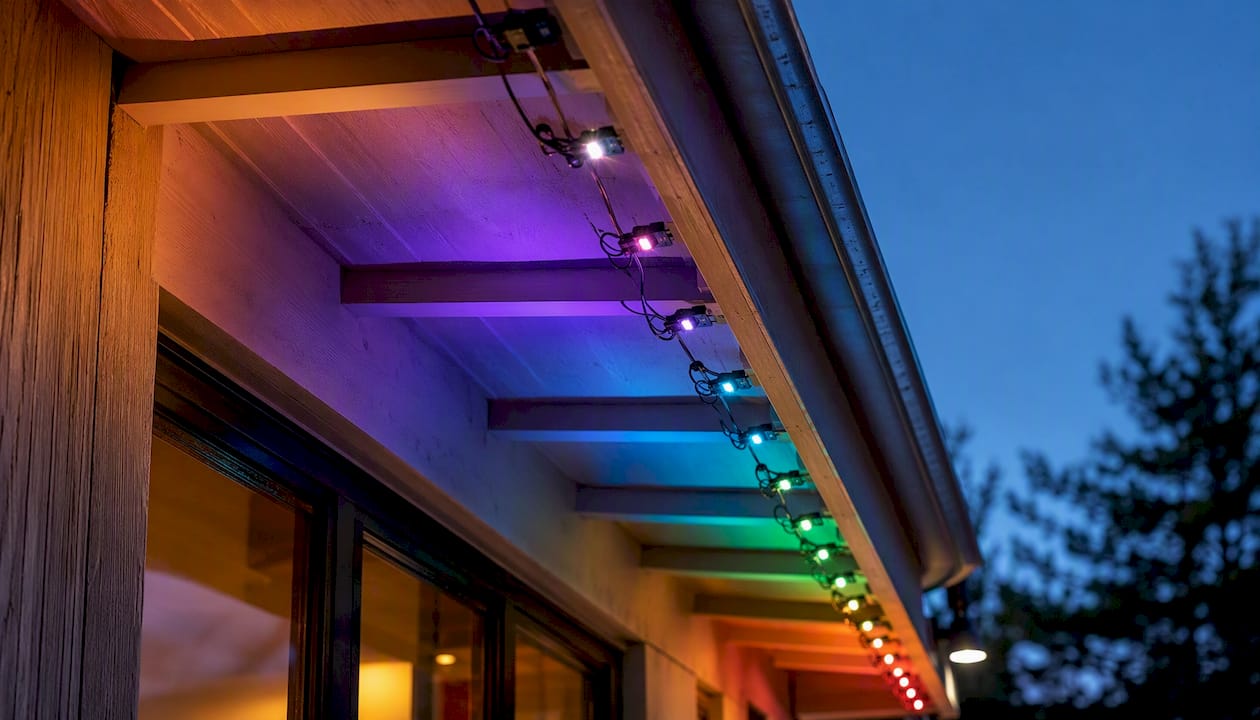
Programmable addressable pixel systems deliver the most creative effects but increase wiring complexity and the need for accurate power budgeting and a capable controller. One real-world install report noted that some surface-mount track profiles can bend on uneven fascia surfaces, making the top channel difficult to seat — a problem that shows up more often on older homes with irregular wood fascia.
Best for: Holiday displays, gameday color schemes, programmable light shows, properties where visual impact is the primary goal.
Pros: Maximum creative flexibility, individual node control, supports complex animations.
Cons: Higher cost, more complex installation, controller and power supply sizing must be precise.
Linear LED strip lighting
Linear LED strip is a flexible circuit board with surface-mounted LEDs, typically sold in reels and cut to length on-site. It mounts to the underside of the soffit or along the eave with adhesive backing or mounting clips. Strip lighting is the most affordable permanent option and works well for continuous, even illumination along a straight roofline.
Weatherproofing varies significantly by product grade. Consumer-grade strips often carry only IP44 ratings, which is marginal for exposed roofline use. Contractor-grade silicone-jacketed strips reach IP67 or IP68 and hold up through multiple seasons. The adhesive backing on cheaper strips tends to fail in heat, so mechanical clip mounting is worth the extra step.
Best for: Soffit underlighting, continuous warm-white accent, budget-conscious installs on straightforward rooflines.
Pros: Low cost, flexible for curved or angled runs, easy to cut to length.
Cons: Lower durability than track systems, adhesive failure risk in high heat, less modular for repairs.
Rope lights and permanent fixed-string systems
Rope lights encase LEDs inside a flexible PVC tube, giving them better UV and moisture resistance than bare strip lighting. Fixed-string systems use weatherproof bulb sockets on a pre-spaced cable, similar in appearance to traditional holiday lights but built for permanent outdoor exposure. Both formats clip directly to the eave or gutter line without a dedicated track.
These are the most DIY-accessible options. Install guides recommend mounting clips every 12 inches and planning the transformer and controller location before running any wire. A GFCI-protected outdoor outlet is required for safe operation.
Best for: Budget-friendly permanent holiday lighting, straightforward eave lines, homeowners comfortable with a basic DIY install.
Pros: Low cost, widely available, easy to replace sections.
Cons: Less polished daytime appearance, limited color accuracy on rope-light formats, shorter lifespan than track systems.
Recessed and soffit-mounted linear fixtures
Recessed soffit fixtures sit flush inside the soffit cavity, with only a small lens or diffuser visible from outside. This format produces the cleanest architectural look of any roofline lighting type and is the preferred choice for high-end residential and commercial properties where daytime aesthetics are a priority.
Installation requires cutting into the soffit material and routing wiring through the cavity, which makes this a professional-only job in most cases. The payoff is a system that is essentially invisible until switched on. Simple warm-white recessed soffit lighting usually offers the best long-term, lowest-maintenance option for year-round architectural accent and security.
Best for: Luxury homes, HOA-strict neighborhoods, architectural highlighting, year-round accent where daytime appearance is critical.
Pros: Cleanest visual profile, protected from direct weather exposure, long service life.
Cons: Most labor-intensive installation, not DIY-friendly, higher cost.
Integrated flood and security fixtures
Integrated flood fixtures combine a directional LED floodlight with permanent mounting hardware along the roofline or at eave corners. Many include motion sensors, dusk-to-dawn photocells, or both. These fixtures serve a dual purpose: they provide consistent perimeter visibility for security and can double as accent lighting when set to a lower output mode.
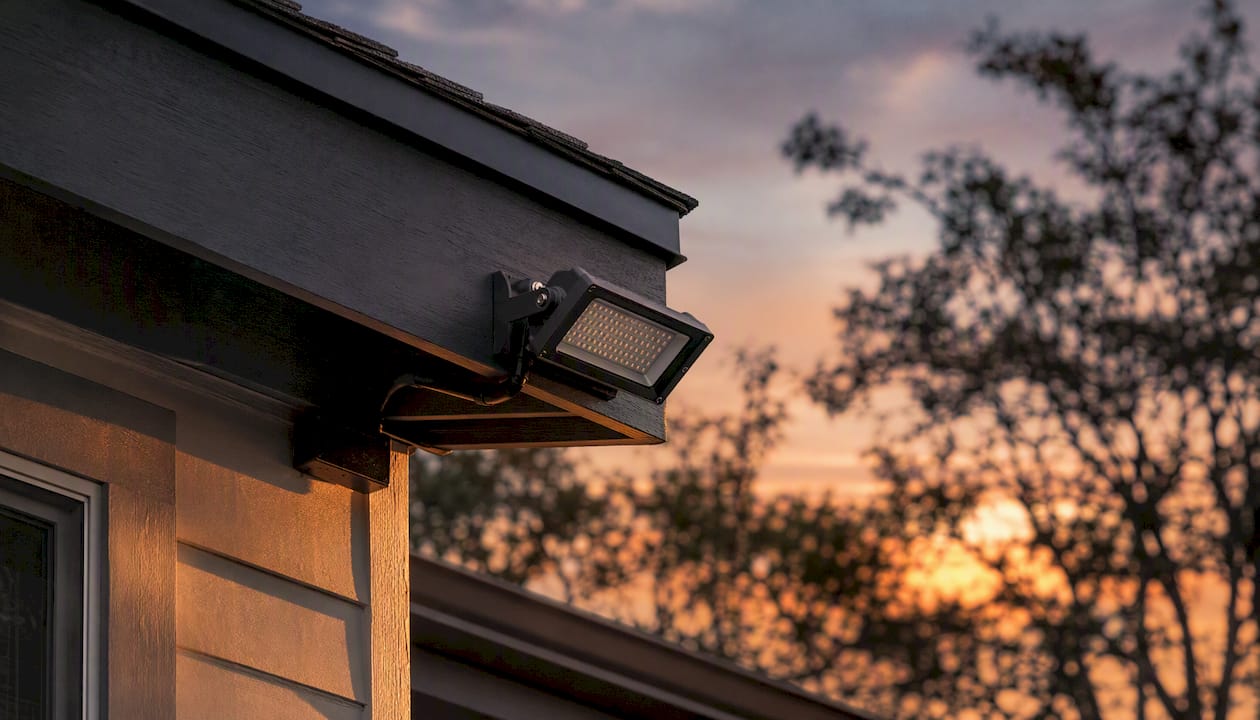
Wattage ranges widely, from 10W accent floods to 50W+ security-grade units. Most carry IP65 ratings as a minimum. The CPSC’s 2022 NEISS data underscores why permanent mounting matters here: ladder-related injuries from seasonal light hanging are a documented consumer safety concern, and a fixed flood fixture eliminates that annual risk entirely.
Best for: Security-focused homeowners, corner and entry-point coverage, properties that need both accent and functional illumination.
Pros: Dual security and accent function, motion-sensing capability, eliminates seasonal reinstallation.
Cons: Less decorative flexibility, directional beam may require adjustment after installation.
2. How permanent roofline lighting is mounted and installed
The installation method determines how clean the finished system looks, how long it lasts, and how easy it is to service. There are four common mounting approaches used in residential permanent roofline lighting installation.
Surface-mounted track: The most common professional method. An aluminum or polycarbonate channel is fastened directly to the fascia board with screws or adhesive clips. LED nodes snap into the channel after the track is secured and wired. This approach works on most standard fascia profiles and allows individual node replacement without disturbing the track.
Clip-mounted string or rope: Clips or hooks attach directly to the gutter lip or eave edge, holding the light cable in place. This is the standard DIY method and works well for rope lights and fixed-string systems. It requires no drilling into the fascia but produces a less rigid, less polished result.
Recessed soffit rail: A routed channel or pre-cut slot in the soffit holds a linear fixture flush with the surface. This requires the most preparation but produces the cleanest result.
Concealed wiring paths: Regardless of fixture type, wiring should run through conduit or behind trim wherever possible. Exposed wire runs degrade faster and are more vulnerable to physical damage.
Typical installation steps
- Site survey: Measure total roofline length, identify fascia and soffit condition, locate existing outdoor outlets, and note any HOA restrictions or permit requirements.
- Power routing: Plan the path from the main panel or sub-panel to the controller location. A GFCI-protected outdoor circuit is required by the National Electrical Code for all outdoor lighting.
- Mounting: Secure track, clips, or soffit rails. On uneven fascia, shimming or surface prep may be needed before the track seats properly.
- Wiring and connections: Run power leads, connect nodes or fixtures, and seal all outdoor connections with waterproof end caps or self-fusing tape.
- Controller placement: Mount the controller or transformer in a sheltered but accessible location. Hiding it behind inaccessible sheathing raises service costs when a repair is needed.
- Programming and testing: Load scenes, test all zones, and confirm GFCI protection is functioning before final seal-up.
Homeowner prep checklist
- Measure total roofline length (all sides you want lit)
- Note fascia material and condition (rot or warping affects track adhesion)
- Confirm a GFCI-protected outdoor outlet is within reach of the controller location
- Check HOA rules and local permit requirements before ordering materials
- Photograph existing eave and soffit details to share with your installer
Pro Tip: Before any permanent install, walk the roofline and check fascia boards for soft spots or rot. A track mounted to compromised wood will pull loose within a season, and re-mounting costs more than fixing the fascia first. A clean, rigid fascia is the foundation of a lasting install — the same principle that applies to any roofline or fascia work.
3. Controls, colors, and smart features in modern permanent systems
The controller is what separates a permanent lighting system from a simple outdoor fixture. Modern systems range from a basic single-zone remote to full smartphone app control with scene scheduling and smart-home integration.
Color modes explained
- Single-color (warm white or cool white): Fixed output, no color change. Lowest cost, simplest wiring, best for architectural accent where consistent tone matters.
- Tunable white: Adjustable color temperature, typically 2700K–6500K. Useful for matching interior lighting or shifting from warm evening accent to brighter security output.
- RGB: Red, green, blue mixing for a wide color range. Standard on most mid-range permanent systems.
- RGBW: Adds a dedicated white channel to RGB. Produces more accurate whites and pastels than RGB alone, which tends to render white as a slightly cool blue-tinted mix.
- Addressable pixel (individually controlled): Each node receives its own signal. Required for animations, color chases, and holiday scene programming.
Controller types and connectivity
Scheduling and scene capabilities vary by platform. Wi-Fi-connected systems generally support sunrise/sunset automation, calendar-based scene switching (for holidays), and remote access from anywhere. Seasonal lighting automation is one of the most practical benefits of a smart-connected system: the lights shift from a warm amber accent in October to a red-and-green holiday display in December without any manual reprogramming.
Pro Tip: Place your controller and power supply within 10 feet of the nearest GFCI outlet and keep it accessible behind a removable panel rather than sealed behind siding. Most field repairs involve the power supply or a connector at the controller end, and accessible hardware cuts service time significantly.
4. How to choose the right permanent roofline lighting for your home
Narrowing down the options comes down to five practical questions. Answer these before requesting a quote or ordering materials, and the right system type becomes clear quickly.
Decision checklist
- What is your primary goal? Holiday color displays point toward addressable pixel systems. Year-round architectural accent points toward warm-white track or recessed soffit fixtures. Security coverage points toward integrated flood fixtures.
- How complex is your roofline? Simple gable ends are straightforward for any system. Multiple hips, dormers, and valleys add corners and transitions that require careful track planning and additional connectors.
- What color and effects do you want? Single-color warm white is the lowest-maintenance long-term choice. Full RGBW addressable systems offer the most flexibility but require more planning and a capable controller.
- What power is available? Confirm whether an outdoor GFCI circuit exists near the controller location. A new dedicated circuit adds cost but is often worth it for larger systems.
- What are your HOA and permit requirements? Many HOAs have rules about visible hardware, color restrictions, or operating hours. Check before selecting a track profile or color mode.
Questions to ask a prospective installer
- What IP rating do your fixtures and connectors carry?
- Are individual nodes or modules replaceable without removing the full track?
- What controller platform do you use, and does it integrate with Alexa or Google Home?
- What warranty do you offer on parts and labor, and what does your maintenance plan cover?
- Can you show me examples of installed systems on homes with a similar roofline profile?
- Is the power supply and controller location accessible for future service?
Request proof of liability insurance and ask to see a sample scene programmed on a similar system before signing. A reputable installer will have both ready.
5. Pros, cons, and common trade-offs of permanent roofline lighting
Wired’s feature on permanent outdoor lights frames the core trade-off clearly: the upfront cost and commitment are real, but homeowners who use their lighting year-round rather than just for holidays tend to find the value proposition strong. The key is going in with clear expectations about both the benefits and the limitations.
Pros
- Year-round value: A permanent system works for every season, not just December. Holiday scenes, gameday colors, and everyday warm-white accent all run from the same hardware.
- No annual reinstallation: Eliminating the ladder climb every November and December is a genuine safety and convenience benefit. Ladder-related injuries are a documented risk in CPSC data, and permanent mounting removes that exposure entirely.
- Programmable effects: Addressable systems can display thousands of color combinations and animations from a smartphone, with no physical changes to the hardware.
- Energy efficiency: LED-based systems draw a fraction of the power of incandescent holiday lights. A typical residential roofline system running 4–6 hours per night adds a modest amount to the monthly electric bill.
- Modular repairability: Quality track systems allow individual node replacement without disturbing the full run.
Cons
- Upfront cost: Professional installation of a full-color addressable system on a mid-size home is a significant investment compared to seasonal lights.
- Permanence: The system is visible year-round, even when off. Track profiles and wire runs need to look clean during the day.
- Repair complexity: A failed node mid-run on a pixel system requires identifying the exact failure point, which is straightforward on modular systems but time-consuming on sealed strip installs.
- HOA friction: Some associations restrict visible hardware colors, operating hours, or specific color modes. Confirm compliance before installation.
- Controller dependency: The system is only as capable as its controller. An underpowered or outdated controller limits what scenes are possible.
Permanent lighting saves homeowners meaningful time over the life of the system, particularly when factoring in the annual cost of seasonal installation and removal.
6. Typical cost ranges and project timeline for U.S. residential installs
Cost varies significantly by system type, house size, and whether installation is DIY or professional. The ranges below reflect general U.S. residential market conditions and are meant as planning benchmarks, not fixed quotes.
| System type | Materials only (approx.) | Professional install (approx.) | Relative complexity |
|---|---|---|---|
| Rope/fixed-string clip system | Low | Low to moderate | DIY-accessible |
| Linear LED strip (soffit) | Low to moderate | Moderate | Moderate |
| LED track/trim system (warm white) | Moderate | Moderate to high | Professional recommended |
| LED track/trim system (RGBW) | Moderate to high | High | Professional recommended |
| Addressable RGB/pixel system | High | High | Professional strongly recommended |
| Recessed soffit-mounted linear | High | Very high | Professional only |
For a detailed local cost breakdown, the permanent lighting cost guide for Charlotte homes covers the specific factors that affect pricing in the greater Charlotte area.
Factors that push cost up or down
- House size and roofline length: More linear feet means more track, more nodes, and longer wiring runs.
- Roofline complexity: Each corner, hip, valley, and dormer adds connectors, transitions, and labor time.
- Scaffolding or lift requirements: Two-story and steep-pitch rooflines may require equipment beyond a standard ladder.
- Permit fees: Some municipalities require an electrical permit for new outdoor circuits. Fees vary by jurisdiction.
- Controller and hub complexity: A basic Bluetooth remote costs far less than a full Wi-Fi hub with smart-home integration.
Project timeline (site survey to final programming)
- Site survey and design: 1–2 hours on-site
- Materials lead time: 3–10 business days depending on kit availability
- Installation day: 4–8 hours for a standard single-story home; longer for complex rooflines or new circuit work
- Programming and scene setup: 1–2 hours after hardware is confirmed working
Energy use context
LED roofline systems are efficient by design. A typical residential track system running at moderate brightness draws well under 100 watts for a standard single-story home, making nightly operation cost-effective compared to incandescent alternatives. Factor a modest annual maintenance allowance into your budget for connector checks and any module replacements.
7. Why professional installation makes a difference
The case for hiring a professional comes down to three things: safety, system longevity, and the quality of the finished result. Code-compliant wiring, properly rated outdoor enclosures, and tested programming are not details that show up in a product listing, but they determine whether the system performs reliably for years or requires repeated service calls.
A professional installer brings:
- Code-compliant wiring: Outdoor circuits must meet NEC requirements for GFCI protection, conduit use, and weatherproof enclosures. An improperly wired system is both a safety risk and a potential insurance issue.
- Weatherproof connections: Every outdoor connection point is a potential failure location. Professional installs use waterproof end caps, self-fusing tape, and sealed junction boxes rated for outdoor exposure.
- Neat concealed routing: Wire runs hidden behind trim or through conduit look better and last longer than surface-exposed cables.
- Tested programming: A professional programs and tests every zone before leaving the site, confirming color accuracy, scene transitions, and scheduling functions work as expected.
- Warranty and service coverage: Reputable installers back their work with a parts-and-labor warranty and offer ongoing maintenance plans.
Pro Tip: Ask your installer to leave the controller and power supply accessible behind a removable panel rather than sealed behind siding or soffit material. Most service calls involve the power supply or a connector at the controller end, and accessible hardware cuts a repair from a half-day job to a 20-minute fix.
Foreverglowlighting’s installation process covers the full workflow from site survey through final programming, including warranty terms and GlowCare maintenance subscription options. For homeowners preparing for a quote, having roofline measurements, outlet locations, and any HOA documentation ready speeds the process considerably.
What most homeowners get wrong about permanent roofline lighting
The most common mistake is treating permanent roofline lighting as a holiday-only purchase. Homeowners who install a full addressable pixel system in November, use it for six weeks, and then leave it dark until the following October are getting a fraction of the value the system can deliver. The hardware is there year-round. A warm-white scene running nightly from dusk to 11 PM costs very little to operate and adds consistent curb appeal and perimeter visibility every single night.
The second most common mistake is underestimating the importance of fascia condition. A track mounted to soft, rotting wood will pull loose. Checking fascia integrity before installation is not optional, and it is one of the first things a qualified installer will assess during a site survey.
Power planning is where DIY installs most often go wrong. Underpowered controllers and undersized transformers cause flickering, color inaccuracy, and premature component failure. Corners deserve specific attention: a 90-degree turn on a pixel run requires a corner connector, and skipping that detail creates a visible dead zone in the display.
Finally, keep spare modules accessible. A sealed, inaccessible install looks clean but makes a single failed node a significant repair. The best systems are designed so that one person with a basic toolkit can swap a node in under ten minutes.
Foreverglowlighting brings permanent roofline lighting to Charlotte homes
Year-round curb appeal, holiday-ready color displays, and reliable perimeter lighting are all possible from a single permanently installed system. Foreverglowlighting designs and installs custom LED roofline systems for Charlotte-area homeowners, with every project built around your specific roofline, your HOA requirements, and the effects you actually want to use.
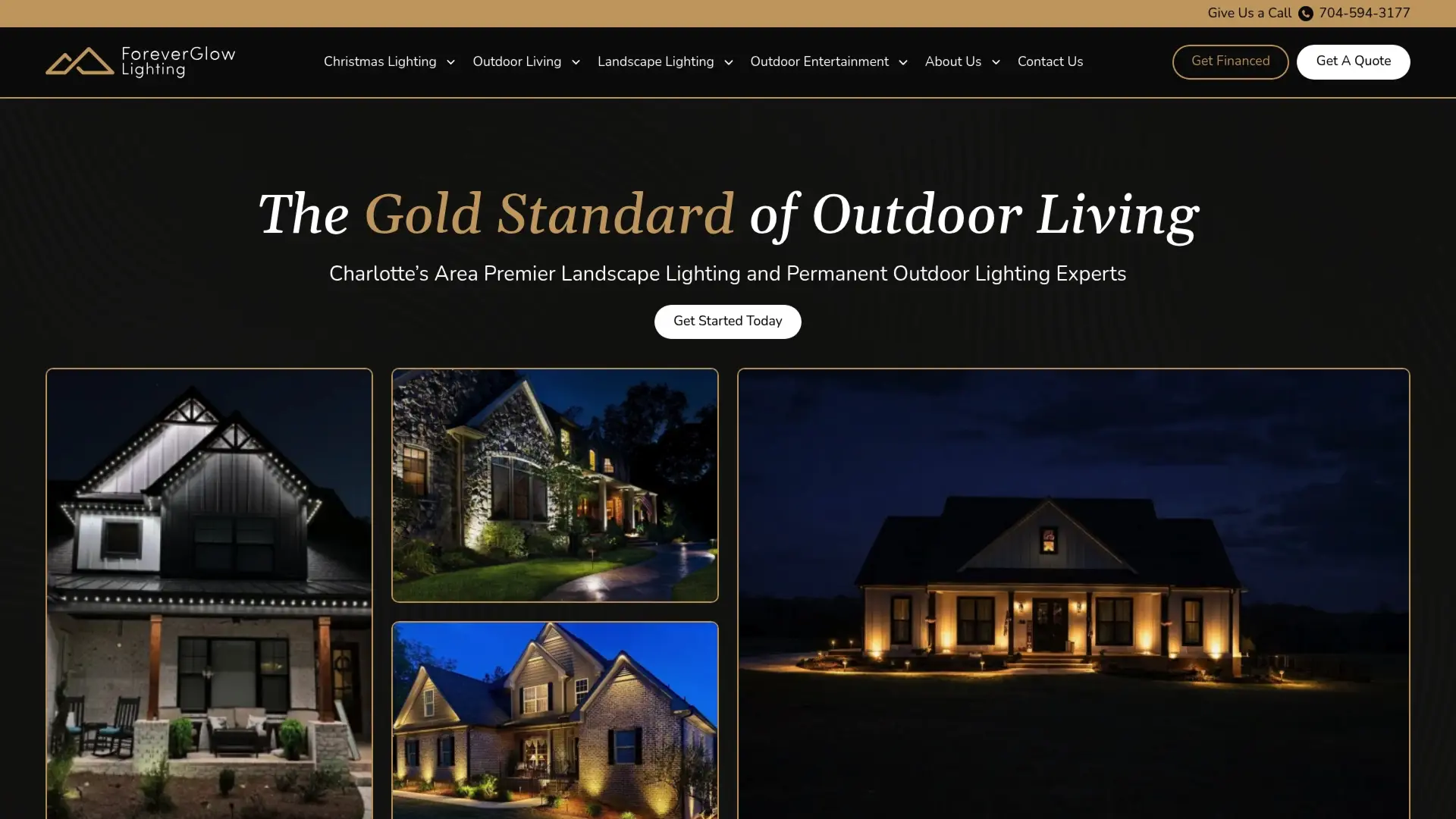
The systems Foreverglowlighting installs are smartphone-controlled, HOA-compliant by design, and backed by a GlowCare maintenance subscription so your system stays performing without you having to manage it. Whether you want a warm architectural accent for everyday use or a full-color holiday display you can switch on from your phone, the process starts with a free on-site estimate.
Explore residential roofline and holiday lighting options or review the full installation process and what to prepare before your first site visit. Have your roofline measurements, outlet locations, and any HOA guidelines ready, and the estimate conversation will be straightforward.
Sources
- 2022 NEISS Data Highlights — CPSC
- Should You Get Permanent Outdoor Lights? — Wired
- Mattos RGB Trim permanent roofline RGB pixel install – Pieter Viljoen’s Blog