
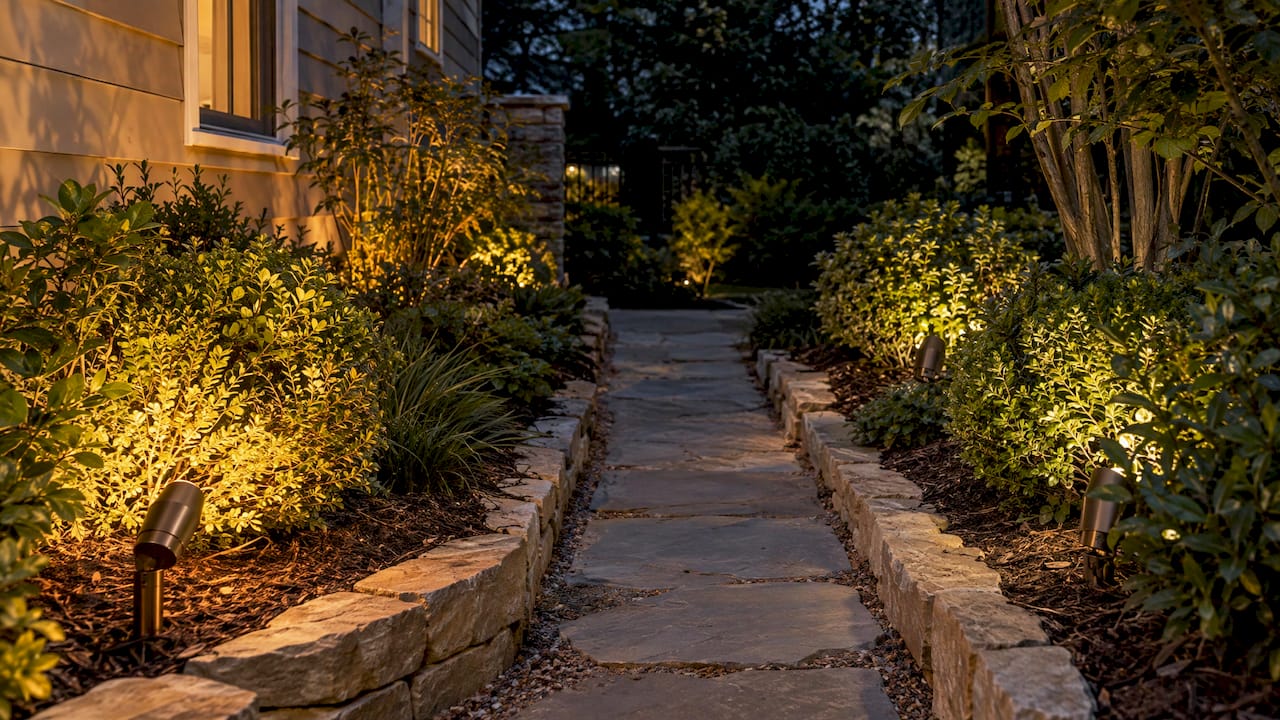
Both 2700K and 3000K are warm white, and the gap between them is small but easy to see outdoors. 2700K is softer and more golden, close to the glow of a classic incandescent bulb. 3000K is slightly cleaner and whiter. For most traditional homes with brick, wood or warm stone, 2700K is the safer pick. For white, gray or contemporary exteriors, and for cool-toned plants, 3000K often looks better. The right answer depends on your materials, your plantings and how the fixtures are aimed, so the rest of this guide shows you how to decide.
TL;DR
- 2700K gives a softer, amber-leaning glow that flatters brick, wood, warm stone, patios and garden beds.
- 3000K gives a slightly crisper, more neutral warm white that suits light masonry, stucco, gray pavers and modern façades.
- Kelvin describes the color of the light, not its brightness. Lumens, beam angle and fixture placement control how bright a scene looks.
- Keep one temperature within each visual zone. Mix them only on purpose.
- Color rendering (CRI) and glare matter as much as the Kelvin number.
Table of Contents
- What the numbers actually mean
- How 2700K and 3000K look outdoors
- Matching color temperature to your home’s exterior
- Which one for which area of the property
- Can you mix 2700K and 3000K?
- Beyond Kelvin: CRI, glare and light pollution
- How to decide for your own property
- Our perspective
- Want it designed for your home?
- FAQ
- Sources
What the numbers actually mean
Kelvin (K) is a measure of correlated color temperature, or CCT. A lower number looks warmer and more yellow. A higher number looks whiter and eventually bluer. Both 2700K and 3000K sit in the warm-white range, which is why they are so often compared.
The common mistake is treating Kelvin as a brightness setting. It is not. A 3000K lamp is not automatically brighter than a 2700K lamp. How bright a scene looks depends on the lumen output of the lamp, its beam angle, how far it sits from the surface and where it is aimed. Two lamps with the same lumens can even look different at night because their beams spread differently. If you want to understand that side of the decision, our guide to what beam angle means for outdoor lighting coverage and our landscape lighting brightness levels guide cover it in detail.
For a broader side-by-side of warm-white options in a home, this 2700K and 3000K comparison for homes is a helpful companion.
How 2700K and 3000K look outdoors
2700K: soft, golden, familiar
2700K produces a gentle amber-leaning glow. Most people read it as cozy and welcoming because it resembles the incandescent lighting they grew up with. At night, on a front entry or a patio, that warmth makes a space feel lived in rather than lit.
It does best on surfaces that already carry warm tones: red and brown brick, cedar and other wood, tan or buff stone, clay-colored roofing. The light deepens those colors instead of fighting them. It is also a natural fit for seating areas, outdoor dining spaces and garden beds, where you want people to relax.
3000K: still warm, a little cleaner
3000K keeps a warm feel but removes some of the yellow cast. White surfaces look closer to white, gray stone looks gray rather than beige, and green foliage looks fresher. The light reads as slightly more neutral and more modern.
That is why 3000K is often chosen for contemporary and transitional homes, painted or stuccoed façades, concrete walkways and architectural uplighting on clean lines.
The difference in plain terms
| 2700K | 3000K | |
|---|---|---|
| Look | Softer, more golden | Slightly whiter, more neutral |
| Mood | Cozy, traditional | Crisp, modern, still warm |
| Often suits | Brick, wood, warm stone, patios, garden beds | Light masonry, stucco, gray pavers, modern façades |
| Plants | Brown, bronze, reddish and deep green foliage | Silver, blue-green and fresh green foliage |
| Risk | Can make white stucco look yellow | Can wash out red brick |
These are tendencies, not rules. A good design adjusts for the specific house.
Matching color temperature to your home’s exterior
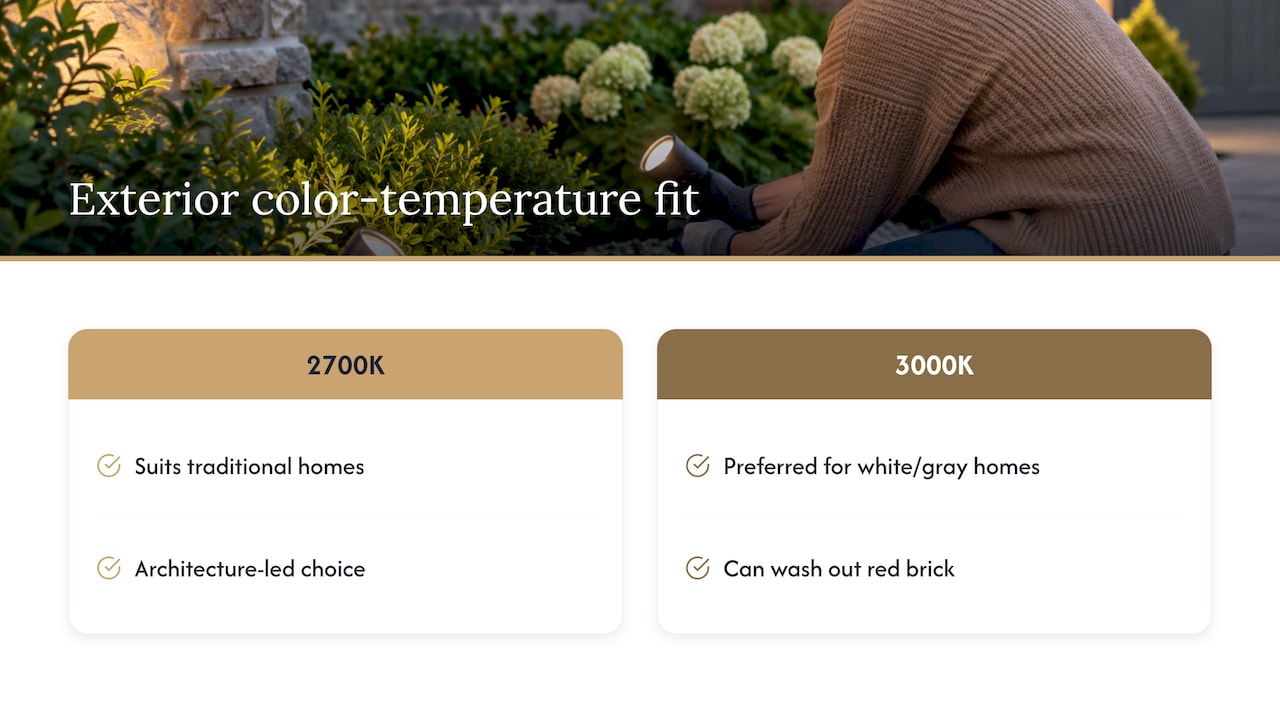
This is where most homeowners get stuck, and where trade guidance is most useful. Industry reporting in Irrigation & Lighting notes that 2700K generally suits traditional homes, while 3000K is often preferred for contemporary white or gray homes, and cautions that 3000K can wash out red brick. It also frames color temperature as a design decision tied to the architecture, the plant material and the focal points, not an isolated lamp spec.
Here is how that plays out on common Carolina exteriors.
Red and brown brick
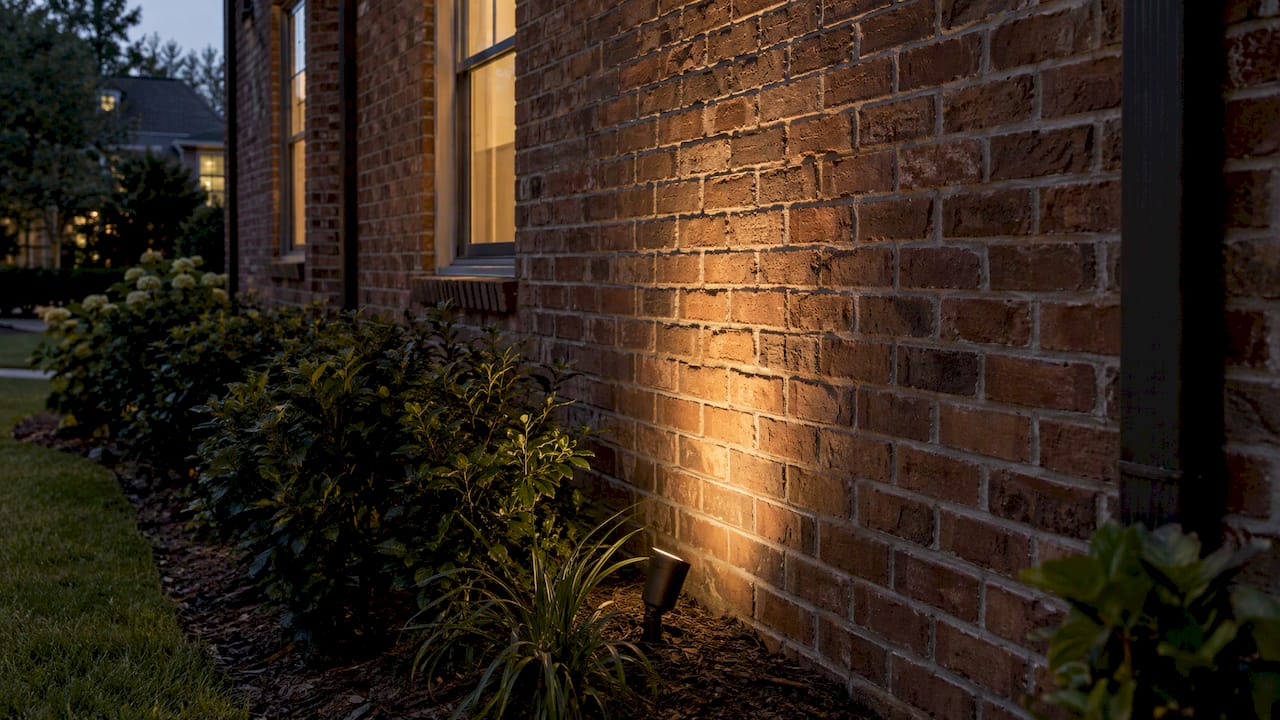
Brick is the classic case for 2700K. The warm light brings out the red and clay tones and keeps the wall from looking pale or pinkish. If your house is brick, see our brick house lighting ideas for placement examples that go with the color choice.
White, gray and painted siding
On white or light gray surfaces, 2700K can push the wall toward cream or yellow. 3000K usually keeps these colors truer. If your siding is a cool gray or blue-gray, 3000K also avoids the tan or brownish cast that very warm light can create.
Stucco and stone
It depends on the shade. Warm-toned stucco and buff or tan stone look rich under 2700K. Bright white stucco and gray or light stone usually look better under 3000K. When the house mixes both, such as gray siding with a brick base, the design needs more thought, which brings us to mixing temperatures.
Plants and trees
Foliage reacts too. Warmer light tends to enrich brown, bronze and reddish leaves and the bark of mature trees. Slightly whiter light tends to make green hedges, ornamental grasses and silver or blue-green plants look cleaner. Many designers will tell you that either temperature can work on a tree, and that how the fixture is aimed and what beam angle it throws can matter as much as the Kelvin value.
Which one for which area of the property
| Area | Usual starting point | Why |
|---|---|---|
| Front entry and walkway | 2700K for brick or wood homes, 3000K for white or modern homes | Matches the façade so the entry feels part of the house |
| Patio, deck and dining area | 2700K | Flattering to skin tones and relaxed in mood |
| Garden beds | 2700K, or 3000K for silver and blue-green plants | Depends on plant palette |
| Architectural uplighting on light walls | 3000K | Keeps light surfaces looking clean |
| Pool and water features | Either, chosen with the surrounding hardscape | Follows the stone and decking |
| Driveway and commercial façades | 3000K is common | Slightly crisper visibility with a warm feel |
This table is a starting point. If you are weighing fixtures for decks, steps or bistro strings, our patio lighting page shows how those spaces are typically handled.
Can you mix 2700K and 3000K?
Yes, but only deliberately. The rule that works is to keep one temperature within each major visual zone. Fixtures lighting the same wall, the same hedge row or the same tree group should share a temperature, unless contrast is part of the plan. A random blend of temperatures across the front yard tends to look inconsistent and accidental, as if fixtures were replaced over time.
Sensible reasons to mix:
- A brick home with a white-trimmed portico, where the entry is 3000K and the brick is 2700K.
- A backyard where the patio is 2700K for comfort and a modern stone feature wall is 3000K.
- A landscape with silver-leafed plantings that need 3000K next to a warm wood pergola.
If you do mix, separate zones physically so that the two colors do not overlap on the same surface. Our landscape lighting layering techniques guide explains how to build those zones.
Beyond Kelvin: CRI, glare and light pollution
The Kelvin number tells you the color of the light. It does not tell you how well that light renders color. The U.S. Department of Energy points out that color rendering varies by LED make, model and CCT, and recommends looking at the spectral power distribution alongside CCT and CRI. Two 3000K lamps can make the same red brick look quite different. A lamp with a high CRI usually shows plant and material colors more faithfully, so it is worth asking for the CRI of any fixture you are considering.
The same DOE fact sheet describes glare, light trespass and sky glow as the main outdoor-lighting concerns. Good design handles all three:
- Glare: Keep the light source shielded or aimed away from eye level, on walkways and from the street.
- Light trespass: Keep light on your property and off the neighbor’s windows.
- Sky glow: Avoid sending light upward without a surface to catch it.
The DesignLights Consortium’s October 2024 guidance, which summarizes IES and International Dark-Sky Association principles, says outdoor lighting should be useful, targeted, no brighter than necessary, controlled and warmer where possible. That is one more reason both 2700K and 3000K are popular for residential work: they keep a warm look and avoid the harsh blue-white of high-Kelvin lamps. It also supports the idea that less is more. Overlighting a tree or a wall flattens the scene and distracts from the rest of the landscape. Contrast between light and shadow is what gives a property depth, and our exterior accent lighting ideas show how to use it.
If you’re curious about the LED technology itself, our homeowner’s guide to LED in landscape lighting covers what to expect from modern fixtures.
How to decide for your own property
You do not have to guess. Work through these steps.
- Walk the property at dusk. Note the dominant materials: brick, stone, siding, roofing, wood. Write down the color of each.
- Sort the surfaces into warm and cool. Red, brown, tan and cream lean warm. White, gray and blue-gray lean cool.
- List the focal points. Entry, key trees, a water feature, a stone wall. Each focal point should have one temperature.
- Compare samples at similar brightness. Aim each sample at the same surface and view it after dark from where you will normally stand, not from two feet away.
- Check CRI and beam angle, not just the Kelvin number.
- Think about the house in daylight too. A color that looks good at night should not clash with what you see in the morning.
- Plan for control. Smart controls let you dim and schedule the lights, which reduces glare and avoids overlighting.
Seeing both temperatures on your own house is the most reliable way to choose. A professional designer can run that comparison for you on site, which is part of why a professionally designed lighting plan pays off. If you want a printable list to take through the process, use our landscape lighting checklist for homeowners.
Our perspective
We approach 2700K vs 3000K as a design question, not a spec-sheet question. The number on the box only matters once you know what the light will land on.
For most homes we look at, the deciding factors are the exterior materials, the plant palette and how the owners use the space after dark. A brick colonial with mature oaks and a covered patio usually points toward 2700K. A white or gray modern home with clean lines and pale hardscape usually points toward 3000K. Plenty of properties fall between the two, and that is where a careful layout and a consistent temperature in each zone make the difference.
We design our systems around commercial-grade, climate-optimized hardware and smart controls, so the color you choose can be dimmed, scheduled and adjusted from your phone. We also design with HOA and municipal requirements in mind, because the right color temperature is only useful if the whole installation fits the rules of your neighborhood.
Our advice is to settle the color temperature before you settle the fixtures. It is the choice you will see every night.
Dave
Want it designed for your home?
If you would rather see 2700K and 3000K on your actual house than imagine it, our team designs and installs custom landscape lighting across the Charlotte area, with smartphone control and layouts planned around your architecture, plantings and neighborhood requirements. You can read about our landscape lighting design service or ask for a free estimate.

If your goal is accent lighting on the façade itself, our architectural lighting service is built for that. And if you also want holiday displays on the same system, our permanent lighting options let you use one installation year-round.
FAQ
Is 3000K brighter than 2700K?
No. Kelvin measures color appearance, not brightness. Brightness comes from the lumen output of the lamp, its beam angle and where it is aimed. A 3000K lamp can look crisper, which sometimes reads as brighter, but it is not inherently more intense.
Which is better for landscape lighting, 2700K or 3000K?
Neither is better in every case. 2700K tends to suit brick, wood, warm stone and traditional homes. 3000K tends to suit white or gray exteriors, light stone and contemporary architecture. Many homes use both, in separate zones.
Will 3000K look too white or cold outdoors?
Usually not. 3000K is still a warm white. It looks cleaner than 2700K but is far from the bluish look of higher-Kelvin lamps. On red brick it can look a little pale, which is the main place designers lean toward 2700K.
Can I use 2700K and 3000K on the same house?
Yes, if each zone is consistent. Use one temperature on a given wall, hedge row or plant group, and change temperature only where the architecture or planting calls for contrast. Mixing at random tends to look unplanned.
What color temperature is best for outdoor lighting overall?
Most residential designs land between 2700K and 3000K. Outdoor-lighting guidance from the DesignLights Consortium favors warmer light where possible, so both fit well. Your home’s materials decide which one wins.
Sources
- Color by numbers, Irrigation & Lighting
- LED Outdoor Area Lighting Fact Sheet, U.S. Department of Energy
- Seven Strategies to Minimize Negative Impacts of Outdoor Light at Night, DesignLights Consortium