
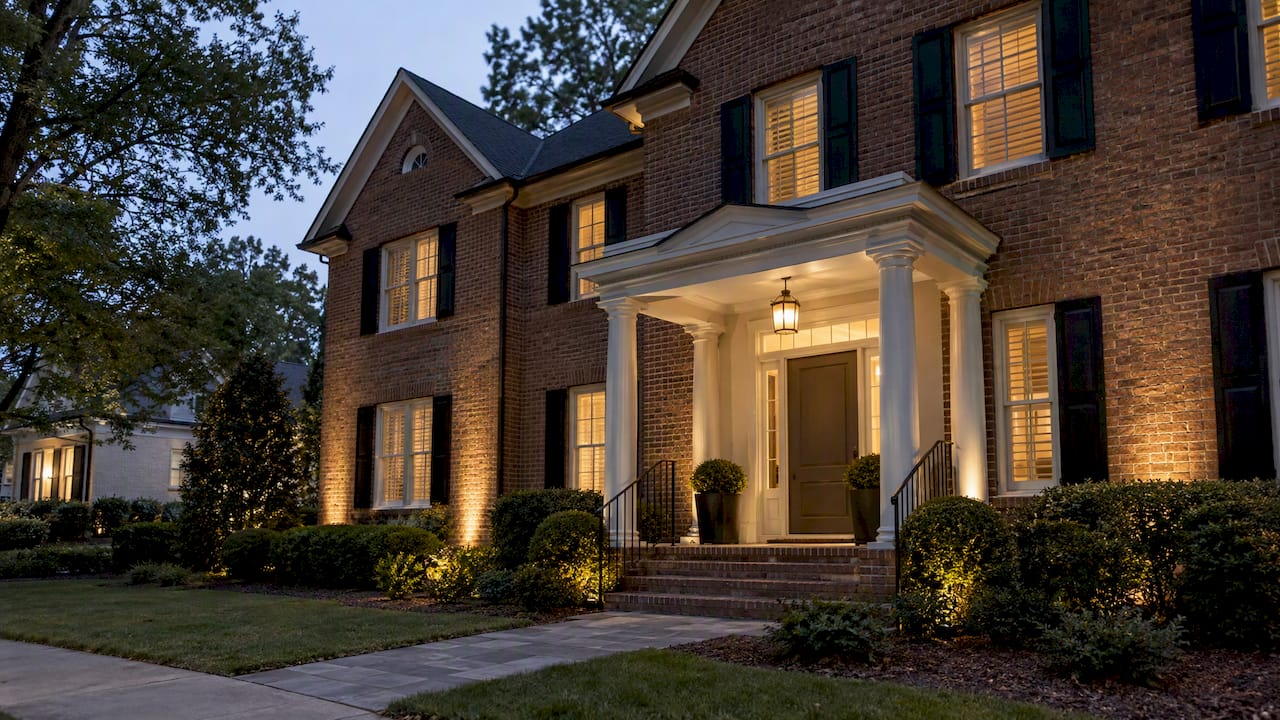
The best lighting for a brick house is warm, layered and aimed with purpose. Light the front door first. Graze the brick so its texture shows. Pick out columns, gables and a few trees. Keep path lights low and evenly spaced. Brick is a textured, absorbent surface, so where a fixture sits matters more than how bright it is. This guide covers what to light, which fixtures and color tones suit brick, how to avoid glare, and what to know about safe installation.
TL;DR
- Start with function: the entry, steps and walkways. Then add accent light on brick, columns, gables and selected landscaping.
- Warm white light, around 2700K, is the usual starting point for brick. Cool white tends to make brick look flat.
- Grazing, with fixtures close to the wall, shows off mortar joints and texture. Fixtures placed too close create hot spots, and fixtures placed too far lose the effect.
- Outdoor electrical work needs outdoor-rated equipment and GFCI protection. Hire a licensed professional for anything hardwired.
- Permanent smart LED systems let you change color and schedules from your phone, with no ladders and no seasonal hanging.
Table of Contents
- Start with what the lighting has to do
- Idea 1: Frame the front door with lanterns or sconces
- Idea 2: Graze the brick to show texture
- Idea 3: Use warm white, around 2700K
- Idea 4: Light columns, gables and architectural details
- Idea 5: Use a roofline track for a clean look
- Idea 6: Light the walkway and steps evenly
- Idea 7: Mark the driveway lightly
- Idea 8: Add landscape layers that frame the brick
- Idea 9: Control glare near the entry
- Idea 10: Balance security, appearance and energy
- Idea 11: Extend the plan to patios, decks and docks
- Idea 12: Plan for year-round use
- Installing lights on a brick house safely
- Our perspective
- Plan your brick home lighting with us
- FAQ
- Sources
Start with what the lighting has to do
Before choosing a fixture, decide what the lights are for. A brick house usually has three jobs to cover: safe arrival, visible architecture and a sense of security. This Old House describes exterior lighting as both functional and visual: light the front door, walkways and steps, then highlight selected landscape features instead of the entire yard.
That order keeps the project from drifting. Homeowners who start with a spotlight on the nicest tree often end up with a bright tree and a dark front step. Do the practical layer first, then add the decorative one.
For most homes, a good plan has four layers:
- Entry and steps: the lanterns or sconces beside the door.
- Pathways and driveway edges: low, shielded fixtures.
- Facade accents: columns, gables, dormers and textured brick.
- Landscape: a few trees, planting beds or garden features.
Our guide to landscape lighting layering techniques goes deeper on how these layers work together.
Idea 1: Frame the front door with lanterns or sconces
The front door is where visitors look first. Lighting there acts as a beacon, helps people see the steps, makes the doorbell and keyhole easy to find, and lets you see who is at the door, according to This Old House.
On brick, classic fixtures tend to look right: black or bronze lanterns, copper-finish sconces and simple cylinder lights. Matching fixtures on both sides of the door create a symmetrical, welcoming look. If the door is recessed or narrow, a single fixture on the latch side plus a soft downlight above can do the job without crowding the brick.
Two practical tips:
- Choose fixtures with frosted or shielded glass so you see a glow, not a bare bulb.
- Mount them at about eye level so the light falls on faces and steps instead of shining into the eyes of anyone approaching.
Idea 2: Graze the brick to show texture
Brick has depth: mortar joints, slight color variation, the occasional rough edge. Grazing places a fixture close to the wall and aims light up or down along the surface so every joint throws a small shadow. Brick facades and textured walls are good candidates for this technique, and columns, dormers and gables can be lit too, as lighting designers at LIT Outdoor Lighting describe it.
The tradeoff is placement. Too close, and you get bright hot spots at the base of the wall. Too far, and you lose the texture and end up with a flat wash. Smooth stucco or painted surfaces suit washing from a distance, but brick almost always looks better grazed.
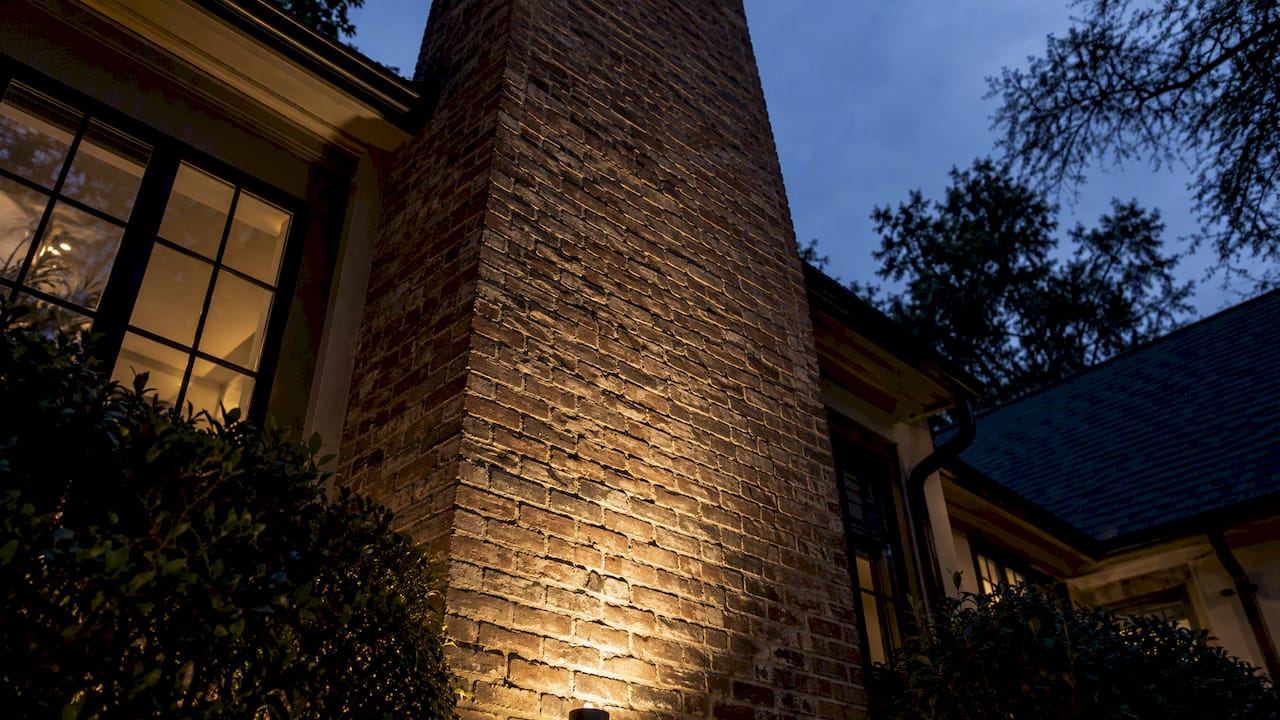
Grazing works best on walls with clear, uninterrupted surfaces: a chimney, the wall beside the garage, the space between windows. Skip it on walls with a lot of vents, meters and downspouts, which the light will also highlight.
Idea 3: Use warm white, around 2700K
Color temperature changes how brick reads at night. Warm white around 2700K brings out the reds, oranges and browns and keeps the house looking residential. Cool white of 4000K and higher can make brick look flat or institutional. That is the common recommendation among lighting professionals, and it matches what we see in practice.
If you are choosing a smart system, you do not have to commit forever. Our permanent LED tracks and accent fixtures can be set to warm white for everyday evenings and switched to color for holidays and events. Keep any architectural fixtures in one color temperature so the facade looks like one composition. For help with how LEDs work outdoors, see the role of LED in landscape lighting.
Idea 4: Light columns, gables and architectural details
Many brick homes have features worth emphasizing: a front portico with columns, a prominent gable, arched windows or a chimney. Accent fixtures at the base, aimed upward, draw the eye up the structure and give the roofline a clear shape at night.
Avoid lighting everything. A facade with six evenly bright features looks busy. Pick two or three focal points, for example the entry portico, the main gable and one specimen tree, and let the rest of the brick fall into shadow. That contrast is what makes the house look designed instead of floodlit.
We cover this in more detail in our guides to exterior accent lighting ideas and exterior architectural lighting.
Idea 5: Use a roofline track for a clean look
A permanent roofline track mounts along the eaves and holds LED points that sit nearly invisible in daytime. On brick homes the track is usually color-matched to the fascia or trim so it blends in. At night it can outline the roof in warm white, or light the home in any color you choose for holidays, team colors or celebrations.
This is what we install. Our systems use smart controls, so you adjust colors and schedules from your phone and never climb a ladder to hang lights again. For a brick house, the practical benefit is that nothing is clipped, nailed or drilled into the brick for seasonal displays, and the same track works all year. See permanent Christmas lighting for how it works, and why permanent beats seasonal holiday lights.
Idea 6: Light the walkway and steps evenly
Path lighting is about safety first and style second. This Old House recommends even, overlapping light on walkways and steps, with staggered fixtures to avoid a runway look. Shielded path lights should direct light onto the walking surface instead of out into the eyes.
On a brick home, a few guidelines help:
- Place fixtures at changes in direction, at steps and at transitions between surfaces.
- Keep them low, below eye level, and use consistent spacing.
- Match the color temperature of your path lights to your facade lighting so the two layers do not compete.
- Use a brick or stone step riser light for a subtle band of light that shows each tread.
Our path lighting guide explains the options in more detail.
Idea 7: Mark the driveway lightly
You do not need to light a driveway from end to end. A post lantern at the entrance works as a landmark, and a few low, shaded fixtures can define the pavement edges. Vehicle headlights already provide long-range illumination, so lighting the entire approach is generally unnecessary.
On a brick home with a brick pier or mailbox column, a small downlight or cap light at the entrance ties the driveway to the house.
Idea 8: Add landscape layers that frame the brick
Brick looks richer against green. Selective landscape lighting is a strong way to add depth. Good candidates include specimen trees, trunks and canopies, shrubs, planting beds, retaining walls, planters and garden structures.
Use different heights for variety:
| Layer | Typical use | Fixture type |
|---|---|---|
| Ground level | Uplighting walls, trunks and columns | Well lights, spot fixtures |
| Knee height | Paths and planting beds | Shaded path lights |
| Eye level | Human-scale detail at entries | Wall sconces, lanterns |
| Overhead | Soft moonlight over beds and paths | Tree-mounted downlights |
The fixture types above follow those named by This Old House: lanterns and wall sconces, recessed well lights, swivel spotlights, shaded path lights, bollards and tree-mounted downlights. Keep tree lighting at a level that does not overpower the facade. The house should remain the main subject.
For 15 specific yard ideas, see landscape lighting for curb appeal.
Idea 9: Control glare near the entry
Glare is the most common mistake on brick homes. Brick absorbs light, so installers sometimes overcompensate with bright, wide beams that blind visitors and neighbors. A few habits help:
- Use controlled beam angles near the door so light lands on the wall and steps, not in the eyes.
- Choose shielded or recessed fixtures when possible.
- Aim fixtures down or along the wall instead of outward.
- Dim where you can. Smart controls let you set scenes: bright enough for arrival, softer for late evening.
We wrote a full guide on how outdoor lighting reduces glare without losing curb appeal.
Idea 10: Balance security, appearance and energy
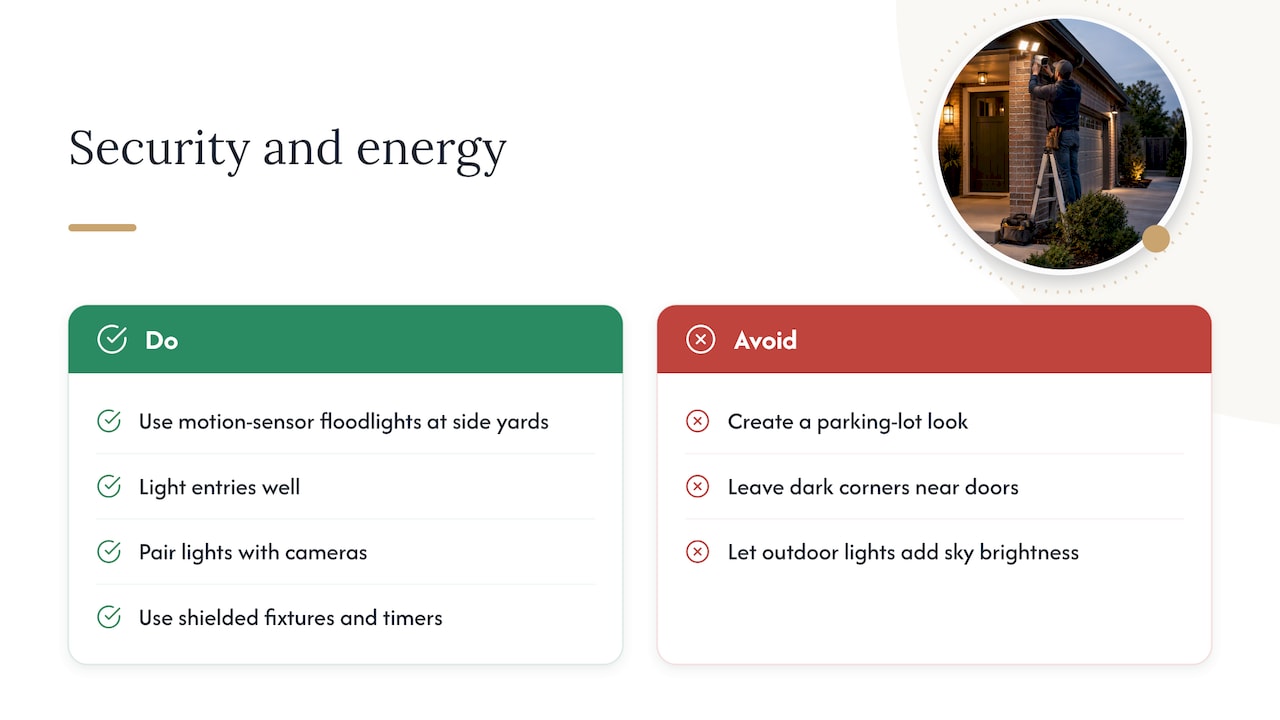
Security lighting does not have to look like a parking lot. Motion-sensor floodlights at side yards and garages and well-lit entries work with a decorative plan instead of against it. Lighting increases the likelihood that suspicious activity will be seen, and it removes dark corners near doors and windows. Pair it with cameras where you have them so the lighting gives the camera usable footage.
On energy, LEDs use far less power than older bulbs, but the U.S. Department of Energy notes that outdoor lighting should still be carefully specified to give needed visibility and safety while limiting impacts such as sky brightness. In practice that means shielded fixtures, sensible brightness, and timers or schedules so lights are on when you need them. Our outdoor LED energy use guide covers the cost side.
Idea 11: Extend the plan to patios, decks and docks
Many brick homes have a rear patio, a deck or a screened porch, and those spaces deserve the same attention as the front. Bistro and string lights over a patio, step lights on a deck and subtle wall lights near the back door make evenings more usable. For homes on the water, marine-grade lighting can carry the plan to the dock. Our patio lighting page shows what is possible.
Idea 12: Plan for year-round use
The smartest brick house lighting does more than one job. The same system can show warm white on a normal night, red and green in December, and team colors on game day. Because it is permanent, you also avoid tangled strands, bulb replacements and trips up an extension ladder. For more uses, see creative ways to use permanent lighting beyond Christmas.
Installing lights on a brick house safely
Brick is not forgiving to drill, and electricity outdoors demands respect. Keep these points in mind:
- Use outdoor-rated, certified products. The Electrical Safety Foundation International (ESFI) recommends outdoor electrical products certified by a recognized testing laboratory, and notes that the National Electrical Code requires GFCI protection for outdoor outlets in new homes. For more on this, see this overview of GFCI protection and outdoor-rated equipment.
- Protect cords. When mounting light strings, avoid pinching cords in doors or windows, and do not support them in a way that damages the insulation, ESFI advises.
- Mind your ladder. ESFI recommends wooden or fiberglass ladders for outdoor decorating because metal ladders conduct electricity.
- Drill into mortar, not brick faces, where possible. Mortar joints are easier to repair than a cracked brick. A professional installer will choose anchors and mounting points for you.
- Check local rules and your HOA. Charlotte-area neighborhoods often have exterior lighting guidelines. Confirm what applies to you before you build.
For permanent systems, our code check after 90 days article explains what to look for after installation, and our pool area lighting safety guide covers GFCI testing near water.
Our perspective
Brick is one of the best surfaces you can light, and one of the easiest to get wrong. It rewards patience: warm color, close and careful placement, and restraint.
We design every system around the house itself. That means commercial-grade, climate-optimized hardware, tracks color-matched to your trim, and smart controls so the lighting changes with your plans, not the other way around. We also design with strict HOA and municipal requirements in mind, which matters in the Carolinas.
Our view is simple: permanent lighting done well should be invisible by day, beautiful at night, and never something you have to think about on a ladder. Our GlowCare maintenance program exists so it stays that way.
Dave
Plan your brick home lighting with us
If you want these ideas designed and installed instead of figured out on your own, Forever Glow Lighting designs custom permanent lighting for Charlotte homes: roofline tracks, landscape lighting design and architectural lighting, all controlled from your smartphone.

We offer a free estimate. Tell us about your home and what you want to highlight, and we will recommend a plan. Contact Forever Glow Lighting to get started.
FAQ
What color light looks best on a brick house?
Warm white, around 2700K, is the usual choice. It enhances the red and brown tones in brick and keeps the house looking like a home. Cool white light can make brick look flat. If you want color for holidays, a smart system lets you switch back to warm white afterward.
Should I light the whole front of my brick house?
No. Light the entry, steps and walkways first, then pick two or three focal points such as columns, a gable or a specimen tree. Selective lighting looks more polished and uses less energy than lighting every surface.
How do I avoid glare and hot spots on brick?
Use shielded fixtures and controlled beam angles, and aim light along the wall instead of out toward people. Fixtures placed too close to brick create bright spots, while fixtures placed too far lose the texture effect. A professional can test positions at night before anything is fixed in place.
Can permanent lights be installed on brick without damaging it?
A professional installer plans mounting points to minimize damage, often using mortar joints and trim instead of brick faces. Roofline tracks mount along the eaves, so they typically do not need to be fastened to the brick wall itself. Ask your installer how each fixture will be attached.
Do I need a licensed electrician for outdoor lighting?
For anything hardwired, yes, and low-voltage systems still need a safe power source. Outdoor outlets should have GFCI protection, and all products should be rated for outdoor use. Check local permit requirements and any HOA rules before work starts.
Sources
- Exterior Lighting Right Where You Need It, This Old House
- Lighting the Front of Your Home, LIT Outdoor Lighting
- Next Steps: Five principles for responsible outdoor lighting, U.S. Department of Energy
- Outdoor Electrical Safety Check Booklet, ESFI
- Outdoor Decoration Safety Tips, ESFI
- Electrical in Prefab Homes: Wiring, Panels and Code