
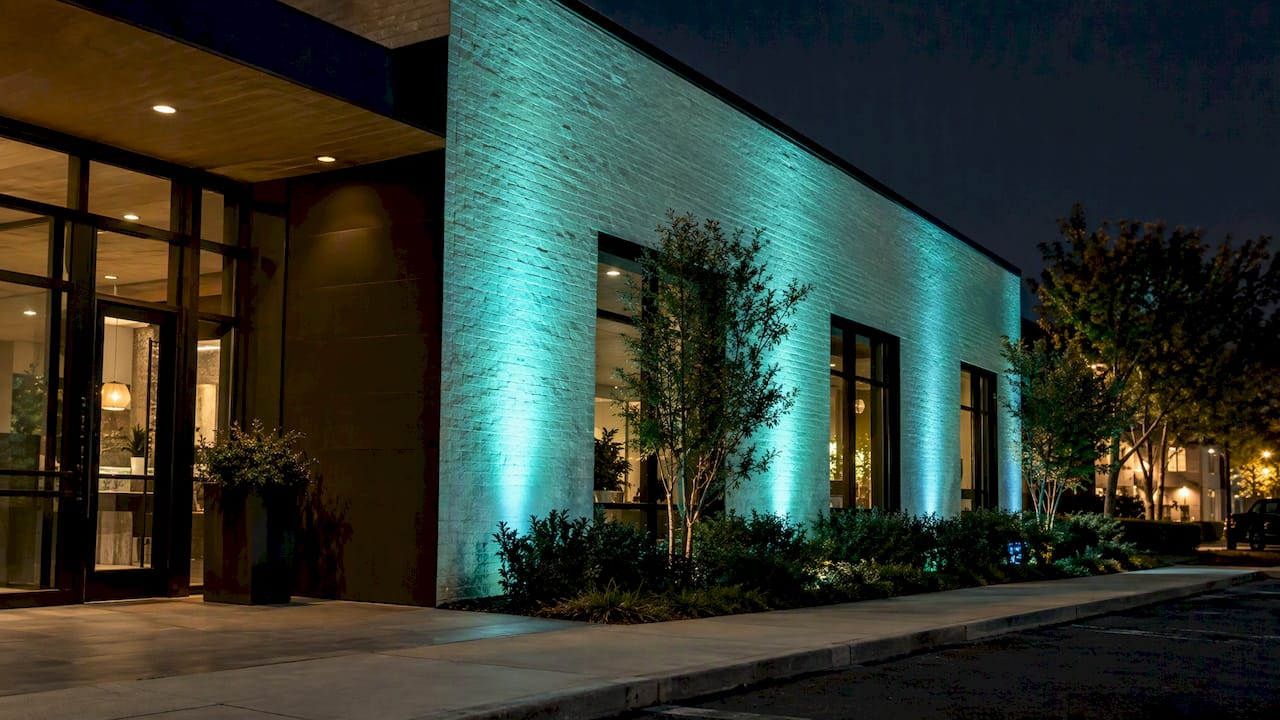
Brand color facade lighting means washing or accenting a building exterior with LEDs set to your company’s exact color, then keeping that color consistent every night. In Charlotte, it works when three things line up: fixtures that can actually reproduce your color, a design that lights the right surfaces without spilling onto neighbors, and a layout that stays inside the city’s exterior lighting rules. This guide covers each, so you can brief an installer and judge a proposal.
TL;DR
- Choose RGBW fixtures, which add a dedicated white LED to red, green and blue, so your brand color and your neutral whites both look right. Source: Dualite
- Ask for color verification in writing. LEDs from different manufacturers vary, so a Pantone match should be checked, not assumed.
- Light the entrance, columns and key features first. Subtle, consistent accent usually builds a brand better than flooding the whole building.
- In Charlotte, the UDO sets foot-candle limits at the lot line, requires cut-off fixtures and prohibits flashing lighting. Design for those from day one.
- Pick an installer who provides design support, documentation and long-term maintenance, not just hardware.
Table of Contents
- What brand color facade lighting actually is
- Why RGBW beats plain RGB for brand colors
- Getting the color right
- Design principle: hierarchy over saturation
- Wall washing or wall grazing
- Charlotte rules to design around
- Responsible lighting is better branding
- Perspective: what we see on Charlotte buildings
- Choosing an installer for a brand color project
- How a project typically runs
- Residential and small commercial: the same principles scale down
- Ready to light your building in your colors
- FAQ
- Sources
What brand color facade lighting actually is
The idea is simple: your logo is teal, your building glows teal. The execution is where projects succeed or fail.
Architectural LED lighting illuminates and defines the exterior features of a building rather than just providing area or task lighting. Brand color work is a specialized version of that. Instead of a generic floodlight, you use controllable fixtures tuned to a specific hue, mounted so the light lands on the surfaces that carry your identity.
It suits several kinds of property:
- Offices, medical buildings and corporate campuses with a signature color
- Restaurants, breweries and hospitality venues that rely on night traffic
- Retail centers and mixed-use buildings where tenants want visibility after dark
- Clubhouses, event venues and municipal buildings that change color for events or seasons
The last group points to a practical advantage of smart color systems. The same fixtures that hold your brand color on a normal night can switch to another scene for a holiday, a fundraiser or a team color week, from a phone or schedule.
Why RGBW beats plain RGB for brand colors
A basic RGB fixture mixes red, green and blue to make white, and the result is often a slightly tinted, harsh white. RGBW adds a dedicated white LED. According to Dualite’s guide for brand managers, that dedicated white gives better-quality white light and more accurate color mixing, which matters for high-end architectural accents.
Why that matters for you:
- Saturated brand tones. The fixture can produce the full visible spectrum while holding a rich, saturated color.
- Clean neutrals. On nights you want a warm or neutral white instead of color, the building does not look purple-tinged.
- Softer pastels and tints. If your brand palette includes a light tone, the white channel helps you reach it without muddy mixing.
Professional systems typically use DMX 512 control for both static brand tones and dynamic sequences, per the same source. For a deeper look at how this works outdoors, see our own explainer, How RGBW Lighting Works Outdoors.
Getting the color right
This is the part most owners underestimate. Your brand guide specifies a Pantone or hex value for print and screens. A light source on a stucco wall at night is a different medium entirely.
Verify, don’t assume
Lumens alone do not decide whether a facade looks like your brand. Color calibration and CRI both matter, and a professional installation should come with spectroradiometric data showing the fixtures match your signature color, because RGBW LEDs vary significantly across manufacturers. Ask to see that data, or ask for an on-site mockup of one bay of the building before the full install.
Expect the surface to change the color
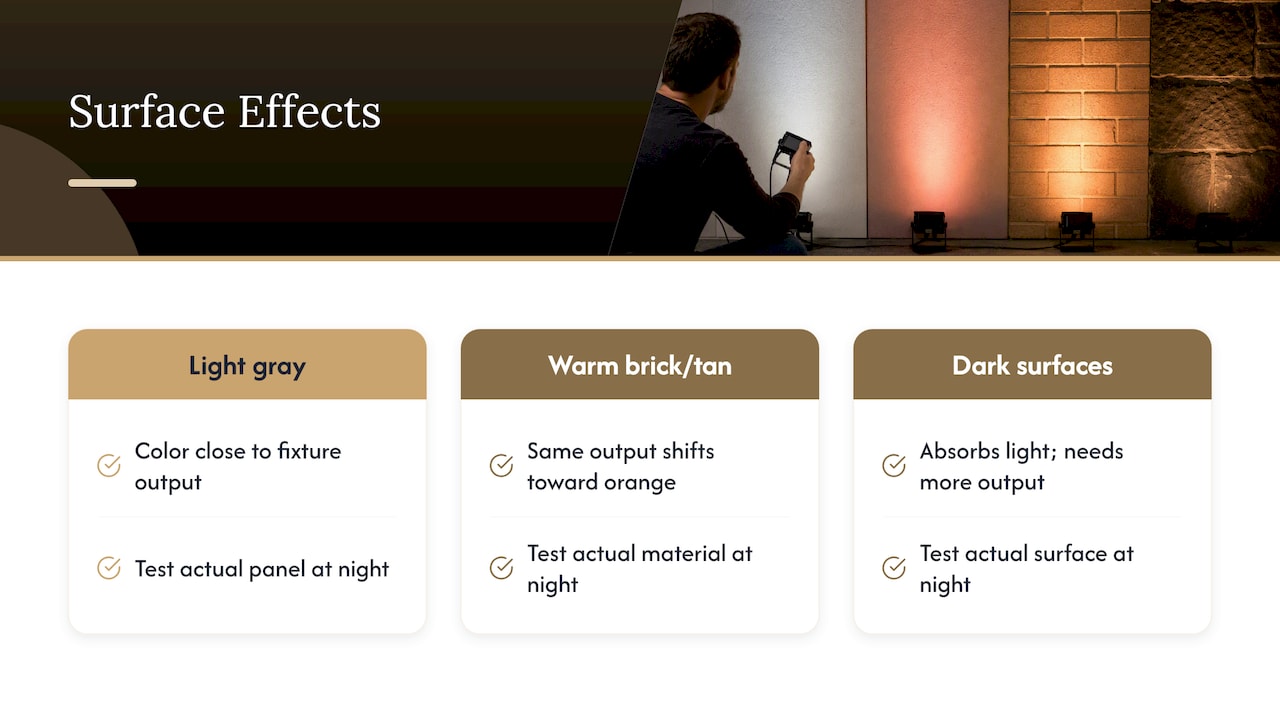
Light is reflected off a surface, so the wall is part of the equation. A light gray panel will show a color close to what the fixture emits. Warm brick or tan stucco will pull the same output toward orange. Dark surfaces absorb light and need more output to read at all. Test on your actual material at night, not on a spec sheet.
Watch the drivers
Cheap drivers are the primary failure point, often turning a premium lighting investment into an expensive maintenance liability within one to two years, according to the same Dualite guide. A color that drifts or flickers defeats the whole purpose. Ask which drivers and controllers are specified and what the warranty covers.
Design principle: hierarchy over saturation
Owners often want the whole building in brand color. Designers usually advise against it. Effective architectural lighting sets a hierarchy: the entrance, signage and structural columns get the emphasis, with balanced contrast, often around a 1:5 ratio, and the building avoids being over-lit so its architecture is not flattened. The same source notes that branding tends to be more powerful through subtle, consistent accent lighting than by turning a building into a giant neon sign.
A workable approach:
- Pick one or two features. An entry canopy, a tower element, a row of columns or a parapet line.
- Use brand color as the accent, white as the base. Keep general facade light neutral and let color mark the focal points.
- Hold the color steady. A consistent brand color each night builds recognition. Save color changes for events.
- Keep brightness moderate. A glowing edge reads as designed. A blinding wall reads as a problem.
Wall washing or wall grazing
Technique matters as much as color. The two methods look completely different, and clients often confuse them.
| Wall washing | Wall grazing | |
|---|---|---|
| Fixture position | About 2 to 3 feet from the wall | Within about 12 inches of the surface |
| Best surface | Smooth: painted stucco, metal panel, smooth plaster | Textured: stone, brick, rough plaster |
| Effect | Even, uniform color across the plane | Shadows that bring out depth and texture |
| Brand color use | Large, clean fields of color | Accent color with dramatic texture |
These distances come from Dualite’s guidance, which also warns that the wrong technique for a surface leaves results flat and unappealing. For brand color specifically, washing generally reads as a color field, while grazing makes the color work with the shadow pattern of the material. Many buildings use both: washing on a smooth signage wall, grazing on a stone base.
Charlotte rules to design around
Charlotte’s exterior lighting standards live in the Unified Development Ordinance. Here is what the UDO’s exterior lighting section says, and what it means for a color facade.
- Foot-candle limits at the lot line. Zero foot-candles at the lot line for lots abutting a Neighborhood 1 or Neighborhood 2 place type. One foot-candle at the lot line for lots abutting any other place type.
- Fixture design. Permanent fixtures, including those on exterior walls, must be full cut-off or semi cut-off designs.
- No flashing lighting. Flashing lighting is prohibited.
- Glare. Exterior lighting must be located, screened or shielded so it does not cause glare or impair the vision of cyclists or motorists.
- Signs are treated separately. The lighting regulations do not apply to lighting for the illumination of signs, though signs have their own rules.
What this means in practice:
- A building backing onto a residential neighborhood needs especially careful aiming and shielding, since the limit at that lot line is zero.
- Color-changing scenes are fine for events, but fast flashing or strobing effects are not. Program transitions as slow fades and holds.
- Fixtures should direct light onto the surface, not outward toward the street or the neighbors.
This is a summary of the published ordinance, not a legal opinion, and codes get amended. Before you finalize a design, confirm requirements and any permit needs with the City of Charlotte or your project architect. We lay out the specifics, including sign limits and permit checks, in our Charlotte exterior lighting ordinance guide.
Responsible lighting is better branding
There is a reputational side too. The Illuminating Engineering Society describes responsible lighting as useful, targeted and low-light, the idea behind the dark sky movement. For a branded facade, that means aiming light at the building surfaces and avoiding stray light that adds to skyglow.
Done well, it avoids the regulatory scrutiny that forces businesses to dim or switch off setups that are too bright. A complaint from a neighbor costs you more goodwill than the lighting ever earned. If this topic matters to your property, our piece on night sky friendly lighting explains the principles in plain terms.
Perspective: what we see on Charlotte buildings
We install permanent lighting across the Charlotte area, and our approach to facade work comes down to restraint and engineering. Permanent systems only pay off if they work reliably for years, so we use commercial-grade hardware chosen for the Carolinas’ weather, with tracks and fixtures color-matched to the building so they disappear by day.
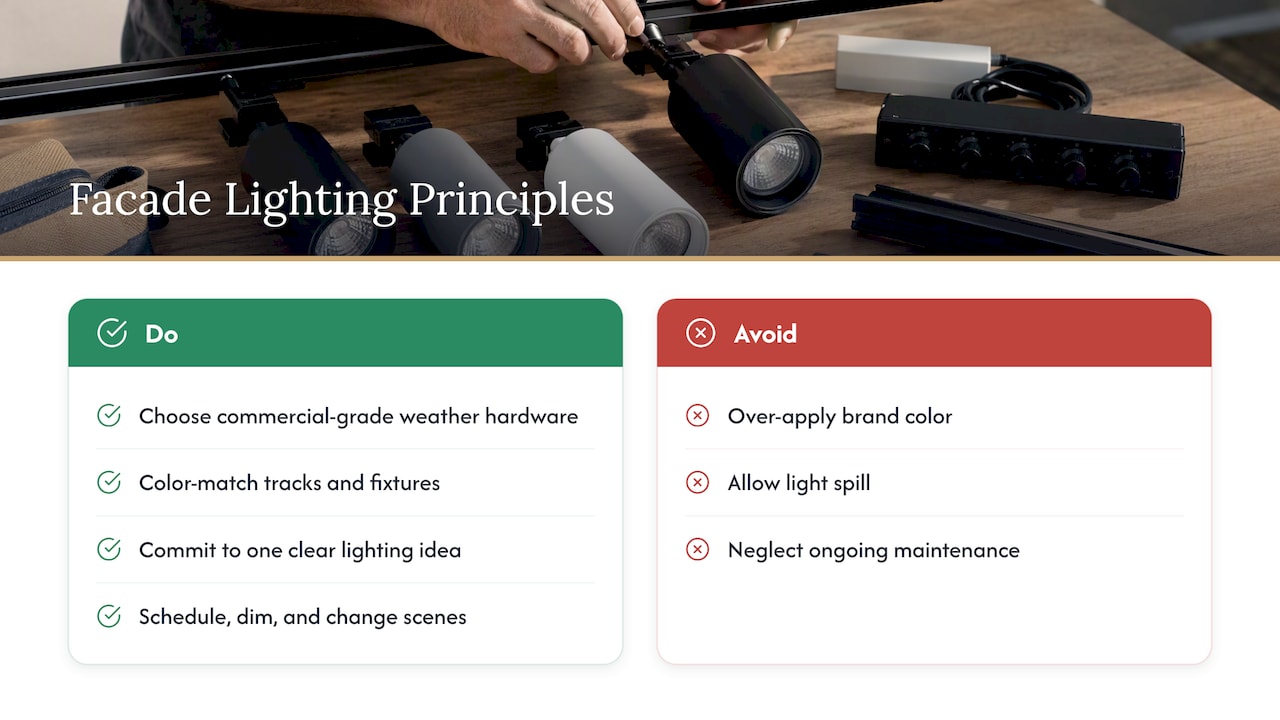
We also think brand color gets over-applied. The properties that look best at night usually commit to one clear idea: a lit entry, a defined roofline, a color accent that repeats. Then they leave the rest alone. That is also the easiest design to keep compliant with HOA and municipal requirements, because less spill means fewer conversations with neighbors and inspectors.
One more point owners miss: the smart controls matter as much as the fixtures. When you can set a schedule, dim after hours and change a scene from your phone, the system fits how the business actually runs. And a maintenance plan matters because a facade that is half dark or visibly off-color is worse than no lighting at all. That is why we offer our GlowCare maintenance subscription alongside installation.
— Dave
Choosing an installer for a brand color project
Experts advise buyers to prioritize project fit over brand size. A smaller manufacturer or installer that provides engineering design support, custom modifications and installation drawings is often a better partner than a global giant that only ships hardware. Technical documentation such as photometrics, and the ability to integrate controls like DMX or Casambi into a central facility system, are the clearest signs of a maintainable, high-end installation.
If you manage a retail or storefront property, this retail lighting and shelving integration guide is a useful companion on coordinating lighting with the rest of a commercial fit-out, from design assistance to installation drawings.
Questions to put to any bidder:
- Can you show spectroradiometric or sample data for our brand color on this fixture?
- Will you do a night mockup on our wall before full installation?
- Which drivers and controllers are specified, and what warranty applies in this climate?
- Do you provide photometric documentation and aiming plans showing lot-line compliance?
- How are fixtures concealed or color-matched to the building by day?
- Who services the system after installation, and how fast?
A proposal that cannot answer these is selling hardware, not a result.
How a project typically runs
Every property differs, but the sequence is consistent:
- Site walk and brand brief. Share your brand color values, the features you want to emphasize and any HOA, landlord or municipal constraints.
- Design and layout. Fixture positions, wall washing or grazing choices, aiming and shielding, and control scenes.
- Mockup and color check. A sample on the actual surface at night, compared against the brand color.
- Installation. Hidden wiring, color-matched tracks or fixtures, and tested controls.
- Programming and handoff. Default brand scene, schedules, dimming and event scenes, plus training for whoever manages the building.
- Ongoing service. Periodic checks so color and output stay consistent.
Our installation process page walks through how we handle this on permanent systems.
Residential and small commercial: the same principles scale down
You do not need a tower to benefit. A restaurant with a stucco front, a medical office with a covered entry or a luxury home with a stone facade all use the same toolkit at smaller scale: a controlled accent color, a clean base white and well-aimed fixtures. For homes, the goal tends toward architectural emphasis rather than branding, and our guides on exterior accent lighting ideas and architectural lighting with contractor-ready specs show what that looks like. For larger properties, see our permanent lighting for commercial buildings guide.
Ready to light your building in your colors
Forever Glow Lighting designs and installs smart, permanent LED systems for Charlotte homes and businesses, with multi-color control from your phone, HOA-compliant design and a climate-specific maintenance program. If you have a facade, entrance or roofline you want to define in your brand color, start with our architectural lighting service and ask for a free estimate. Bring your brand color values and we will plan the mockup around them.
FAQ
What is facade lighting in architecture?
Facade lighting is the deliberate illumination of a building’s exterior surfaces to define its features at night. It is distinct from area or task lighting because it focuses on the architecture itself, using techniques such as wall washing and grazing. Brand color facade lighting adds a controlled color to that approach.
Can LED lights match my exact Pantone brand color?
Often closely, but not automatically. RGBW LEDs vary significantly across manufacturers, so request verification data and a night mockup on your actual wall. The surface material will also shift the apparent color.
Can a Charlotte business use color-changing facade lighting?
Yes, within the rules. Charlotte’s UDO prohibits flashing lighting and requires cut-off fixtures, with foot-candle limits at the lot line. Slow fades and steady scenes are the safe approach, and you should confirm details with the City of Charlotte before installing.
Should the whole building glow in my brand color?
Usually not. Designers recommend a hierarchy that emphasizes the entrance, signage and key structural elements, with balanced contrast. Subtle, consistent accents tend to build a brand better than flooding the entire facade.
Sources
- LED Architectural Lighting for Commercial Properties: What Every Brand Manager Should Know (Dualite)
- Coloring Outside the Lines (Illuminating Engineering Society)
- Retail Lighting And Shelving Integration Guide (DirectShopfittings)