
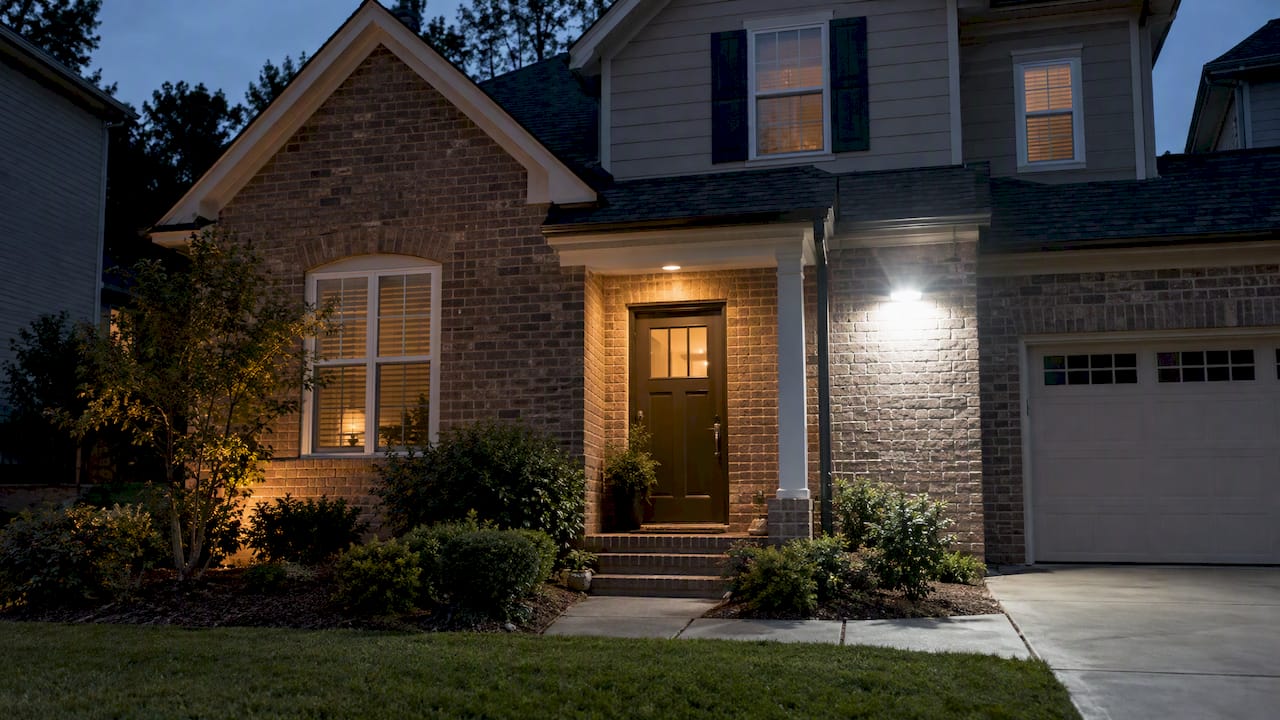
The most common exterior lighting mistakes are too much light, the wrong placement, cool color temperatures, poor wiring and ignoring the neighbors. Almost all of them are decided at the design stage, before a single fixture goes in. They are also cheaper to prevent than to fix. This guide covers eleven mistakes we see on Charlotte-area homes, what the rules and research say about each, and how to avoid them.
TL;DR
- Over-lighting is the most common mistake. Use light only where and when it is needed, at the lowest useful brightness, and aim it so it stays on your property.
- Choose warm color temperatures (2700K to 3000K), shielded fixtures and layered light (ambient, task, accent) rather than a few broad floodlights.
- Wiring and connections fail first outdoors. Waterproof splices, correctly mounted transformers and proper grounding matter more than the fixture finish.
- In Charlotte, light spill at property lines and HOA rules can turn a pretty design into a violation. Plan for both before installation.
- Lighting helps security, but it works best alongside cameras, motion sensors and good sightlines, not as a stand-alone fix.
Table of Contents
- Mistake 1: Lighting everything instead of lighting something
- Mistake 2: Relying on floodlights instead of layers
- Mistake 3: Choosing the wrong color temperature
- Mistake 4: Glare from fixtures that are exposed or poorly aimed
- Mistake 5: Ignoring light trespass
- Mistake 6: Skipping the design phase
- Mistake 7: Cheap fixtures and weak connections
- Mistake 8: Getting the electrical details wrong
- Mistake 9: Mismatched fixtures and no cohesion
- Mistake 10: Expecting lighting alone to stop crime
- Mistake 11: Forgetting maintenance and controls
- Quick reference: mistake, symptom, fix
- Our perspective: design for the worst night, not the best photo
- When it makes sense to call a professional
- FAQ
- Sources
Mistake 1: Lighting everything instead of lighting something
Over-lighting is the mistake we see most. Owners worry about dark corners, so they add fixtures until the house looks like a parking lot. The result is flat, glaring and expensive to run, and it makes the home look worse at night, not better.
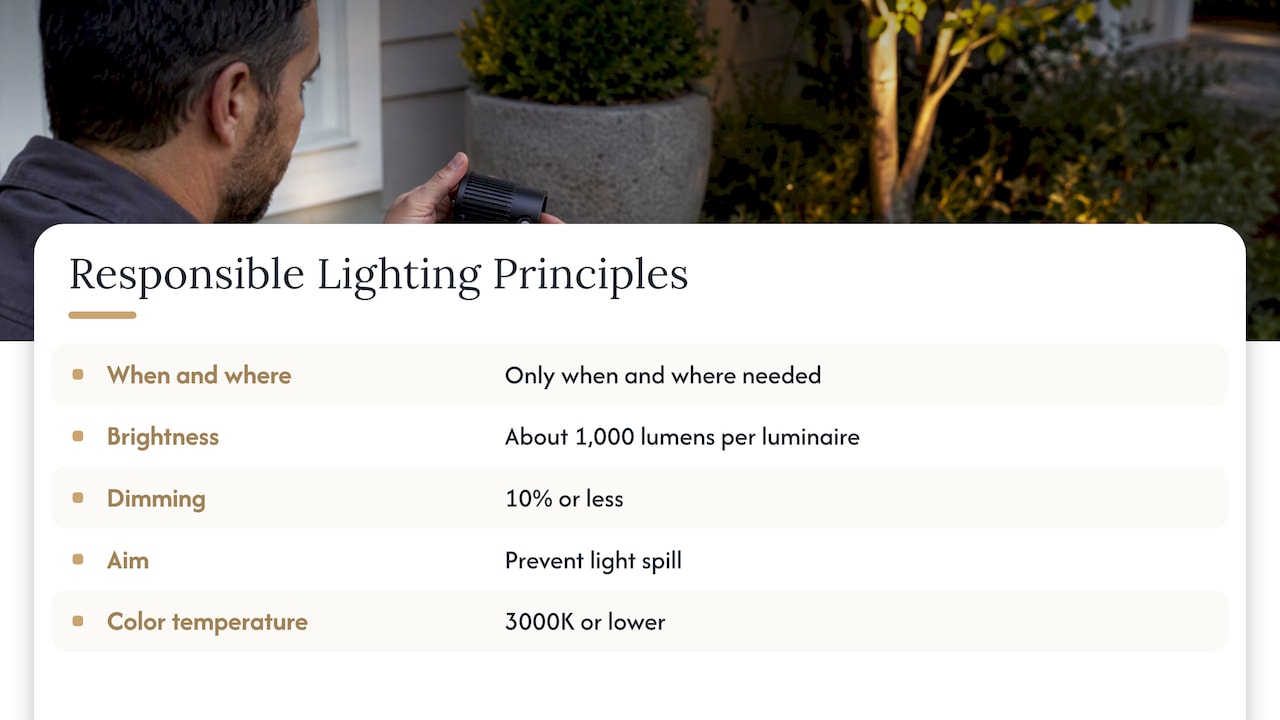
DarkSky International’s five principles for responsible outdoor lighting give a sound test: light should be used only when and where it is needed, at the lowest brightness that does the job, aimed to prevent spill, and in warmer colors. Its residential guidance points to a ceiling of about 1,000 lumens per luminaire, a color temperature of 3000K or lower, and dimming down to 10% or less.
A practical way to apply this: walk the property at dusk and list what you actually need to see. Steps, the front door, the driveway edge, one or two architectural features. Light those. Leave the rest dark. Darkness around lit features is what gives them depth.
Mistake 2: Relying on floodlights instead of layers
One or two bright floods on the eaves light a lot of surface, but they flatten texture, cast hard shadows and create glare for anyone looking toward the house. Designers get better results by layering three types of light:
- Ambient: a soft, low general glow so the space feels connected.
- Task: light for a purpose, such as steps, a grill, a pathway or a keypad.
- Accent: focused light on a tree, a stone wall or a column.
The ND Landscape Services design guide describes the same three layers of path, accent and ambient light using warm 2700K to 3000K sources and careful angles to avoid glare. We walk through how the layers fit together in our guide to landscape lighting layering techniques.
Mistake 3: Choosing the wrong color temperature
Cool white light, 4000K and above, can look clinical on brick, wood and stone. It also makes skin tones look harsh, which is partly why people ask why they look bad under certain lighting. Warm white between 2700K and 3000K flatters materials and faces and sits better with the interior lights seen through your windows.
Match color temperature across the whole property. A mix of 2700K path lights, 3500K wall lights and 5000K security fixtures looks accidental from the street. If you want color for holidays or events, that is a job for a smart, programmable system, with a warm white default for everyday use.
Mistake 4: Glare from fixtures that are exposed or poorly aimed
Glare is what you notice when you can see the bulb instead of what it lights. It happens when fixtures are unshielded, mounted at eye level, or aimed outward instead of down and across. Glare also reduces what you can see: bright points make the surrounding area look darker by contrast, so people (and cameras) see less.
A contractor’s fixture guide from Dauer Manufacturing treats fixture selection as the core of landscape lighting and names glare, dark spots and early failure as what you get when the type does not match the job. Practical rules:
- Pick fixtures with shields, hoods or louvers where the light source could be seen.
- Aim path lights so the pool of light falls on the ground, not into the eyes of someone walking toward the house.
- Test every aiming angle at night, from the street, the driveway and the neighbor’s side of the fence.
Mistake 5: Ignoring light trespass
Light trespass is light that lands where you did not intend it, usually a neighbor’s bedroom window. It is a leading source of neighbor complaints. The Illuminating Engineering Society notes that measuring only the light levels inside your target area misses what leaks out of it, and that even aimable LEDs can cause glare and spill complaints when they sit on old, oversized mounting.
In Charlotte, the city’s Unified Development Ordinance, Article 16 sets the exterior lighting standards for multi-family, mixed-use and nonresidential properties: zero foot-candles at a lot line abutting a Neighborhood 1 or Neighborhood 2 place type, and one foot-candle at lot lines abutting other place types. It also requires full or semi cut-off fixtures and prohibits flashing lighting. Those rules are written for non-single-family uses, so a single-family homeowner’s main constraint is usually an HOA or a neighbor, but they show the standard the city expects. Commercial owners and property managers should treat them as binding.
Two of our guides go deeper: how to keep lighting on your property and Charlotte’s exterior lighting ordinance. If a project needs a permit, our permit guide for Charlotte outdoor lighting explains how to avoid delays. Rules change, so confirm current requirements with the city before you build.
Mistake 6: Skipping the design phase
Most expensive fixes begin with “we’ll just place a few lights and adjust.” Without a plan, you end up with uneven spacing, circuits that cannot carry the load, and a transformer that is too small for what you later want to add.
A proper design answers these questions before installation:
- What are the three or four views that matter, from the street, from the patio and from inside?
- Which zones need task light for safety?
- What is the total load, with room to expand?
- Where will the light fall beyond your lot line?
- Does the HOA require approval of fixtures, colors or hours?
Our landscape lighting design service starts with exactly this walk-through, and our systems are designed for HOA and municipal compliance from the start.
Mistake 7: Cheap fixtures and weak connections
Budget fixtures often fail in one of three ways: moisture gets in, finishes fade or corrode, or the LED module dies and cannot be replaced. In Charlotte’s humid summers, heavy thunderstorms and occasional freezes, outdoor hardware expands and contracts constantly. That loosens connections over time, and water finds them.
The cheapest part of the system is often the most costly mistake. Wire connectors that are not rated for wet or buried use let rain, hose spray and sprinkler water short out a connection. Watch for these:
- Twist-on indoor wire nuts used outdoors.
- Splices left unsealed in planting beds, where sprinklers run.
- Cable buried too shallow or laid where edging and aeration tools will cut it.
- Plastic fixtures in full sun that go brittle within a few seasons.
Choose commercial-grade, weather-rated fixtures and sealed connections. That is the standard we install to.
Mistake 8: Getting the electrical details wrong
Low-voltage lighting is more forgiving than line voltage, but it is not exempt from rules. In North Carolina, 21 N.C. Admin. Code 28B .0507 sets requirements for low-voltage landscape lighting installed by licensed contractors. As summarized in our research, it calls for waterproof wire connections, weather-proof fixtures, transformers mounted at least 18 inches above grade, and wiring loaded to no more than 80% of capacity.
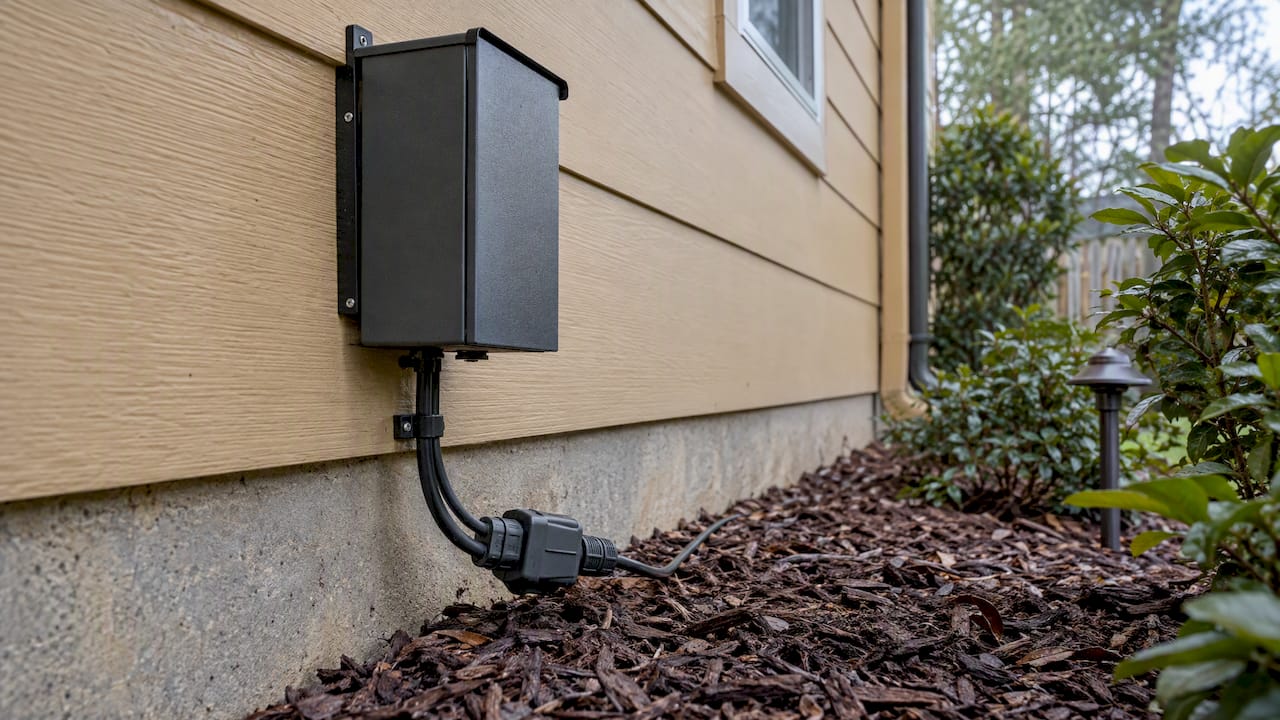
That last number catches people out. A transformer run at its limit has no room for the next addition and runs hot. Load a system to about four-fifths of capacity and you can add a fixture later without replacing anything.
Any line-voltage work, such as new outdoor circuits or wall-mounted fixtures wired to the house, should be done by a licensed electrician with a permit where required. If you want to understand what “rough-in” work involves before talking to a contractor, this low voltage rough-in overview explains the basics of planning cable runs before finishes go on.
Mistake 9: Mismatched fixtures and no cohesion
Do all exterior light fixtures need to match? Not exactly, but they should agree. Mixing finishes, styles and color temperatures at random reads as clutter. A reliable approach is one finish family (for example, black or bronze) across the entire exterior, with a consistent color temperature. Porch sconces should also be in proportion to the door: oversized or undersized fixtures are one of the more visible design errors, especially at entries.
For rooflines, cohesion means a system that disappears in the day. Permanent LED tracks that are color-matched to the trim do this. Strings clipped on at random heights do not. See our architectural lighting service and homeowner specs for exterior architectural lighting.
Mistake 10: Expecting lighting alone to stop crime
Do exterior lights deter burglars? Partly, and it is more nuanced than most ads suggest. The College of Policing’s review of street lighting found that improved lighting can reduce crime, on average by about 21%. But it is street lighting in public areas, not home exteriors, and researchers point to community pride and informal social control as likely drivers, not simple deterrence. The review does not support the idea that a bright floodlight alone protects a house.
What lighting does well at home: it removes hiding spots, makes activity easier to notice, and gives cameras usable images. It does that best when it is even, not blinding. Glare toward the street or into your own camera lens reduces security. Visibility matters in barriers too: a piece on visibility in fencing and security makes a related point that clear sightlines support safety. Pair lighting with cameras and motion sensors, and read our landscape lighting security solutions and safety benefits guides.
Mistake 11: Forgetting maintenance and controls
Even a well-built system drifts. Trees grow into beams, sprinklers knock fixtures out of aim, timers reset after outages, and seasonal changes mean the schedule that suited July does not suit December. A system that is always on, with no dimming or schedule, wastes energy and adds to sky glow.
Controls are the fix. Dimming, schedules and motion triggers let you run low levels most nights and full brightness when you want it. DarkSky’s guidance on night sky friendly lighting fits here, and so does an annual check of aim, connections and transformer load.
Quick reference: mistake, symptom, fix
| Mistake | What you see | Fix |
|---|---|---|
| Over-lighting | Flat, glaring, high energy use | Light only key features, dim, aim down |
| Floodlights only | Harsh shadows, no depth | Layer ambient, task, accent |
| Cool color temperature | Clinical look on brick and wood | 2700K to 3000K across the property |
| Exposed fixtures | Visible bulbs, dark surroundings | Shielded, hooded fixtures |
| Light trespass | Neighbor complaints | Cut-off fixtures, test from lot line |
| No design | Uneven spacing, overloaded transformer | Plan views, zones and load first |
| Weak connections | Flickering, dead runs | Sealed, wet-rated connectors |
| Wrong electrical specs | Overheating, code issues | 18-inch transformer height, 80% max load |
| No controls | Constant glare and wasted power | Dimmers, schedules, sensors |
Our perspective: design for the worst night, not the best photo
We get called after a lot of lighting jobs that went wrong, and the pattern is consistent. The fixtures were fine. The plan was missing. Someone chose brightness over balance, ran a transformer too close to its limit, or never checked what the light did at the property line.
Charlotte is a demanding place for outdoor hardware. Summer humidity, storms and the occasional hard freeze all test seals and connections, and many neighborhoods have HOAs that review exterior changes. That is why we build around commercial-grade, climate-optimized hardware, color-matched tracks and smart controls, and why compliance is part of design, not an afterthought. A good system should be nearly invisible by day, comfortable at night and quiet toward your neighbors.
My advice to any homeowner: if a plan cannot tell you where the light will fall, how much power it uses and who will service it in five years, keep asking questions until it can.
— Dave
When it makes sense to call a professional
If you are already seeing glare, tripped breakers, dead runs or a neighbor’s complaint, it is usually cheaper to have the system assessed than to keep adjusting it. The same applies if you plan permanent roofline lighting, because track systems, power supplies and controls need to be sized and placed together.
Forever Glow Lighting designs and installs permanent LED roofline tracks, landscape and architectural lighting, patio and bistro lighting, and commercial exterior lighting across the Charlotte area, all controlled from your phone. Our GlowCare maintenance subscription keeps systems checked and adjusted after installation. To start, request a free estimate on our site and we will walk the property with you.
FAQ
Do all outdoor light fixtures need to match?
They do not need to be identical, but they should share a finish family and the same color temperature. Different styles can work if scale and finish agree. Random mixes of warm and cool bulbs are the most noticeable mismatch.
Do exterior lights deter burglars?
They can help, but not on their own. Research on public street lighting shows crime reductions of around 21% on average, likely tied to more visibility and community activity. At home, combine even lighting with cameras, motion sensors and clear sightlines.
What are common problems with landscape lighting?
The usual ones are moisture in connections, loose wiring, fixtures knocked out of aim, overloaded transformers and glare. Temperature swings loosen connections over time, so an annual check of aim, seals and load prevents most failures.
How bright should residential exterior lighting be?
Lower than most people expect. DarkSky’s residential guidance points to roughly 1,000 lumens or less per luminaire at 3000K or warmer, with dimming. Start low and add light only where you cannot see what you need.
Sources
- Five Principles for Responsible Outdoor Lighting, DarkSky International
- Street lighting, College of Policing
- 21 N.C. Admin. Code 28B .0507, Cornell LII
- Eyes on the Ball, Illuminating Engineering Society
- Outdoor landscape lighting design, ND Landscape Services
- Types of Landscape Lighting, Dauer Manufacturing
- Low Voltage Rough-In: A Practical Guide for 2026
- Why visibility matters in fencing